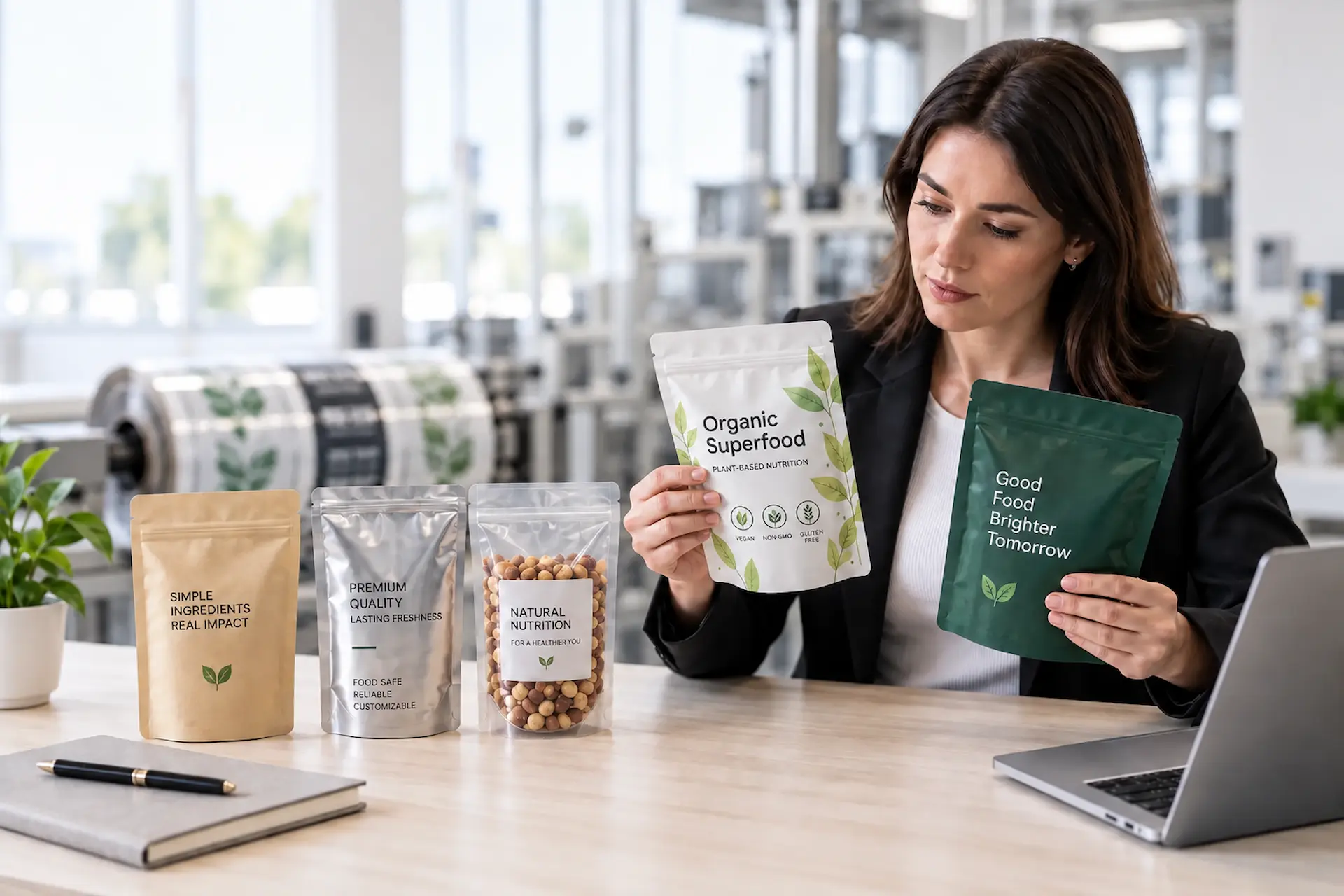


























Flat pouches are one of the most efficient flexible packaging formats—but ordering them well requires buyer-level decisions, not just design. Also called lay flat or lay-flat pouches, they’re three-side seal bags: sealed, filled, then closed.
Success depends on a few key choices: the right barrier (oxygen/moisture/light/aroma), the film structure, correct size and headspace, reliable sealing on your filling method, the right usability features, a finish that supports conversion, and an MOQ/SKU plan that reduces first-run risk.
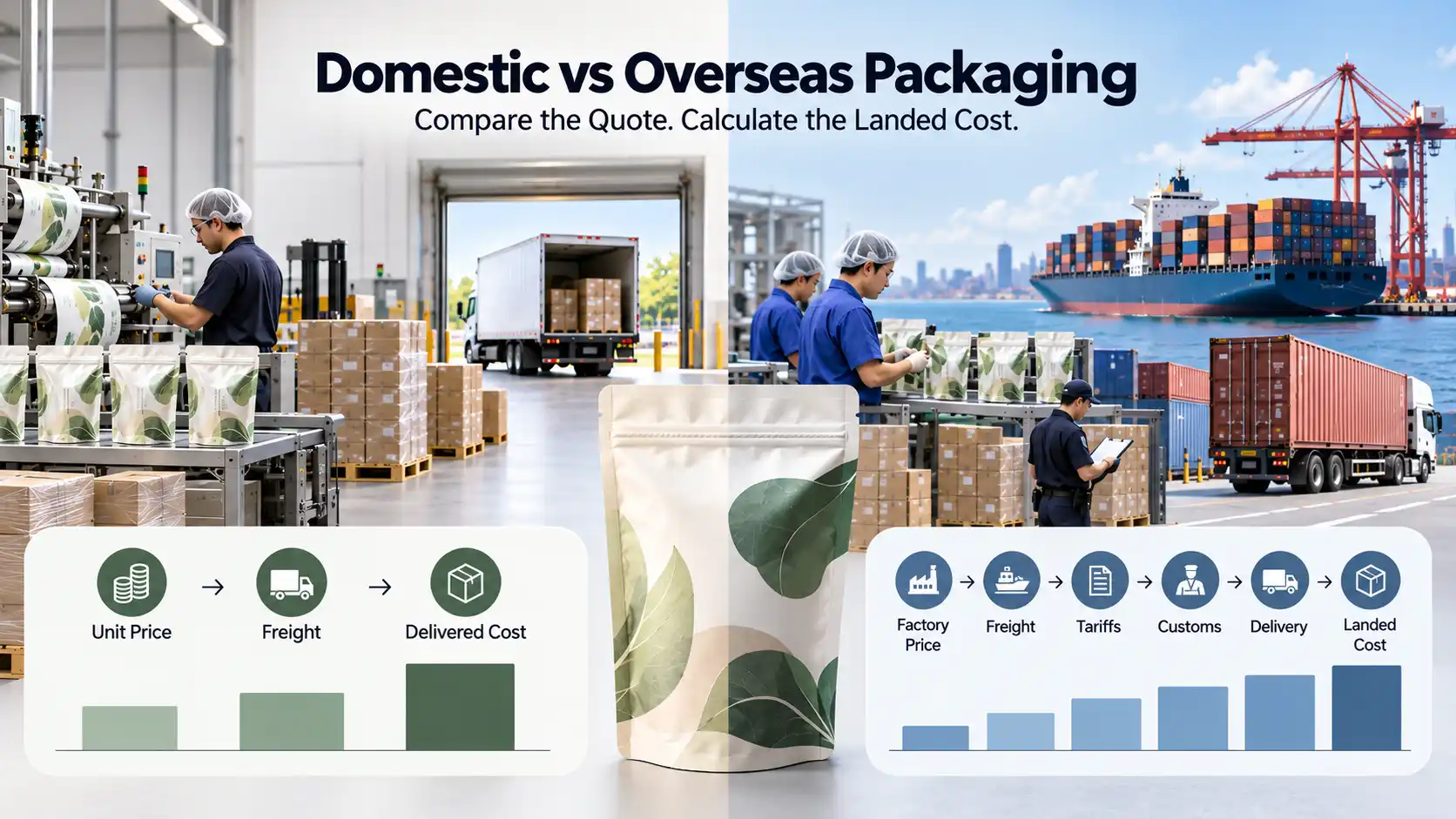
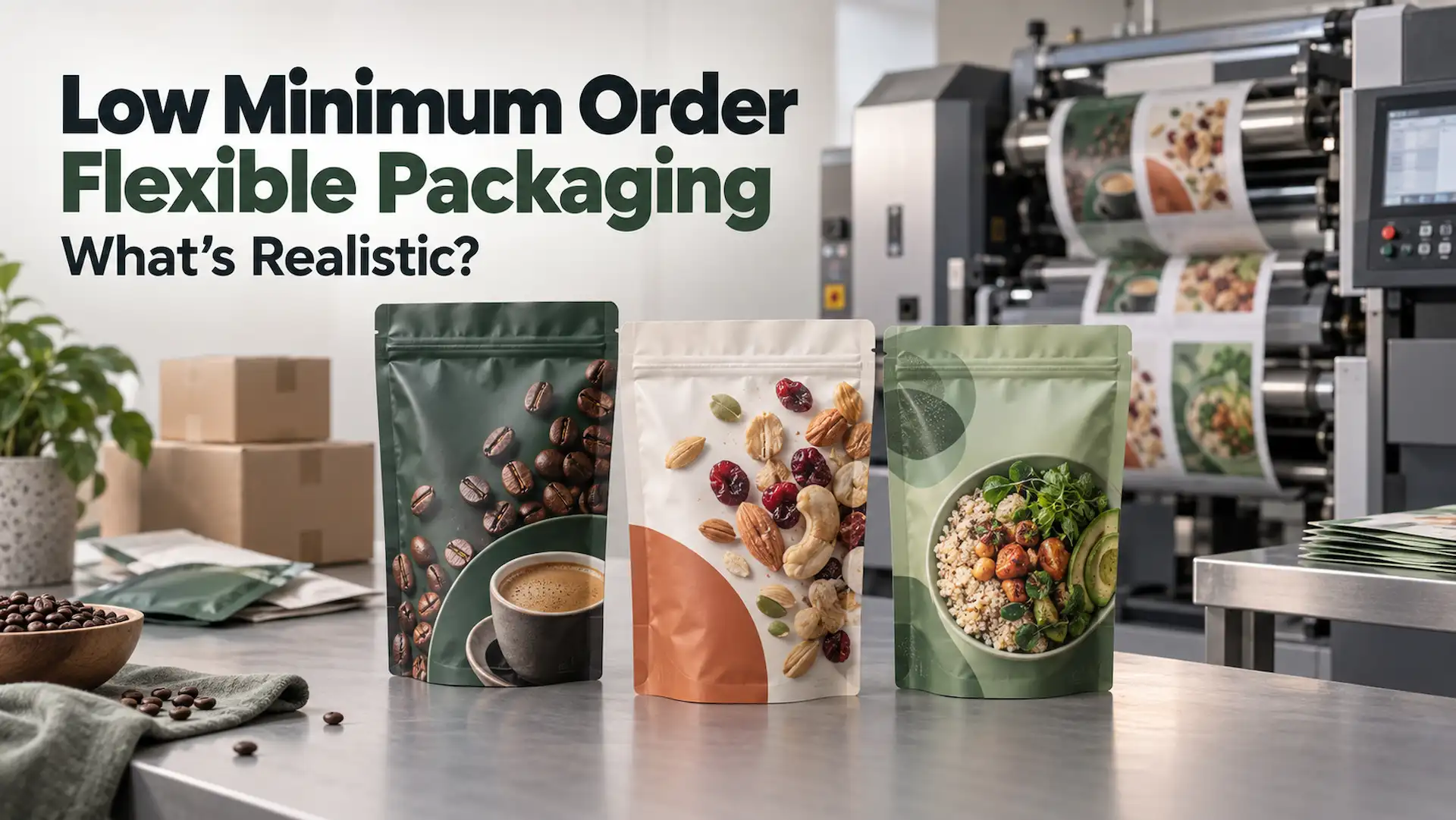
As a benchmark, many digitally printed custom flat pouches start around 1,000 units and take about 2–3 weeks from artwork approval to delivery, with the option to split quantities across SKUs when specs match.
The safest path is simple: get samples or a functional prototype, validate barrier, usability, and seal performance, then request a quote with a complete spec sheet (film, size, features, finish, SKUs, and delivery target).
What Flat Pouches Are and When They’re the Right Choice
In most purchasing conversations, flat pouches refer to a three-side seal format—sealed on three sides and open at the top for filling—also commonly described as a “flat pouch” or “pillow pack.”
Because a typical lay flat pouch has no bottom gusset, it doesn’t naturally stand upright on its own. This is not inherently a drawback; it is a format optimized for compactness, cartoning efficiency, and smaller servings or sample use cases.
From a practical buyer perspective, flat pouch packaging is often the best fit when:
- your product is sold in smaller serving sizes, sample packs, or compact DTC-friendly units, and
- you want clean front/back branding with less structural complexity than gusseted formats.
If you need upright shelf presence without racks, peg hooks, or display cartons, you should evaluate stand-up or flat bottom packaging instead—because the format itself becomes part of merchandising.
Pros and Cons
Pros
- Efficient storage and transport: 3-side seal formats are commonly described as economical for storage and transportation and consistent for cartoning.
- Strong for smaller servings and samplers: Flat pouches are explicitly positioned as a sleek, preformed solution for smaller servings and sample-style packaging.
- Customization range: Common features (zip closures, hang holes/handles, windows, rounded corners, valves/spouts) are widely available on custom flat pouch packaging.
- Digital printing reduces early-stage risk: Digital printing is positioned as optimized for low-volume runs with full custom print on barrier films, avoiding plate/cylinder setup fees and enabling multi-SKU runs.
Cons
- Doesn’t self-stand: If you need the package to stand on a shelf by default, flat pouches compete at a disadvantage against gusseted stand-up or flat bottom formats.
- Barrier mistakes are costly: If your barrier spec doesn’t match product sensitivity, customers may experience staling, clumping, or aroma loss even when printing looks perfect; barrier performance is evaluated via OTR and WVTR/MVTR, and must consider seals/closures too.
- Usability oversights are conversion killers: Missing basics (tear notch, resealability where needed) creates friction customers remember—especially in repeats.
Comparison: Flat Pouches vs Stand-Up vs Flat Bottom Packaging
The table below uses published MOQs and lead-time benchmarks as a practical reference point (especially for digitally printed, custom preformed pouches). Actual “typical” values vary by supplier, film structure, and print method, but these benchmarks are directionally useful when planning your first run, launch timing, and cash flow.
| Format | Best use | Pros | Cons |
| Flat pouches (lay-flat / three-side seal) | Samples, single-serve, compact DTC units, peg/display carton retail | Compact; efficient for storage/cartons; clean front/back branding | Doesn’t naturally stand on the shelf |
| Stand-up pouches | Retail shelf and larger fill sizes | Stands upright; strong shelf presence | More structural complexity than lay-flat |
| Flat-bottom packaging | Premium retail presence, more panels, “box-like” stability | High stability; more branding panels | Often higher MOQ |
The Decision Framework Before Ordering
Below is the ordered checklist professional buyers use. The goal is to lock performance first, then aesthetics—because barrier, seals, and fill behavior determine the real customer experience.
The seven key decisions
-
Barrier requirement (oxygen/moisture/light/aroma)
Barrier performance is commonly evaluated using OTR (oxygen transmission rate) and MVTR/WVTR (moisture/water vapor transmission rate), and total performance depends on the full pack system, including heat seals and closures.
-
Material structure
Common flexible packaging barrier approaches include foil, metallized films (e.g., VMPET), and polymer barrier layers (e.g., EVOH) embedded within laminations or coextrusions; paper-based aesthetics often require polymer layers for heat seal and function.
-
Size and headspace
Headspace affects perceived value and seal consistency. Artwork placement must respect seal/trim zones defined by a dieline, or you risk cutting into key text, barcodes, or regulatory copy.
-
Filling method (hand-fill vs co-packer vs automation)
Your seal consistency and failure rate depend on the interaction between film structure and your sealing process; buyers should validate seal performance under realistic conditions, not just at room temperature on a desk.
-
Features
Common features for custom lay flat pouches include tear notches, zip closures, hang holes/handles, window knockouts (where supported), and optional valves/spouts for specific products.
-
Finish
Matte, gloss, and soft-touch matte finishes are commonly offered and impact shelf/scroll perception; finish is part of “conversion design,” not decoration.
-
Quantity and SKU strategy (risk control)
Digital printing is positioned for low-volume runs and can support multi-SKU runs when the dieline/specs match, with per-SKU MOQ constraints published by some suppliers.
Material and barrier options with short pros/cons
These are buyer-level options you’re likely to choose among for custom flat pouch packaging. Film structures vary, so use these as decision categories and confirm with the supplier’s spec sheet.
Foil-based high barrier
Pros: Often described as the “gold standard” for maximum barrier needs and long shelf-life applications; strong protection against oxygen, moisture, and light when engineered properly.
Cons: Can be less compatible with recyclability goals; must be validated for real-world flexing and seal integrity in your distribution environment.
Metallized films (e.g., VMPET / met-PET)
Pros: Provides a “substantial enhancement” in barrier vs PET alone and creates a premium metallic appearance at a lower cost than foil in many applications.
Cons: Generally positioned as less than a true foil-level barrier; confirm OTR/WVTR targets for your shelf-life requirement.
EVOH barrier layers inside PE/PP structures
Pros: EVOH is widely recognized as a strong polymeric oxygen barrier and is commonly coextruded as a thin layer inside protective structures.
Cons: Moisture can reduce EVOH barrier performance, so EVOH typically must be protected within a multilayer “sandwich.”
Mono-material recyclable direction (#4 LDPE-based laminate)
Pros: A #4 LDPE-oriented structure can be identified with a #4 resin code and positioned as recyclable where store drop-off exists; published supplier data may include oxygen/moisture barrier values and notes on How2Recycle alignment.
Cons: In the U.S., film packaging is often not accepted in curbside programs, and store drop-off depends on consumer access and correct handling (clean/dry).
Features by Channel: What to Add (and Why)
A common mistake is choosing features by what “looks premium” instead of what reduces friction in your channel.
Practical feature availability across three-sided seal/flat pouch formats includes tear notches, reclosable zippers, hang holes, windows, and finish options.
| Channel | Recommended feature combo | Why it works |
| DTC / e-commerce | Strong barrier + zipper (if multi-use) + tear notch | Protects product during shipping and enables resealability; the tear notch reduces open frustration. |
| Retail (peg/display carton) | Hang hole + high-read finish (matte or gloss) + window (when trust-building) | Hang holes enable peg merch. Finish helps “pop” or look premium; windows can increase confidence by showing the product. |
| Samples/trial | Tear notch + simple front hierarchy + optional hang hole | Trials win when opening is effortless, and the front message is instantly clear. |
Buyer note: Some suppliers publish that certain features (e.g., zippers, tear notches, hang holes, rounded corners) may have no upcharge—verify this because it changes your cost/benefit math.
Printing and artwork checklist
Use this as your “handoff standard” between brand and supplier.
- Choose print method based on risk and volume: Digital printing is positioned as optimized for low-volume runs, full-color quality on barrier films, and no plate/cylinder fees.
- Confirm MOQ and SKU splitting rules: Some suppliers allow multiple SKUs per order if all versions share the same dieline/specs, with a per-SKU minimum.
- Submit the right file formats: Commonly accepted formats include layered PDF, EPS, and AI.
- Work on the dieline: Use a dieline/template that defines trim and seal zones, including requests for custom-sized dielines where needed.
- Proof what matters (not just colors): Proofs should reflect windows/knockouts, metallic areas, zipper placement, and tear notch location before approval.
- Plan timing around proof approval: Published lead-time benchmarks often start “from approval,” not from your first email—late artwork causes launch delays.
Six common mistakes buyers should avoid
- Choosing “standard film” without defining OTR/WVTR needs (barrier miss = shelf-life miss).
- Assuming the film barrier is the whole story (seals and closures affect total barrier performance).
- Sizing by looks instead of filling reality (bad headspace, poor seals, weak shelf perception).
- Designing without the dieline (critical copy lands in seal/trim areas).
- Overloading the front panel (low scanability hurts conversion, especially in retail and small packs).
- Skipping samples/prototypes before committing (you can’t judge seal performance, zipper alignment, and “in-hand” feel from a screen).
Sustainability options and trade-offs:
- Recyclable mono-material direction (#4 LDPE): Some suppliers describe recyclable laminates built from two layers of oriented LDPE and identifiable with a #4 resin code (including compatible zip closures), often paired with a published datasheet.
- Trade-off: disposal reality in the U.S.: How2Recycle states that plastic bags/wraps/films are not accepted in most curbside programs in the U.S., but many are eligible for store drop-off when labeled and handled correctly.
- Compostable options: Some suppliers offer “100% compostable” or biodegradable pouch materials and position them as high-barrier; validate disposal infrastructure and shelf-life requirements before committing.
- Material reduction (downgauging): Reducing film thickness can reduce material use and cost, but must be validated so barrier and puncture performance remain acceptable.
Sample testing checklist:
Request samples (or a functional prototype) and test these items using your real product and a simple “shipping simulation” (shake, compress, store for a short period):
- Seal integrity and consistency (no easy peel/splitting).
- Opening experience (tear notch works cleanly).
- Zipper performance (alignment, closure feel, repeated use) if included.
- Headspace and “looks full” perception after settling.
- Scuff resistance and finish quality (matte/gloss/soft-touch).
Practical note: Some suppliers publish that you can request samples via a quote request, and that they can also produce functional prototypes/mockups (often with an added charge).
Conclusion:
Flat pouches may look simple, but choosing them well is a strategic decision. When barrier, film structure, size, and features match how your product is used and sold, flat pouch packaging becomes a growth tool—not just a container.
Brands that win treat custom flat pouches as part of product quality. They test samples, validate seals, and manage first-run risk. Do that, and your packaging won’t just look good—it will protect quality, support scale, and quietly help your product sell.
Ready to Order Custom Flat Pouches?
Get expert guidance on materials, barriers, sizing, and printing—so your packaging works from day one.
FAQs:
1. What are flat pouches?
Flat pouches are flexible pouches—often three-side seal formats—sealed on three sides and open for filling, then sealed closed. They’re also commonly called lay-flat pouches or flat pouches.
2. What’s the difference between flat pouches and stand-up pouches?
Stand-up pouches have a gusseted base designed to stand upright; flat pouches typically do not, making them more compact but less “self-merchandising” on shelves.
3. What MOQ and lead time should I plan for?
As a benchmark, some digital custom-pouch suppliers publish MOQs starting around 1,000 bags for flat and stand-up pouches (higher for flat-bottom formats), with U.S. delivery benchmarks around 2–3 weeks from approval.
4. Can I split one order across multiple SKUs?
Often yes—if all SKUs share the same dieline (same size/specs). Some suppliers publish a per-SKU minimum (e.g., 500 bags per SKU) when splitting.
5. How do I choose the right barrier film?
Start by identifying what damages your product first (oxygen vs moisture vs light). Barrier performance is commonly evaluated via OTR and WVTR/MVTR, and total pack performance must also consider seals and closures, not just the film layer.