



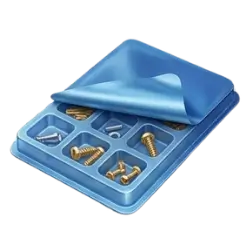

















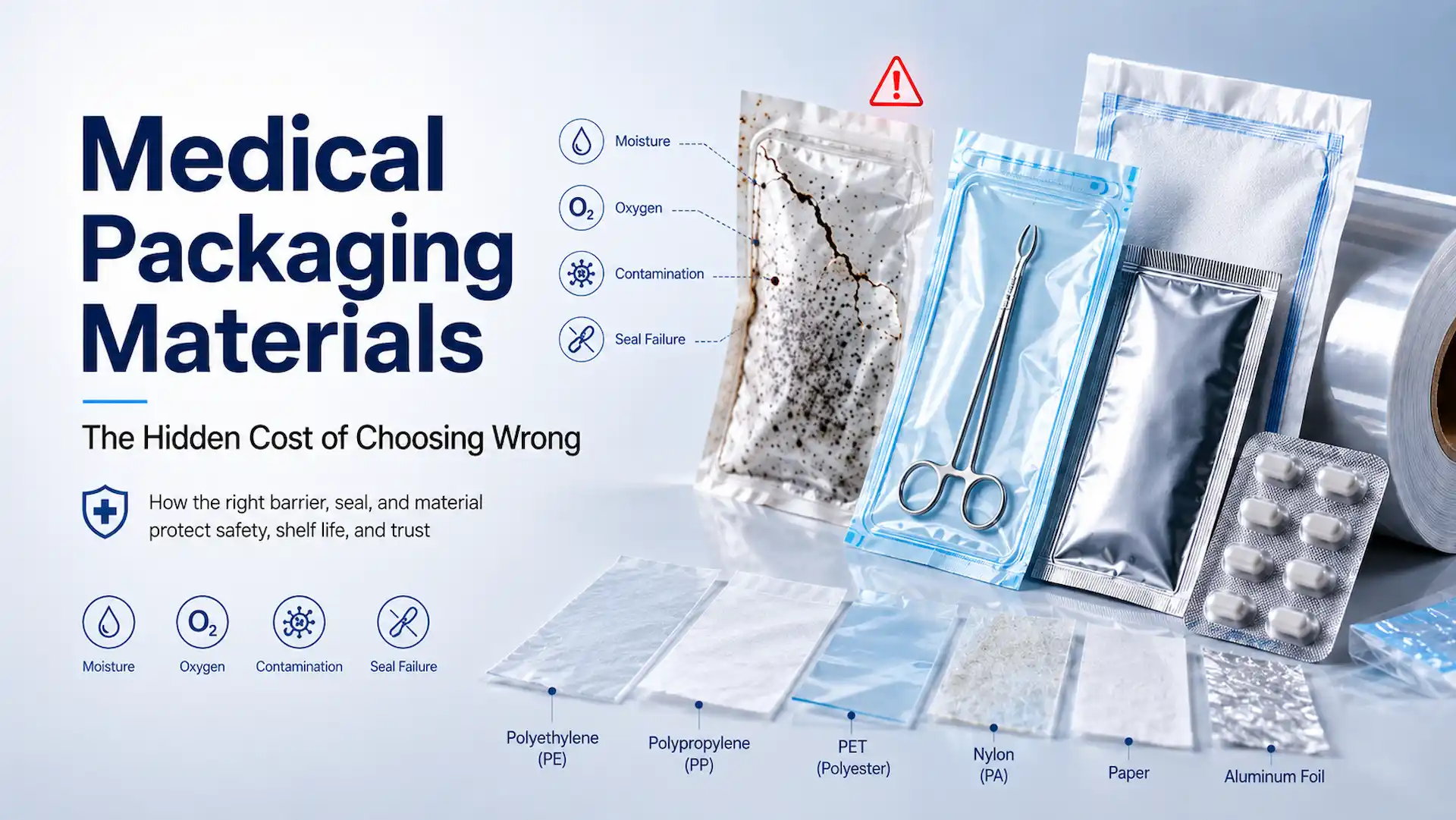
A medical pouch doesn’t look like much. Thin film, a strip of foil, a label. Easy to write off as the cheap part of the project. But that little wrapper is the last thing standing between your product and everything that could ruin it. Air, moisture, germs, a rough ride in a delivery van. When the packaging holds, nobody gives it a second glance. When it fails, it’s suddenly the only thing anyone’s talking about. And that’s the trap. The cheaper film wins the quote, so it wins the order. Then it splits at the seal, or buckles during sterilization, or quietly lets moisture in on a long shipment. Now you’re scrapping stock and missing dates. So no, with medical packaging the cheapest option is rarely the cheapest in the end. You’re not just buying a bag. You’re buying protection, and the freedom to stop worrying about it.
What Are Medical Packaging Materials?
Medical packaging materials are the films, foils, papers, and plastics that wrap and protect medical and pharmaceutical products. It’s a broad family. One end of it is a wipe sachet you’d barely notice. The other is a sealed surgical kit that has to stay sterile for months.
You’ll meet these medical grade packaging materials in plenty of forms:
- Medical and pharmaceutical pouches
- Barrier films and foil laminates
- Poly films like polyethylene and polypropylene
- Tyvek-style sterile barrier materials
- Paper and kraft structures
- Blister packs and rollstock
- Child-resistant pouches
- Recyclable and compostable options
Whatever shape it takes, the job’s the same. Lock out oxygen, moisture, light, dust, and bacteria, and survive the handling in between.
Why Material Choice Matters More in Medical Packaging
Compare it to a crisp packet. If a crisp packet splits, you’re out a snack. Mildly irritating. If a medical pouch splits, you could be looking at a contaminated drug or a non-sterile device, and a patient on the other end of that.
So one material has to pull off a lot at once:
- Keep the product sterile and safe to use
- Protect the drug or device from damage
- Hold together for the whole shelf life
- Satisfy the regulators
- Open easily, without a struggle
- Look trustworthy to every buyer who picks it up
That’s the difference. A minor material slip in this space doesn’t stay minor for long.
The Hidden Cost of Choosing the Wrong Medical Packaging Material
This is where the cheap film stops being cheap. The quote shows you one cost. The failures show you the rest, usually weeks or months later, and usually all at once.
- Seals that give way. Wrong inner layer, weak seal, and you get open seams or a slow leak. The cruel part is they often look fine on day one. The problem only surfaces once the product’s already shipped.
- Contamination is sneaking in. A pinhole. A thin barrier. A seal that didn’t take. Any of them can let air, moisture, or bacteria reach something that was supposed to be sealed tight. With sterile devices and drugs, that’s serious. Sterility failures are behind more than a third of drug recalls in recent years.
- Stock you have to throw out. One bad packaging run and you might reject the whole batch, scrap finished goods, or repackage from scratch. Money in the bin, plain and simple.
- A launch that drags. Fail validation and you’re back at the start. Source new material, make new samples, run the tests again, wait for sign-off again. Every week that slips costs you.
- Testing bills on repeat. Choose badly and you’ll test it again. Then again. Add the paperwork and extra checks, and you’re paying over and over to prove something that should’ve worked the first time.
- Recalls and regulators knocking. If the failure reaches the shelf, expect recalls, customer notices, maybe an investigation. It’s not rare, either. In one UK review of medicine recalls, packaging faults caused about a quarter of them. A single recall can run into tens of millions in lost sales, sometimes much more.
- Trust you won’t buy back easily. Pharmacies, clinics, and buyers expect medical packaging to feel safe and solid. Hand them a leaky pouch or a split seam and the message lands instantly. Good luck undoing that impression.
Important note: Most of these failures hide until the product’s already in a warehouse or on a shelf. Finding the fault that late always costs more than getting the material right at the start.
Common Medical Packaging Material Mistakes Brands Make
Strip away the detail and the same mistakes keep showing up. Here’s the short list:
- Buying the cheapest film without checking the barrier the product really needs
- Skipping the question of whether it can survive sterilization
- Wrapping a sharp or heavy product in thin, weak material
- Cutting corners on the sealant layer
- Underestimating how much oxygen, moisture, or light the product can take
- Forgetting the trip from factory to truck to warehouse to shelf
- Not checking whether a real person can open it without a fight
- Picking a pack that looks great and protects poorly
- Jumping to full production with zero testing
- Using one material structure for the entire product range
Nothing here is complicated. It’s just easy to skip when the pressure’s on.
Main Types of Medical Packaging Materials and When to Use Them
No single material wins every time. Each one’s good at a particular job. Here’s the rundown of the common medical device packaging materials and where they earn their keep:
| Material | What it brings | Works well for |
| Polyethylene (PE) | Flexible, seals easily, common inner layer | Pouches, sachets, wipes, single-dose packs |
| Polypropylene (PP) | Moisture resistance, clarity, handles heat | Clear packs, light products, items needing visibility |
| PET / polyester | Strength, structure, crisp printing | Printed pouches, laminates, strong outer layers |
| Nylon | Toughness, resists punctures | Products with edges, heavier handling |
| Paper / kraft laminates | Natural look and feel | Brand-led packs, wellness products, eco-minded ranges |
Two of these are worth a longer look.
Foil is the heavy hitter. Its layer blocks nearly all the oxygen, moisture, odor, and light, which is why barrier foil packaging for medical products turns up everywhere. Foil pouch medical packaging keeps quality intact for the long haul, and medical packaging aluminum foil is the obvious pick when shelf life can’t be compromised. A trace of oxygen or damp is enough to slowly wreck a sensitive drug, so for pharmaceuticals, powders, and tablets, foil usually takes it. You’ll see it most in single-dose strips and high-barrier sachets, where each dose has to stay sealed on its own until someone needs it.
Then you’ve got the medical-grade sterile barrier materials, the Tyvek-style and medical grade paper structures. These medical-grade packaging materials pull off a neat trick. They breathe enough to let sterilization happen, but still keep germs out. That’s exactly what devices, procedure kits, surgical tools, and anything else needing real medical device sterile barrier packaging are after.
Choose the Right Medical Packaging Material
Getting this right isn’t hard. You just have to ask things in the right order.
Begin with the product. Device, tablet, cream, patch, test kit? Sterile or not? Sharp, heavy, wet, dry, delicate? Pin that down first, because the rest follows from it.
Then the barrier. Oxygen? Moisture? Light? Odor? The more fragile the product, the stronger the barrier you’ll need. A vitamin that oxidizes, say, needs far more oxygen protection than a dry adhesive plaster.
Now the process. This one trips people up constantly. A film that seems ideal can still buckle under the heat, gas, or radiation used to sterilize or fill it. Quick rule of thumb: steam wants a material that takes heat, gas needs one that breathes so the gas can move in and out, and radiation can leave certain plastics brittle or a little discolored. Get the pairing wrong and the pack can fail before it ever reaches a patient.
Don’t skip the journey. Heat, humidity, pressure, packed cartons, long routes, careless handling. The packaging has to take all of it, not just behave in a lab.
Last, test it. Samples, prototypes, a proper run-through. A small spend here heads off a big one later. Going full production on an untested structure is a gamble you don’t need to make.
Medical Pouches vs Blister Packaging vs Rigid Containers
Material’s one half. Format’s the other, and it matters just as much. Here’s how the main three line up:
| Format | Suits | Why it works |
| Medical pouches | Tablets, patches, swabs, wipes, test kits, creams, single-use items | Light, printable, space-saving, plays nicely with barrier films |
| Blister packaging | Tablets, capsules, small dosed items | Clear view of the product, dose-by-dose protection, retail-ready |
| Rigid containers | Bulky, sharp, or fragile items | Crush resistance and a solid, protective structure |
Step into rigid medical packaging materials and you’re into trays and hard containers built to absorb a knock. The materials for rigid medical packaging are picked first and foremost for strength. Which one’s right for you comes down to the product, the barrier it needs, the safety bar, and the budget.
Why Barrier Films Are Critical in Medical and Pharmaceutical Packaging
Boil it down and a barrier film does one thing: keep the outside out. It’s the product’s armor. Good medical barrier packaging pulls its weight by:
- Shutting out oxygen that would spoil or weaken the product
- Keeping moisture away from powders and tablets
- Blocking light that breaks down delicate ingredients
- Holding in odor and flavor
- Guarding against contamination
- Stretching the shelf life
Get the barrier level wrong, whether in a medical device barrier packaging film or a tray, and you’ll pay for it later in lost quality, a shorter shelf life, and complaints that catch you off guard.
The Role of Seal Strength in Medical Packaging
Here’s a thing that gets overlooked: the seal. You can pick a fantastic film and still lose a lot if the seal’s weak, because the seal is what keeps the pack actually closed.
A handful of things decide how well it holds:
- The heat-seal inner layer
- Seal temperature, pressure, and time
- Material thickness
- The pouch shape and what’s inside it
- The filling process
Line those up and the pack stays shut. Miss them and you’ve got leaks and split seams, no matter how good the film is. Put bluntly, a medical pouch is only as good as its seal.
Sustainability in Medical Packaging: Important, but Safety Comes First
Loads of brands want greener packaging now, recyclable or compostable, and fair enough. But medical packaging answers one rule before any other: protect the product. Full stop.
Greener options worth a look:
- Recyclable mono-material films
- Compostable structures
- Designs that use less material
- Lighter flexible formats
Mono-material films are made from a single type of plastic, which makes them far easier for recycling systems to actually process than mixed laminates.
Important note: A sustainable material only deserves the job if it still meets the barrier, strength, and sealing the product needs. Greener is good. It’s never worth risking safety for.
How Flexible Packaging Helps Medical and Pharmaceutical Brands
Flexible packaging hands medical and pharma brands room to get the small stuff right. A specialist like Flexible Pouches builds the pack around your product, rather than cramming your product into a bag that already exists.
What that looks like day to day:
- Custom sizes and custom-printed designs
- Rollstock for automated filling lines
- FDA-grade materials
- High-barrier films, foil included
- Child-resistant options
- Clear, metalized, foil, and kraft structures
- Recyclable and biodegradable choices
And custom doesn’t have to mean slow or massive orders. Low minimums and quick turnaround put it within reach for smaller brands too. So the material, the style, and the print end up matching what the product needs, instead of whatever happened to be on the shelf.
A Simple Checklist Before Choosing Medical Packaging Materials
Before you sign off, run through this:
- Is the material right for the product?
- Does it block moisture, oxygen, light, and contamination?
- Will it survive shipping?
- Does it suit your sealing method?
- Is it compatible with your sterilization or filling process?
- Can it last the full shelf life?
- Is it easy and safe to open?
- Does it handle your branding and labeling?
- Have you tested it before full production?
- Does it fit the budget without hiding any risk?
What to Ask Your Packaging Supplier Before Ordering
A few pointed questions upfront save you cash and second-guessing later. Ask your supplier:
- What material structure do you recommend for this product?
- What barrier level does this film give?
- Is the material FDA-grade?
- Can this pouch be heat sealed?
- Can I see a prototype or proof first?
- Which pouch style suits my product?
- Can you supply rollstock for filling machines?
- Do you offer child-resistant options?
- Do you offer recyclable or biodegradable materials?
- What’s your lead time?
Conclusion
Medical packaging materials aren’t the afterthought of the project. They decide whether your product stays safe, lasts its shelf life, clears the regulators, and keeps the trust of everyone who handles it. And the cheap option flips to expensive the moment it leaks, fails a test, or sends a batch to waste.
Start with the product and build out from there. Work out what it needs, choose the right barrier and seal, test before you scale, and partner with a supplier who can line up material, style, and performance. Do that, and the packaging just gets on with its job, protecting your product, and the business behind it.
Ready to Get Your Medical Packaging Right?
Don’t risk your product, or your reputation, on the wrong material. Flexible Pouches makes custom, FDA-grade medical and pharmaceutical packaging in the exact size, style, and barrier you need, from high-barrier foil pouches to child-resistant and eco-friendly builds. Request a free quote today and get packaging built to protect.
FAQs:
1. What are medical packaging materials?
They’re the films, foils, papers, plastics, and laminates that keep medical and pharmaceutical products safe through storage, shipping, and use.
2. Why does the right medical packaging material matter so much?
Because it’s what shields the product from moisture, oxygen, light, contamination, damage, and seal failure, while protecting safety, shelf life, and trust.
3. What’s the best material for medical pouches?
There’s no single answer. It hinges on the product, the barrier it needs, the sealing process, the shelf life, and whether it’s sterile.
4. Are foil pouches good for medical packaging?
Yes. Foil gives strong protection from oxygen, moisture, light, and odor, so it fits sensitive products and anything needing a long shelf life.
5. Can medical packaging be eco-friendly?
It can, as long as safety comes first. Recyclable, biodegradable, and compostable options work when they still meet the product’s barrier and strength needs.
6. What happens if you use the wrong medical packaging material?
You’re risking leaks, weak seals, damaged product, contamination, failed testing, delayed launches, waste, recalls, and lost trust.