

























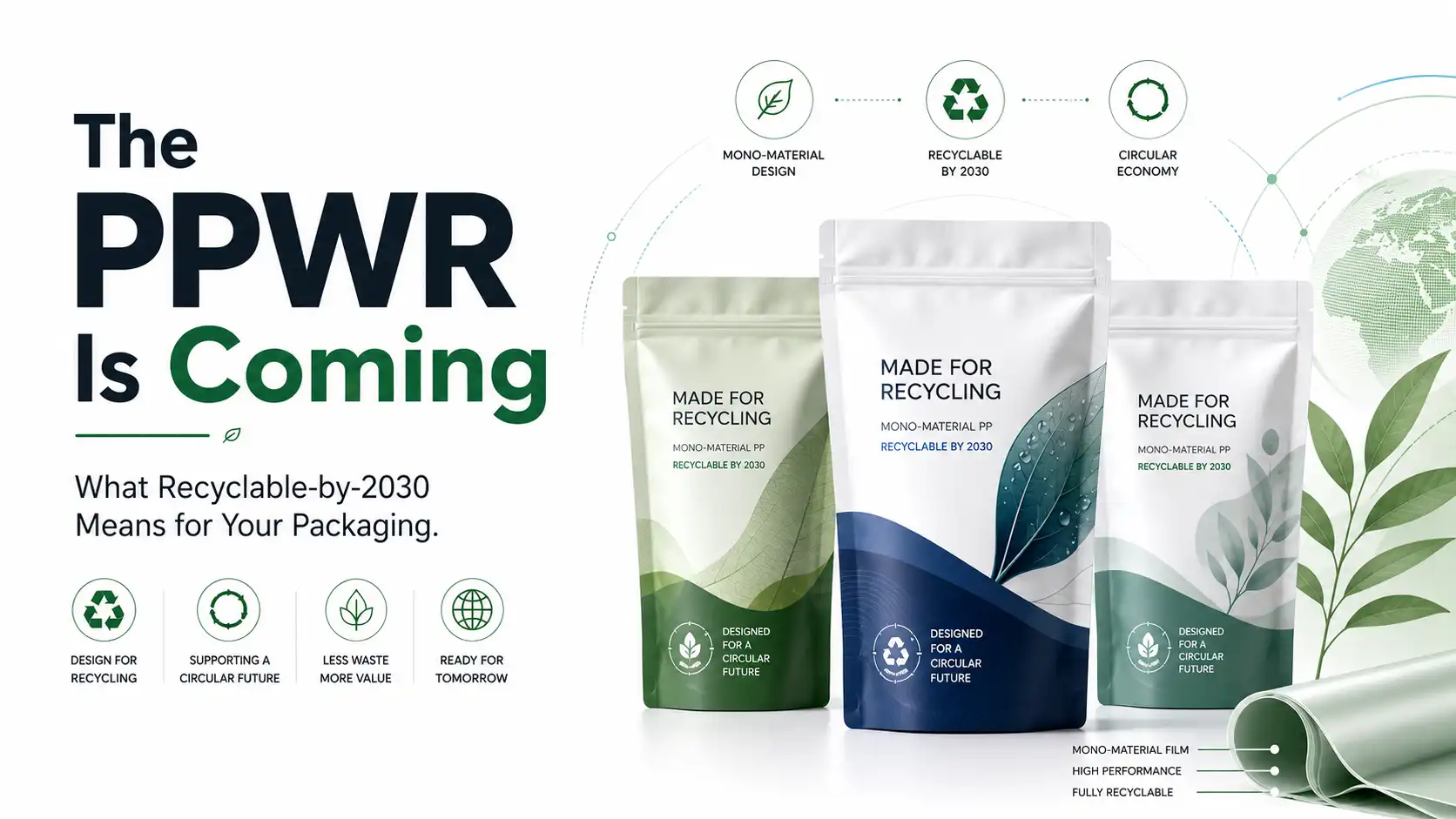
Packaging is entering a new compliance era, and it’s moving faster than most brands expect. Under the PPWR regulation, attractive design and a vague “eco-friendly” label just won’t cut it with EU regulators anymore. Packaging has to be easier to recycle, easier to document, and built for rules that are still being finalized in Brussels. Recyclable-by-2030 isn’t a line item to punt to next year’s planning cycle. It’s a packaging design decision, a material choice, and a documentation task, all landing at once.
The PPWR requirements, short for the Packaging and Packaging Waste Regulation, sit alongside a wider set of packaging regulations. US manufacturers supplying private label programs into the EU need to follow these just as closely as EU-based brands do. Know which requirements apply to your pouches, and by when, and the rest gets a lot less overwhelming.
What Is the PPWR and Why Is It Changing Packaging?
The Packaging and Packaging Waste Regulation, or PPWR, is the European Union’s new rulebook for how packaging gets designed, labeled, and recycled. Gone is the old patchwork of national packaging regulations. In its place: one single set of rules that apply the same way in every EU country.
No more leaning on whichever country had the loosest standard. PPWR requirements reach into almost every part of a packaging decision, from material choice and recyclability to labeling and recycled content.
Suppliers, importers, and any business placing packaging on the EU market all share responsibility here, regardless of where that business happens to be based. A quick breakdown of who typically carries which role:
| Role | What it means for you |
| Manufacturer | Owns the brand and sets the packaging design specifications |
| Importer | Brings the packaging or packaged product into the EU |
| Distributor | Sells or supplies packaging already placed on the EU market |
Put PPWR on a business leader’s desk, not just a sustainability team’s checklist. Losing market access over non-compliant packaging hits sales and supply chains long before it ever makes it into a sustainability report.
What Does “Recyclable by 2030” Actually Mean?
“Recyclable by 2030” sounds simple. The real test behind PPWR requirements is stricter than most brands assume, because a material being technically recyclable somewhere in the world means very little on its own.
What actually counts is whether it works with the collection, sorting, and recycling systems that exist across the EU right now. Recyclability grades measure exactly that, and they’re the part of PPWR that matters most for recyclable flexible packaging like pouches and films.
A pack gets scored on real recycling performance, not a marketing claim. Mixed materials, foil layers, parts that can’t be pulled apart, coatings that confuse sorting equipment, all of it drags a score down, often without the brand even realizing it.
Important note: The exact grading criteria are still being finalized by EU regulators, with final rules expected around 2028. Waiting isn’t the smart move here. Packaging tested and adjusted early gets a much smoother path once the final criteria lock in.
Theoretical recyclability used to be enough. Practical recycling performance is the bar now, and that shift is the single biggest change PPWR brings to packaging design.
Which PPWR Requirements Will Affect Brands First?
Not every PPWR rule lands on the same date. Knowing what hits first is what keeps this manageable instead of overwhelming. Here’s the practical order, from what’s already active to what’s still being finalized:
- Recyclability design rules, so packaging can be sorted and recycled at scale, already shaping design decisions today
- PCR requirements and PPWR recycled content targets, requiring a set percentage of recycled material in plastic packaging by 2030
- Packaging minimization, cutting excess weight, volume, and empty space across every format
- Substance restrictions, including limits on PFAS and other substances of concern in food-contact packaging
- Labeling rules, so consumers know how to sort packaging correctly at home
- Documentation and supplier data, proving material composition and recyclability claims whenever they’re requested
- Reuse or refill rules, for select categories like transport and beverage packaging
Map your current packaging against this list now, and you’ll know exactly where the gaps sit. That’s a far easier conversation to have before an EU customer or auditor asks, not after.
Are Your Current Pouches Ready for PPWR Recyclability Grades?
Most flexible pouches on the market were built for shelf life and barrier protection first. Recyclability came second, if it was considered at all. That’s precisely the combination PPWR recyclability grades are now putting to the test.
Multilayer pouches usually cause the trouble, films mixed with foil or metallized layers to keep oxygen and moisture out. Every extra layer makes a pack harder to sort, and recycling facilities often can’t pull them apart cleanly.
Coffee, pet food, and tea pouches tend to be the worst offenders here, leaning hardest on foil or metallized barriers to protect aroma and freshness. These are also the categories where brands feel they can least afford to compromise on shelf life.
The smaller parts matter too, films, barrier layers, inks, closures, windows, valves, zippers, and adhesives. Any single one of them can drag a grade down.
Enter Mono-material structures: built from a single polymer family like PE or PP, and increasingly the practical route to genuinely recyclable pouches and recyclable flexible packaging. Sorting equipment reads them easily, and recyclers process them without a fight.
A recyclability claim is only as good as the material data behind it. Supplier proof holds up under documentation checks. A general assumption doesn’t.
How Will PCR Requirements Change Plastic Packaging Choices?
PCR requirements are one of the more concrete parts of PPWR to plan around. PCR simply means post-consumer recycled content: plastic that a consumer already used, that got collected, and that came back as new material.
PPWR recycled content rules set a minimum share of that PCR for plastic packaging, and the exact number shifts depending on what the packaging is actually used for.
| Packaging type | By 2030 | By 2040 |
| Food-contact plastic (non-PET) | 10% | 25% |
| Food-contact PET packaging | 30% | 50% |
| Plastic beverage bottles | 30% | 65% |
| Other plastic packaging | 35% | 65% |
A line on a spec sheet won’t cut it. Suppliers need to document PCR content, and that gets harder fast for food-contact packaging, where safety rules restrict which recycled materials can even touch food or personal care products.
2030 is closer than the supply chain is ready for. Demand for high-quality, food-safe PCR is set to spike, and recycled plastic already carries a price premium over virgin material in plenty of categories. Lock in supplier relationships and testing now, or compete for scraps later.
Why Mono-Material Recyclable Pouches Are Taking Over
A mono-material pouch is built from one type of plastic, not several stacked together. Picture a single-family structure, PE with PE, PP with PP, instead of a mix where every layer needs its own recycling path.
Recycling facilities are sorted by material type, which is exactly why this matters. A pouch made from one plastic family sails through that system. A pouch mixing plastics, foil, and adhesives usually gets rejected before it even reaches the line.
A high barrier, mono-material #4 recyclable film is built for precisely this. It still takes a zip closure, a degas valve, full custom printing, all of it, without trading away recyclability to get there.
Performance doesn’t have to give. Coffee, pet food, supplements, and personal care products still demand real protection against oxygen, moisture, and light, and mono-material films have closed that gap fast.
Shelf life or recyclability was never really the choice for recyclable pouches and recyclable flexible packaging. It’s both, plus the seal strength and branding a product already leans on.
For a health and wellness, pet food, or tea and coffee brand shipping into the EU, that’s becoming table stakes, not a bonus line in a sell sheet.
What Packaging Features Can Hurt Recyclability?
Some of the packaging details brands are proudest of are quietly working against them. A quick audit usually turns up a few familiar culprits:
- Metallic finishes and foil layers, which block sorting equipment from reading the base material
- Heavy ink coverage, especially dark or full-surface printing
- Mixed-material windows, where a different plastic is used just to show the product inside
- Labels made from an incompatible material, which do not separate cleanly during recycling
- Certain coatings and adhesives, added for shine or shelf appeal but not for function
- Complex closures or accessories, like multi-material zippers, valves, or spouts
- Decorative features that add material without adding function, such as extra layers purely for a premium feel
There’s nothing wrong with any of these features on their own. The problem is that hardly any brand checked how they interact with PPWR recyclability grades, not until new packaging regulations turned recyclability into a requirement instead of a nice-to-have for recyclable flexible packaging sold into the EU.
How Can Brands Prepare Their Packaging Before 2030?
A full packaging overhaul overnight isn’t what this calls for. What it calls for is a clear, honest inventory, plus a system for keeping up as packaging regulations get finalized.
- Audit every current packaging format, pouch by pouch, not just your best sellers
- Flag structures at risk, especially multilayer or foil-based pouches
- Ask suppliers for real material composition and recyclability data, not general claims
- Review PCR options for each plastic packaging type you use
- Test mono-material recyclable pouches against your existing barrier and shelf-life needs
- Recheck labels, closures, films, coatings, and inks against the list above
- Update artwork and packaging systems ahead of upcoming labeling rules
- Keep packaging data organized in your ERP or internal packaging system, so it’s ready the moment a supplier or auditor asks
- Check for recognized recycling labels, such as How2Recycle, so your recyclability claims hold up with retailers as well as regulators
Important note: Don’t confuse ERP with EPR. ERP is the internal software many brands already use to manage supply chain and packaging data. EPR, or Extended Producer Responsibility, is the separate EU system that ties packaging fees to how recyclable your packaging actually is. Clean ERP data makes EPR reporting far easier when the time comes.
Beyond 2030: The Future of the Packaging Industry Under PPWR
PPWR reads like a preview of where the future of the packaging industry is headed, in the EU first, and everywhere else not long after.
More demand for recyclable pouches and recyclable flexible packaging across food, pet food, and personal care categories. Less unnecessary packaging. More recycled content as the default, not the exception. Far more transparency from suppliers about what’s actually inside a pack.
Flexible pouches already hold a natural edge here. A pouch uses far less material and empty space than a rigid container protecting the same product, and that lines up well with where PPWR’s packaging minimization rules are headed.
PPWR news is worth tracking over the next few years too, since several grading and labeling rules are still being finalized by EU regulators. Brands that adjust early, and keep an eye on updates, set the pace. The rest scramble to catch up.
Conclusion
Brussels didn’t write PPWR to sit quietly in a regulatory filing somewhere. It’s already reshaping how brands think about packaging design, material choice, recycled content, recyclability, and the paperwork tying it all together. Waiting until 2030 to act only narrows the options on the table, especially for flexible packaging brands still running multilayer structures today. Brands reviewing their pouches now, instead of later, are the ones who move through 2030 without a scramble.
Treat this as a design project now, not a compliance scramble later. More choice in materials. More room to test. A much smoother run into 2030. Recyclable-by-2030 is not just a distant compliance deadline to plan around later. It is a clear signal that packaging must become easier to recycle, easier to prove, and smarter from the start.
Get Your Packaging Ready for the PPWR Shift
Looking to move toward recyclable flexible packaging before 2030? Explore recyclable pouches, mono-material films, and custom flexible packaging options designed to support better performance, stronger shelf appeal, and future-ready packaging decisions.
Our high barrier, mono-material #4 recyclable film conforms to How2Recycle guidelines and is produced in BRC-GS certified facilities, so your recyclability claims hold up wherever your product ships.
Get a free quote and start moving your packaging toward PPWR-ready recyclability today.
FAQs:
1. What are the main PPWR requirements for packaging?
PPWR requirements cover recyclability, minimum recycled content, packaging minimization, labeling, documentation, and limits on substances of concern like PFAS. Together, these rules affect material choice, design, and the paperwork behind every pack placed on the EU market.
2. What does recyclable-by-2030 mean under PPWR?
Packaging has to work with real EU collection and recycling systems, not just carry a recyclable label. By 2030, only packaging that meets a required recyclability grade will be allowed on the market.
3. Are flexible pouches recyclable under PPWR?
Some are, some aren’t there yet. Mono-material recyclable pouches have a much better chance of meeting PPWR’s recyclability grades than multilayer pouches with foil or mixed plastics.
4. What are PPWR recyclability grades?
A scoring system that measures how well packaging performs in real recycling systems. Packaging needs to meet a minimum grade to stay on the EU market, and that minimum gets stricter over time.
5. What are PCR requirements in packaging?
A minimum share of post-consumer recycled content that plastic packaging must contain. The exact percentage depends on the packaging type, and brands need supplier documentation to prove it.
6. How can brands prepare for PPWR before 2030?
Start with a full packaging audit, flag risky multilayer structures, ask suppliers for real material data, and test mono-material alternatives. Keep labeling and packaging records organized well ahead of the deadline.