





















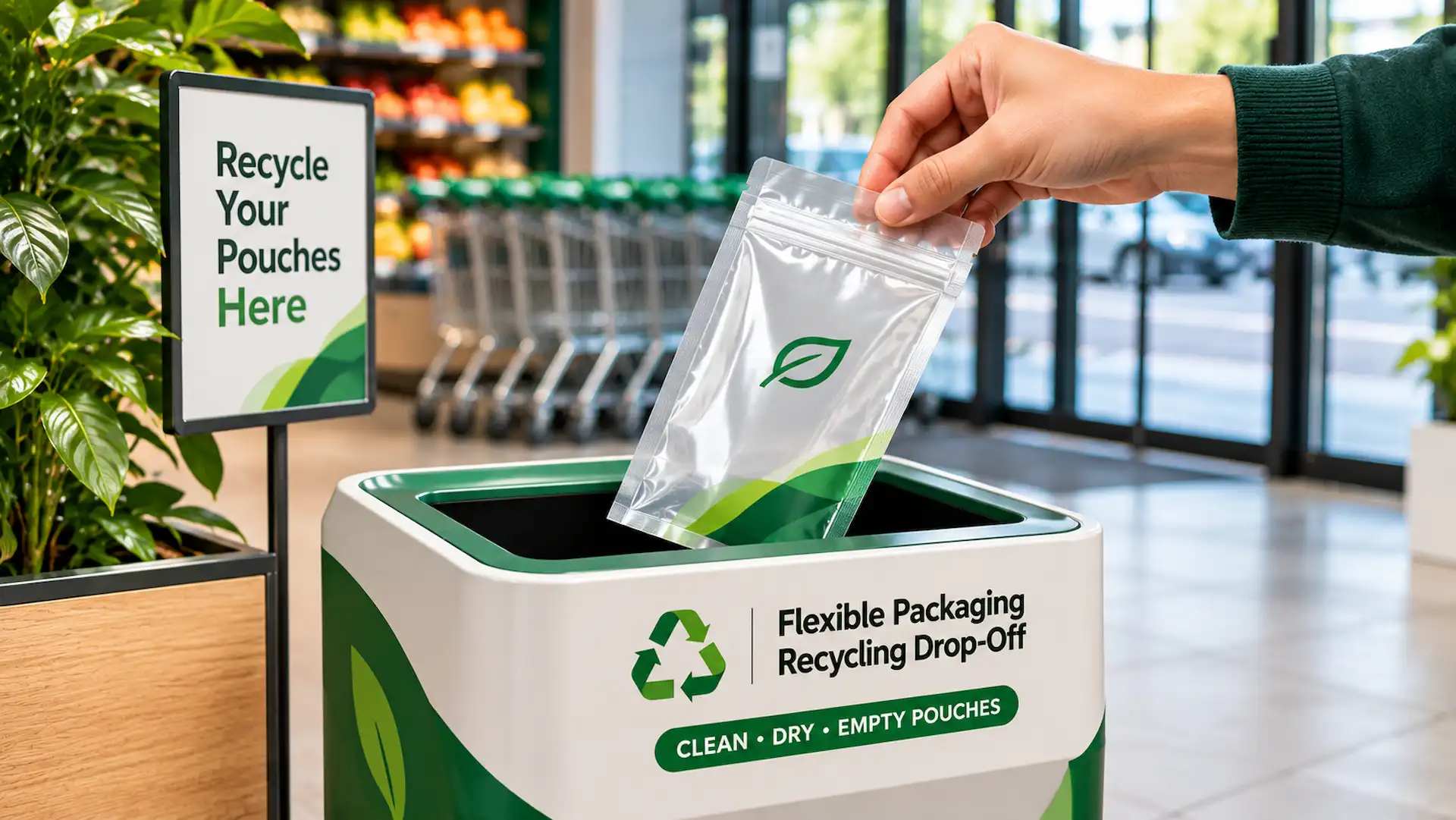
If you’ve bought bread or paper towels lately, you’ve probably seen it on the back of the bag: a little How2Recycle label telling you the empty wrapper goes back to the store. For years, that label on film packaging carried chasing arrows with “Store Drop-off” written in the middle. Look again now and you’ll find a plain collection bin instead.
That small redesign has a lot behind it, including a California law and a court fight. Since we make recyclable mono-material pouches for brands that want this exact label, we get asked about it constantly. So here’s what we’ve learned: what changed, which films and products actually qualify, how a brand gets the How2Recycle label onto its own pouch, and what the law looks like after SB 343’s October deadline.
What Changed With the How2Recycle Store Drop-Off Label?
The arrows went away. That’s the headline, though the reasons behind it are what should shape your next print run.
Old Label vs New Pro Label
| Legacy Store Drop-off label | New Store Drop-off Pro label | |
| Symbol | Chasing arrows with “Store Drop-off” inside | A store collection bin |
| Message | Implied “recyclable” through the arrows | Tells shoppers the pack is collected through Store Drop-off |
| Status | No longer assigned to new requests since August 2025 | Assigned to every new request since August 2025 |
| Proof approvals | Accepted only until February 1, 2026 | Required for all new artwork |
Why the Arrows Disappeared
GreenBlue, the nonprofit behind How2Recycle, announced the redesign in April 2025. They’d run two rounds of consumer research and kept seeing the same thing: people read the symbol first and the words second, if at all. A bin looks like the bins at the front of the store. Arrows look like “toss it in the blue cart,” which is exactly what you don’t want for film.
California was the other push. Nobody could say for sure whether SB 343 would let packaging that recycles only through store drop-off be called “recyclable.” Rather than gamble on it, How2Recycle pulled the arrows.
Already printed the old version? You’ve got company. The rollout guide for members explains that existing labels were swapped to the Pro design automatically inside the Member Platform. Your actual packaging stays the same until you approve new artwork, though, and keeping it current is on you as the member.
Also worth a mention: How2Recycle is piloting a separate Customer Return label for film collected outside retail bins. It’s optional and not open to everyone yet, so for a PE pouch, Store Drop-off is still the label to aim for.
Which Pouches Qualify for the Store Drop-Off Label?
Material comes first, product second. We’ve watched brands get the film exactly right and then get stuck on what’s inside the bag.
The Basic Rule: It Has to Be Polyethylene
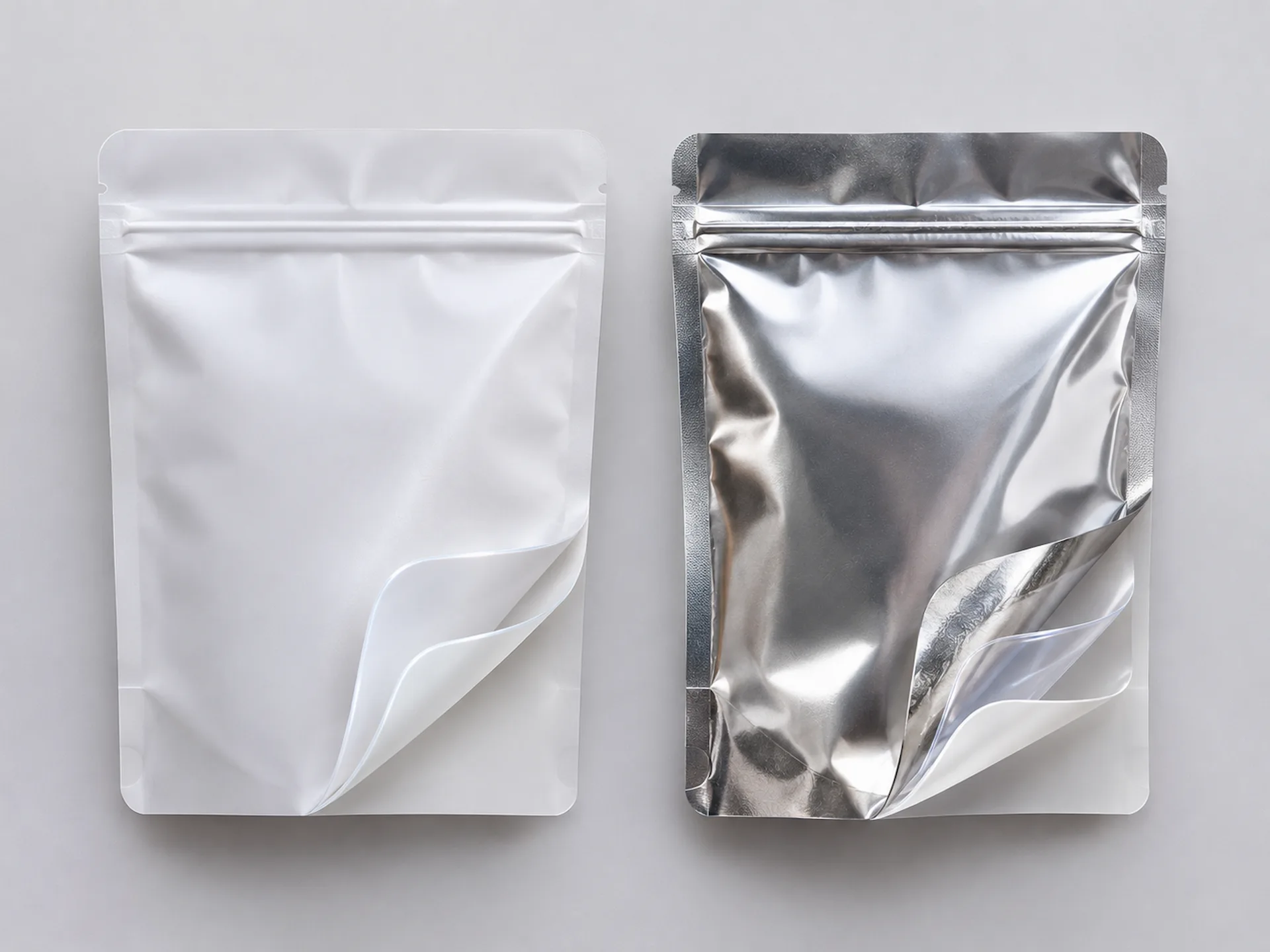
The How2Recycle Store Drop-off label is for flexible packaging made of polyethylene, either HDPE (#2) or LDPE (#4). Bread bags, produce bags, paper towel overwrap and cereal liners are the classic examples. It only exists in the US. Ship the same PE film to Canada and it gets a “Widely Recyclable” label instead, because programs there collect it at the curb.
Film Laminations That Qualify (and the Ones That Need Testing)
A lot of people go looking for “film laminations that qualify for How2Recycle certification.” Technically there’s no certification, since How2Recycle calls itself a pre-qualification program. Its Guidelines for Use set out the rules, and here’s roughly how they land on typical pouch builds:
| Pouch build or feature | Where it stands | What you’ll need |
| All-PE laminate (PE/PE), PE zipper | The standard route to Store Drop-off | Specs and photos for your label request |
| PE with a thin EVOH barrier layer | Possible, but EVOH triggers testing | APR test results or a pre-qualified film |
| Total PE content under 90% | Testing may be required | APR test results |
| Metallized layer or metallic ink | Testing required | APR test results |
| Barrier coatings such as PVOH | Testing required | APR test results |
| Non-PE zipper, label or cold seal | Testing required | APR test results, or switch to PE parts |
| PET/PE, foil or kraft laminates | Generally not eligible | A different label, or a mono-PE redesign |
When testing is needed, it’s APR’s Critical Guidance Protocol for Polyethylene Films, done at a lab APR recognizes. You can skip it if your film already has APR design recognition or How2Recycle pre-qualification, which is a good reason to ask your supplier what paperwork exists before you order. Wondering how much barrier you’d give up going all-PE? Our comparison of mono-material PE vs multi-layer pouches lays it out.
Products That Can’t Use the Label, Even in a Perfect Pouch
Here’s where brands get caught out. How2Recycle doesn’t only look at the pouch. It looks at what you’re selling too, since leftover product ends up in the collection bin. Right now the guidelines rule out:
- wet, sticky, gooey or oily products, like condiments, dairy, refrigerated meat and liquid soap
- hazardous products, such as pesticides or medical waste
- dirt-like products, like potting soil or sand
- products whose film lacks strong end markets, such as salty snacks and chocolate
- anything shoppers can’t easily get clean and dry, such as a pack you’d need a tool to empty
Important Note: Selling chips, pretzels or chocolate? Then even an all-PE pouch won’t get the Store Drop-off label under today’s guidelines. Check your category in the latest Guidelines for Use before paying for a material change. If you’re excluded, our guide to recyclable vs compostable vs biodegradable films walks through the other options.
How to Earn the How2Recycle Label on Your Pouch, Step by Step
It isn’t a one-time form. Think of it as a handful of steps, with most of the effort going into pulling together accurate details about your pouch.
- Make sure the right company joins. This trips people up more than anything else. The brand shown on the package has to be the member, so your pouch supplier can’t simply pass the label along. Film makers and converters can join as well, but what they get is recyclability feedback and pre-qualification, not your on-pack label. If you’re a private-label supplier, start with the retailer. Membership means signing an agreement, and depending on your company type there may be an annual fee.
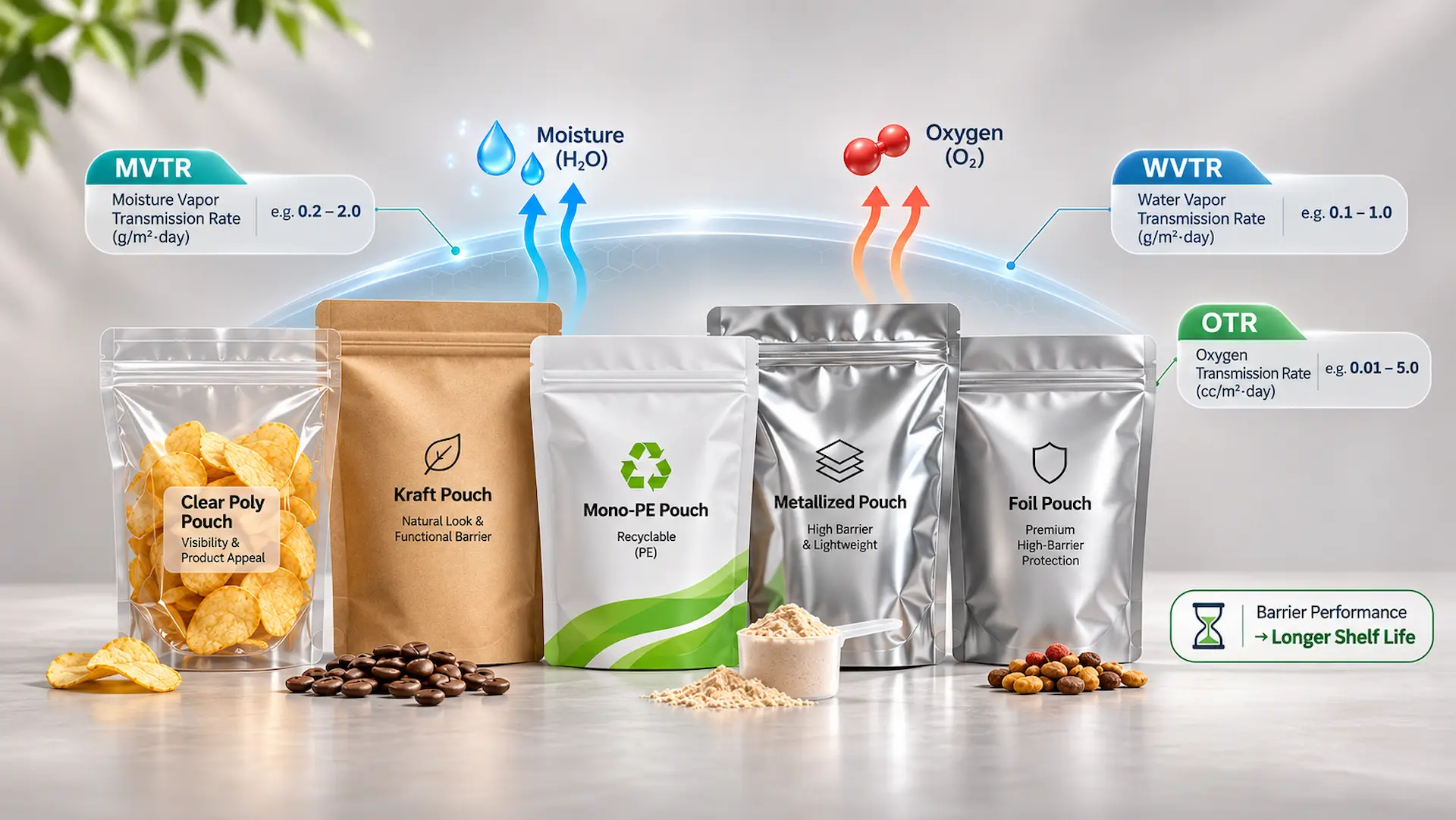
- Choose a PE structure that still protects your product. You’re aiming for 90% polyethylene or more, a PE zipper and no metallized layer. Then comes the hard question: will it last your full shelf life? Our #4 recyclable film’s data sheet shows an OTR of 4.03 cc/m²/day and a WVTR of 6.21 g/m²/day, which is fine for lots of dry goods and not enough for some. Our guide to reading OTR and WVTR numbers helps you judge.
- Get your paperwork from the supplier. Ask for the layer-by-layer structure, the data sheet and any APR recognition or How2Recycle pre-qualification letter. A pre-qualified film can save you a round of testing.
- Test, if your structure calls for it. EVOH, metallization, coatings, non-PE parts, or PE content below 90% can each send you to an APR-recognized lab. When density is the only concern, a simpler sink-float test may do.
- Submit the package on the Member Platform. Upload specs and photos for each unique package. How2Recycle reviews it and comes back with the label it qualifies for, along with design feedback.
- Put the label on your artwork and get the proof approved. The Store Drop-off label has to carry its qualifying statement, and you can’t redraw it. Nothing goes to press until How2Recycle signs off on the proof.
- Watch for updates. The Guidelines for Use change regularly, and members have to follow the latest version. A label you earned last year isn’t guaranteed forever.
Plastic Film Recycling Today: The Honest Picture
Before printing any recycle label, it’s worth knowing how store drop-off recycling works out in the real world. Access is pretty good. Collection is not, at least not yet.
A 2025 Sustainable Packaging Coalition study found 70.72% of Americans live within a 3-mile drive of a store that takes PE film, and How2Recycle relies on that study to support the Store Drop-off label. The researchers were frank about the weak spots, though. Staff check bins by eye. Badly contaminated loads often get thrown out. And nobody tracks, in any standard way, how much of the collected film is truly recycled.
Then there’s volume. By The Recycling Partnership’s estimate, the US captures less than 1% of the nearly 4.8 million tons of film and flexible packaging made each year, and hardly any curbside programs accept it. That’s the gap a clear label is trying to close. Shoppers looking for plastic film recycling drop-off bins nearby can search the Plastic Film Recycling map.
Are Plastic Bags Recyclable?
Most are, just not in the bin at your house. Grocery, bread and produce bags are PE film, and PE film belongs in store drop-off bins. How2Recycle points out that in the US, most curbside programs don’t accept bags, wraps or film. So can you recycle plastic bags? Yes, as long as they’re clean and dry and you bring them back to a store that collects them.
Are Ziploc Bags Recyclable?
They are, by the same route. On its sustainability page, Ziploc points people to store drop-off where accepted, for clean and dry bags, and admits they may not be recyclable everywhere. The standard seal-top bags are polyethylene film, so they fit the PE stream. Designing a recyclable pouch with a zipper works the same way: keep every part PE.
Is Mylar Recyclable?
Not through store drop-off, no. Mylar is a brand name for PET film, and most “Mylar bags” pair metallized PET or foil with a PE sealant. That combination isn’t polyethylene-based, so it doesn’t belong in the film stream, and curbside programs generally won’t take it either. For the details, here’s our breakdown of what Mylar bags are made of.
Can You Recycle a Multi-Layer Pouch?
Only when every layer is polyethylene, or when the non-PE parts pass APR testing. Plenty of snack, coffee and pet food pouches still pair PET, foil or nylon with PE for barrier, and those generally can’t go in drop-off bins. So if you typed “multi layer pouch recycle” into a search bar, the real answer is that the layers decide, not the format.
Recycle Labels and the Law: SB 343, FTC and EPR
Whatever your label says, regulators read it as a marketing claim. For pouch brands selling in the US, three sets of rules matter most.
California SB 343
California’s truth-in-labeling law covers products and packaging manufactured on or after October 4, 2026. Roughly speaking, you can only use chasing arrows or say “recyclable” there if the material is collected by programs serving at least 60% of Californians and sorted by facilities serving 60% of those programs. Film collected at stores doesn’t fit neatly into that, which is the whole reason the arrows came off the Store Drop-off label.
A federal court stepped in during July 2026 and paused the Attorney General’s enforcement of parts of the law, but only for the trade groups that brought the case. How2Recycle’s statement on the injunction says SB 343 is still active and its own labels haven’t changed. Packaging made before the October date is grandfathered, so what counts is when it was produced, not when it sells.
The FTC Green Guides
At the federal level, an unqualified “recyclable” claim is only okay when recycling is available to at least 60% of consumers where the product is sold. Below that line, the Green Guides expect you to qualify the claim. In a way, the Store Drop-off label is that qualifier, since it tells people exactly where the pouch should go.
EPR Laws
More states keep passing extended producer responsibility laws, and what you pay often depends on whether a package is recyclable. An earned label and tidy records make reporting a lot less painful. Our guide to US EPR for packaging covers which states have laws and what brands need to report.
Important Note: How2Recycle states outright that its label assignment and proof approval don’t guarantee compliance with SB 343 or other laws. Skip extra “100% recyclable” wording or arrows elsewhere on the pack, and have someone who knows packaging law review your final artwork.
Conclusion
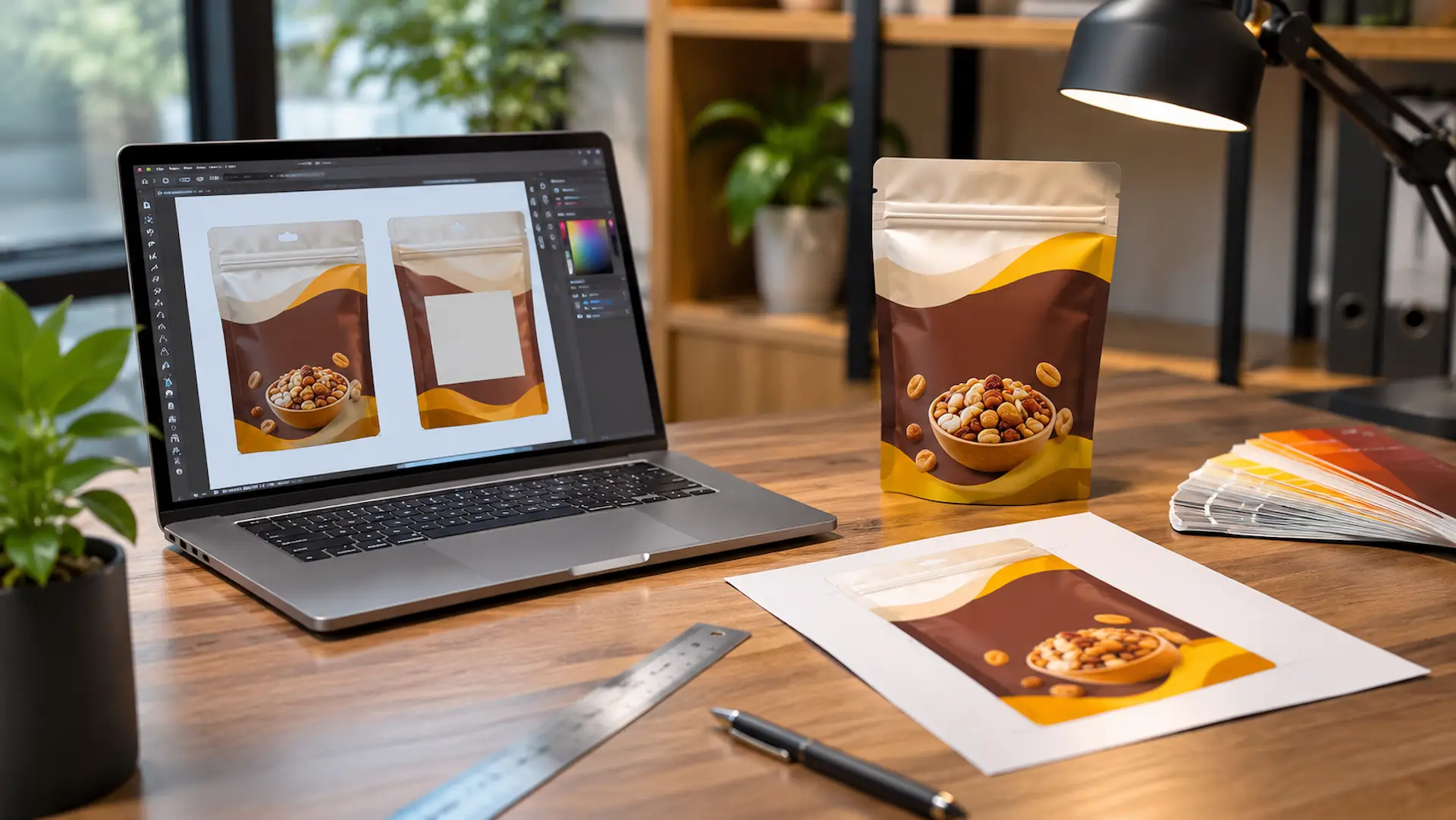
The new How2Recycle label is simpler to look at than the old one. Getting it onto your own pouch takes more thought. The film needs to be polyethylene, the zipper and other extras need to play nicely with PE, and the product inside has to be something the drop-off stream can actually handle. Get those right and what’s left is mostly paperwork.
A few things worth keeping in mind as you plan:
- The Store Drop-off Pro label uses a bin icon, not chasing arrows.
- Your brand, not your supplier, has to be the How2Recycle member.
- EVOH, metallization, coatings and non-PE parts usually mean APR testing.
- Salty snacks, chocolate and wet or oily products are excluded for now.
- SB 343 applies to anything made for California from October 4, 2026.
Store drop-off has flaws, and even the groups running it say as much. Still, an earned, specific label beats a vague recycling claim every time, for your customers and for your legal team.
Planning a Store Drop-Off Pouch? Start With the Right Film
Our mono-material #4 recyclable film conforms to How2Recycle guidelines, and we can build it into stand up pouches, flat pouches, flat bottom bags or rollstock, with a PE zipper option on premade pouches. Send us your product and shelf life target and we’ll share the data sheet you’ll need for your label request. Runs start at 1,000 bags and usually ship in about 10 business days. When you’re ready, request a quote for your recyclable pouches.
FAQs
Here are the questions we hear most from brands looking into How2Recycle.
1. What is the How2Recycle label?
It’s a standard on-pack label from How2Recycle, a program run by the nonprofit GreenBlue, that tells shoppers what to do with each part of a package. The main outcomes are Widely Recyclable, Check Locally, Store Drop-off and Not Yet Recyclable.
2. Where can shoppers find How2Recycle info for a plastic pouch?
Start with the label on the pack. Fuller explanations sit on how2recycle.info, and for store drop-off pouches the Plastic Film Recycling map shows nearby collection bins. Some Check Locally and Widely Recyclable labels now include a QR code too, though Store Drop-off labels simply send people to the store.
3. Is How2Recycle a certification?
Not technically. It describes itself as a pre-qualification program. How2Recycle reviews your package and assigns a label, but your brand still owns its claims and its legal compliance.
4. Can we use the label if our pouch supplier is a How2Recycle member?
Unfortunately not. The brand on the package has to be the member. Your supplier’s membership, or a pre-qualified film, can make your own request quicker, but it doesn’t give you permission to print the label.
5. Does the Store Drop-off label apply in Canada?
Store Drop-off is US-only. In Canada, eligible PE films get a Widely Recyclable label, since curbside and municipal drop-off programs there take them.
6. Do we have to replace old Store Drop-off labels with arrows?
Yes, over time. How2Recycle stopped approving legacy proofs on February 1, 2026, and wants every package moved to the Pro label. For anything made for California on or after October 4, 2026, the Pro design is the safe choice. Stock made before that date is grandfathered under SB 343.