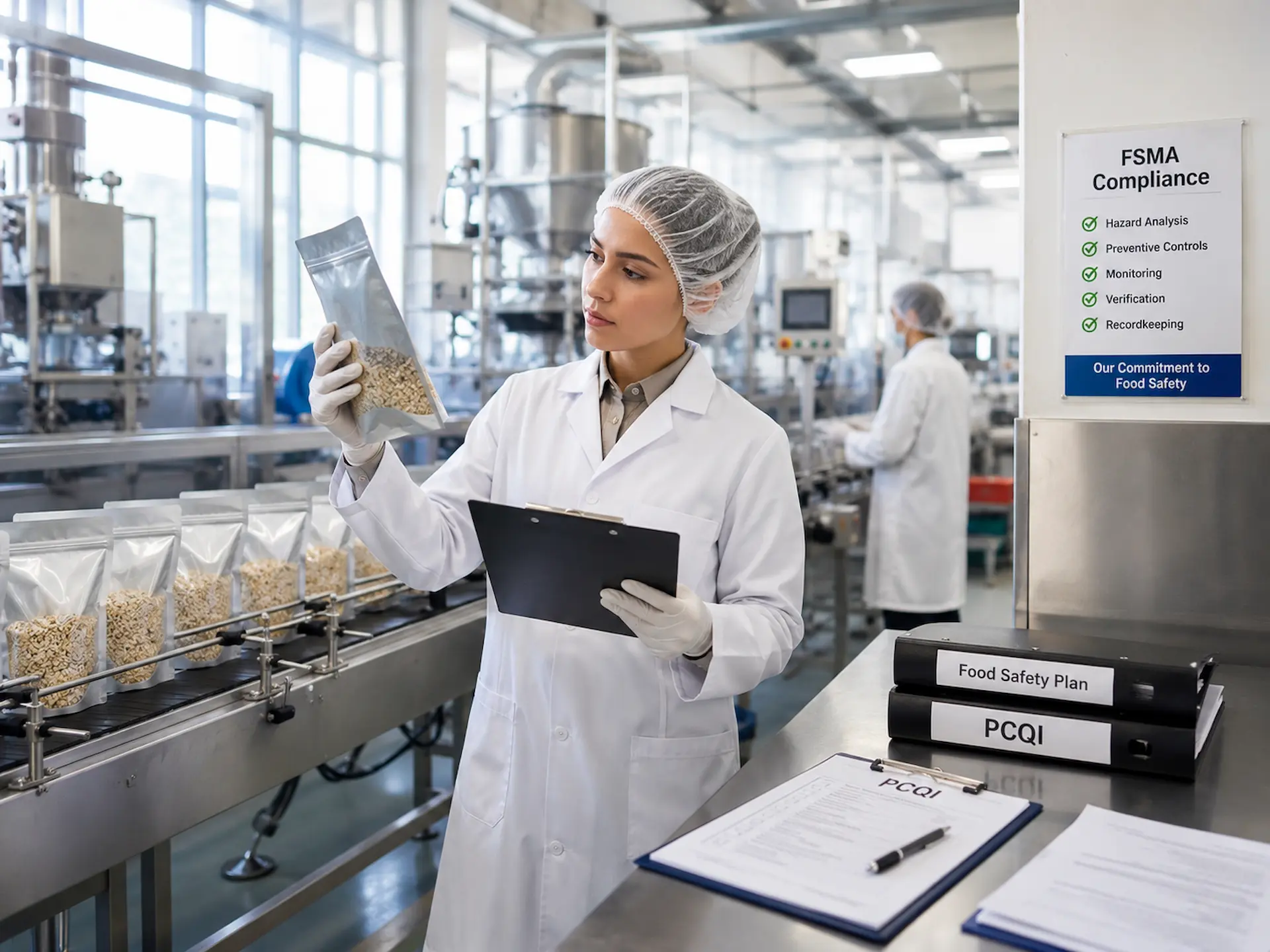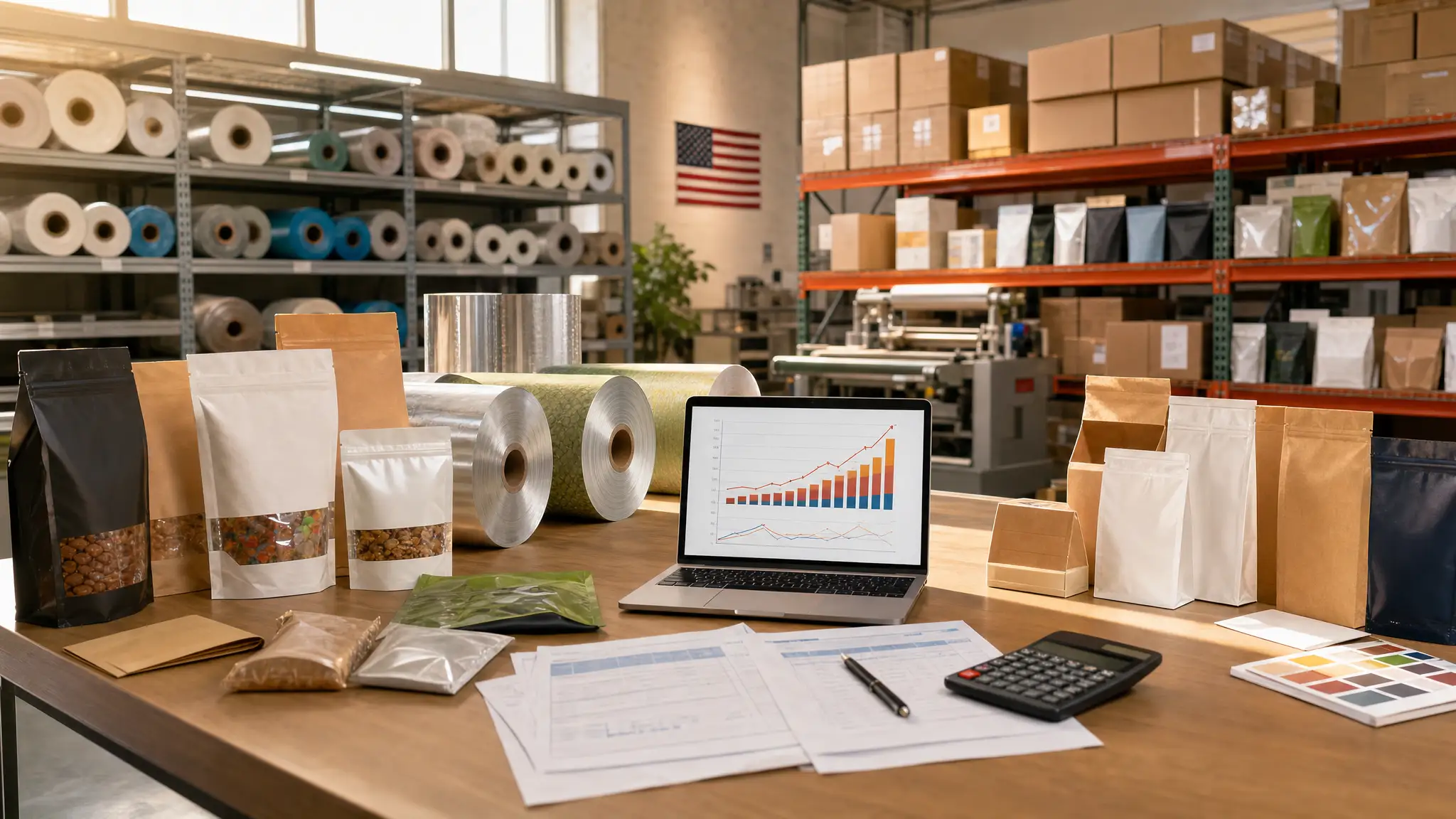





















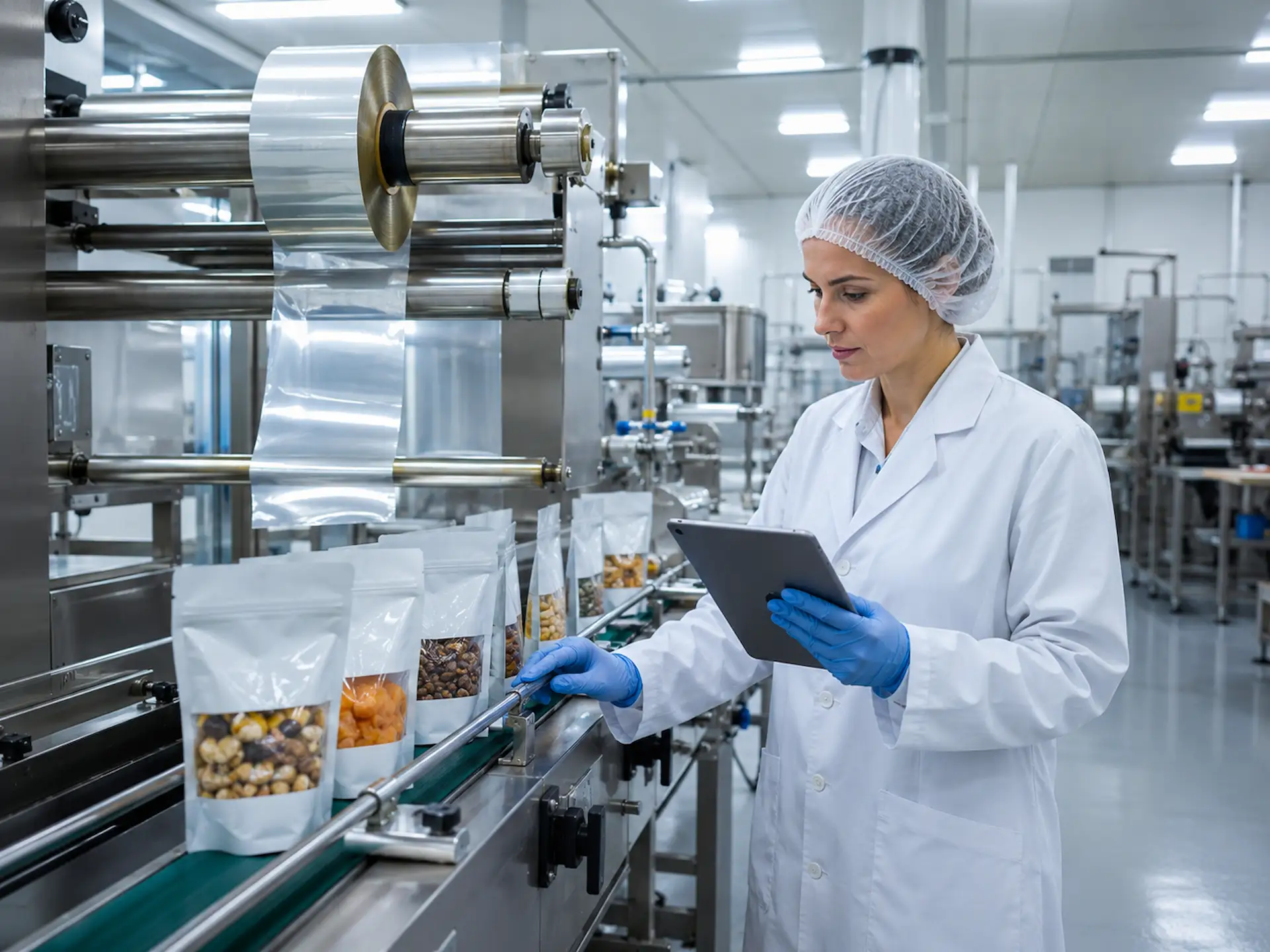
Packaging used to be the last thing buyers worried about. That’s no longer the case. With food scandals, recalls, and tighter rules across most regions, retailers want to see exactly how their packaging is made. They want real proof. And the proof most of them ask for is BRCGS packaging certification.
About 70% of the world’s leading retailers now require BRCGS from their packaging suppliers. Over 6,200 sites in more than 91 countries already hold the certificate. If you make packaging materials and you’re trying to grow into bigger markets, you really can’t ignore it. This guide explains what BRCGS is, what Issue 7 changed in 2025, the audit process, the actual costs, and how to get certified step by step.
What Is BRCGS Certification? The Story Behind the World’s Leading Packaging Standard
BRCGS stands for Brand Reputation through Compliance Global Standards. Bit of a mouthful. The story is simpler. In 1998, a group of major UK retailers (the British Retail Consortium) wanted one set of rules they could trust across all their suppliers. They started with food safety. By 2001, they had a separate version for packaging. The packaging standard was renamed BRCGS Packaging in 2020. Most people in the industry still say “BRC” anyway.
The standard runs under the LGC Group now. Its real weight comes from one thing: GFSI recognition. The Global Food Safety Initiative is what makes BRCGS more than just a UK audit. With GFSI behind it, retailers, food brands, and regulators across the world accept the certification.
There are several BRCGS standards under the same name. Food Safety, Storage and Distribution, . Agents and Brokers and Consumer Products. For anyone making packaging, the one that matters is BRCGS Packaging Materials.
Inside the BRCGS Packaging Materials Standard
Think of it as a global rulebook for packaging makers. The standard lays out the safety, hygiene, and operational rules your site has to meet to be trusted by international buyers. And it doesn’t only apply to food packaging anymore. The scope has grown a lot.
What the standard covers in terms of materials:
- Plastics, rigid and flexible
- Paper and board
- Glass
- Metal
- Flexible films
- Digital print (added in Issue 7)
- Compostable and biodegradable packaging (also new)
Industries that use it:
- Food and beverage
- Cosmetics and personal care
- Pharmaceuticals
- Hygiene-sensitive consumer goods
- Single-use disposables (cups, napkins, trays, that kind of thing)
Who needs to get certified:
- Packaging manufacturers, food and non-food
- Converters and printers
- Repackers
- Suppliers of inks, glues, coatings
Adoption is growing about 8% per year. The simple read on that is buyers want it more, and suppliers without it are slowly getting left out of bigger conversations. 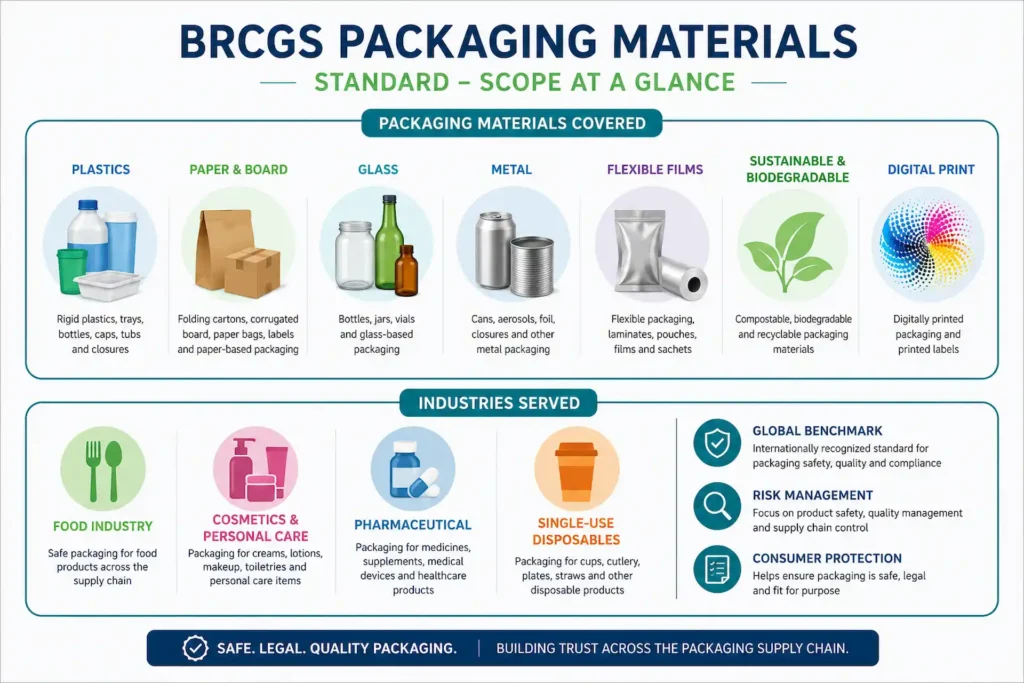
Why BRCGS Packaging Certification Matters
I still meet packaging manufacturers who treat certification as just another cost. It usually doesn’t end well. Without BRCGS, most major retailers won’t even shortlist you. There are a few reasons it became a basic expectation.
- Market access. Top retailers in the UK, EU, and North America have made BRCGS a baseline supplier requirement. Without it, you’re not even in the conversation.
- Third-party trust. A certificate from an accredited body works as independent proof your packaging is safe. That kind of credibility takes years to build on your own. The audit gets you there in months.
- Real numbers behind it. A Birkbeck study found certified businesses pull in about 7.5% more in sales and 6% more in profit on average. So the certification doesn’t really cost you. It tends to pay itself back.
- Less audit fatigue. Without a recognised certification, every buyer wants to send their own auditor. With BRCGS, one audit usually covers it.
- Cleaner internal operations. Recalls drop. Waste drops. Training improves. Most sites that go through the process come out cleaner on the other side.
- Free exposure on the BRCGS Directory. Every certified site gets listed there. Buyers actively search the directory when they need new suppliers. That’s free visibility to exactly the audience you want.
BRCGS Packaging Materials Issue 7
Issue 7 was published on 28 October 2024. From 28 April 2025, every new audit has to be done against this version. The changes are real. 167 clauses were revised, and a new one was added.
Here are the nine updates worth knowing.
- HARA has been reworked. It’s now lined up with Codex Alimentarius and HACCP. The analysis has to cover physical, chemical, biological, and operational risks. Equipment failure and human error sit inside that too now.
- Product safety culture is no longer a soft thing. You have to show a real plan with measurable progress. Saying “we have a safety culture” doesn’t fly anymore. You need training, communication, and visible leadership behind it.
- Senior management has more skin in the game. Signing the policy and stepping away isn’t enough.
- A confidential reporting system is now required. Workers need an anonymous channel to flag safety concerns. That’s one of the brand-new clauses.
- The scope has expanded. Digital print packaging, compostable materials, and biodegradable packaging are all officially covered.
- Allergen controls are tighter. A proper allergen risk assessment is mandatory, not optional.
- If you outsource anything (printing, lamination, coating, whatever it is) there are clearer rules around documenting it and including it in your HARA.
- There’s a new blended audit option. Some of the audit can be done remotely, the rest on-site. Multi-site businesses get the most from this.
- And the four-hour traceability rule. From raw material to finished product and back, you’ve got four hours to trace it.
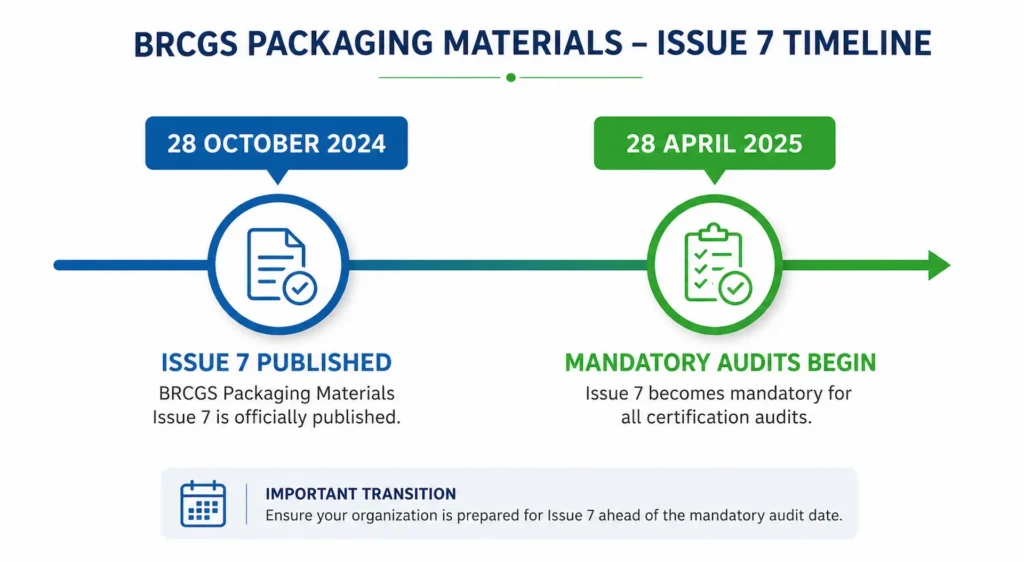
Important Note: If your last audit was Issue 6, that certificate is still valid until it expires. But your next one will be Issue 7. Start preparing now, not when you’ve got two months left.
The 8 Pillars of the BRCGS Packaging Standard
The whole standard sits on eight areas. Nail these and the audit gets a lot easier.
| Pillar | What It Means |
| 1. Senior Management Commitment | Written policy, visible leadership, and a measurable culture plan |
| 2. Hazard & Risk Analysis (HARA) | Identify all safety, quality, and process risks and implement controls |
| 3. Product Safety & Quality Management System | Documented procedures, traceability, CAPA, and formal QMS elements |
| 4. Site Standards | Clean facility, pest control, foreign-body checks, and safe utilities |
| 5. Product & Process Control | Specifications, artwork/prepress control, and robust change management |
| 6. Personnel | Trained, healthy, and competent staff in every role |
| 7. Supplier & Raw Material Management | Approved supplier list with regular reviews and performance checks |
| 8. Traceability & Crisis Management | Full traceability within 4 hours and a tested recall plan |
These aren’t tickboxes. They’re the daily habits of a well-run site. Get sloppy with one and the others usually slip too.
How BRCGS Packaging Connects to BRCGS Food Safety
A lot of packaging suppliers don’t see how their certification ties back to BRCGS food safety. The link is bigger than it looks.
Food brands certified to BRCGS food safety (currently Issue 9) are legally on the hook for the safety of anything that touches their food. Packaging counts. So if a packaging supplier causes contamination, the food brand absorbs the legal and reputational hit.
That’s why food brands actively prefer suppliers who already hold BRCGS packaging certification. It pulls one layer of risk out of their supply chain. As a supplier, you become the safer option by default.
If you’re already supplying, or want to supply, a BRCGS-certified food brand, getting your own packaging certification makes winning and keeping that work much easier.
How to Get Your BRCGS Certificate
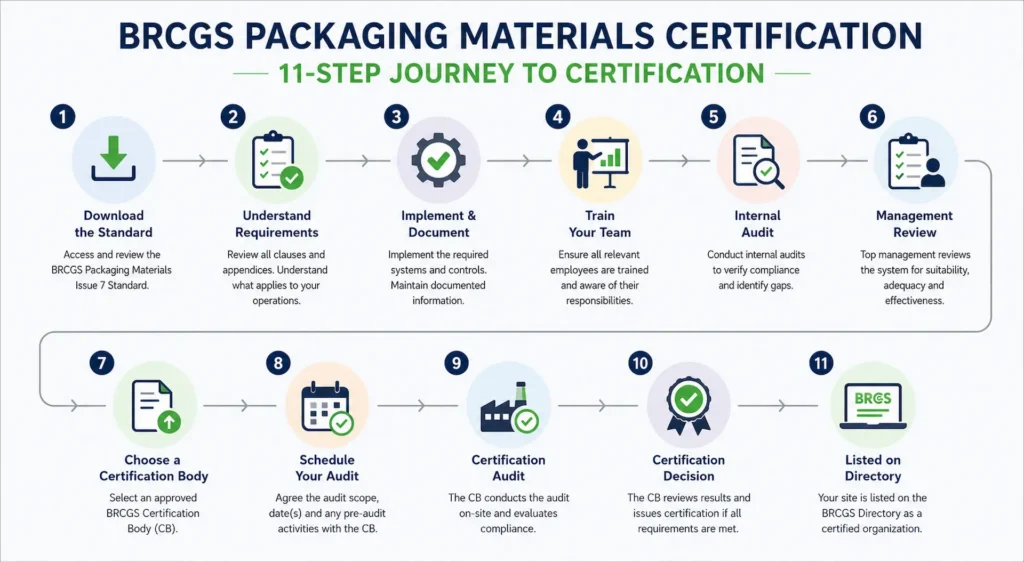
The process isn’t that complex. It just needs planning. Eleven steps from interested to certified:
Step 1. Download the standard. Get BRCGS Packaging Materials Issue 7 and the Interpretation Guidelines from the BRCGS store.
Step 2. Train the team. BRCGS Academy or an approved provider works. Train across roles, not just QA. Production, supervisors, and key operators all need it.
Step 3. Do a gap analysis. Go through each clause and mark what’s covered and what’s missing.
Step 4. Use the self-assessment tool. It’s free and useful for spotting weak areas before the auditor does.
Step 5. Pick a certification body. Choose one from the BRCGS Directory. Two or three quotes before deciding is a good idea.
Step 6. Run an internal audit. Mock the real one. Document everything.
Step 7. Close the gaps. Fix the issues from step 6 and keep proof of every fix.
Step 8. Book the actual audit. Pick announced or unannounced (+). The unannounced one earns you a higher-grade label like AA+.
Step 9. Handle non-conformities. 28 days to fix them. 90 days for first-time sites. Send the evidence back to the auditor.
Step 10. Get your certificate. Valid for 12 months if all checks pass.
Step 11. Listed in the directory. Your site goes live where buyers actually look.
Cost and timeline in a quick view:
| Phase | Time Needed | Approximate Cost |
| Preparation and gap analysis | 8–16 weeks | Depends on how much work is needed |
| On-site audit | 1.5 days + 0.5 day reporting | $5,000 to $15,000 per site |
| Annual re-audit | Every 12 months | Recurring fee |
If you’d rather not work it all out alone, our BRCGS consultants help packaging manufacturers do it faster. Worth a quick call.
BRCGS Grading System Explained
Every BRCGS audit ends with a grade. That grade tells buyers what kind of operation you’re running. It also decides how often you’ll be audited going forward.
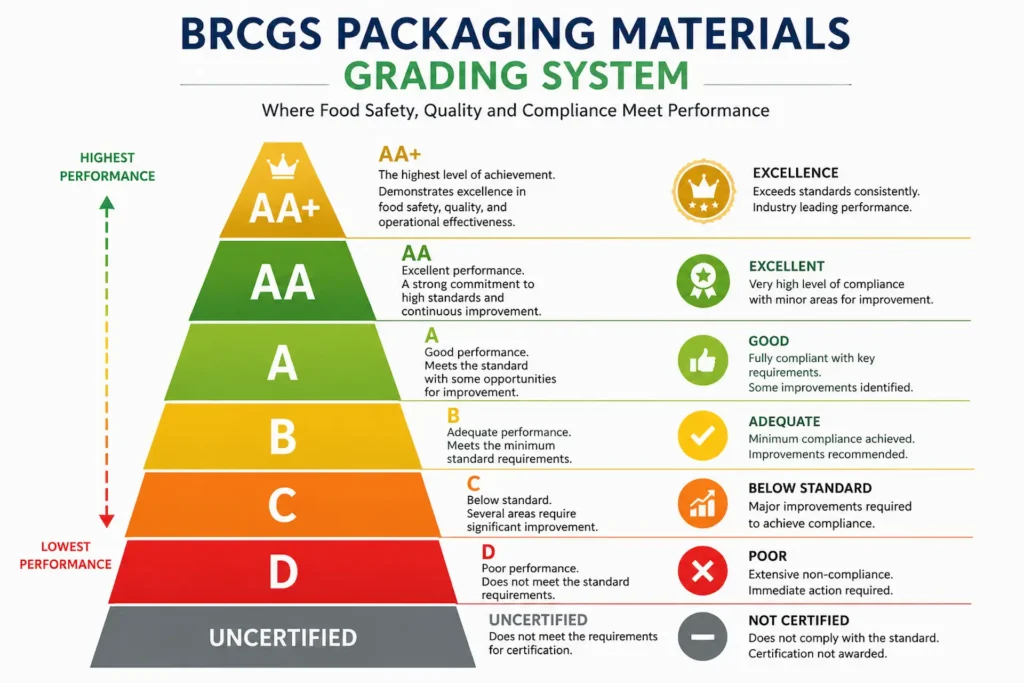
The “+” thing matters. If your grade has a plus (like AA+), it means you passed an unannounced audit. The auditor showed up out of nowhere and your site still met the standard. Buyers respect that grade. It tells them your safety isn’t just an audit-day show.
Common Audit Problems and How to Avoid Them
Most sites that lose marks don’t have broken systems. They have small gaps that quietly pile up. Here are the ones that keep showing up.
The six most common non-conformities:
- Weak or missing safety culture plan (Clause 1.1.2)
- Site and equipment issues like dust on overheads, duct-tape fixes on machines, cracked walls. Over half of all NCs land here.
- Incomplete supplier approval records
- Slow traceability that runs past the four-hour rule
- Pest control lapses
- Missing or weak allergen risk assessments, which Issue 7 cares about a lot more
A few things that usually help:
- Start the culture plan early in the year, not the week before the audit
- Run mock audits two or three months before the real one
- Train staff role by role, not in one big group
- Keep documents version-controlled and quick to find
- Replace temporary fixes with permanent ones and keep the records
Important Note: Auditors don’t just check the paperwork. They watch how staff behave on the floor. If your written policy says one thing and your team does another, that gap shows up in your grade fast.
BRCGS Packaging vs Other Certifications
There are a few packaging-related certifications around, so it’s worth a side-by-side.
| Standard | GFSI Recognised | Best For | Style |
| BRCGS Packaging | Yes | UK / EU / US retailers | Prescriptive, retailer-driven |
| FSSC 22000 | Yes | Global food supply chains | ISO-based, more flexible |
| ISO 22000 | No | Internal management | Generic, flexible |
| IFS PACsecure | Yes | German / French markets | Detailed scoring |
If your buyers are UK, EU, or US-based, BRCGS Packaging is almost always the answer. Most recognised, most demanded, often the only one those retailers care about.
FSSC 22000 works for some global brands. But for packaging specifically, BRCGS still leads.
Conclusion
BRCGS packaging certification has moved well past optional. Issue 7 has raised the bar again, and the manufacturers who start preparing now will be the ones picking up the bigger contracts over the next few years. The ones who keep putting it off will keep losing to suppliers who didn’t. That’s just the direction things are going.
Yeah, it costs time and money. But the bigger markets, real ROI, and stronger buyer trust make it one of the smarter moves a packaging business can make. Treat it as a growth investment, not just a line item.
Ready to Start Your BRCGS Journey?
Getting BRCGS certified shouldn’t feel like a guessing game. Our certified BRCGS experts have helped packaging manufacturers move from Issue 6 to Issue 7, close audit gaps, and earn top grades without the usual stress. From the first gap analysis to audit-day support, we’re with you the whole way.
Book a free consultation. Or grab our BRCGS Issue 7 readiness checklist. Or just hop on a quick call and we’ll figure out where you’re at.
If you want to get listed and start winning the contracts that need certified suppliers, now’s the right time to move.
FAQs
Q1: What is BRCGS certification in simple terms?
An independent check that confirms your business meets a strong global standard for safety, quality, and operations. For packaging makers, it’s the most trusted mark of safety worldwide.
Q2: Is BRCGS the same as BRC?
Yeah. BRC was the original name. It was rebranded as BRCGS in 2020. Plenty of people still say “BRC” out of habit. Same thing.
Q3: How long does BRCGS packaging certification take?
Sites in decent shape usually need 8 to 16 weeks. With bigger gaps, six months or more isn’t unusual.
Q4: How much does BRCGS packaging certification cost?
The audit itself sits between $5,000 and $15,000 per site. Training, consulting, and gap fixes add to that. Site size and certification body affect the final number.
Q5: What’s the difference between BRCGS food safety and BRCGS packaging?
Food safety is for food manufacturers. Packaging is for companies that make packaging materials. A lot of food brands now require their packaging suppliers to hold the packaging version.
Q6: What happens if I fail a BRCGS audit?
You get a chance to fix things. Minor issues have 28 days. Bigger problems may need a full re-audit. A “D” or “Uncertified” grade can suspend the certificate until everything’s sorted.