




















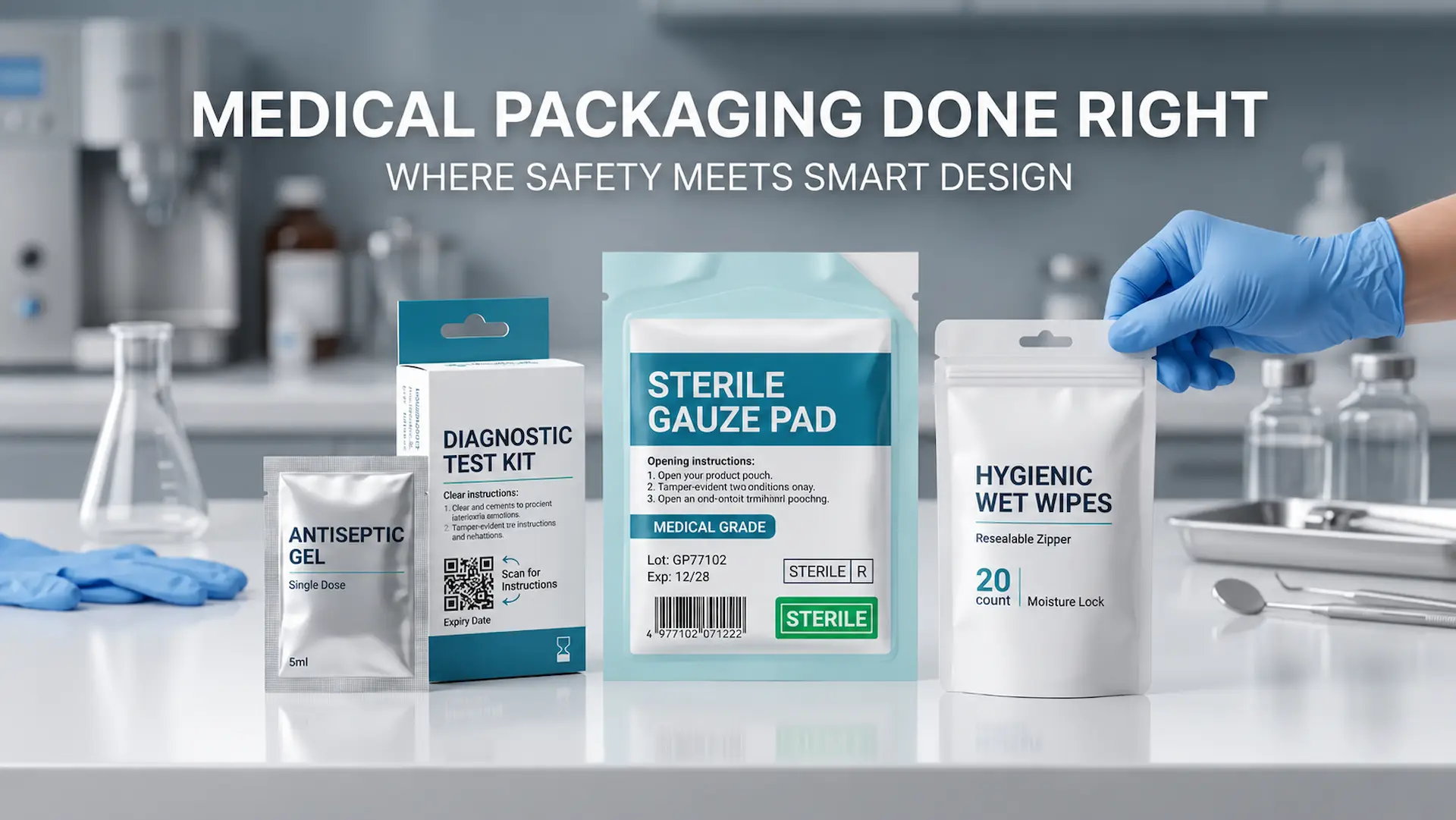
A patient never visits your facility or meets your quality team. The only thing they hold is the package. So when we talk about medical packaging, we’re really talking about the one piece of your business that ends up in someone’s hands during a stressful moment. If the package fails, everything behind it fails with it.
And smart design is not decoration here. It’s the tear notch a nurse can open while wearing gloves. It’s the label a tired parent can read at 2 a.m. It’s the seal that proves nobody touched the product first. This guide walks through what “done right” looks like, from materials to formats to the small details people only notice when something goes wrong.
What “Medical Packaging Done Right” Really Means
Strip away the jargon, and good medical packaging has four jobs. It protects the product, keeps information clear, supports safe handling, and matches how the product is actually used in real life.
That last one trips up a lot of brands. A wound-care wipe used in an ambulance needs very different packaging than a vitamin sitting on a store shelf. One has to open instantly under pressure; the other has to survive months of shelf time and curious kids.
When packaging is done right, nothing leaks, nothing confuses, and nothing slows the user down. Honestly, great medical packaging is a little boring and that’s exactly the point. Drama belongs in your marketing, not in opening a sterile pouch.
Safety Comes First: Protection, Sterility, and Product Integrity
Healthcare products face threats that ordinary retail items never have to worry about:
- Moisture and oxygen that break down active ingredients
- Light exposure that degrades sensitive formulas
- Contamination from dust, microbes, or careless handling
- Transport damage from drops, pressure, and temperature swings
- Tampering anywhere between your facility and the end user
Here’s the difference in plain terms: a snack bag that fails means a stale snack. A medical pouch that fails can mean an unusable test kit or a non-sterile swab reaching a patient.
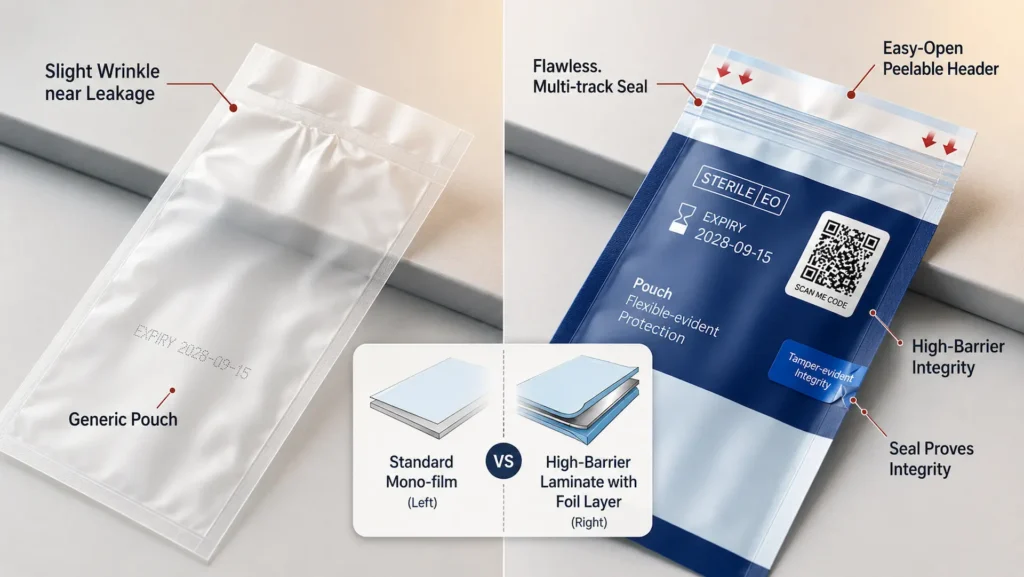
That’s why high-barrier films, strong seals, tamper evidence, and realistic shelf-life planning aren’t “premium extras” in this industry. They’re the baseline. Every healthcare package has three core functions: protect the product, communicate clearly, and stay easy to use and safety sits on top of all three.
Choosing the Right Healthcare Packaging Materials
The best healthcare packaging materials depend entirely on what you’re protecting. There’s no single “best” film, only the best match. Common options include:
- Barrier films and laminates — block moisture, oxygen, and light; the backbone of most medical pouches
- Foil layers — maximum protection for highly sensitive products like test strips and medications
- Paperboard — used for cartons, inserts, and blister cards
- Blister films — give each tablet or dose its own sealed pocket
- Flexible pouch films — lightweight, strong, and easy to customize and print
When comparing health care packaging materials, always start with compatibility. A cream needs a different film structure than a dry swab. A liquid needs stronger seals than a patch.
A good supplier will ask about your product first and recommend materials second, never the other way around. If a vendor pushes one material for everything, that’s your cue to keep looking.
Medical Grade Packaging: What Brands Should Check Before Ordering
“Medical grade” should mean more than a clean white pouch with a serious-looking font. Before you place an order, confirm that your medical grade packaging actually delivers:
- Safe, FDA-grade materials that won’t react with your product
- Strong, consistent seals on every single unit
- A clean, printable surface for sharp and clear labeling
- Tamper-evident options built into the design
- Dedicated space for batch numbers, lot codes, and expiry dates
- Room for barcodes or QR codes without crowding the artwork
For sterile devices, there’s another layer to know about: ISO 11607, the international standard covering sterile barrier systems and validation for terminally sterilized medical devices. If your product is sterile, your packaging conversation should include it.
Important Note: “Medical grade” is a claim, not proof. Always ask your supplier for material documentation and certifications before committing to a large production run. A trustworthy manufacturer will share these without hesitation.
Smart Design Makes Medical Product Packaging Easier to Use
Picture the person opening your product. Maybe they’re sick. Maybe they’re stressed, elderly, or wearing gloves. Smart medical product packaging respects that moment instead of fighting it.
Simple design choices make a surprising difference: tear notches that actually tear, peel-open seals that don’t require scissors, resealable zippers for multi-use items like wipes, readable fonts instead of tiny legal print, and color coding that separates product variants at a glance.
Some products call for more advanced touches to compartments for accessories, anti-static layers for electronic devices, or temperature-control elements for sensitive shipments.
None of this is fancy. It’s simply design that thinks about the person, not just the product. And users feel the difference immediately, even if they can’t name it.
Flexible Packaging for Healthcare Market: Why More Brands Use It
Walk through any pharmacy and you’ll notice pouches steadily replacing rigid boxes and bottles. The shift toward flexible packaging for healthcare market needs is happening for very practical reasons:
- Lightweight packs cut shipping and storage costs significantly
- Custom sizing fits the product exactly, with no wasted space or material
- High-barrier films protect as well as and often better than rigid options
- Full-surface printing turns every pack into a branding tool
- Single-dose formats improve hygiene, dosing accuracy, and convenience
There’s a business advantage hiding here as well. For small and mid-size healthcare brands, flexible packaging usually means lower order minimums and faster production timelines than tooling-heavy rigid formats. You can launch sooner, test more designs, and adjust without massive upfront costs.
Medical Flexible Packaging for Test Kits, Wipes, Patches, and Single-Dose Products
Different products need different pouches. Here’s how medical flexible packaging matches up with real-world healthcare items:
| Product | Best Format | Why It Works |
| Test kits & swabs | Lay-flat (3-side seal) pouch | Compact, sterile, easy tear-open |
| Wet wipes | Resealable stand-up pouch | Locks moisture in after opening |
| Patches & band-aids | Small flat pouches | Clean, single-use protection |
| Creams, gels & lotions | Stand-up pouch or stick pack | Controlled use, less mess |
| Single-dose medication | Stick packs & sachets | Exact dosing, travel friendly |
This is where pouches truly shine. They protect like serious medical packaging but stay light, compact, and genuinely easy to open which matters when the user might be a patient managing their care at home, not a trained professional.
Healthcare Rollstock for Fast, Consistent, and Scalable Packing
If your team runs automated form-fill-seal machines, healthcare rollstock will quickly become your best friend. Instead of ordering pre-made pouches, you receive printed film on rolls configured for your production line. The machine then forms, fills, and seals each pack in one continuous, efficient flow.
Rollstock works beautifully for sachets, stick packs, and lay-flat pouches at high volume. It also makes multi-SKU production refreshingly simple; you can run several product versions or seasonal variations without retooling between batches.
For growing brands, the payoff is consistency. Every pack comes out identical, output speeds up, and your packaging scales smoothly as order volumes climb.
Folding Cartons for Healthcare: When a Box Still Makes Sense
Pouches don’t replace everything, and they were never meant to. Folding cartons for healthcare still earn their place as secondary packaging the printed box around the pouch, blister card, or tube.
Cartons add structure on retail shelves, provide generous space for detailed instructions and regulatory text, hold leaflets and inserts, and offer an extra layer of protection during shipping. They also give pharmacists and retailers a clean, stackable unit that’s easy to display and scan.
The smartest setups pair both formats: a high-barrier pouch protecting the product inside, and a crisp printed carton carrying the brand story and required information outside.
Packaging for Medical Products Must Support Traceability
Ask yourself one uncomfortable question: if something went wrong tomorrow, how fast could you find every affected unit? That’s exactly what traceability answers. Reliable packaging for medical products always includes dedicated room for:
- Lot and batch numbers
- Expiry dates
- Barcodes and QR codes
- Serialization, wherever regulations require it
These small printed details do heavy lifting. They make recalls faster and more precise, keep inventory accurate, simplify audits, and protect patients from expired or compromised products.
Important Note: Plan your traceability space at the artwork stage, not after. Squeezing a lot of code onto a finished design later almost always hurts readability and readability is the entire point of printing it.
Smart Packaging: QR Codes, RFID, and Anti-Counterfeit Features
Modern healthcare packaging is getting connected, and it’s worth paying attention to. A simple QR code can open video instructions, confirm authenticity, or link a patient to dosage guidance in seconds. RFID and NFC tags go further, supporting real-time tracking, smarter inventory control, and anti-counterfeit verification across the entire supply chain.
Some systems even include temperature indicators, which matter enormously for cold-chain products that lose effectiveness when storage conditions slip.
You don’t need every feature on day one. Even one well-placed QR code linking to clear, helpful instructions makes your pack more useful to patients and noticeably harder for counterfeiters to copy.
Sustainable Healthcare Flexible Packaging Without Risking Safety
Sustainability matters in healthcare too; it just can’t come before patient safety. The encouraging news? Healthcare flexible packaging is already a greener choice in several ways. Pouches use far less raw material than rigid containers, weigh less during shipping, and generate less waste at the end of their life.
From that starting point, brands can go further: recyclable mono-material films where barrier requirements allow, right-sized packs that eliminate wasted space, and responsibly sourced materials throughout.
The rule is refreshingly simple. Go green wherever it’s safe to do so, and never where it isn’t. Your customers will respect both halves of that sentence.
Common Mistakes Brands Make With Medical Packaging
Even careful, well-funded brands slip up. These are the mistakes that show up again and again:
- Too little labeling space — regulatory text ends up cramped and unreadable
- Hard-to-open packs — frustrating for elderly users or anyone wearing gloves
- Wrong material choice — a film that can’t handle the product’s moisture or chemistry
- Weak tamper evidence — or worse, none at all
- No traceability plan — lot codes treated as a last-minute afterthought
- Ignoring shipping conditions — packaging tested on desks, not in delivery trucks
- Design before safety — picking the look first, then forcing function to fit
Every single one of these is avoidable with a little planning and the right packaging partner asking the right questions early.
Final Checklist Before You Order Custom Medical Packaging
Run through this quick list before signing off on any order:
- What exactly is the product liquid, dry, cream, or device?
- Which barriers need moisture, oxygen, light, or all three?
- Is there enough space for labels, lot codes, and expiry dates?
- How will users open a tear notch, peel seal, or zipper?
- Does it need tamper evidence or child resistance?
- Pouch, rollstock, blister card, carton or a combination?
- Are there sustainability goals worth building in now?
- Can the supplier show certifications and material documentation?
Ten minutes spent on this checklist can save weeks of reprints, delays, and expensive headaches later.
Conclusion: Safe, Clear, and Smart Packaging Builds Trust
Medical packaging works hardest when nobody notices it. The product arrives intact, the seal proves it’s untouched, the label answers every question, and the pack opens without a fight. That’s safety and smart design working together exactly the way they should.
Get those basics right, and your packaging does far more than protect a product. It tells every patient, pharmacist, and retail buyer that your brand takes their safety seriously.
Ready to Get Your Medical Packaging Done Right?
FlexiblePouches creates FDA-grade custom pouches, rollstock, and folding cartons for healthcare brands with low minimums, fast 10-day turnaround, and eco-friendly material options. Tell us what you’re packaging, and we’ll help you build something safe, smart, and shelf-ready.
FAQs
1. What is medical packaging?
It’s the protective packaging used for healthcare products: medications, test kits, wipes, patches, devices, and similar items. Its job is keeping products safe, sterile, and clearly labeled from the production line all the way to the patient’s hands.
2. What are the best healthcare packaging materials?
Depends on the product. High-barrier films and laminates block moisture, oxygen, and light. Foil handles very sensitive items, and paperboard suits cartons and blister cards. The right material is the one matched to whatever you’re protecting.
3. What does medical grade packaging mean?
Packaging built from safe, compliant materials with strong seals and proper labeling space, produced under controlled quality standards. Sterile devices also fall under standards like ISO 11607. Always confirm the claim with supplier documentation.
4. Is flexible packaging good for healthcare products?
For many products, yes, it’s the smarter pick. Pouches deliver strong barrier protection while staying light, compact, and easy to open. They also ship cheaper and give you the entire surface for custom printing.
5. When should brands use healthcare rollstock?
When products run on automated form-fill-seal lines. Rollstock delivers consistent, high-speed output for sachets, stick packs, and pouches, and lets you switch between product versions without retooling anything.
6. What is the difference between medical flexible packaging and folding cartons for healthcare?
Flexible packaging, meaning pouches, sachets, and rollstock, is usually primary packaging, the layer touching and protecting the product itself. Folding cartons are secondary packaging, the printed box adding structure, branding, instructions, and extra protection. Plenty of brands use both together.