

























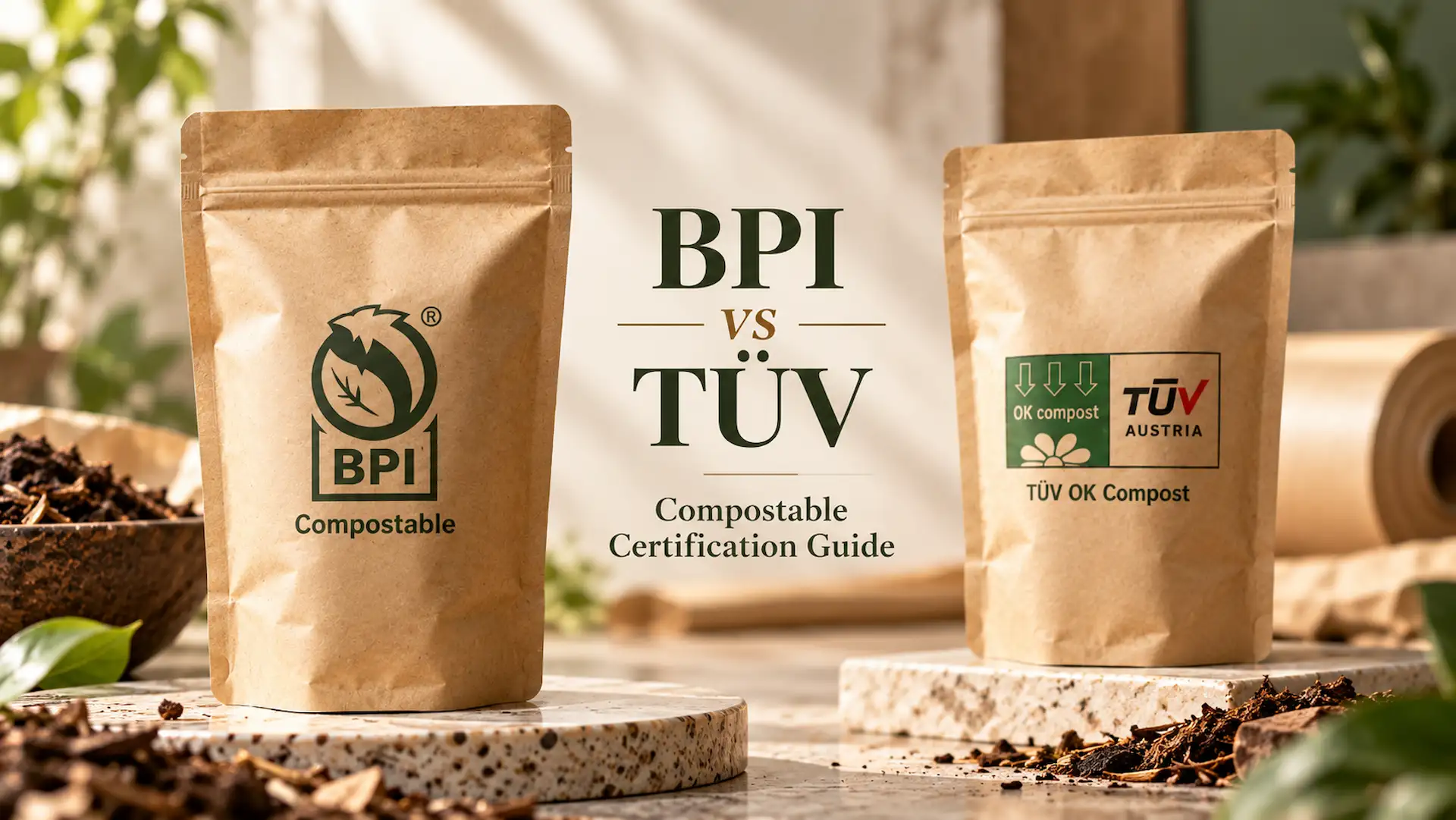
Choosing compostable packaging sounds simple until you come across different certification labels. Two common names are BPI Compostable and TÜV OK Compost. Both help businesses identify packaging that meets recognized compostability requirements, but they are not exactly the same. Their testing programs, certification categories, and market recognition can differ. Understanding these details makes it easier to choose packaging that supports your sustainability goals.
If you are comparing packaging materials, it also helps to understand the difference between recyclable, biodegradable, and compostable films. Our guide to recyclable vs compostable vs biodegradable films explains these differences. In this article, we will focus on BPI and TÜV OK Compost certifications, how they work, and what they mean for flexible packaging.
What Is BPI Compostable Certification?
BPI is short for Biodegradable Products Institute. It’s a non-profit that certifies compostable products in North America, and its logo means an outside group looked at the product, not just the brand’s own marketing team.
What Does BPI Certified Compostable Mean?
What is BPI certified, in plain words? A lab tested the product and it broke down in a composting facility without leaving anything nasty behind in the finished compost. That’s the BPI compostable meaning most of the time. And yes, facility is the key word here. It’s about hot, managed commercial composting, not the heap at the back of your garden.
- One certificate covers one exact product. It’s never a blanket approval for a company.
- PFAS (the “forever chemicals” people worry about) are limited as well.
- Seeing the logo isn’t enough. The product should also appear in BPI’s listing.
How Does BPI Compostable Certification Work?
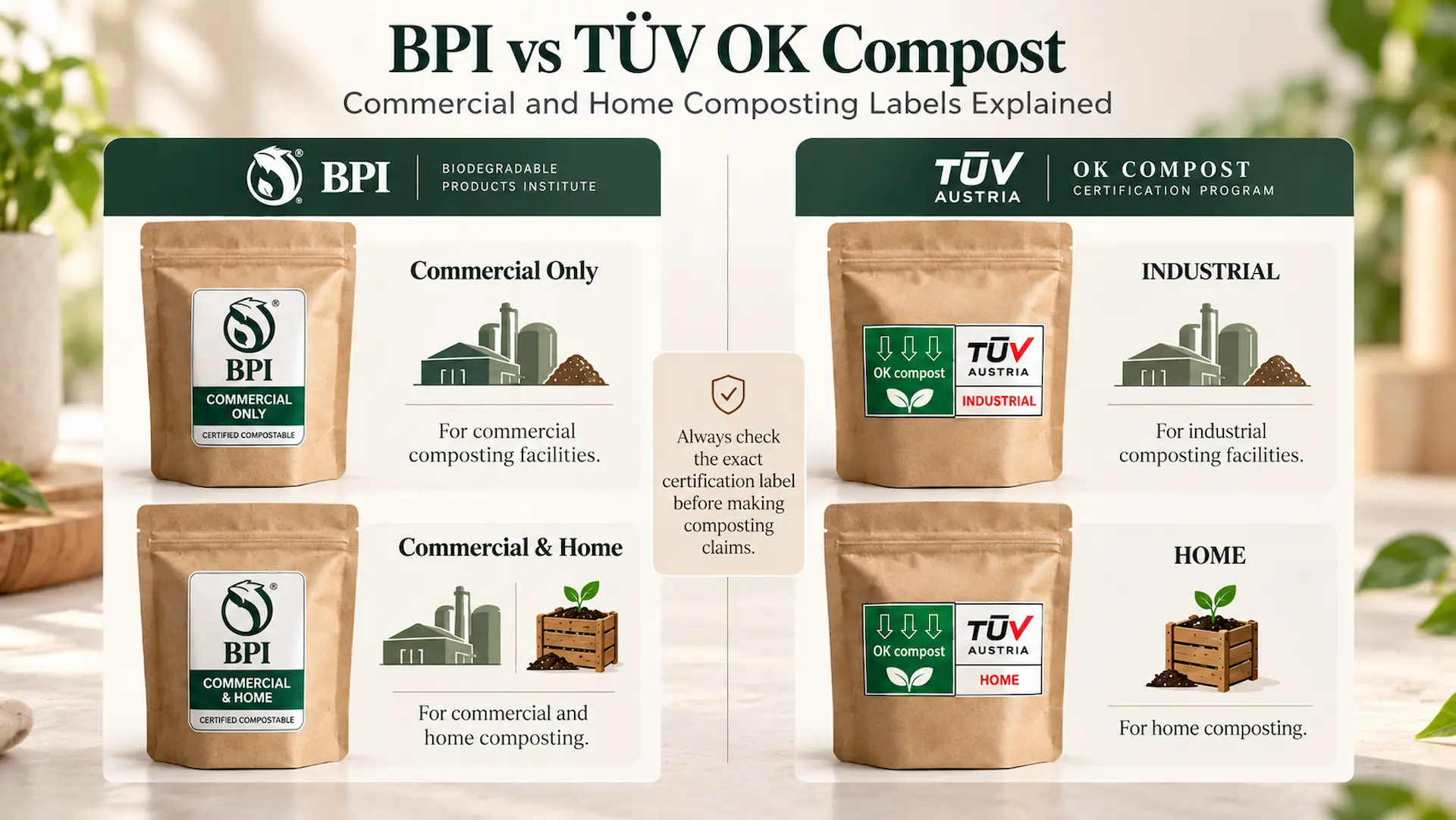
A company applies for one exact product, and its materials get tested to ASTM standards. Until late 2025, BPI only certified products for commercial composting. Then BPI opened a combined Commercial & Home Compostable Certification, with applications starting December 1, 2025. The home side is stricter. The product has to break down in the cooler conditions of a backyard pile, and the rules lean on a French standard called NF T 51-800. And if a brand changes its recipe later, the old certificate may not cover the new version. Dive Brief: +3
- BPI Commercial means it composts in a commercial facility.
- BPI Commercial & Home means it also breaks down in a backyard pile.
- A plain BPI logo? Assume commercial only.
What Is TÜV OK Compost Certification?
TÜV Austria runs the OK compost program. It’s common in Europe and used worldwide. And unlike BPI, it has had separate industrial and home labels for quite a while.
TÜV OK Compost INDUSTRIAL vs HOME Certification
The label is where people get tripped up. OK compost INDUSTRIAL is meant for composting facilities. OK compost HOME is meant for a backyard pile, which is cooler, slower, and much harder on a material.
- INDUSTRIAL follows EN 13432.
- HOME is made for garden compost at normal outdoor temperature.
- A bare “OK compost” with no second word tells you nothing. Look for INDUSTRIAL or HOME.
How Does TÜV OK Compost Certification Work?
It works a lot like BPI’s process. The product goes to a lab, TÜV Austria reviews the results, and if everything passes, the company gets a certificate and a logo. Heavy metals and other materials are checked too. Make a big change to the product later and you’ll probably have to test again.
- Testing is done on the product itself.
- Results are measured against EN 13432 or the home scheme.
- The certificate names the product and the company behind it.
BPI Compostable vs TÜV OK Compost: What Are the Main Differences?
On paper, both programs do the same job: prove a product breaks down safely. In practice they run on different rulebooks and serve different regions. This table shows where.
| Point | BPI | TÜV OK Compost |
| Run by | Biodegradable Products Institute | TÜV Austria |
| Main market | North America | Europe, used worldwide |
| Industrial standard | ASTM D6400, D6868, D8410 | EN 13432 |
| Industrial test target | About 90% biodegradation in 180 days | About 90% biodegradation in 6 months |
| Home option | Commercial & Home certification (newer) | OK compost HOME |
| Home test basis | NF T 51-800 | Up to 12 months at outdoor temperature |
| Where to check | BPI product catalog | TÜV Austria list and certificate copy |
Certification Standards and Testing Requirements
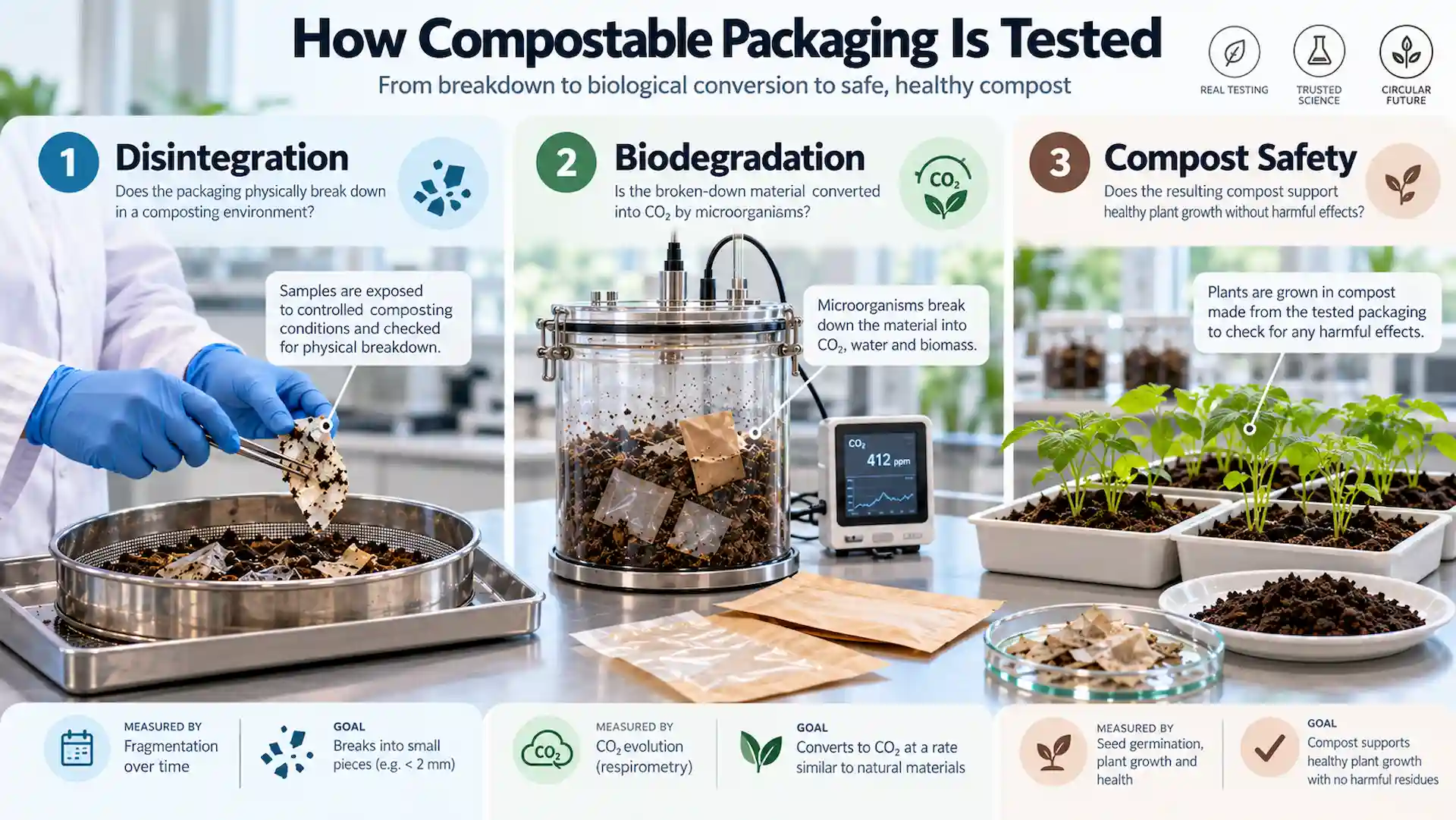
The tests themselves are close cousins. Both ask how much of the material turns into CO2, how well it falls apart, and whether plants can grow in the finished compost. The big difference is the rulebook sitting underneath.
- BPI works from ASTM standards.
- TÜV’s industrial mark works from EN 13432.
- BPI adds its own PFAS limits, while EN 13432 sets heavy metal limits.
Composting Conditions and Market Recognition
Industrial composters run hot, around 55 to 60°C. A home pile just follows the weather. That’s how a bag can vanish in a facility and still be sitting in your garden months later. For recognition, most US composters and buyers look for BPI, and TÜV Austria’s mark is the usual proof in Europe.
- Home composting is cooler and slower.
- Neither certificate automatically replaces the other.
What Testing Standards Are Used for BPI and TÜV OK Compost?
Compostability certification is based on measurable testing requirements. These standards help determine whether a product can break down under specified composting conditions without creating unacceptable problems for the finished compost.
ASTM D6400 and BPI Certification Standards
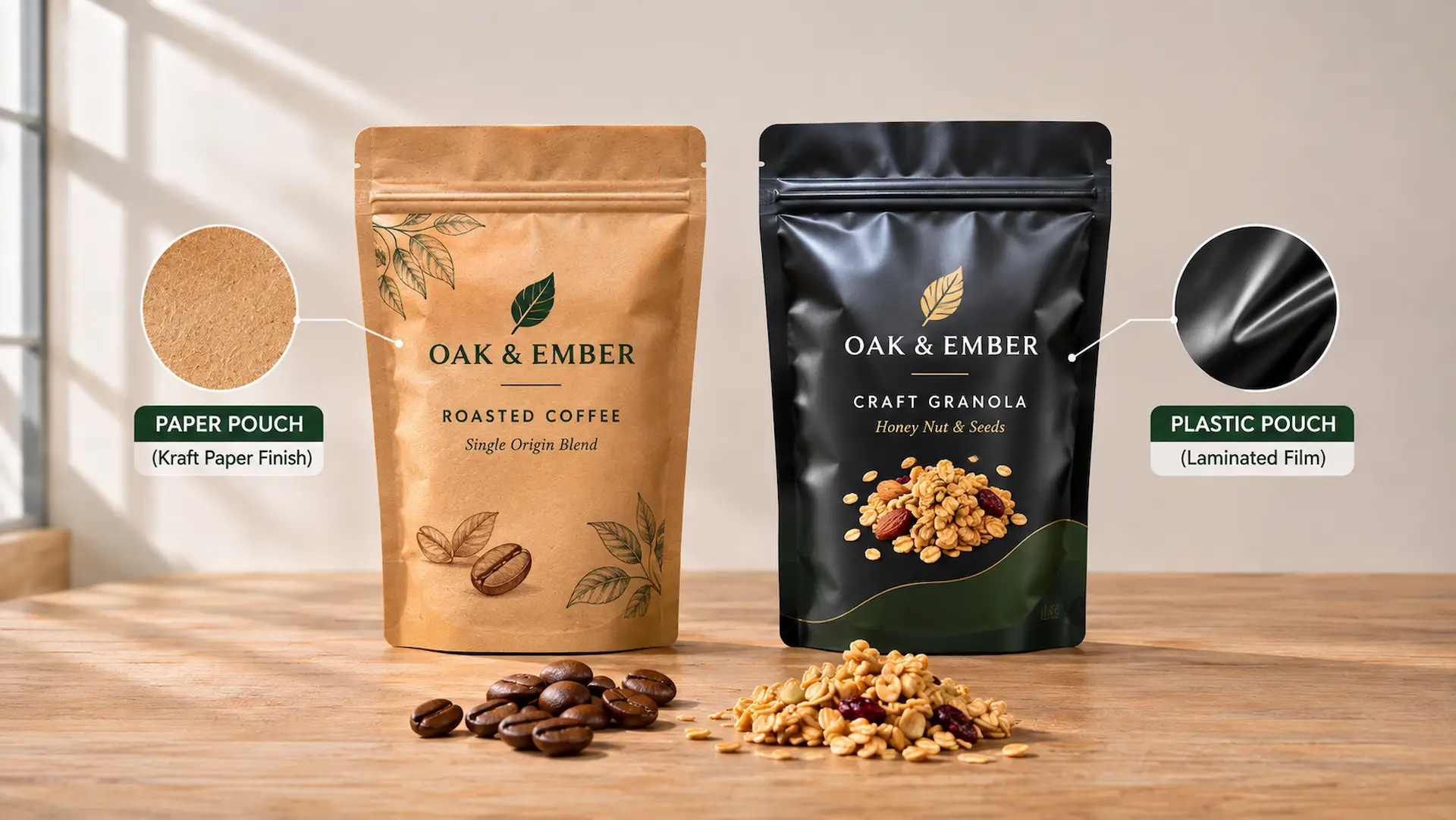
BPI starts with ASTM D6400, the standard for plastics, and can also assess an item under D6868 or D8410 if it’s eligible. A kraft paper pouch with a compostable liner can go down a different route than a plain plastic film. netzerocompare
- ASTM D6400 covers plastics and plastic films.
- ASTM D6868 covers coatings and films on paper.
- ASTM D8410 covers fiber-based items.
EN 13432 and TÜV OK Compost Testing Requirements
EN 13432 is Europe’s rulebook for compostable packaging. For home composting, many people point to the French standard NF T 51-800. Whichever rulebook applies, the lab looks at three things. dincertco
- Biodegradation: at least 90% of the material has to turn into CO2 in the set time, roughly 180 days for industrial tests.
- Disintegration: after 12 weeks, nearly everything should pass through a 2 mm sieve.
- Compost safety: plants should grow normally in the finished compost, and heavy metals must stay within limits.
Important Note: ASTM D6400 and EN 13432 look alike, but they are not the same standard. Never treat a certificate under one as proof for the other.
How Do BPI and TÜV Certifications Apply to Compostable Packaging?
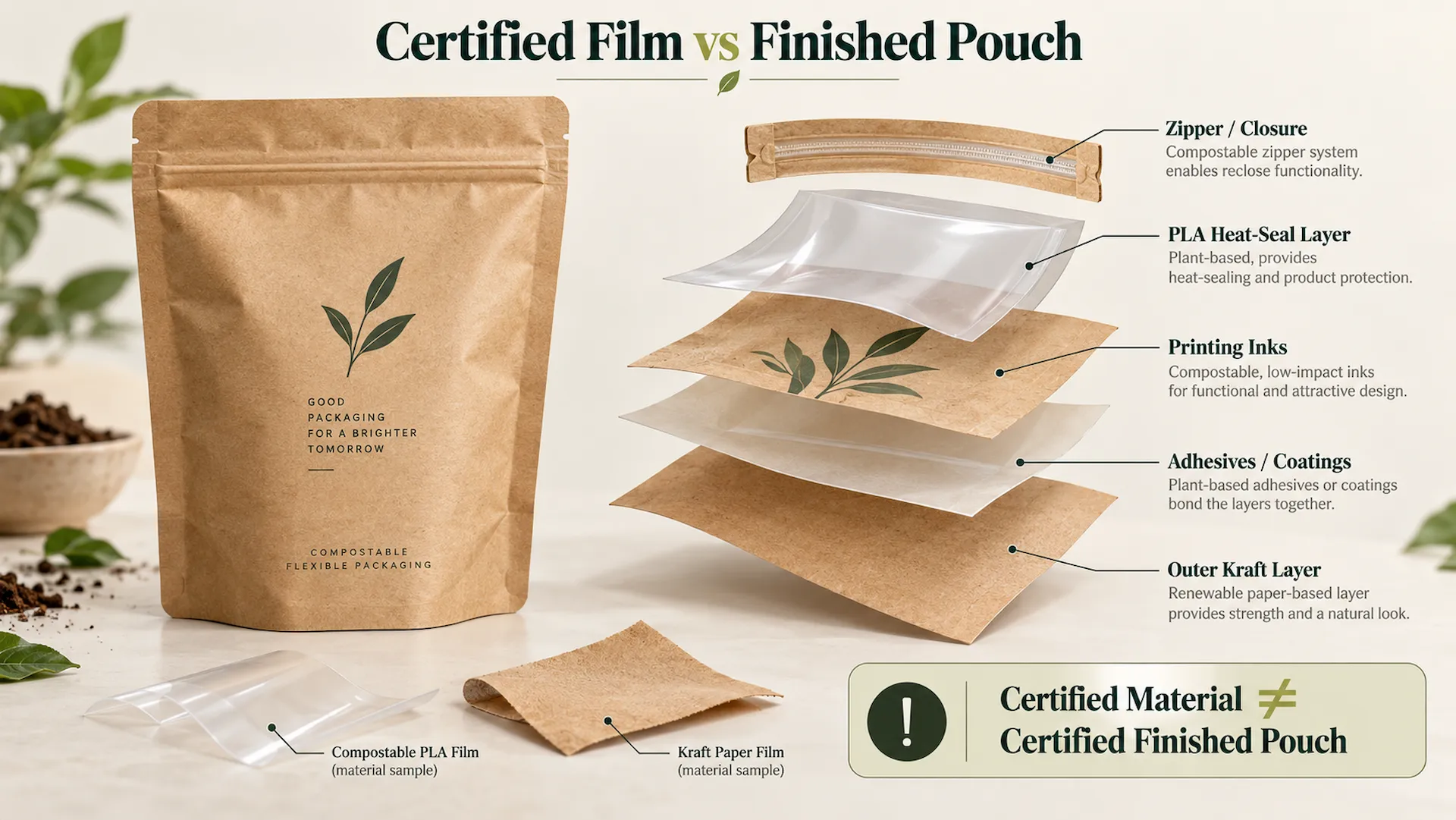
Certification becomes especially important when choosing flexible packaging. A pouch may contain several materials, including an outer film, sealant layer, adhesives, printing inks, and a zipper. Each can affect how the finished packaging behaves during composting.
Which Flexible Packaging Materials Can Be Certified?
PLA-based films, plant-based plastic blends, and paper with a compostable coating can all qualify. Regular petroleum plastic can’t. But a pouch is more than its film, so even a stand-up pouch made from a certified film isn’t automatically certified as a finished pouch. If you want to compare film types, our material options page lays them out.
- The film is the main body, such as PLA-based or paper-based layers.
- Any coating added for barrier or sealing counts too.
- Inks and adhesives are part of the final result.
- So are zippers and valves.
Important Note: A certified film does not always mean a certified pouch. Ask for proof that covers the finished pouch, with the same film, ink, and closure you plan to buy.
Does Certified Compostable Packaging Break Down at Home?
Only if it’s certified for home composting. A standard BPI or OK compost INDUSTRIAL product needs the heat of a commercial facility, and a garden pile rarely gets that hot. Think of a customer finishing your granola and tossing the empty pouch into the backyard bin. If it’s industrial-only, it could still be sitting there next spring.
- Look for the OK compost HOME mark.
- Or look for BPI’s Commercial & Home label.
- Neither one? Treat it as commercial composting only.
How Can You Verify BPI and TÜV OK Compost Certifications?
Certification logos can help buyers identify suitable packaging, but a printed symbol should never be the only evidence. Checking official certification information is a practical way to avoid unsupported environmental claims.
How to Check BPI and TÜV Certification Labels
Anyone can copy a logo. A certificate number is much harder to fake, so ask for it first. If you’re still comparing suppliers, our guide on how to choose a flexible packaging manufacturer has some good questions to ask.
- Get the certificate number and the exact product name.
- For BPI, look the product up in BPI’s online catalog.
- For TÜV, ask for the certificate copy and find the product in TÜV Austria’s list.
- Make sure INDUSTRIAL or HOME matches what’s printed on the pouch.
- Check that the company name and dates fit your order.
Common Mistakes When Reading Compostable Certification Claims
Most mistakes come from trusting the logo a little too much.
- Believing a logo that has no certificate number behind it.
- Using “biodegradable” and “compostable” as if they mean the same thing. The first has no fixed time or place.
- Assuming an industrial label also works at home.
- Accepting a certificate for the raw material instead of the finished pouch.
- Forgetting that a recipe change after certification can break the match.
BPI vs TÜV OK Compost: Which Certification Is Better for Your Packaging?
Neither certification is automatically better for every business. The right choice depends on your target market, customer disposal options, packaging design, and specific certification requirements.
Choosing Certification for the US and European Markets
For the US, BPI is usually the safer pick, since many composters and buyers ask for it. Some states also restrict which products can use the word “compostable” on a label. California is one example, so check the rules in each state where you sell. In Europe, EN 13432 through TÜV Austria is the usual route.
- US industrial claim: BPI.
- European industrial claim: OK compost INDUSTRIAL.
- Backyard claim: OK compost HOME or BPI Commercial & Home.
- Selling in both regions: some brands hold both certificates.
What Should Packaging Buyers Check Before Choosing?
Start with where the pouch will be sold and what happens to it afterward. If composting barely exists near your customers, recyclable pouches may be a more honest fit than a compostable claim nobody can use.
- Which certificate does your target market expect?
- Will customers compost at home or through a local program?
- Does the certificate cover the finished pouch?
Find the Right Compostable Packaging With Flexible Pouches
At Flexible Pouches, we make custom printed pouches in compostable film structures. One option is a plastic-free, kraft-paper-based film with a PLA heat-seal layer and water-based inks, and zippers and degas valves can be added. Orders can start at around 1,000 bags, and most digital orders ship in about 10 business days. Tell us your market and how customers will dispose of the pouch, then ask for paperwork that matches your exact build. Still planning your first order? Our guide to low minimum order flexible packaging covers what’s realistic.
Conclusion
BPI and TÜV OK Compost both mean an outside lab tested the product, but they follow different rules and serve different markets. The biggest question is where the pouch will end up, a commercial facility or a backyard pile. Always check that the certificate covers your exact pouch and not only the film. A claim you can prove is worth more than a green leaf.
Ready to Explore Compostable Packaging for Your Brand?
Your packaging should protect your product, represent your brand, and support environmental claims you can explain clearly. Flexible Pouches offers custom flexible packaging solutions with material, sizing, and printing options for different business needs.
Explore your packaging options and request a custom quote from Flexible Pouches today. Share your product requirements and ask about suitable compostable materials and available certification documentation.
FAQs
1- What does BPI compostable mean?
Basically, an independent group, the Biodegradable Products Institute, checked that the product breaks down in a composting facility under ASTM standards. Notice it says facility. Unless the label also says Commercial & Home, don’t count on it vanishing in your backyard pile.
2- What is the difference between BPI certified and TÜV OK Compost?
Mostly the rulebook and the region. BPI works from ASTM standards and is the name you’ll see most in the US. TÜV OK Compost comes from TÜV Austria, follows EN 13432, and has separate industrial and home labels. Both are real certifications, but you can’t swap one for the other.
3- Is BPI-certified packaging suitable for home composting?
Usually not. A regular BPI logo means commercial composting only. If you want to say a pouch works at home, look for BPI’s newer Commercial & Home label or TÜV’s OK compost HOME mark. And check that the certificate names your exact product.
4- Is TÜV OK Compost certification recognized in the USA?
Plenty of people know it, and it can back up a compostable claim. The catch is that many US composters, buyers, and states lean on ASTM-based proof like BPI. Before you print, ask your composter and look at the rules in the states you sell in.
5- Can packaging have both BPI and TÜV OK Compost certifications?
Yes, they can. Each one tests and approves the product separately, so you’d hold two certificates. Brands that sell in both North America and Europe sometimes do this. It means extra cost and more waiting, but one pouch can then carry the right proof in both places.
6- How can I tell if compostable packaging is certified?
Ask your supplier for the certificate number and the exact product name, then look it up in the BPI catalog or on TÜV Austria’s list. Make sure the certificate covers the whole pouch, the right label type, and current dates. A logo by itself isn’t enough.