





















Ordering custom flexible packaging can become difficult when a supplier asks how many bags you need. A new brand may only want enough packaging for a first launch, seasonal product, or new flavor. Buying thousands of extra bags can tie up cash and leave packaging sitting in storage. This is why low MOQ flexible packaging has become important for startups, growing brands, and businesses testing new products.
However, “low MOQ” does not mean the same thing as every packaging company. One supplier may consider several thousand units a small run, while another may support much lower quantities. Pouch type, material, printing method, features, and number of designs all affect the final minimum. Before ordering, it is also worth understanding the difference between premade vs custom pouches so you can choose the right packaging route.
What Does Low MOQ Mean in Flexible Packaging?
MOQ is short for minimum order quantity. Put simply, it’s the fewest units a manufacturer can run for one specific packaging setup and still make the job worth doing.
The word “low” is where things get slippery. A low minimum on a plain digitally printed stand-up pouch looks nothing like the minimum on a spouted pouch with a custom shape and three finishes. Same factory, very different floor.
MOQ, Low MOQ, and No MOQ Explained
Four terms, used loosely, and they aren’t interchangeable:
- Standard MOQ — the usual production minimum for a format and print method
- Low MOQ — a reduced minimum, normally made possible by digital printing and simpler specs
- Small MOQ — often just another way of saying low MOQ, though some suppliers reserve it for tiny pilot batches
- No MOQ — one unit or a handful, and almost always a prototype, a sample, or a stock bag with a label stuck on it
No MOQ doesn’t mean the same pricing, film options or barrier performance you’d get on a real production run. It usually means you’re buying something else entirely.
Order MOQ vs MOQ Per SKU
This is the bit that trips people up. The total order minimum is what the press needs to run at all. The per-SKU minimum is the smallest amount of one artwork they’ll produce inside that run.
Say the total is 1,000 bags and the per-SKU floor is 500. That means two flavours at 500 each, not one flavour at 1,000. If you sell three or four varieties, that detail decides whether your launch is affordable. Ask about both.
What Is a Realistic MOQ for Flexible Packaging?
There’s no universal MOQ in this industry, and anyone who quotes a number before asking a single question is guessing. What’s realistic comes down to how the pouch is built, how it’s printed, what film it needs, and what you’ve bolted onto it.
Typical Low-MOQ Packaging Scenarios
| Packaging Requirement | Typical Purpose |
| Prototype or single sample | Product testing, photography, buyer meetings |
| Short-run custom pouches | Startups, first launches, limited editions |
| Standard custom pouch run | Retail-ready production for a growing brand |
| Multi-SKU production | Several flavours sharing one run |
| Specialty pouch production | Retort, child-resistant, spouted, odd shapes |
None of those rows carry a fixed figure, and that’s on purpose. Two brands can order the same pouch at the same quantity and still get different minimums, simply because one needs a metallised barrier and the other doesn’t.
Important Note: Every MOQ you read online, this article included, is a general guide. Your real number only exists once a supplier has seen your size, film structure, features, artwork count and finish. Get it in writing on a quote before you build a budget around it.
Minimums Can Change by Packaging Format
- Stand-up pouches — the standard retail format, and usually where the friendliest minimum sits
- Lay-flat and 3-side-seal pouches — simple build, so minimums land close to stand-up
- Flat bottom pouches — more panels, more forming steps, higher floor
- Printed rollstock — sold by film length instead of bag count, so the maths works differently
- Spouted and specialty pouches — extra components and tighter tolerances push the number up
- Retort and child-resistant formats — testing and compliance add another layer on top
If money’s tight, changing format is one of the first levers worth pulling.
Why Do Flexible Packaging Manufacturers Have Minimum Order Quantities?
The short version: nearly all the work happens before the first sellable pouch appears. Running 100 fully customised pouches costs a factory almost as much as running 5,000, because the expensive part is getting set up, not staying running.
Setup and Production Costs
Every job gets the same prep no matter the size. Press calibration, job setup, prepress checks, colour management, proofing, quality control. All fixed costs. Divide it across 500 pouches and it looks brutal. Divide it across 10,000 and it more or less vanishes.
Film, Conversion and Complexity
Film comes on rolls, and a short run won’t use up a roll. Different barrier films also run differently on press, and some throw off more waste at the start before colour settles. That waste is identical whether you ordered 1,000 bags or 50,000.
Printing is only half the job, too. Printed film still has to become a bag on a separate machine: cutting, sealing, gusset forming, zipper insertion, inspection. Every feature adds another step to dial in, whether that’s a valve, a window, a die-cut shape or a soft-touch finish.
Design count matters as well. One artwork across 3,000 pouches is straightforward. Splitting those 3,000 across six flavours isn’t, because the press has to carry six sets of artwork through the same run.
How Digital Printing Makes Low-MOQ Flexible Packaging Possible
Almost every genuinely low minimum in this industry exists because of digital printing. Without it, short-run custom pouches would still be something you had to beg for.
Why Digital Printing Works Well for Short Runs
Conventional printing needs tooling. Rotogravure runs on engraved copper cylinders, one per colour, and every one has to be made before anything hits film. Digital skips that entirely.
What disappears from your first order:
- Printing plates and engraved cylinders
- Tooling charges before production even starts
- Weeks of waiting while cylinders get engraved
- Most of the press setup time
- Any cost attached to changing your artwork
People always ask about print quality. Modern digital presses hold colour tightly enough that a shopper standing at the shelf won’t pick the difference.
Who Benefits Most From Short-Run Digital Printing?
- Startups placing a first packaging order
- New launches where demand is anyone’s guess
- Seasonal packaging, limited editions and collabs
- Product lines carrying several flavours
- Brands testing one market before going wider
- Companies mid-rebrand who don’t want old stock
If that sounds like you, a short run isn’t settling for less. It’s the right call for where you are.
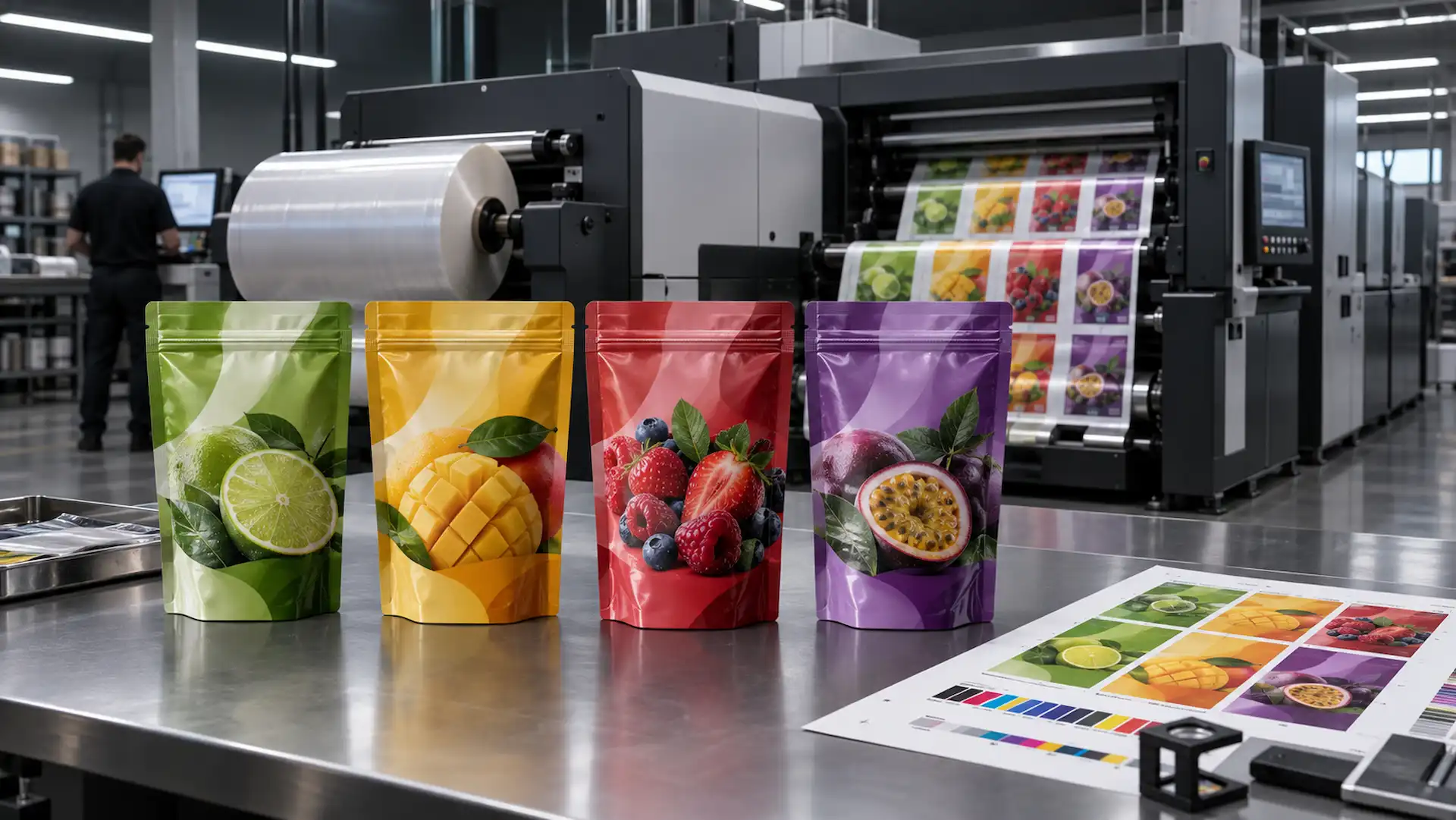
Digital Printing vs Rotogravure for Low and High Volume Orders
Both produce excellent packaging. They just suit different volumes, and picking wrong costs you money in either direction.
| Factor | Digital Printing | Rotogravure |
| Best suited for | Short and medium runs | Large-volume runs |
| Printing cylinders | Not needed | One per colour, per design |
| Multiple designs in one run | Easy and cheap | Rarely worth it at low volume |
| Artwork changes | Free and immediate | New cylinders required |
| Lead time to first unit | Short | Longer, cylinders come first |
| Unit economics | Strong on short runs | Strong at scale |
Go digital when your artwork is still moving, when several SKUs launch together, when demand is unproven, or when you’re up against a deadline.
Switch to rotogravure once your artwork has settled and your volume is big enough to swallow the cylinder cost. Engraved cylinders get reused, so a design that runs unchanged for years keeps getting cheaper on every reorder. Neither method wins outright. Your volume decides which is right today.
Low MOQ vs No MOQ Packaging: What’s the Difference?
Search for custom pouches and you’ll find offers at every level. One pouch. Fifty bags. A few hundred. A thousand and up. Side by side the numbers look comparable. They’re usually not describing the same thing at all.
When No-MOQ Custom Packaging Makes Sense
Tiny quantities do have a real job to do. They work for product photography, samples for buyers, trade shows, early shelf-appeal testing, influencer kits, and very small pilot launches at a market or pop-up.
Getting a single functional prototype made before you commit to a full run is one of the cheapest smart moves available. You get to check how the pouch fills, how the seal holds, and where the artwork sits, while changes still cost nothing.
When a Commercial Low-MOQ Run Is the Better Choice
Once you’re properly selling, a small commercial run beats a no-MOQ order most of the time. You’ll want one when your product needs:
- Retail-ready quality and consistency
- Barrier performance matched to shelf life
- Repeat production that comes back identical
- Real control over size, film and features
Questions to Ask Before Choosing a No-MOQ Supplier
- Is this a fully functional pouch or just a display sample?
- Which film structures can I get at this quantity?
- What’s the real cost per unit once setup is counted?
- Can I pick a custom size, or only stock dimensions?
- Will my next order match this one for colour and material?
If the answers go vague around barriers and repeatability, you’re being sold samples rather than packaging.
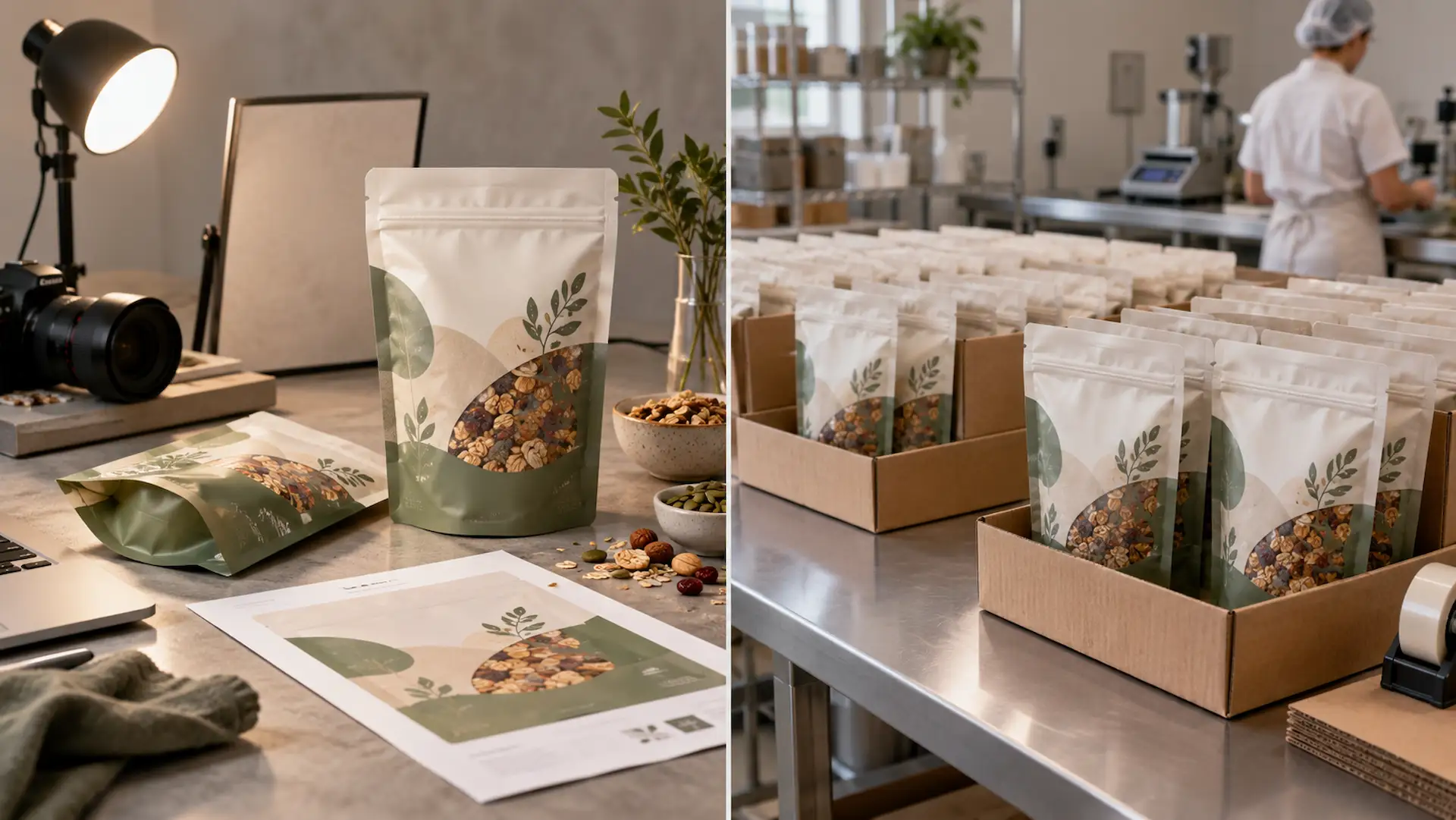
Low MOQ Does Not Always Mean the Lowest Packaging Cost
There’s a difference between the lowest order quantity and the lowest total cost to your business, and it’s the part most packaging guides skip.
Why Smaller Runs Usually Cost More Per Pouch
Those setup costs get divided by however many units you order. Fewer units, bigger share each. If setup runs $1,000, that’s $1.00 a pouch across 1,000 units and $0.20 across 5,000. Nothing about the setup changed. Only the division did.
Why Ordering Too Much Packaging Can Cost More
The opposite mistake is more common, and it’s the expensive one. Ordering 20,000 pouches for a better unit price only pays off if you genuinely get through 20,000 pouches. What tends to go wrong:
- Cash locked up in stock that’ll take two years to move
- Storage costs nobody budgeted for
- A brand refresh while thousands of old bags sit in a corner
- Recipe or label changes that make the printed panel wrong
- SKUs discontinued before the packaging runs out
Important Note: Packaging is one of those rare costs where buying more can genuinely lose you money. Before you scale an order up for a better price per unit, work out how many months of stock you’re actually buying. If it’s more than twelve, think again.
The sweet spot usually covers realistic sales for six to twelve months, plus a buffer for your reorder lead time. Paying a bit more per pouch to avoid dead stock is often the smarter call.
How to Reduce Your Flexible Packaging MOQ Without Sacrificing Quality
You’ve got more control over your minimum than you probably think. These moves do most of the work.
1- Print digitally. The most direct lever there is. No tooling means the floor drops straight away, and artwork changes stay free.
2- Share one dieline across your SKUs. If all your flavours use the same dimensions, they can share a single run. This is the most effective trick available to a multi-flavour brand, and it costs nothing but planning.
3- Keep film structures consistent. Running one film across your range simplifies setup. Some products need a different barrier, but check before you assume yours does.
4- Launch your strongest SKUs first. Lead with two proven sellers, then add the rest on the next run with real sales data behind it.
5- Prototype before you produce. Fixing an artwork or fill problem on one prototype costs almost nothing. Fixing it on 5,000 printed bags costs 5,000 printed bags.
6- Skip features that don’t sell product. Ask whether that window or specialty finish genuinely shifts units. Check first, though, because some suppliers throw in custom sizes and features like zippers and tear notches at no charge anyway.
7- Plan reorders instead of overbuying. A reorder on the same dieline is a faster, simpler job than the first one ever was.
Low-MOQ Flexible Packaging Options From Flexible Pouches
Here’s how the numbers work at Flexible Pouches, so you’ve got something concrete to measure against rather than theory.
| Packaging Option | Minimum Order |
| Stand-up pouches | From 1,000 bags |
| Lay-flat / 3-side-seal pouches | From 1,000 bags |
| Flat bottom pouches | From 3,000 bags |
| Multi-SKU orders on one dieline | 500 bags per SKU |
| Functional prototypes | Single unit, additional charge applies |
| Printed rollstock and specialty formats | Confirmed at quote stage |
Digital jobs run on an HP Indigo 20000 with no plate or cylinder fees. Proofs come back inside 24 business hours, most orders ship in around 10 working days, and US delivery typically runs 2 to 3 weeks from approval. Shipping is free worldwide on custom printed orders.
The 500-per-SKU rule is where this gets useful. If your flavours share one size and spec, a 1,000-bag order becomes two SKUs at 500 apiece, and a 3,000-bag order covers six. The one condition is that every pouch sits on the same dieline.
Sustainability isn’t excluded either. Any pouch size can be built from recyclable film or plastic-free compostable material, zippers and valves included, so going eco-friendly won’t push you into a bigger order.
How to Choose a Low-Volume Flexible Packaging Supplier
Advertised minimums are marketing. What counts is what a supplier will actually do for your job.
1- Check the MOQ for your exact format. A site-wide figure rarely applies to every pouch style. Ask for the number attached to your size and film.
2- Ask whether the minimum is per order or per SKU. For a multi-flavour brand, this changes the answer completely.
3- Compare printing capabilities. A supplier running both digital and conventional presses can move you between them as you grow. One with only a conventional kit can’t help you start small.
4- Confirm barrier and material options. Make sure the films available at your quantity match your shelf life. Cheap short-run offers often come apart here.
5- Review lead times. Proof turnaround, production, shipping. Add all three before you promise a launch date to a retailer.
6- Make sure they can scale. Whoever prints 1,000 bags today should handle 100,000 in two years without you starting again with new dielines and fresh colour matching.
What to Ask and Prepare Before Requesting a Quote
Your quote is only as good as your brief. Have this ready before you hit send:
- Product type, pouch style, and dimensions (or fill weight if you’re unsure)
- Total units and number of SKUs
- Barrier requirements or target shelf life
- Print, finish, closure and feature preferences
- Artwork status, launch date, shipping destination
Then ask them: what’s the MOQ for my exact pouch, is it per SKU or per order, can multiple designs share one dieline, are there plate or setup charges, what’s the full lead time, and how does pricing move at 2x and 5x my quantity? Hand over all of that and you’ll get a realistic minimum with accurate pricing on the first reply.
Conclusion:
There’s no universal number behind low MOQ flexible packaging. What’s realistic depends on how your pouch is built, how it’s printed, the film it needs, the features you’ve added, how many SKUs you’re running, and how much stock your business can genuinely sell through in a sensible window. Tiny and no-MOQ orders earn their keep for prototypes and early testing, while digitally printed short runs usually make more sense for packaging that has to sit on a shelf.
The best order isn’t the smallest one you can find. It’s the smallest quantity that still gives you the quality, barrier performance and unit economics your product needs. Work backwards from your sales forecast instead of forwards from a supplier’s minimum.
Ready to Find the Right Packaging Quantity?
You do not have to guess how many bags you should order. Share your product, pouch style, expected quantity, number of SKUs, and packaging requirements with Flexible Pouches to identify an option that fits your current needs and future growth.
Request a Custom Packaging Quote
FAQs
1. What is considered a low MOQ for flexible packaging?
There’s no official industry figure, but anything in the low thousands per run counts as a low minimum. Plenty of conventional suppliers still open at 25,000 units or more, so anyone working from 1,000 to 3,000 bags sits genuinely at the low end.
2. What is the minimum order quantity for custom printed pouches?
Digitally printed stand-up and lay-flat pouches commonly start around 1,000 bags per dieline. Flat bottom pouches start higher, around 3,000, because they take more forming steps. Rollstock is measured in film length rather than bag count, so it’s quoted on a different basis.
3. Can I order custom pouches with no minimum quantity?
You can order a single custom printed pouch as a prototype, and it’s worth doing before a full run. What you can’t usually get at no minimum is a commercial run with your choice of barrier film, a custom size, and repeat orders that match.
4. Can I split a low-MOQ order between multiple designs or SKUs?
Yes, as long as every pouch shares the same dieline, meaning identical size and specifications. A typical setup is a 1,000-bag total minimum with a 500-bag floor per SKU, which lets a brand launch two flavours instead of one.
5. Is digital printing better for short-run flexible packaging?
For short runs, yes, in almost every case. Digital removes plate and cylinder charges, cuts setup time, lets you change artwork for free, and carries several designs through one run. Rotogravure takes over once volume is high and artwork has stopped changing.
6. How can I reduce the MOQ for custom flexible packaging?
Print digitally, share one dieline across your SKUs, keep film structures consistent, launch your strongest products first, and cut features that don’t help the product sell. A prototype also saves you from the expensive version of a mistake, which is reprinting a full run.