

























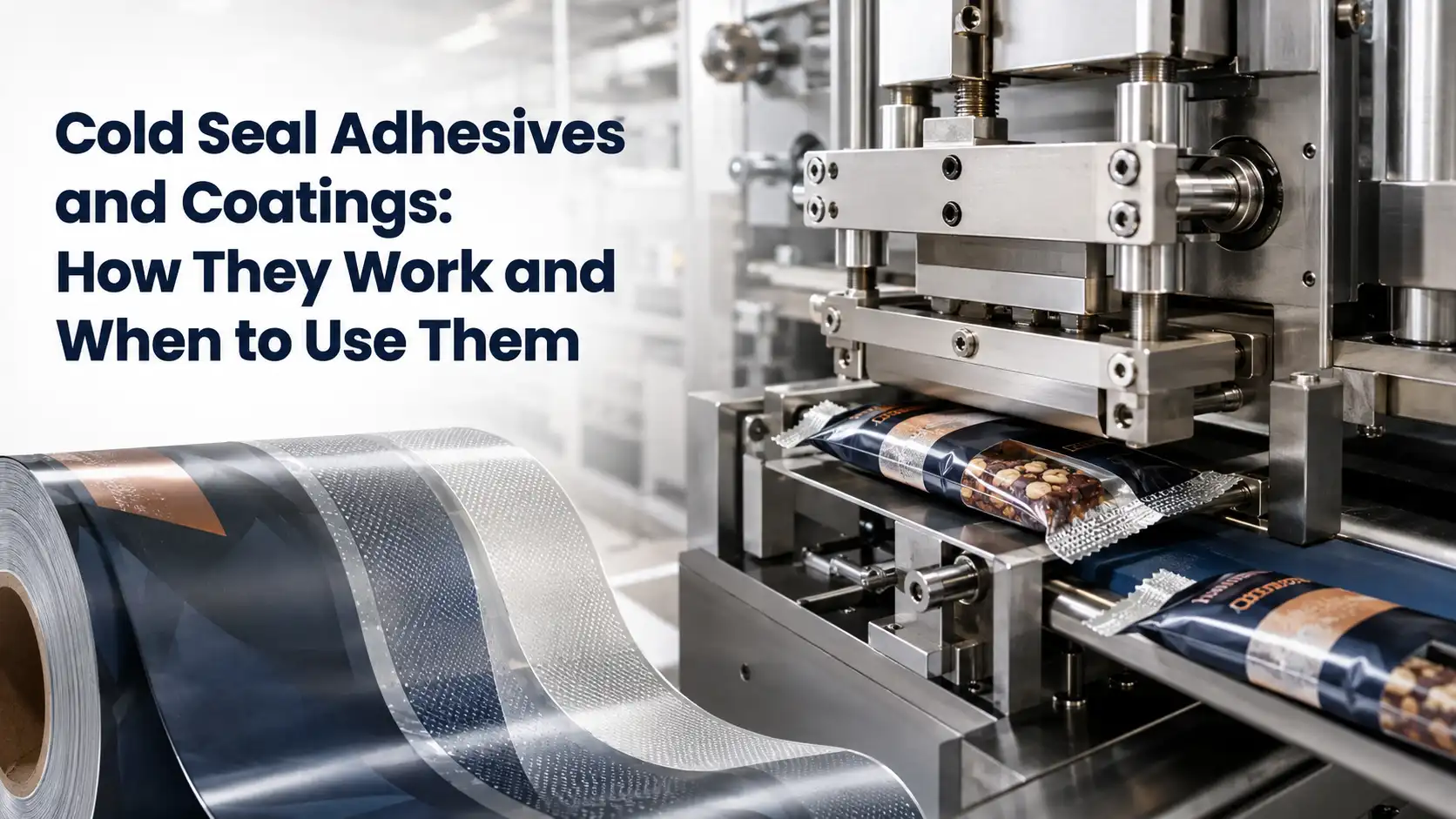
Some products simply do not like heat. Chocolate softens, protein bars lose their shape, and thin films can wrinkle or shrink the moment a hot sealing jaw closes on them. That is the exact problem cold seal packaging was built to solve. Instead of melting the film to close the pack, the seal is formed by pressure alone.
Speed is the second reason brands look at it. A flow wrapper running thousands of packs an hour loses output every time it waits for sealing jaws to reach and hold a steady temperature. A pressure-activated seal removes that wait, which is one reason cold seal work is usually supplied as custom printed rollstock rather than as premade bags. This guide explains how cold seal works, what the adhesive is made from, how it is coated onto film, and when the method genuinely makes sense for your product.
What Is Cold Seal Packaging?
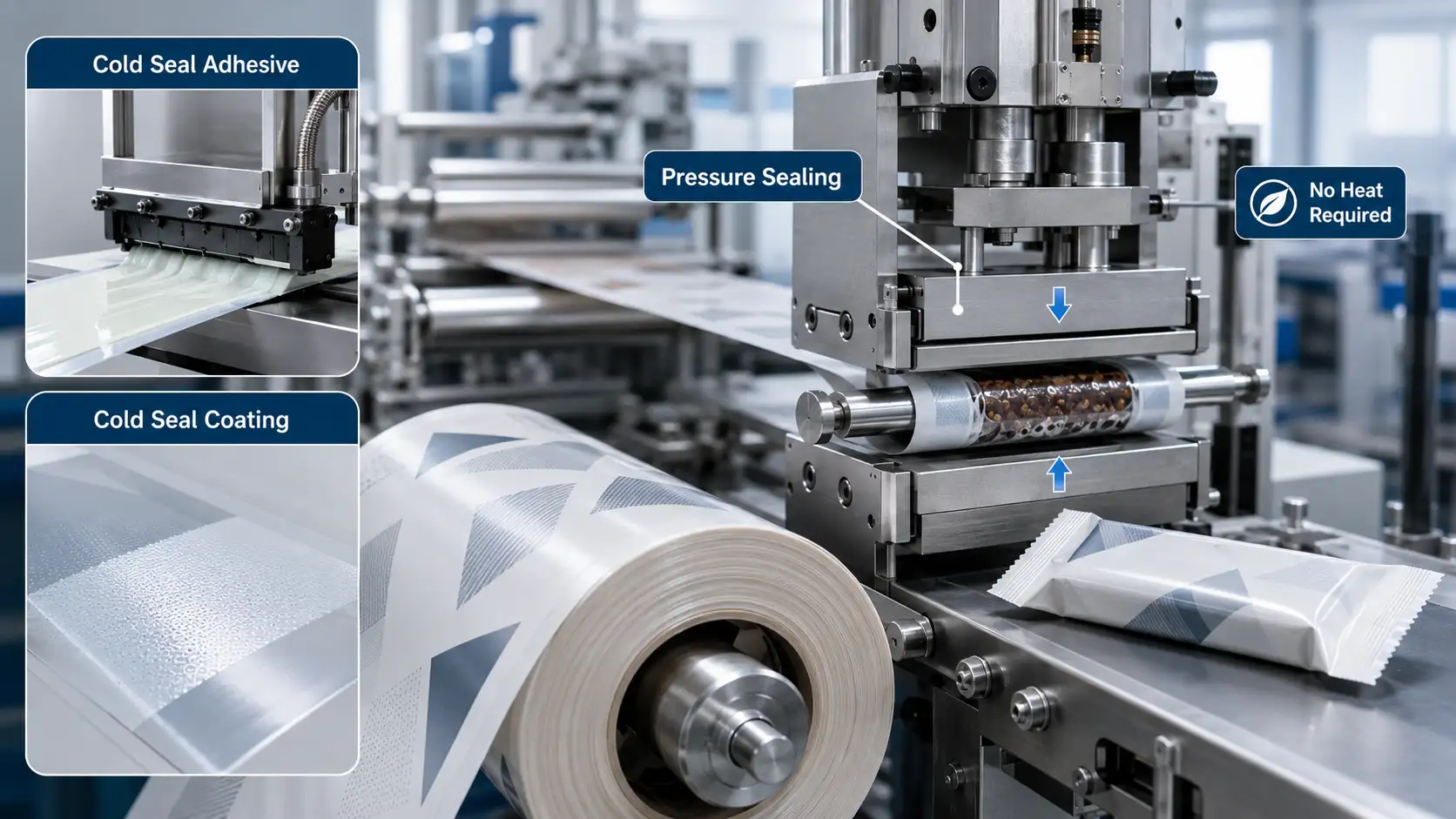
Cold seal packaging closes a pack by pressing two coated surfaces together. No heat at the sealing station. The film carries a thin layer of cold seal adhesive wherever the pack needs to shut, and the machine’s jaws squeeze those areas until they grip.
What makes it work is that the coating only sticks to itself. Press it against plain film and almost nothing happens. Press it against another coated face and you’ve got a seal before the jaws have finished closing. People call this pressure sealing or room-temperature sealing. Nothing melts, which is the whole point.
Cold Seal Adhesive vs Cold Seal Coating
These two get used interchangeably, and in conversation nobody minds. They’re not quite the same, though.
- Cold seal adhesive is the wet formulation the chemistry, usually water-based, before it touches any film.
- Cold seal coating is that adhesive once applied to the substrate, dried, and laid down in a set pattern at a set weight.
Recipe versus finished dish, roughly. A supplier can have a genuinely good formulation and still hand you bad material if the application is patchy or the pattern drifts.
How Do Cold Seal Adhesives and Coatings Work?
The mechanism isn’t complicated, but two different kinds of sticking are going on at the same time. Separate them and the rest of this makes sense.
Cohesive Bonding Between Cold Seal Surfaces
Two separate things have to go right.
The first is adhesion the coating gripping the film underneath it. Weak anchorage and the layer peels off the substrate, so the seal fails even though the adhesive itself was fine.
The second is cohesion, and this is the interesting one. The coating bonds to itself far more readily than to anything else. Put two coated faces together under pressure and the layers effectively merge. That’s what people mean by a cohesive cold seal.
Why does pressure do the job alone? Because nothing needs melting. The jaws close, the coated faces make full contact, and the bond forms almost instantly.
The Cold Seal Process From Coating to Final Seal
Start to finish, it runs like this:
Coating → Drying → Winding → Forming or wrapping → Pressure → Seal
The converter applies adhesive to the web in the required pattern, then dries it to drive off the water. The coated web is wound into rolls, protected by a release surface so it doesn’t stick to itself. On your line, the rollstock folds around the product, the jaws press the coated areas together, and the pack is closed.
Worth pointing out: heat does appear here, but only in the drying oven at the converting stage. By the time the roll reaches you, the sealing step never goes above room temperature.
What Are Cold Seal Adhesives and Coatings Made Of?
Nearly all of it is water-based, which suits food packaging environments. Within that, two families.
Natural Rubber Latex-Based Cold Seal Adhesives
The traditional route. Natural rubber latex has exactly the property this job needs — it bonds to itself under pressure while staying fairly indifferent to other surfaces. Most formulations blend it with acrylics to dial in tack, seal strength and drying behaviour, and it’s been the default for decades because it seals fast at low coating weights.
One caveat comes up often enough to mention. Natural rubber latex carries a protein allergen question in certain markets, and buyers in medical or sensitive food segments tend to raise it early.
Synthetic Cold Seal Adhesives
Partly an answer to that question, partly a way of giving converters more control. These use acrylic or other synthetic polymer systems instead of rubber. Manufacturers pick them to avoid latex proteins, to get steadier batch-to-batch behaviour, to cut the risk of odour transfer into chocolate, or simply because seal strength is easier to tune.
Neither family wins outright. It comes down to the product, the film it sits on, the machine it runs through and the paperwork it has to satisfy.
What Determines Cold Seal Performance?
- Cohesion — how hard the coating grips itself under pressure
- Substrate adhesion — how well it anchors to the film
- Seal strength — enough to survive transit, not so much that customers can’t open it
- Coating weight — too light and seals fail, too heavy and adhesive squeezes out
- Coating consistency — an even layer, no thin patches or streaks
- Processing conditions — jaw pressure, dwell, web tension, and how the roll was stored
Important Note: Cold seal rollstock isn’t a material you can order and forget about. Coated rolls are sensitive to storage conditions, and months in a hot warehouse can change how the coating behaves and raise the risk of blocking in the roll. Get shelf life and storage guidance from your converter in writing, and rotate stock properly.
How Cold Seal Film and Coating Systems Are Designed
The adhesive is one layer in a larger build. A cold seal film needs a printable outer face, barrier where the product demands it, the coating on the inside, and a release surface on the outside of the web.
Materials Used for Cold Seal Film
| Material | Typical role in the structure |
| BOPP / OPP film | The usual carrier — clarity and stiffness for flow wrap |
| PET film | Strength and stability, often the printed outer layer |
| PE film | Flexibility and toughness on the sealant side of laminates |
| Metallized film | Light, moisture and oxygen barrier for sensitive products |
| Paper | Where a matte or natural look is wanted |
| Laminates | Combining barrier, print and coating into one structure |
Not every substrate suits every adhesive. Surface energy, treatment level and the release lacquer all have a say, which is why film selection gets worked out alongside the coating supplier rather than before them. If you’re still settling on a structure, the material options page compares what each film brings.
What Is a Cold Seal Release Coating?
Here’s the practical headache. Cold seal bonds to itself, and a roll is thousands of metres of the same film wound tightly on itself under tension. Left alone, the coating on one wrap would meet the wrap below and the roll could block solid.
So the release coating release lacquer, same thing goes on the opposite side of the web, giving that outer surface a low-grip finish so the roll unwinds cleanly. It’s a balancing act. Slippery enough to protect the roll, not so slippery that print quality or machine tracking suffer, and chemically compatible with whatever cold seal system sits on the reverse.
How Is Cold Seal Adhesive Applied to Packaging Film?
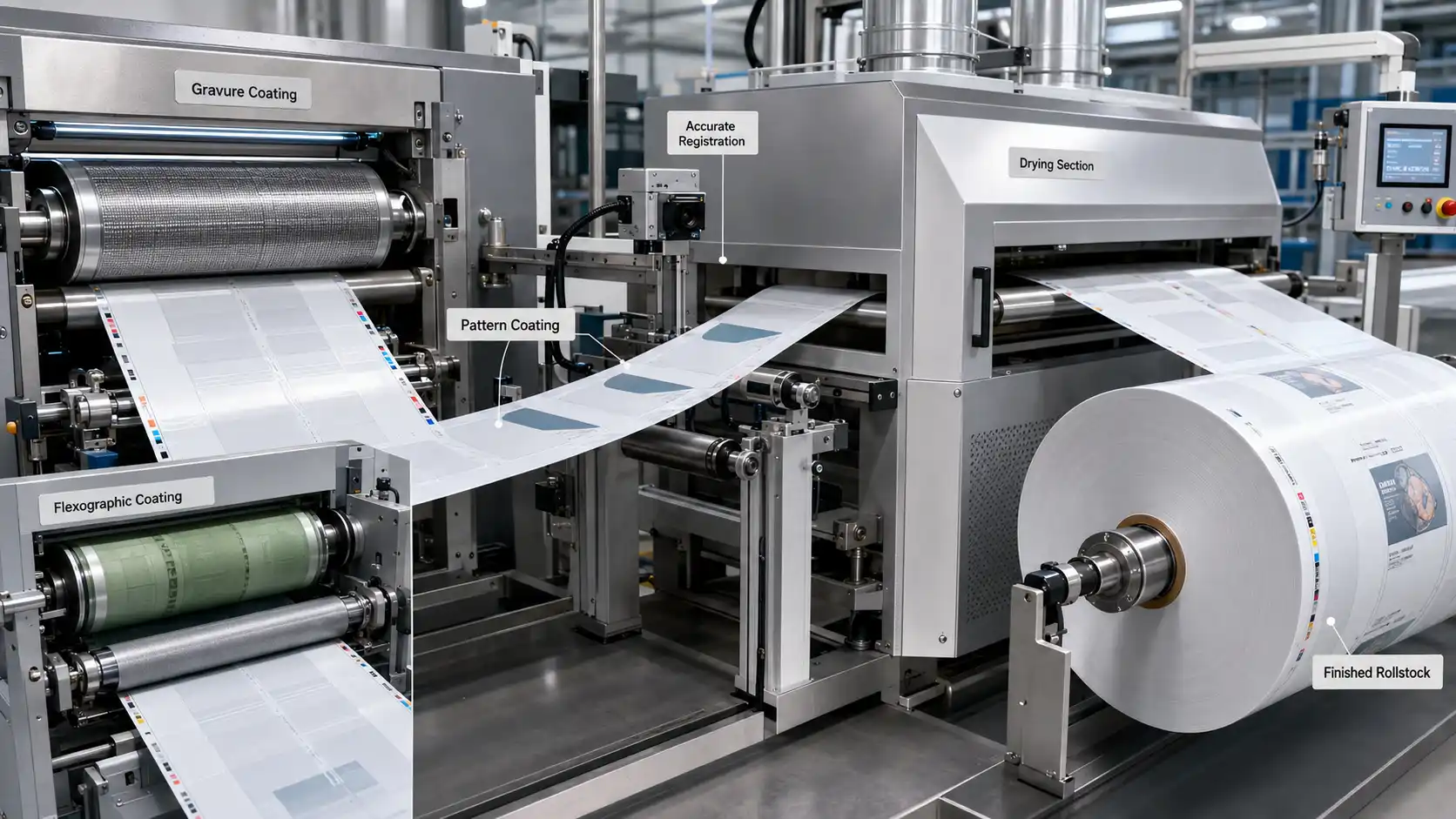
This happens at the converter, not on your line. They coat, dry and wind, then ship rollstock that’s ready to run.
Pattern Coating and Accurate Registration
Cold seal is rarely applied across the full web. It’s pattern coated — adhesive only where the pack has to close, so the fin seal and the end seals.
The logic is straightforward. Adhesive costs money and coating everything wastes most of it. Uncoated areas keep print looking clean, product contact zones stay adhesive-free, and film handles better when only defined areas are tacky.
Since the pattern has to land exactly where the jaws do, coating registration matters enormously. Let it drift against the print and cut-off and your seals start landing half on bare film. Tight registration control is one of the clearest signals of a capable converter.
Cold Seal Coating Methods
Gravure coating uses an engraved cylinder that picks adhesive up in tiny cells and transfers it. Excellent control over coating weight, very accurate patterns, and the standard choice for demanding work. Same cylinder principle used in rotogravure printing, just carrying adhesive instead of ink.
Flexographic coating uses a flexible plate and anilox roll. More economical on shorter runs and pattern changes, slightly less precise at very low coating weights.
Drying and Coating Control
Four things need controlling at once. Coating weight sets both seal strength and cost. Drying has to remove the water completely without cooking the film — under-dry it and you’ll get blocking in the roll or poor seals later. Registration has to hold across the entire run, not just the first hundred metres. And web handling covers tension, tracking and winding, because coated webs are fussier than plain film.
Producing packaging materials with cold glue is easy to describe and hard to do consistently at speed. That gap is where converter capability shows.
What Are the Benefits of Cold Seal Packaging?
Almost every advantage traces back to one thing: no heat at the sealing station. Here’s what that actually buys you on the floor.
1- Protects Heat-Sensitive Products
The headline one. Chocolate blooms, coatings soften, fillings melt, delicate baked goods deform. Take heat out of the seal area and the product leaves the wrapper in the condition it went in.
2- Supports High-Speed Packaging Lines
Heat sealing needs dwell time — jaws staying shut long enough to melt the sealant layer. Pressure needs contact and not much else. On fast flow wrap lines that turns straight into packs per minute.
3. Reduces Heat Exposure During Packaging
Not just the product. Thin films, metallised layers and some laminates distort or delaminate under repeated heating. Removing sealing heat protects the packaging too.
4. Simplifies Start-Up and Production Control
No warm-up at the start of a shift, no temperature drift to chase through it, no cooling before packs can be cased. On lines with frequent changeovers that adds up.
When Should You Use Cold Seal Packaging?
Two situations make the case on their own. Everything else is really just a list of the products where those two tend to show up together.
When the Product Is Sensitive to Heat
If your product changes texture, shape or appearance when it warms even slightly, cold seal deserves a serious look. This is the strongest case for it and usually the reason a brand switches.
When Packaging Speed Is a Priority
High-speed flow wrapping and horizontal form fill seal operations gain the most. When seal dwell is your bottleneck rather than product feed, dropping the heat requirement can lift throughput without new machinery.
Products Commonly Packaged With Cold Seal
- Chocolate and confectionery — the classic use, still the biggest
- Protein and nutrition bars — soft coatings and inclusions, common across health and wellness packaging
- Cereal and snack bars — fast lines, fragile textures
- Biscuits and baked goods — where jaw heat causes visible damage
- Ice cream and frozen treats — packed cold, sealed cold
- Selected medical and specialty products — where a clean heat-free seal is required
Plenty of brands in retail food packaging run conventional heat seal quite happily. Cold seal isn’t an upgrade, it’s a different tool.
Cold Seal vs Heat Seal: What Is the Difference?
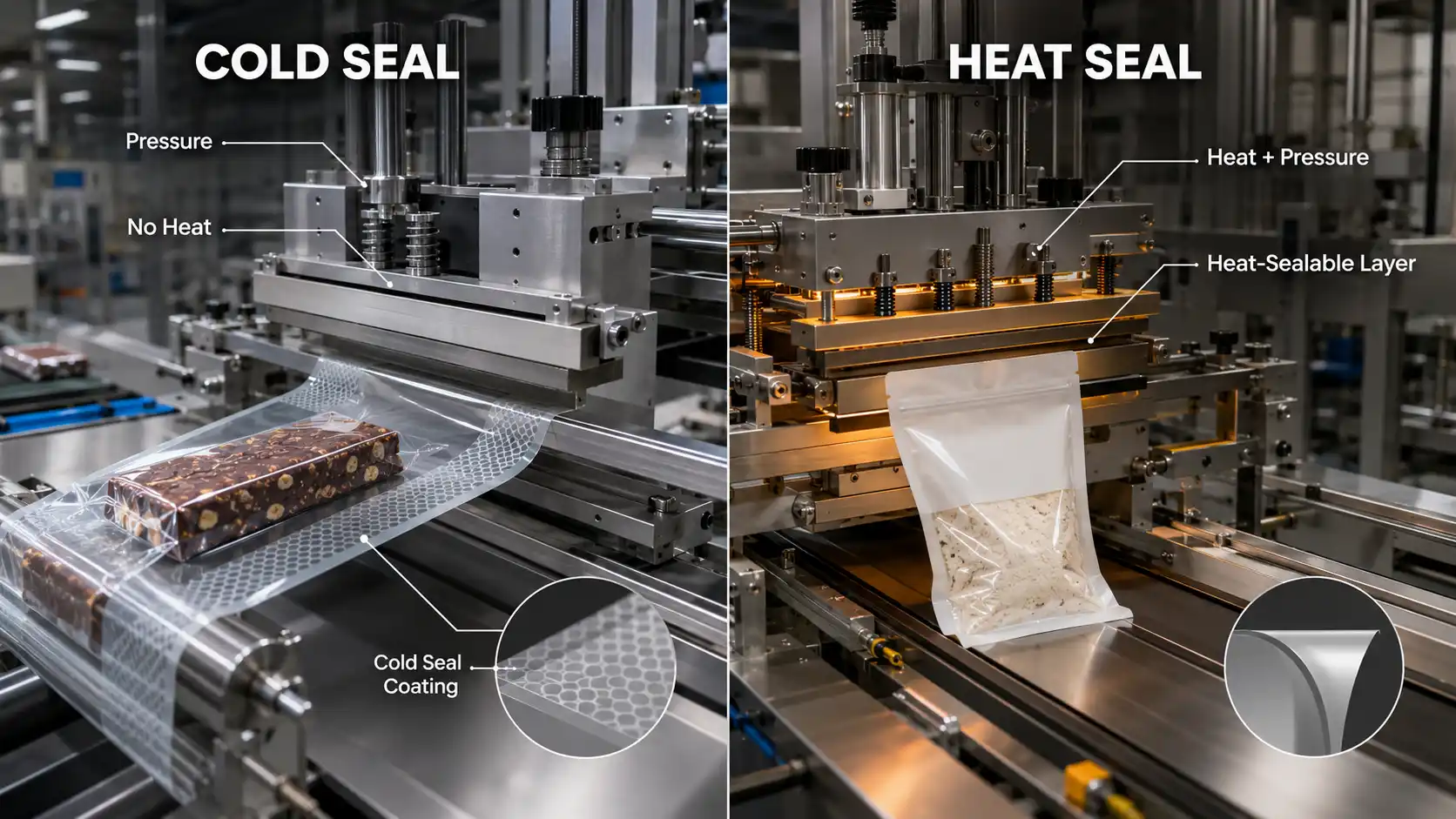
Same job, opposite approach. This is the comparison most people are really after when they start reading up on cold seal.
| Factor | Cold Seal | Heat Seal |
| Seal activation | Pressure | Heat and pressure |
| Heat exposure | No sealing heat | Heat required |
| Adhesive / coating | Cold seal coating required | Heat-sealable layer required |
| Line speed | Well suited to high-speed applications | Depends on heat and dwell requirements |
| Heat-sensitive products | Strong application | Requires careful temperature control |
| Typical applications | Bars, confectionery, snacks, specialty products | Wide range of flexible packaging |
When Cold Seal Makes More Sense
Pick it when the product can’t take heat, when line speed is your constraint, or when the film structure itself suffers under repeated hot jaws. It also suits operations running short production bursts, since there’s no warm-up penalty every restart.
When Heat Seal May Be More Appropriate
Honestly, heat seal is still the right answer more often than not. Cheaper per square metre with no adhesive coating to pay for. Stronger hermetic seals for barrier-critical products. Better with powders, liquids and long shelf life, and no roll blocking to manage.
Most pouch formats depend on heat sealing. If you’re weighing formats rather than sealing methods, the comparison of premade and custom pouch routes covers that separately.
Important Note: Cold seal is not a drop-in swap for heat seal. Switching means changing the film structure, the coating, the release surface and usually your machine settings too. Plan it as a packaging redesign with proper trials, not a material substitution on an existing spec.
How to Choose the Right Cold Seal Adhesive and Coating
There’s no single best adhesive, only the right one for your film, your product and your machine. These six checks are worth working through in roughly this order.
1- Match the Adhesive to the Packaging Substrate
Start at the film. The coating has to anchor to whatever you’re running, and treatment levels, existing print and barrier layers all affect that. Sort compatibility first, because a mismatch here undermines every decision after it.
2- Define the Required Seal Performance
Get specific about what a good seal means for your product. Strength enough to survive filling, transit and drop tests. Integrity across the full shelf life. The opening experience you want — clean peel or permanent bond.
3- Consider Packaging Equipment and Production Speed
Your machine sets hard limits: jaw pressure, dwell, line speed, roll dimensions. Bring your engineer in early, because the best adhesive on paper is useless if the equipment can’t deliver steady pressure at your target speed.
4- Check Release Coating and Rollstock Compatibility
The release surface has to suit the cold seal system on the reverse. Check unwind behaviour, print protection and blocking resistance in the same conversation, not after the film is specified.
5- Confirm Food-Contact and Regulatory Requirements
Food-contact compliance, migration limits, allergen declarations — confirmed in writing for every market you sell into. Latex questions surface here regularly, and requirements tighten further for medical work.
6- Test the Complete Packaging Structure
This is the step people skip. Film, adhesive, release coating, product and machine behave as one system, and problems almost always appear at the joins rather than inside any single component.
Trial it on your actual line, with your actual product, on the actual film. Then test the packs the way real life will full shelf life, real transit, real temperature swings. If any spec term is unfamiliar during those conversations, keep the flexible packaging glossary open.
Conclusion
Cold seal works when the whole system is designed together. Adhesive chemistry, coating application, film structure, release surface, production conditions. Get one wrong and the seal suffers no matter how good the rest of it is.
The decision itself is simple enough. Cold seal earns its place when heat damages your product or when speed is the wall you’re hitting. Outside those two cases, heat seal is usually the more practical route.
Get the Right Cold Seal Structure for Your Product
Cold seal only performs when the film, the coating and the release surface are matched to what you’re packing and the line you’re running it on. That’s the part worth settling before you commit to an order.
We build custom rollstock and flexible packaging to order — low minimums from 1,000 units, digital printing with no plates or tooling, and most orders shipping within about 10 working days of art approval. Send us your product details and line specs and we’ll work through the structure with you. If heat seal turns out to be the better fit for your application, we’ll tell you that too.
FAQs
1. What is cold seal packaging?
It’s a sealing method where two coated film surfaces bond under pressure alone, with no sealing heat. Most common on heat-sensitive products and high-speed flow wrap lines.
2. How does cold seal adhesive work without heat?
The adhesive is cohesive, meaning it bonds to itself far more readily than to anything else. Press two coated faces together and the layers merge. Nothing melts, so pressure and a moment of contact are enough.
3. What is the difference between cold seal adhesive and cold seal coating?
The adhesive is the wet formulation, usually water-based. The coating is that adhesive after it’s been applied to the film, dried, and laid down in a set pattern at a controlled weight.
4. What materials can be used for cold seal packaging?
BOPP and OPP are the usual carriers, plus PET, PE, metallized films, paper and laminates. Not every substrate suits every adhesive, so confirm compatibility with your converter before locking the structure.
5. What is the difference between cold seal and heat seal packaging?
Cold seal bonds with pressure only and needs a cold seal coating. Heat seal uses heat plus pressure and needs a heat-sealable layer. Cold seal protects heat-sensitive products and runs faster; heat seal is cheaper and gives stronger hermetic seals.
6. What products are best suited for cold seal packaging?
Chocolate and confectionery, protein and nutrition bars, cereal and snack bars, biscuits and baked goods, ice cream, and some medical and specialty products. The common thread is heat sensitivity, high line speed, or both.