
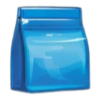





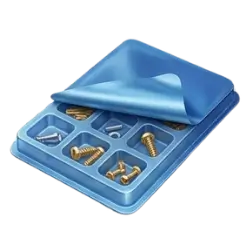
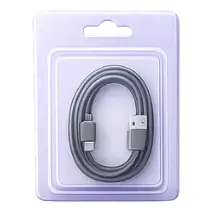


















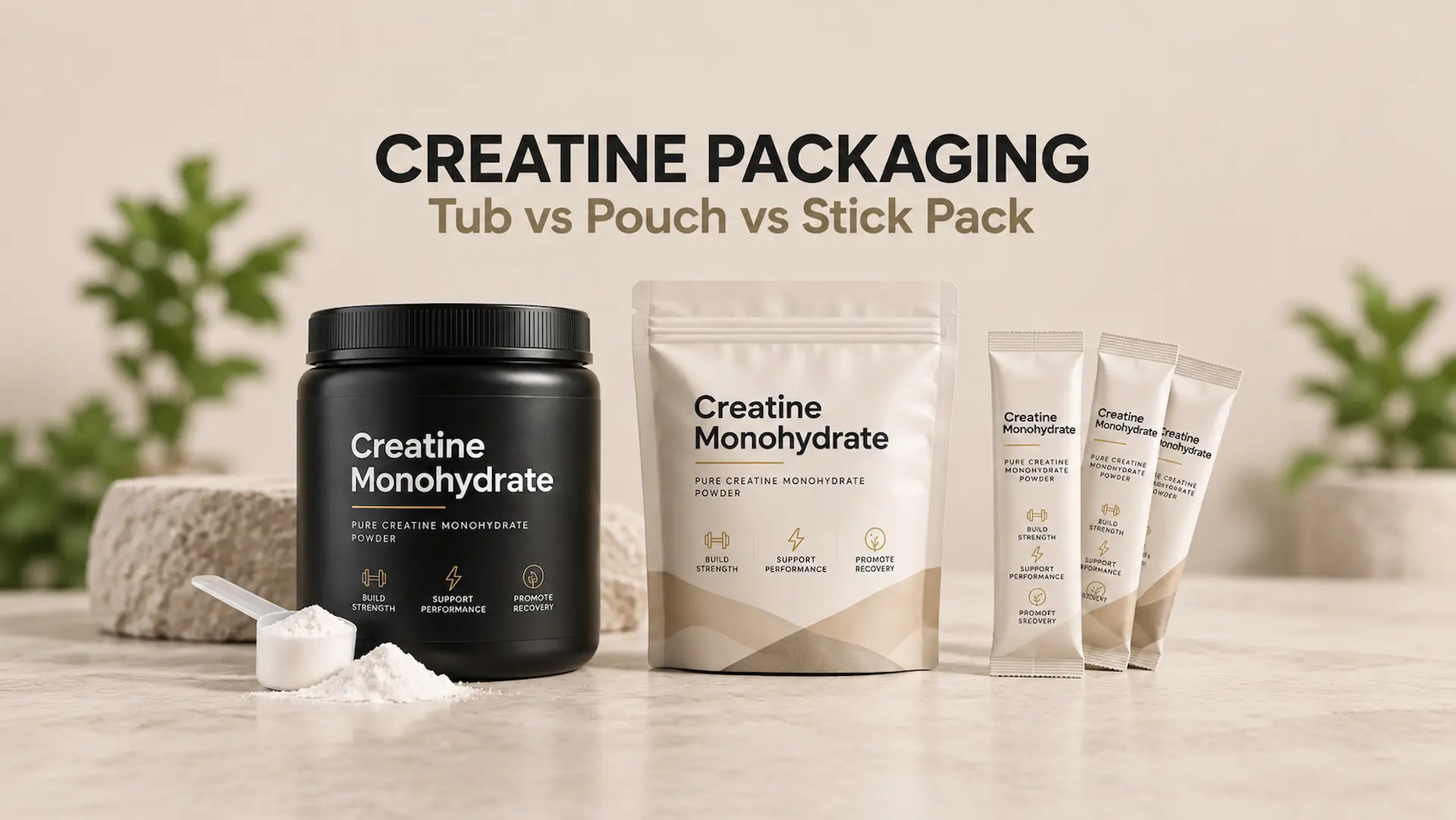
A tub, a pouch, or a small stick pack? They may all hold the same creatine powder, but the packaging makes a real difference. It affects how the powder is stored, how customers use it, and how much space the product takes up. Even something as simple as opening and closing the pack can change the customer experience.
For supplement brands, choosing the right creatine packaging is about more than appearance. Material strength, moisture protection, filling costs, and shipping all deserve attention. As explained in this protein powder packaging guide, choosing the right pack for powdered supplements takes some planning. So, how do tubs, pouches, and stick packs compare? Let’s look at what each option offers.
Three Ways to Package Creatine: Tubs, Pouches, and Stick Packs
They all look obvious on a shelf. Up close, each one is built differently and solves a different problem, so a quick definition of each saves confusion later.
Creatine Tubs: The Traditional Bulk Packaging Option
The tub is the format the whole category grew up on. Say “tub of creatine” and everyone pictures the same thing.
- Rigid plastic container, usually HDPE or PET
- Screw-on lid with a foil seal underneath
- Scoop dropped in on the filling line
- Normally 60 to 200 servings, so 300 g up to 1 kg
- Labelled with a wraparound label or a shrink sleeve
Creatine Pouches: A Flexible Alternative to Plastic Tubs
A creatine pouch is a laminated film bag with a zipper across the top. The scoop still goes inside. The difference is weight: a bag is a few grams of film, and it folds down as the powder goes. Two builds cover almost every creatine product:
| Pouch style | How it sits | Typical creatine sizes |
| Stand-up pouches | Bottom gusset, stands on its own | 150 g to 500 g |
| Flat-bottom pouches | Square base, sits like a small box | 500 g to 2 kg and up |
Creatine Stick Packs: Small Packs for Individual Servings
A stick pack is a narrow tube of film, heat-sealed at both ends, holding one serving.
- Usually 5 g, sometimes 7 g with flavouring
- Tear notch at the top, no reseal
- No scoop, no lid, nothing to wash
- Sold in a box or outer pouch of 10 to 30
Tub vs Pouch vs Stick Pack: What’s the Real Difference?
Here’s the full comparison in one place. Everything after this table explains the “why” behind each row.
| Types | Creatine Tub | Creatine Pouch | Creatine Stick Pack |
| Typical capacity | 300 g to 1 kg (60–200 servings) | 150 g to 2 kg (30–400 servings) | 5–7 g (1 serving) |
| Rigid or flexible | Rigid | Flexible | Flexible |
| Opening and resealing | Screw lid over foil seal | Press-to-close or slider zipper | Tear notch, no reseal |
| Moisture protection | Good when sealed; depends on lid threads after opening | Good; depends on film barrier and zipper quality | Best; sealed until the moment of use |
| Serving method | Scoop | Scoop | Pre-measured |
| Storage and portability | Bulky, heavy, needs cabinet space | Flat, light, fits a drawer or gym bag | Pocket-sized |
| Packaging and shipping cost | Most material, heaviest freight | Low weight, low freight, low MOQ | Highest cost per serving |
| Best application | Home use, bulk value buyers | DTC, retail, subscription, bulk refills | Travel, samples, trial packs, premium bundles |
Which Packaging Keeps Creatine Powder Dry and Protected?
Creatine monohydrate has one enemy, and it isn’t time. It’s moisture. Let humid air at it and a free-flowing powder turns into rocks, and slowly into something weaker. Of all the rows in that table, this is the one to get right.
Moisture Barriers: Plastic Walls vs Flexible Films
- Tub walls: thick plastic is a fair barrier on its own, but the lid-to-body joint is the weak spot. Threads loosen, powder gets caught in them, and the seal is never the same after week one.
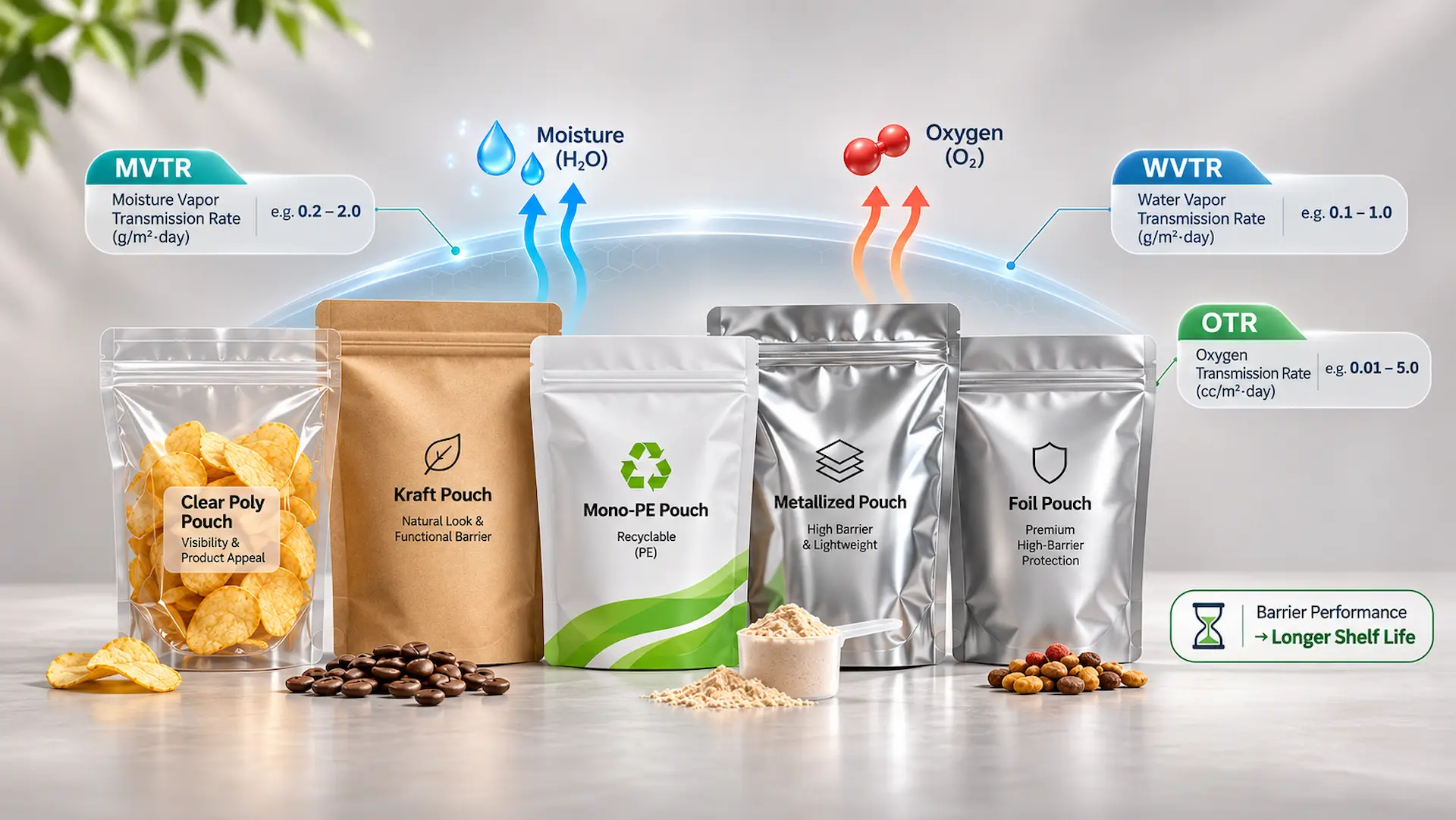
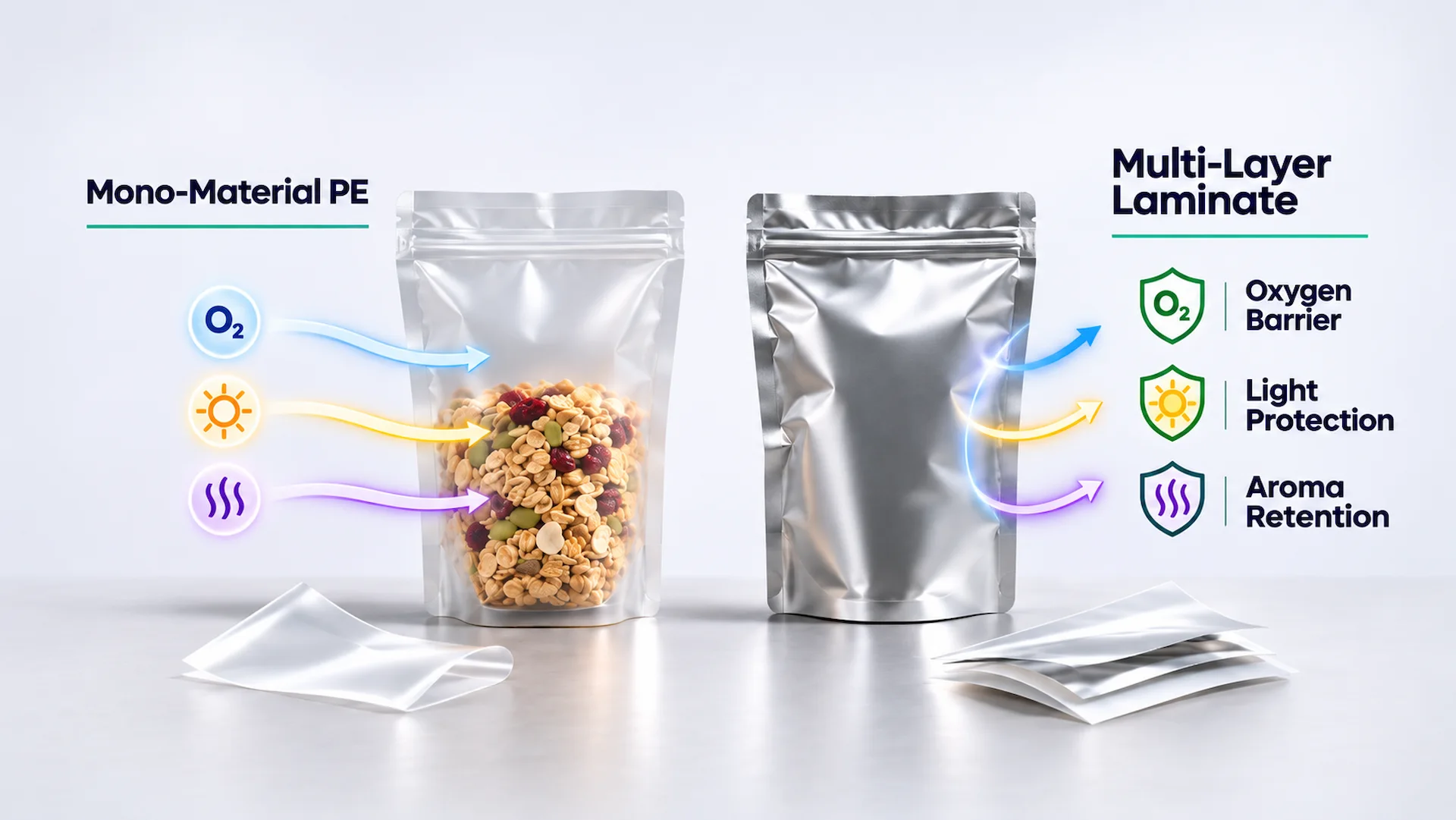
- Pouch films: protection comes from the laminate, not thickness. A foil or metallised layer blocks moisture better than most tub plastics, and the bag is heat-sealed on every edge.
- The spec that matters: choose the right film thickness and barrier grade for a powder that grabs water the second it gets a chance.
- Stick pack films: the same laminates as pouches, with no zipper and no repeated opening. That’s why sticks win this round outright.
Screw Lids, Zipper Seals, and Tear-Open Stick Packs
Each closure has its own way of letting you down, and each has a fix:
| Closure | How it fails | What to do about it |
| Screw lid | Cross-threads, left loose, powder in the threads | Foil seal under the lid; remind customers to wipe the rim |
| Zipper | Clogs with fine powder from careless scooping | Wide zipper, tear notch above it, gusset for easy access |
| Stick pack | Nothing to fail, but leftover powder is exposed | Match the fill to the dose so nothing is left over |
What Happens to Creatine After the First Opening?
The first opening is where the formats split. From then on, a tub and a pouch both let a little humid air in every day.
- A tub in a steamy kitchen cakes toward the bottom long before the last scoop
- A well-sealed pouch holds up better, mostly because the zipper closes flat against the powder and leaves less air inside as the bag empties
- A stick pack has no “first opening” for the rest of the box; every serving stays factory-sealed until its turn
- The customer’s habits matter too: a lid left off overnight undoes a lot of good packaging
Important Note: Clumpy creatine is almost always a sign of moisture getting in, not of the powder going bad. It’s still a complaint in your inbox, and it points straight back at the packaging.
How Much Creatine Can Each Packaging Format Hold?
Capacity isn’t only about cramming more powder in. It decides whether you sell by weight or by serving, and that changes the label, the price and the customer’s idea of value.
Tubs for Large, Multi-Serving Quantities
- The classic answer for 300 g, 500 g and 1 kg
- Rigid shape stacks well on a shelf and in a carton
- Easy to scoop from while it’s full
- Mostly empty air once a third of the powder is gone
- The customer carries that empty space around for months
Resealable Pouches for Small and Bulk Creatine Packs
This is where creatine bags surprise people. They cover both ends of the range.
- Stand-up pouches handle 150 g to 500 g comfortably
- For bulk creatine monohydrate powder packaging, flat-bottom pouches run up to 1 kg, 2 kg and 5 lb
- A wide zipper opening lets a scoop in without fighting the bag
- A 2 kg creatine monohydrate bag takes less than half the shelf space of the same weight in tubs
- It folds flat when empty, which gym suppliers and wholesale buyers appreciate
Stick Packs for Pre-Measured Single Servings
Stick packs flip the logic. You’re not selling powder by the gram anymore.
- One stick, one serving, usually 5 g exactly
- Sold as “30 servings,” not “150 g,” so the label and price read differently
- A 10-count sampler becomes possible, which no tub or bag can offer sensibly
- No half-used product sitting around losing freshness
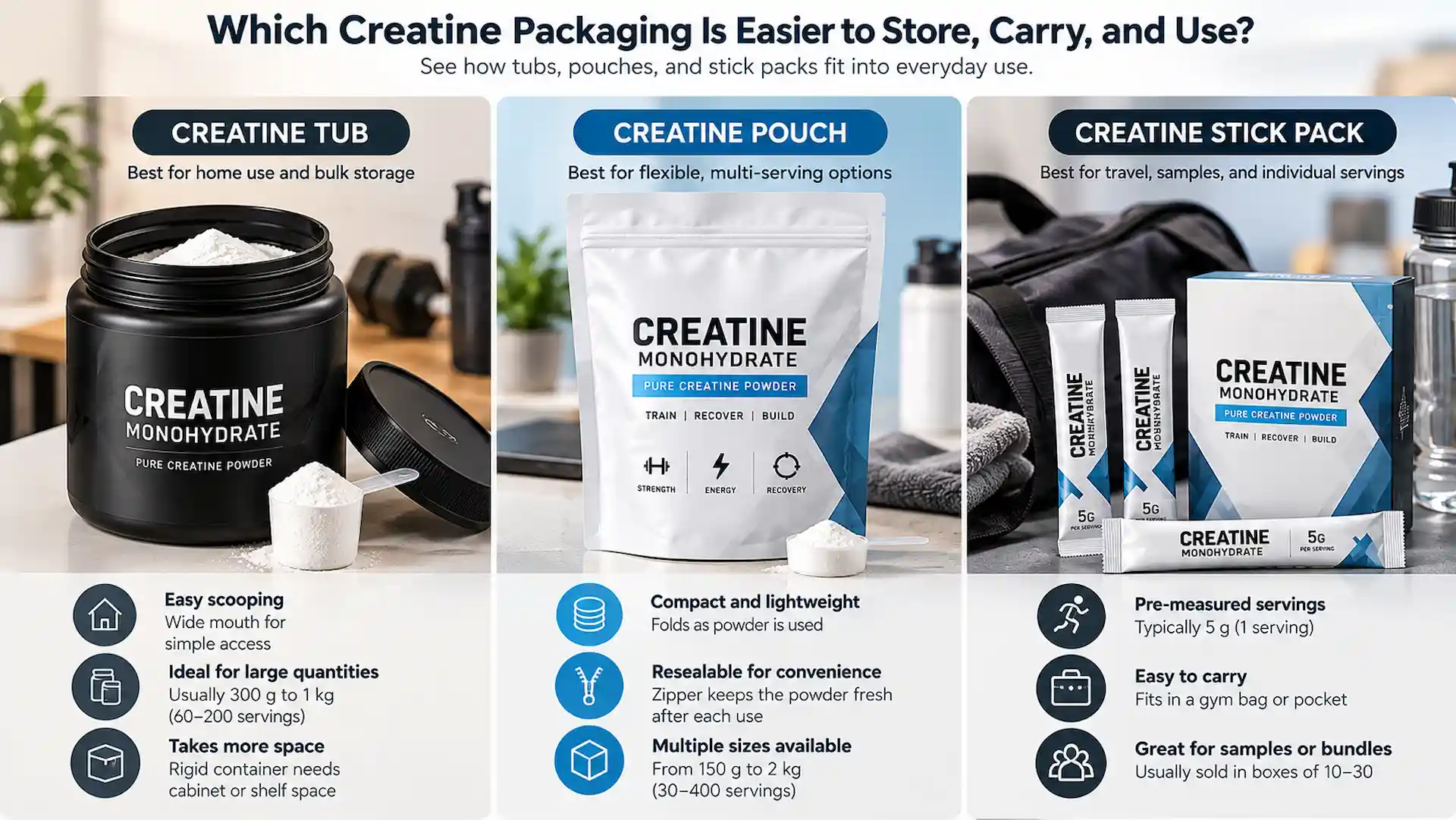
Which Creatine Packaging Is Easier to Store, Carry, and Use?
This is the part customers feel every day. It drives reviews, reorders, and whether the product gets finished or forgotten in a cupboard.
Shelf and Storage Space: Rigid Tubs vs Flexible Pouches
A tub stays full-size from the first scoop to the last. A pouch shrinks as it empties. That gap shows up in three places:
| Where | Tub | Pouch |
| Customer’s cabinet or gym bag | Takes the same space full or empty | Folds down as it’s used |
| Retail shelf | Fewer SKUs per shelf | More SKUs per shelf |
| Your warehouse | 1,000 empty tubs fill a pallet | 1,000 empty pouches ship flat in a carton |
Scooping From a Tub or Pouch vs Opening a Stick Pack
Scooping has the same three problems whether the powder is in a tub or a bag:
- The scoop sinks to the bottom and gets buried
- The dose changes with how hard the powder is packed
- Some of it ends up on the counter
A wide-mouth tub is a little easier to scoop from than a narrow bag, which is exactly why pouch design matters. A gusseted bag with a full-width zipper fixes most of it. A stick pack skips the whole argument. Tear, pour, done.
Which Format Works Better for Travel and On-the-Go Use?
No contest.
- A tub of creatine is the wrong shape and weight for a gym bag
- Powder tipped into unlabeled baggies is a headache at airport security
- A small pouch travels fine for a weekend
- Stick packs are the only format built for a desk drawer, a carry-on or a locker
That’s why plenty of brands sell both: a pouch for home, sticks for the road.
The Cost of Creatine Packaging: Where Do Tubs, Pouches, and Stick Packs Differ?
Every format costs something different to make, fill and move. Prices swing with supplier and volume, so what follows is the pattern rather than a price list.
Packaging Materials and Filling Costs
| Format | Material per unit | Filling | Minimum runs |
| Tub | Moulded container, lid, foil seal, scoop, label | Simple, fast | Usually large; tooling involved |
| Pouch | A few grams of printed film plus a zipper | Simple with a scoop drop | Low; digital runs from about 1,000 bags, ~10 business days |
| Stick pack | Least film per unit, most film per gram of creatine | Needs a forming and filling line fed by printed rollstock | Depends on the line or co-packer |
Shipping and Storage Costs
Freight is where tubs quietly lose. Empty, they’re bulky. Full, they’re heavy. Pouches cut both the weight and the carton size, which matters if you’re an e-commerce brand paying by dimension. Stick packs ship light as well, though the outer box adds a layer.
Why Single-Serve Stick Packs Can Cost More per Serving
Thirty sticks means thirty seals, thirty tears, thirty fills and thirty pieces of printed film. That’s the honest reason a box of sticks costs more per serving than a tub or bag of the same powder. Brands make the maths work with:
- Exact dosing, every time
- Zero waste from a half-finished, caked tub
- A premium price point that convenience buyers accept
- Sampler packs that turn into full-size orders
Important Note: Compare cost per serving the customer actually finishes, not just cost per gram. A tub thrown out at the halfway mark because it caked was never the cheap option.
Which Packaging Looks Better on the Shelf?
Packaging is the first thing a buyer sees and often the only thing they read. Each format hands you a different canvas.
The Familiar Look of Creatine Tubs
Tubs read as “serious supplement” to a lot of shoppers, mostly out of habit. The price of that familiarity is design freedom. You get a wraparound label or shrink sleeve on a curved surface, and the lid and base usually stay plain.
Custom Printed Creatine Pouches for Retail Display
A printed pouch is artwork edge to edge.
- Front, back and bottom gusset can all carry design
- Matte, gloss or metallic finishes
- Optional window so the powder shows
- Stand-up bags hold their shape on a shelf; flat-bottom bags look like a box without the weight
Protein brands made the same move a few years back, which is why we covered protein powder pouches vs tubs separately.
Branding Opportunities on Small Stick Packs
A stick is small, but it travels further than any tub. It ends up on desks, in gym bags, in friends’ hands. Clean type and one strong colour do more here than a crowded label. Let the outer box or carry pouch do the heavy lifting on the shelf, and let the stick be the reminder afterwards.
Tub, Pouch, or Stick Pack: Which Should Your Creatine Brand Choose?
There’s no single winner, and any article claiming one is selling something. Pick the format that matches how your creatine gets bought and used.
Choose a Tub When Bulk Storage and Scoop Access Matter Most
- Your buyers are price-first home users
- They want 100-plus servings in one container
- You’re selling at gym counters where the format is expected
- Shelf space and freight weight aren’t your main worry
Choose a Pouch When You Need Flexible, Resealable Packaging
- You sell online or run a subscription
- You want full-colour branding on every panel
- You need to launch with 1,000 units, not a pallet
- You want one format that covers a 150 g starter bag and a 2 kg bulk creatine monohydrate bag
Choose a Stick Pack When Individual Servings Are the Priority
- Dosing accuracy is part of your pitch
- Travel, trial packs or gifting drive your sales
- You’re positioned at the premium end
- You plan to pair sticks with a home-use pouch
Still torn? Walk through these five in order:
- Who buys it? Value shopper, convenience buyer, or gym-goer on the move
- How many servings per unit? Under 30 leans pouch or sticks; over 100 leans tub or bulk bag
- Where is it sold? Online and subscription favour pouches; gym counters tolerate tubs; travel and gifting favour sticks
- What’s your launch volume? Small runs favour digital-printed pouches and rollstock
- Could two formats serve the same customer? Often, yes
Whichever way you learn, order mockups and prototypes first. Run a real fill, work the zipper fifty times, and leave a filled bag in a humid room for a few weeks before you sign off on a run.
Final Verdict: The Right Pack for the Right Creatine Product
Tubs still make sense for bulk, price-driven buyers who scoop at home. Pouches win on weight, branding, seal and size range, from sampler to bulk, which is why so many creatine brands have moved to them. Stick packs cost more per serving but fix dosing and portability in a way nothing else can. Match the pack to the product and the customer, and the choice mostly makes itself.
Ready to Package Your Creatine the Right Way?
Flexible Pouches makes custom printed stand-up pouches, flat-bottom bags and stick pack rollstock for supplement brands, with high-barrier films built for moisture-sensitive powders, resealable zippers, and recyclable or compostable options. Pouch runs start at 1,000 units and most orders ship in about 10 business days, with free shipping to most destinations. Tell us your serving size and sales channel and we’ll help you pick the format and build it.
FAQs
1- Is a pouch better than a tub for creatine powder?
For most online and retail brands, yes. A pouch weighs less, ships cheaper, seals tighter after opening and gives you more room to print. A tub still wins for very large bulk sizes and for buyers who expect the traditional look.
2- Are stick packs suitable for creatine monohydrate?
Yes. A 5 g serving fits a standard stick, the film keeps each dose dry until it’s torn, and there’s no scoop to lose. The main thing to weigh is cost per serving, which runs higher than a tub or pouch.
3- Can creatine powder stay fresh in a resealable bag?
It can, as long as the bag uses a high-barrier laminate and a decent zipper. Most clumping complaints trace back to thin film or a zipper clogged with powder, not to the pouch format itself. Close it flat and keep it away from steam.
4- Which packaging is best for bulk creatine powder?
For 1 kg and up, a flat-bottom pouch with a wide zipper is hard to beat. It holds the weight, stands on a shelf, takes far less space than a tub of the same size, and folds down as it empties. Big tubs work too; they just cost more to ship.
5- Are creatine stick packs more expensive than tubs?
Per serving, usually yes. Each stick is its own sealed package, so film, filling and sealing all add up. Brands offset it with exact dosing, no wasted powder and a premium price, often selling sticks alongside a cheaper home-use pouch.
6- What packaging material works best for creatine powder?
A multi-layer laminate with a foil or metallised barrier layer and a strong heat-seal layer. It blocks moisture, which is the one thing creatine monohydrate won’t tolerate. The same structure suits pouches and stick packs; tubs rely on thick HDPE or PET plus a foil seal.