























Open a fresh pouch of smoked paprika and you can tell in two seconds if it was packed well. The color is deep red, and the smoky smell reaches you before the spoon goes in. A badly packed paprika looks dull and tastes like dust, even if the spice was perfect on the day it was ground. In most cases, the bag is what failed. Good spice packaging bags and seasoning packets protect the color, aroma, and flavor your customers are paying for.
Spices and herbs lose quality to four things: light, oxygen, moisture, and heat. The right pouch blocks all four and still looks great on a shelf. This guide covers the best film for each spice, the right spice pouches for herbs and BBQ rubs, how long spices last in a sealed pouch, U.S. labeling rules, and what custom printing costs at low volumes. We use the same checklist when we build custom printed food pouches for spice brands, so you’ll see exactly what we look at first.
What Is the Best Packaging for Spices?
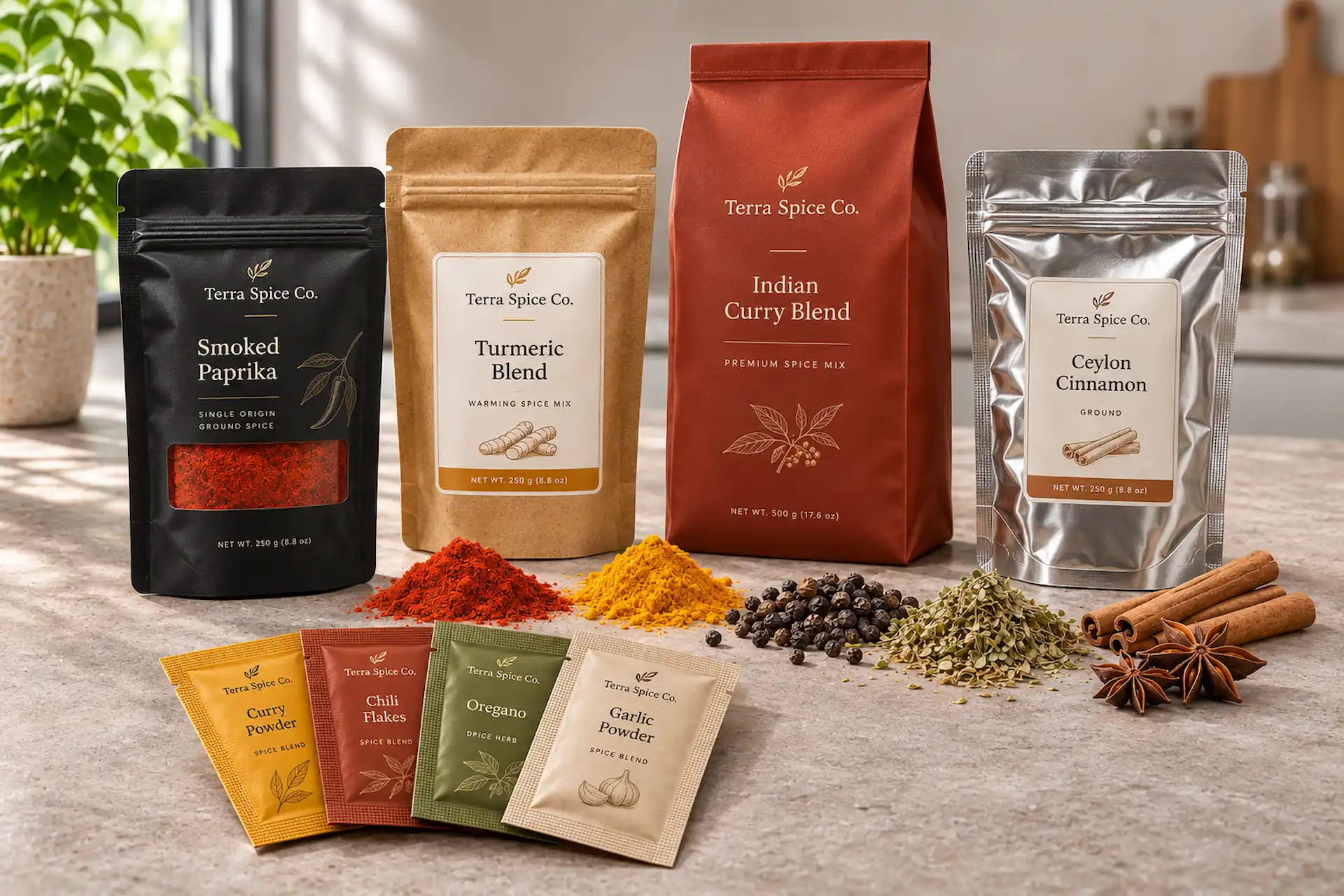
The best packaging for spices is an opaque, multi-layer barrier pouch with a strong heat seal and a resealable zipper. Foil or metallized film blocks light and oxygen, a food-safe sealant layer holds the seal, and the zipper protects the spice after the first use.
Glass jars and tins still have fans, but flexible spice packaging bags win on several points for most brands:
- Lighter weight, so shipping costs less than glass
- No breakage in transit or on the shelf
- More printable space for your story, recipes, and label details
- Less storage space before and after filling
- Easy to scale from small retail pouches to bulk foodservice bags
The catch is that the word “pouch” covers a huge range of films. A thin clear bag and a foil laminate both look like pouches, yet they protect spices in very different ways. The sections below help you pick the right one.
What Ruins Spices Inside the Bag?
Spices don’t spoil like fresh food, but spice quality drops every day the product sits in the wrong bag. Four threats cause most of the damage.
| Threat | What It Does to Spices | Spices Hit Hardest | Packaging Fix |
| Light | Fades color pigments and speeds up oxidation | Paprika, chili powder, turmeric, saffron, dried green herbs | Opaque foil or metallized film, with a small window or none |
| Oxygen | Breaks down the volatile oils that carry aroma | Ground spices, black pepper, nutmeg, dried citrus peel | High oxygen barrier film, plus nitrogen flush for premium lines |
| Moisture | Causes clumping, caking, and mold risk | Garlic powder, onion powder, salt and sugar blends, BBQ rubs | Low moisture transmission film, strong seals, tight zipper |
| Heat | Speeds up every reaction above | All spices, especially ground ones | Cool, dark storage away from hot windows and trucks |
Does Light Affect Spices in Packaging?
Yes. Light affects spices in packaging mainly by fading their color, and the effect is strongest on red, yellow, and green spices. Paprika and chili powder get their red from carotenoids, turmeric gets its yellow from curcumin, and dried herbs stay green because of chlorophyll. All three pigments break down faster under light.
This is a real shelf problem, not just a lab finding. Swedish spice brand Santa Maria saw light bleaching the color of some spices in its range and sponsored research into packaging solutions that reduce it. Faded spice usually tastes weaker too, so shoppers read color as a sign of freshness.
Clear pouches with big windows look great on day one. After weeks under bright store lights, the spice behind the window can look much older than it is.
Oxygen, Moisture, and Aroma Loss
Oxygen attacks the volatile oils that give each spice its smell. Grinding exposes more surface area, which is why ground cumin fades faster than whole cumin seed. A film with a low oxygen transmission rate slows that loss down.
Moisture is the second big problem, especially for blends. Purdue University research found that seasoning blends become more sensitive to humidity as more ingredients are mixed in, and crystalline ingredients like salt and sugar make caking more likely.
There is also a quieter issue called flavor scalping. Polyethylene, the most common sealant layer inside pouches, tends to absorb oily, nonpolar aroma compounds, the same type found in many spice oils. For strong spices like clove, cinnamon, or cumin, ask your supplier about the sealant layer, not just the outside look. Knowing how to read barrier numbers like MVTR and OTR on a spec sheet makes that conversation much easier.
Spice Shelf Life in a Sealed Pouch
Spice shelf life in a sealed pouch depends on two things: the form of the spice and the barrier of the film. Spices rarely become unsafe with age, but they do lose color, aroma, and strength. McCormick gives these general quality windows for spices stored properly:
| Spice Form | Examples | Typical Best-Quality Window |
| Whole spices | Peppercorns, cumin seed, cinnamon sticks, cloves | 3 to 4 years |
| Ground spices | Cumin, ginger, paprika, chili powder | 2 to 4 years |
| Leafy herbs and most blends | Basil, oregano, rosemary, taco and BBQ blends | 1 to 3 years |
These numbers assume a cool, dark place and a good seal. Some university extension guides give much shorter windows, so many brands set a conservative best-by date and test their own product over time. A thin clear pouch on a sunny shelf will sit near the bottom of each range. A sealed foil or metallized pouch kept in a dark warehouse can reach the top end.
Once a customer opens the bag, the clock speeds up. A press-to-close zipper that seals tightly after every use is the simplest way to protect the second half of a spice’s life.
Choosing the Right Film for Spice Pouches
The film is the part of the pouch that does the real protecting. Here is how the most common spice packaging materials compare.
| Film Type | Light Barrier | Oxygen and Moisture Barrier | Shows Product | Best For |
| Clear PET/PE laminate | Low | Medium (higher with coated films) | Yes | Whole spices, coarse rubs, fast-selling SKUs |
| Metallized PET (VMPET) | High | High | No | Most ground spices and blends |
| Aluminum foil laminate | Very high | Very high | No | Paprika, saffron, turmeric, premium and export lines |
| Kraft paper with barrier liner | High | Medium to high, based on the liner | Only with a window | Natural, organic, and small-batch brands |
| Compostable film | Low to medium | Low to medium, with higher-barrier options available | Some films | Eco-focused brands with fast turnover |
| Recyclable mono-material PE | Medium with white or opaque print | Medium | Optional | Brands working toward recyclability goals |
Foil vs Clear Pouch for Spices
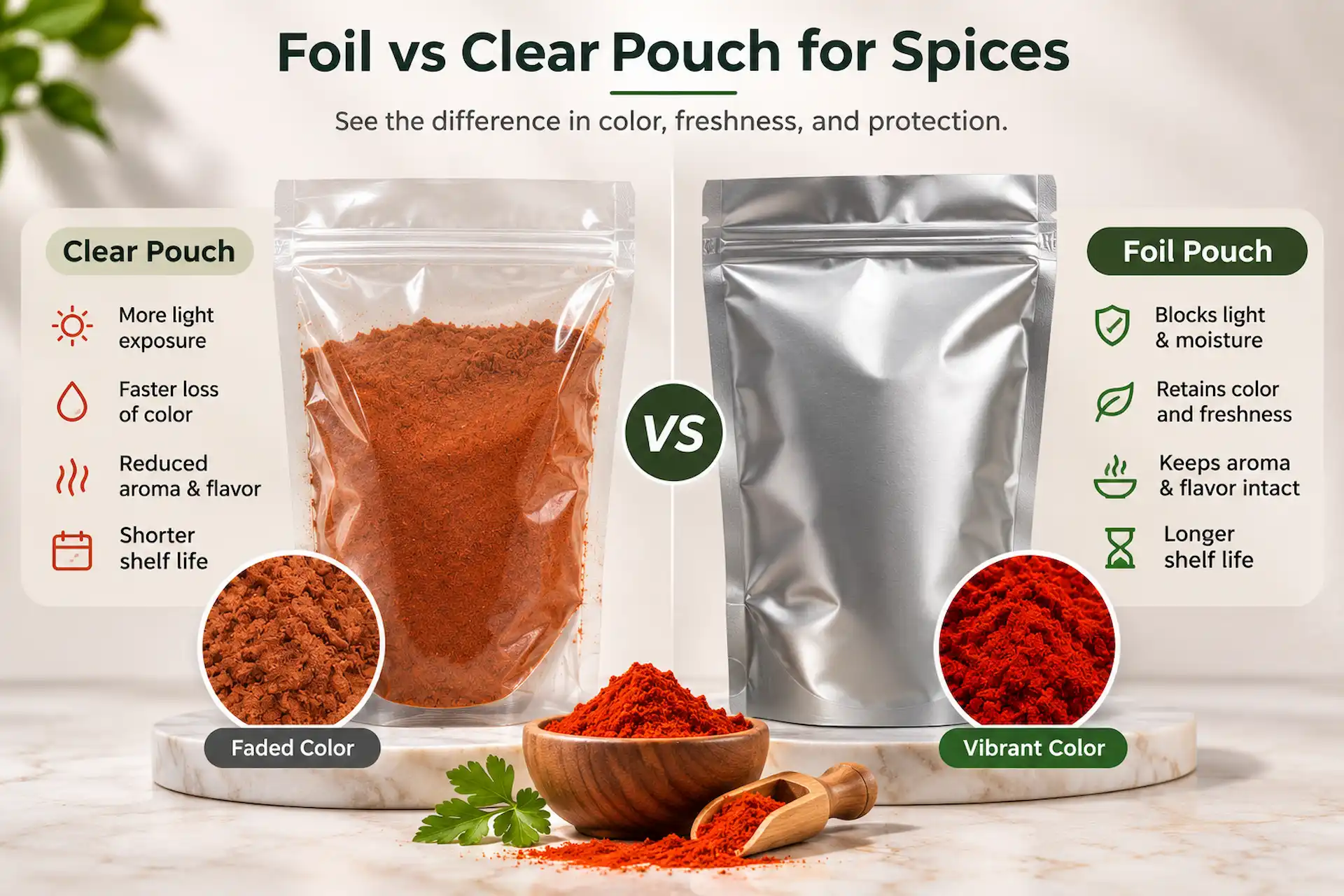
Choose foil or metallized film when color and aroma are your selling points. Choose clear film when shoppers need to see the product before they buy. Foil wins on protection every time, while clear film wins on visibility, and visibility sells coarse rubs, whole chilies, and colorful blends.
Many brands split the difference with a metallized pouch and a small window. The window gives a peek at the product while most of the spice stays in the dark. If you want the full trade-offs, we compare metalized film and aluminum foil side by side in a separate guide.
Important Note: A clear window is a light leak. For paprika, turmeric, saffron, and dried green herbs, keep the window small, move it to the back panel, or skip it. A window also shows any fading to every shopper who picks up the bag.
Kraft Paper Spice Bags
Kraft paper spice bags give a natural, farmers-market look that suits organic and small-batch brands. Paper alone is not a barrier, though. A kraft pouch protects spices only because of the plastic, metallized, or foil liner laminated inside it.
Check that liner before you order. A kraft bag with a thin PE liner looks the same as one with a metallized barrier, but the second one will keep your cumin fragrant far longer. Kraft also scuffs more easily than film, so plan for that in shipping cartons.
Compostable and Recyclable Spice Packaging
Compostable spice packaging uses plant-based films such as PLA or cellulose, plus compostable inks and adhesives. Barrier used to be the weak spot, but higher-barrier compostable laminates are now available. Austrian brand Sonnentor, for example, packs its herbs and spices in a high-barrier compostable cellulose film.
Expect a shorter shelf life from many compostable options, and confirm certification for the whole finished pouch, not just the film. U.S. buyers usually look for BPI certification or a TÜV OK compost mark.
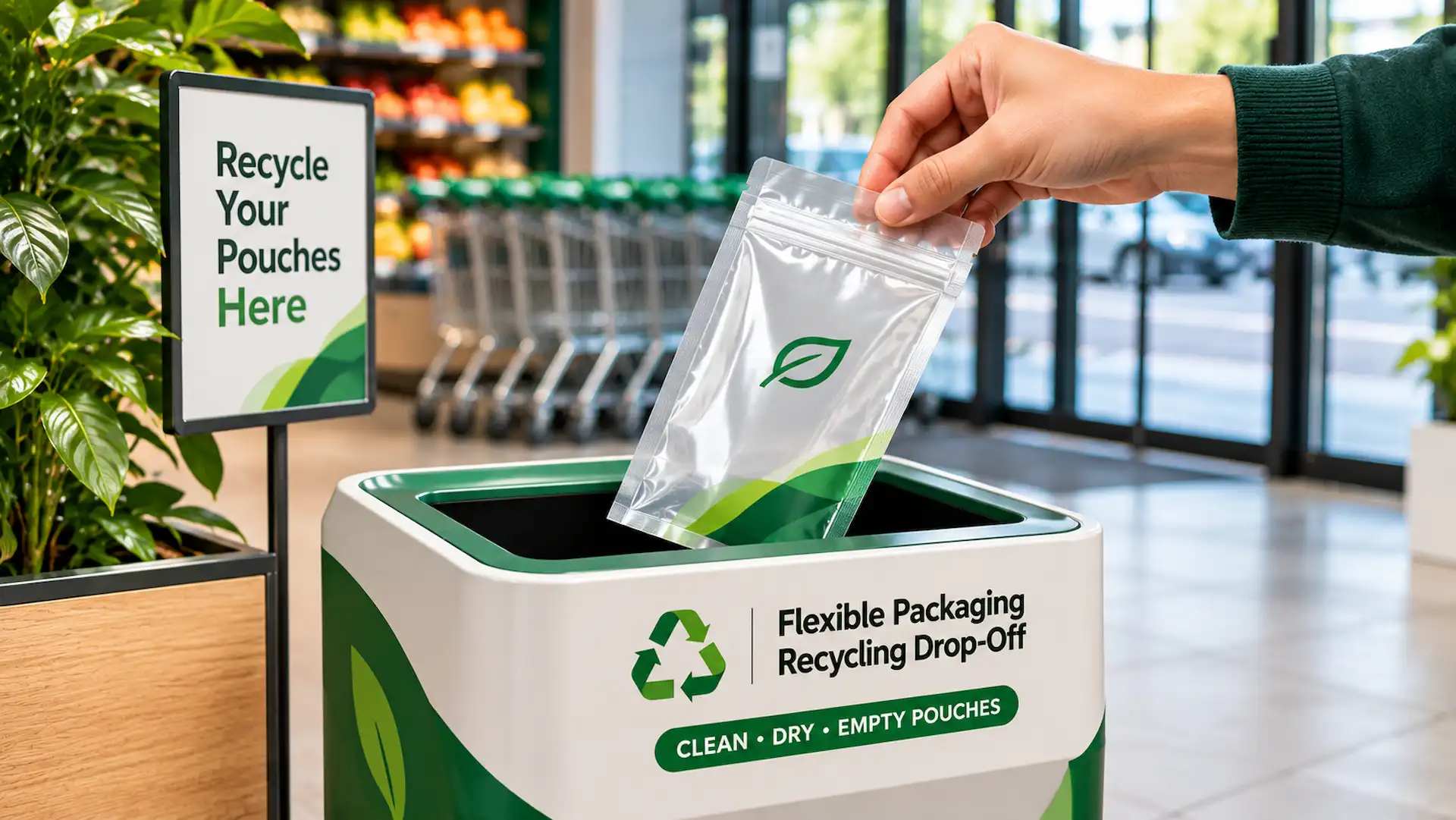
Recyclable spice packaging usually means a mono-material PE pouch, where every layer comes from the same plastic family. These pouches can often go into store drop-off programs where accepted, though their barrier is lower than foil. For most ground spices, a mono-PE pouch with a thin barrier coating is a sensible middle path.
Choosing Spice Pouches by Product Type
A ground spice, a leafy herb, and a chunky BBQ rub each put different stress on a bag. Match the pouch style to the product first, then pick the film. The same rule applies to single spices and to seasoning packaging bags for blends.
Stand Up Pouches for Spices
Stand up pouches for spices are one of the most popular retail formats. A bottom gusset lets the bag stand on a shelf, the front panel works like a billboard, and a zipper keeps the spice fresh at home. Many spice brands sell in sizes from about 2 oz to 1 lb.
The stand up format suits almost every spice, from ground turmeric to whole peppercorns. Add a hang hole if you plan to sell on peg hooks, and a tear notch above the zipper so the first opening is clean.
Flat Bottom Bags for Spices
Flat bottom bags for spices have a box-shaped base and four side panels. A flat bottom bag stands straighter than a stand up pouch, holds more volume in the same shelf space, and gives you extra panels for recipes, origin stories, or label details.
Flat bottom bags work well for larger sizes, bulk spices, and premium lines that want a boxed look without a box. The trade-off is a higher unit cost than a standard stand up pouch.
Herb Packaging Bags
Dried herbs are light, bulky, and fragile. Herb packaging bags need extra room for the same weight, so a 1 oz bag of basil is much bigger than a 1 oz bag of cumin. A wide gusset or a flat bottom gives leaves space without crushing them.
Herbs also lose their green color quickly in light, so opaque or mostly opaque film is the safer choice. If you want shoppers to see the leaves, place a small window on the back panel.
BBQ Rub Packaging
BBQ rub packaging has to handle salt, sugar, coarse pepper, and sometimes chili flakes. That mix creates two problems: clumping and puncture. Salt and sugar pull in moisture, and sharp flakes can stress thin film.
For rubs, use a thicker film with a strong moisture barrier, a wide heat seal, and a sturdy zipper. Larger sizes for pitmasters and restaurants, often 1 lb to 5 lb, usually move into flat bottom bags or heavy-duty stand up pouches. A clear window works better on a rub than on paprika, since buyers like to see the coarse texture and a popular rub doesn’t sit on the shelf for long.
Seasoning Packets for Single Servings, Kits, and Samples
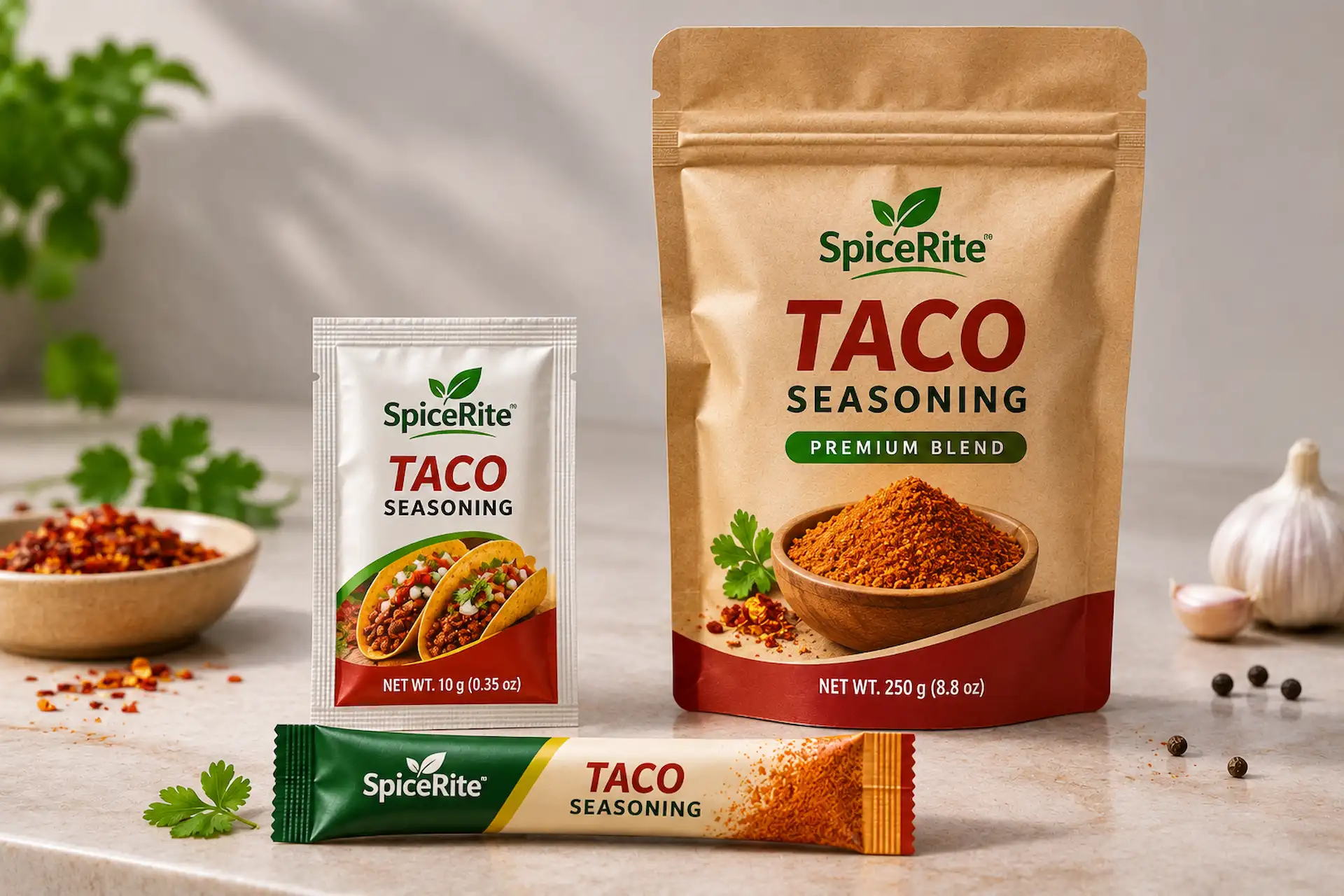
Seasoning packets are small, sealed, single-use packs that hold enough spice for one meal, one recipe, or one taste test. Brands use seasoning packets wherever a full pouch would be too big or too costly.
- Meal kits and subscription boxes
- Instant noodles, rice dishes, and snack add-ons
- Foodservice and takeout, such as pepper, chili flakes, or rub portions
- Free samples for trade shows, sales calls, and online orders
- Recipe mix packets such as taco, chili, or ranch seasoning
Most seasoning packets are made as 3-side or 4-side seal flat sachets, or as slim stick packs. Sachets hold more powder and leave room for branding, while stick packs pour cleanly and fit into tight kit boxes. If you’re weighing both, our guide to sachets and stick packs explains where each one fits.
Barrier matters even more in a small packet. A tiny packet has a lot of film surface for very little spice, so any oxygen or moisture that gets through has a bigger effect on flavor. Use a metallized or foil structure for packets meant to last months, and add a tear notch so customers can open seasoning packets without scissors.
High-volume seasoning packets are usually filled on form-fill-seal machines from printed rollstock. Smaller runs often start with premade sachets that are filled and sealed by hand or on a tabletop sealer.
Spice Packaging Labeling Requirements in the USA
U.S. spice packaging labeling requirements come from the FDA, and every retail spice pouch or seasoning packet needs the same core items. The FDA Food Labeling Guide covers the full rules.
- Statement of identity: the common name of the product, such as “Ground Cumin” or “Smoky BBQ Rub,” on the front panel.
- Net quantity: the weight in both U.S. and metric units, such as “Net Wt 2 oz (57 g),” in the bottom 30% of the front panel.
- Ingredient list: every ingredient in descending order by weight.
- Allergen statement: any of the nine major U.S. food allergens, including sesame, which shows up often in seed blends.
- Name and place of business: the manufacturer, packer, or distributor.
- Nutrition Facts: required for many blends, but often not for plain spices.
Spice rules have a few twists. Under 21 CFR 101.22, spices can be listed together as “spices” instead of one by one, which helps protect a signature blend. Onion, garlic, and celery are treated as foods rather than spices, so they must be named on the ingredient list.
Nutrition labeling depends on the recipe. Plain spices with insignificant amounts of all nutrients are usually exempt from the Nutrition Facts panel. Once you add an ingredient that carries nutrients, such as salt or sugar, the blend generally needs a panel unless a small business exemption applies.
Important Note: Paprika, turmeric, and saffron are colors as well as spices. Federal rules say to list them by name or as “spice and coloring,” not under the general word “spices.” This detail is easy to miss on blend labels.
Selling in Canada or the EU too? Mustard is a priority allergen in both, and local language rules apply. Before you print for any market, run your artwork past a label reviewer. Our guide to FDA-compliant artwork and labeling walks through the final checks we recommend before you approve a proof.
How to Package Spices for Resale
Learning how to package spices for resale comes down to a few steps done in the right order. This is the process we see working best for new spice brands.
- Check your legal path. Many states let you sell dry spice blends made at home under cottage food laws, usually direct to customers inside your state. Selling wholesale, to retailers, or online across state lines usually calls for a licensed facility, and often FDA food facility registration.
- Start with clean, dry spices. Buy from suppliers who treat spices for pathogens and share test results. Dried spices and herbs have been linked to foodborne illness outbreaks, and packaging can’t fix a contaminated product.
- Pick the film and pouch style. Use the sections above to match the barrier and format to each SKU.
- Size the pouch to the fill. Ground spices are dense and herbs are not, so test-fill samples before you order a full run.
- Fill in a low-humidity room. Moisture picked up during filling stays trapped inside the sealed bag.
- Seal and check every batch. The heat seal is the real freshness barrier, and the zipper is only for reclosing.
- Add lot codes and best-by dates. Most spices don’t need them under federal rules, but retailers expect them and they make recalls far easier.
- Store and ship cool and dark. Keep finished pouches away from heat and sunlight in your own storage too.
For premium or export lines, ask about nitrogen flushing. Replacing the air in the bag with nitrogen lowers the oxygen level at the moment of sealing, which helps ground spices hold their aroma longer.
Custom Printed Spice Bags: MOQ and Printing Options
Custom printed spice bags help a small brand look shelf-ready from day one. The two main print methods differ mostly in minimum order size and cost per bag.
| Factor | Digital Printing | Rotogravure Printing |
| Typical minimum order | From about 1,000 pouches | Often 5,000 to 10,000+ per design |
| Plates or cylinders | None | One engraved cylinder per color |
| Cost per bag | Higher, but flat at any quantity | Lowest at high volume |
| Several flavors in one order | Easy, no extra setup per design | Each new design adds cylinder cost |
| Turnaround | About 7 to 10 business days after art approval (our standard) | Longer, since cylinders must be made first |
| Best for | Launches, seasonal blends, and wide flavor ranges | Large, stable best-sellers |
Minimum Order for Custom Spice Bags
The minimum order for custom spice bags is set mostly by the print method. With digital printing, we can produce as few as 1,000 custom printed pouches, and several designs can run in the same order. That flexibility matters for spice brands. A line of eight blends at 10,000 bags each would tie up a lot of cash in stock that slowly ages on the shelf.
Very early brands sometimes start with stock pouches and printed labels, then switch to fully printed bags once sales are steady. When you’re ready for that step, our guide to low minimum orders explains how short runs keep cash and inventory under control.
Conclusion
Spices sell on color, aroma, and flavor, and the bag decides how long those last. Start with the four threats of light, oxygen, moisture, and heat, then match the film and pouch style to each product.
- Use foil or metallized film for paprika, turmeric, saffron, and dried herbs.
- Use stand up pouches or flat bottom bags for retail, and seasoning packets for single servings and samples.
- Give salt and sugar rubs a strong moisture barrier and a wide seal.
- Get the label right, including “spice and coloring” where it applies.
- Use digital printing to launch many flavors without huge minimums.
The right spice packaging bags pay off in fewer stale complaints and more repeat orders. A customer who opens a bag of rub months later and still smells the smoke is a customer who comes back.
Get Spice Pouches That Keep Flavor Locked In
Tell us what you’re packing, how much you need, and where it will sell. Our team will recommend the film, pouch style, and size for each blend, and we create proofs within 24 business hours of receiving your art. Request a free quote to get started.
Frequently Asked Questions
Here are quick answers to the questions spice brands ask us most often.
What kind of bag keeps spices fresh the longest?
An opaque, multi-layer pouch made with foil or metallized film keeps spices fresh the longest. The film blocks light, oxygen, and moisture, and a tight zipper protects the spice after opening. Clear bags look nice but let light fade color faster.
How long do spices last in a sealed pouch?
In a sealed, high-barrier pouch stored cool and dark, whole spices usually keep their best quality for 3 to 4 years and ground spices for 2 to 4 years. Leafy herbs and most blends last about 1 to 3 years. Spices rarely become unsafe, but they lose flavor over time.
Do spice pouches need a zipper?
Retail spice pouches should have a zipper, because most customers use a spice over weeks or months. Single-use seasoning packets don’t need one, since they’re emptied in one go. In both cases, the heat seal does the main job of protecting the spice before opening.
Do I need a Nutrition Facts panel on spice packaging?
Plain spices with insignificant amounts of nutrients are usually exempt from the Nutrition Facts panel. Blends with added salt, sugar, or other ingredients that carry nutrients generally need one, unless your business qualifies for the FDA small business exemption.
What is the minimum order for custom spice bags?
With digital printing, custom spice bags can start at about 1,000 pouches, with no plate or cylinder costs. Rotogravure printing usually needs several thousand bags per design, but it costs less per bag at high volume.
Can compostable spice packaging keep spices fresh?
Yes, for many spices, as long as you choose a higher-barrier compostable laminate and match the shelf life to how fast the product sells. Compostable films generally protect less than foil, so they suit fast-selling SKUs better than spices that sit for years.