



















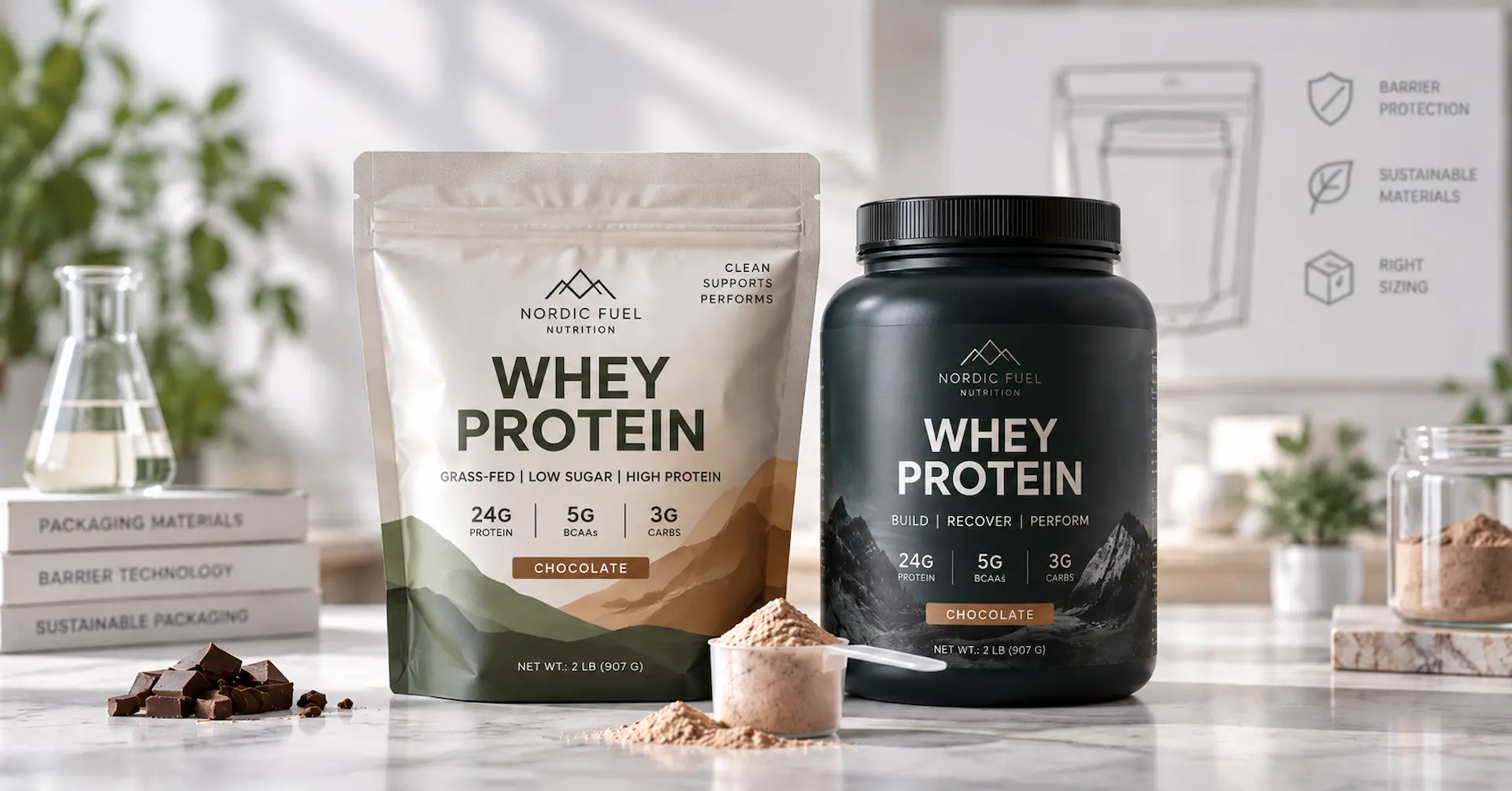
Protein powder looks simple to pack until you start working out the details. The package has to keep moisture away, close properly after each use, leave enough room for a scoop, and survive storage and shipping. Get the size wrong, and even a well-designed package can feel awkward or look half empty.
That is why choosing protein pouches involves more than replacing a plastic tub with a bag. The pouch style, barrier, zipper, dimensions, and powder itself all affect the result. If pouch sizing is new to you, our custom pouch size and capacity guide explains how weight, volume, density, gusset depth, and headspace work together.
What Does Protein Powder Packaging Need to Protect Against?
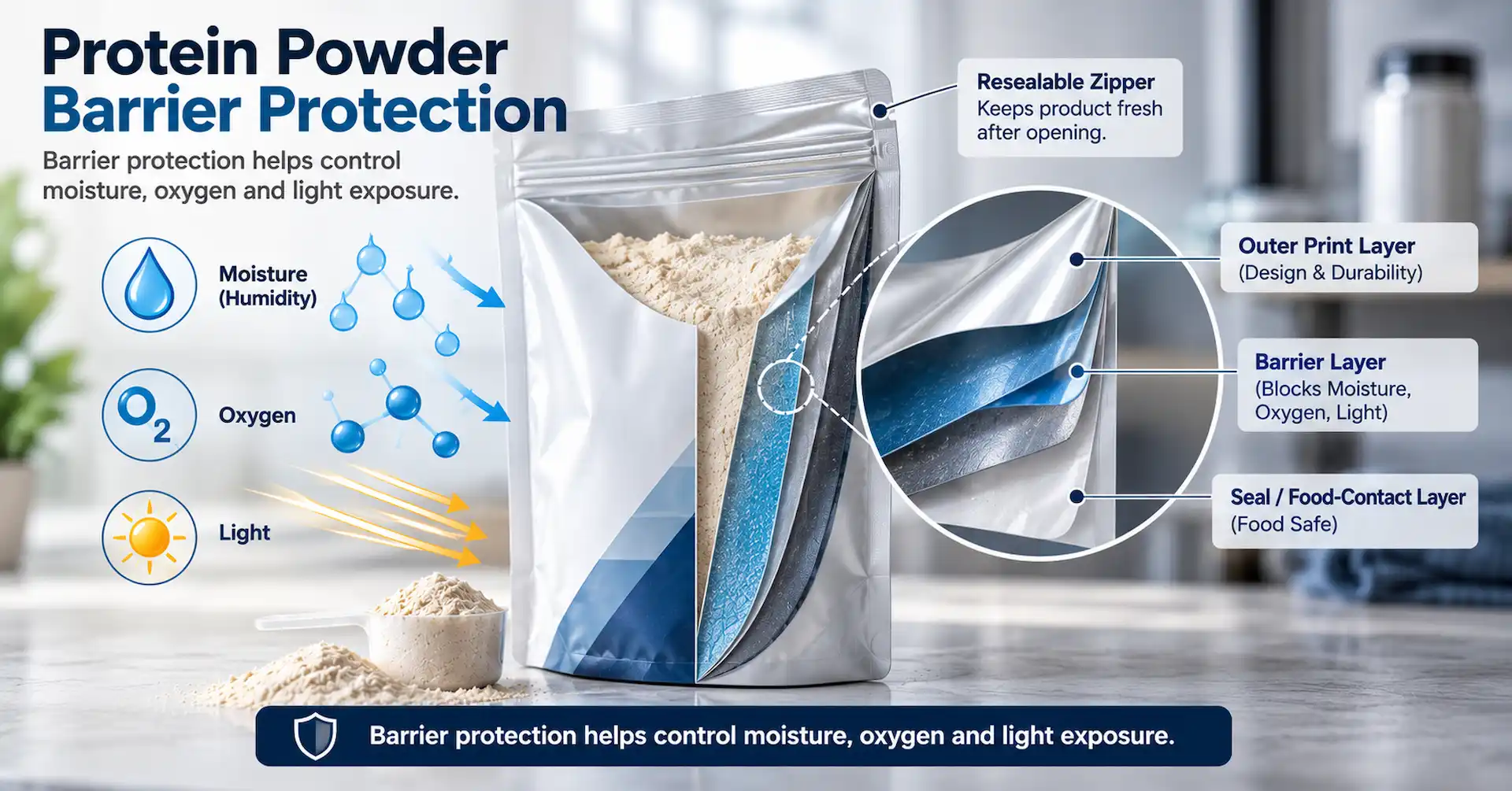
Protein powder needs protection throughout storage, shipping, and everyday use. Moisture is one of the biggest concerns because humidity can cause powder to clump or cake, making it harder to scoop and mix.
Depending on the formula, oxygen and light can also affect product quality over time. Good protein packaging should help protect against:
- Moisture and humidity
- Oxygen exposure
- Light where relevant
- Outside contamination
- Damage during storage and shipping
- Loss of freshness after repeated opening
The package should also support the product’s weight and stay securely sealed. A small sample pouch and a 2 kg protein package place very different demands on the material, seals, and pouch construction.
Important Note: Barrier requirements vary by product. The formula, expected shelf life, storage conditions, and distribution route should all be considered before selecting the packaging material.
Protein Powder Pouch vs Tub: Which Is Better?
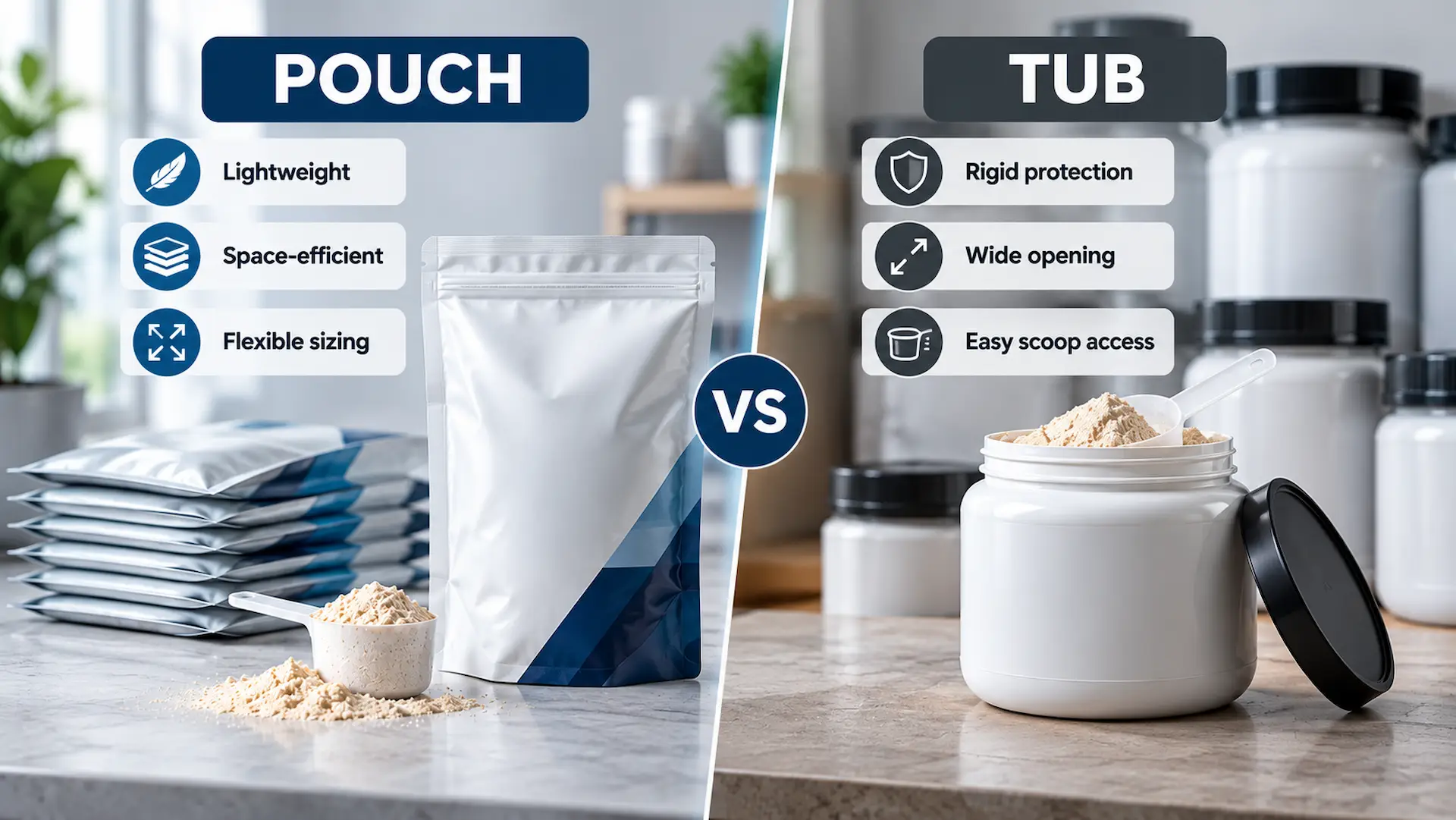
Honestly, the best protein packaging depends on your product and where you sell it. Here’s how the two formats compare:
| Factor | Pouch | Tub |
| Barrier protection | Strong with the right film | Strong with a good seal |
| Package weight | Very light | Heavier |
| Storage space | Ships and stores flat | Bulky even when empty |
| Shipping efficiency | Less weight and bulk | More bulk per carton |
| Scoop access | Good with a wide opening | Easy wide mouth |
| Resealability | Zipper | Screw-top lid |
| Physical protection | Can puncture if too thin | Resists crushing |
| Branding area | Front, back and gusset | Label only |
| Material use | Less plastic per unit | More plastic per unit |
| Best applications | Online sales, trials, refills | Large at-home sizes |
Where Protein Pouches Have the Advantage
Most of the pouch’s wins happen before anyone opens the bag. According to the Flexible Packaging Association, a pouch can use up to 60% less plastic than a comparable rigid container, and empty pouches ship flat. Brands also get:
- Lower parcel costs for online orders
- Short digital print runs, so a new flavor isn’t a big gamble
- Cheap refill packs for customers who already own a tub
Packing protein powder in pouch format also traps less air, since the bag settles around the product.
Where Protein Tubs Have the Advantage
Tubs still have real strengths. The wide mouth makes scooping easy, even with a big scoop. Rigid walls keep their shape as the powder level drops, and they hold up well in a crowded delivery van. Shoppers buying a 5 lb supply also tend to expect a tub.
When Should You Choose a Pouch or a Tub?
Match the format to how your customers buy and use the product:
| Your situation | Better fit |
| Mostly e-commerce sales | Pouch |
| Many flavors or small batches | Pouch |
| Samples, trials or refills | Pouch |
| Limited warehouse space | Pouch |
| Large fills scooped daily at home | Tub or wide flat-bottom pouch |
| Retail shelves that expect rigid packs | Tub |
Many brands simply use both.
Which Pouch Style Is Best for Protein Powder?
Each pouch style fits a different fill size and use:
| Style | Best for | Why it works |
| Stand-up pouch | 250 g to 1 kg | Stands well, versatile, cost-effective |
| Flat-bottom pouch | 1 kg and up | Stable box shape, five print panels |
| Lay-flat pouch | Samples and small fills | Low cost, easy to mail |
| Stick pack | Single servings | Pre-measured, no scoop needed |
| Rollstock | High-volume brands | Runs on your own filling line |
The gusset, seals and zipper change how much powder fits, how wide the bag opens, how it runs on a filler and how it stands on a shelf. Heavier fills usually do better in flat-bottom pouches, which stay upright and open wide.
What Barrier Does Protein Powder Packaging Need?
You can’t see the barrier, but it decides how long your powder stays fresh.
Moisture Barrier
Moisture is enemy number one. Whey and most plant proteins pull water from the air, so a humid storeroom can turn smooth powder lumpy, then caked.
Heat speeds it up. A U.S. study on whey protein concentrate found sealed bags lasted at least 18 months in cooler storage, but only about 9 months at 35°C (95°F). Barriers buy time, but storage still counts.
Oxygen and Light Barrier
Oxygen works more slowly. It makes the fats in many formulas taste stale and flattens flavor, while light fades blends with greens, vitamins or natural colors.
A plain whey isolate that sells within months doesn’t need the same armor as a superfood blend shipped overseas. Let the formula decide.
Choosing the Right Barrier Material
| Material | Barrier level | Good to know |
| Clear barrier film | Moderate to high | Shows the product, little light protection |
| Metallized film | High | Opaque, suits most protein powders |
| Foil laminate | Highest | 7-micron foil blocks nearly all oxygen, moisture and UV |
| Kraft with barrier layers | Moderate to high | Natural look, barrier from inner layers |
| Recyclable mono-material PE | Good to high | Easier end of life, test first |
Want a greener option? Recyclable structures work well for many powders, but test shelf life with your real product first.
Important Note: A film sold as “high barrier” isn’t automatically right for you. Choose it based on your formula, shelf-life target, storage conditions and shipping route.
Essential Features of a Good Protein Powder Pouch
A great film won’t save a pouch that’s awkward to use. These features protect the powder and make the daily scoop easier:
| Feature | Why it matters |
| Resealable zipper | Powder-resistant designs stop dust jamming the track |
| Wide opening | A full scoop goes in and out cleanly |
| Tear notch | A clean first opening above the zipper |
| Strong seals | Stay tight when kept free of powder dust |
| Bottom gusset | Helps the bag stand and adds capacity |
| Puncture resistance | Heavy fills need a tougher laminate |
| Printable area | Room for the nutrition panel, barcode and lot codes |
| Surface finish | Matte feels premium; gloss makes colors pop |
How to Choose the Right Protein Powder Pouch Size
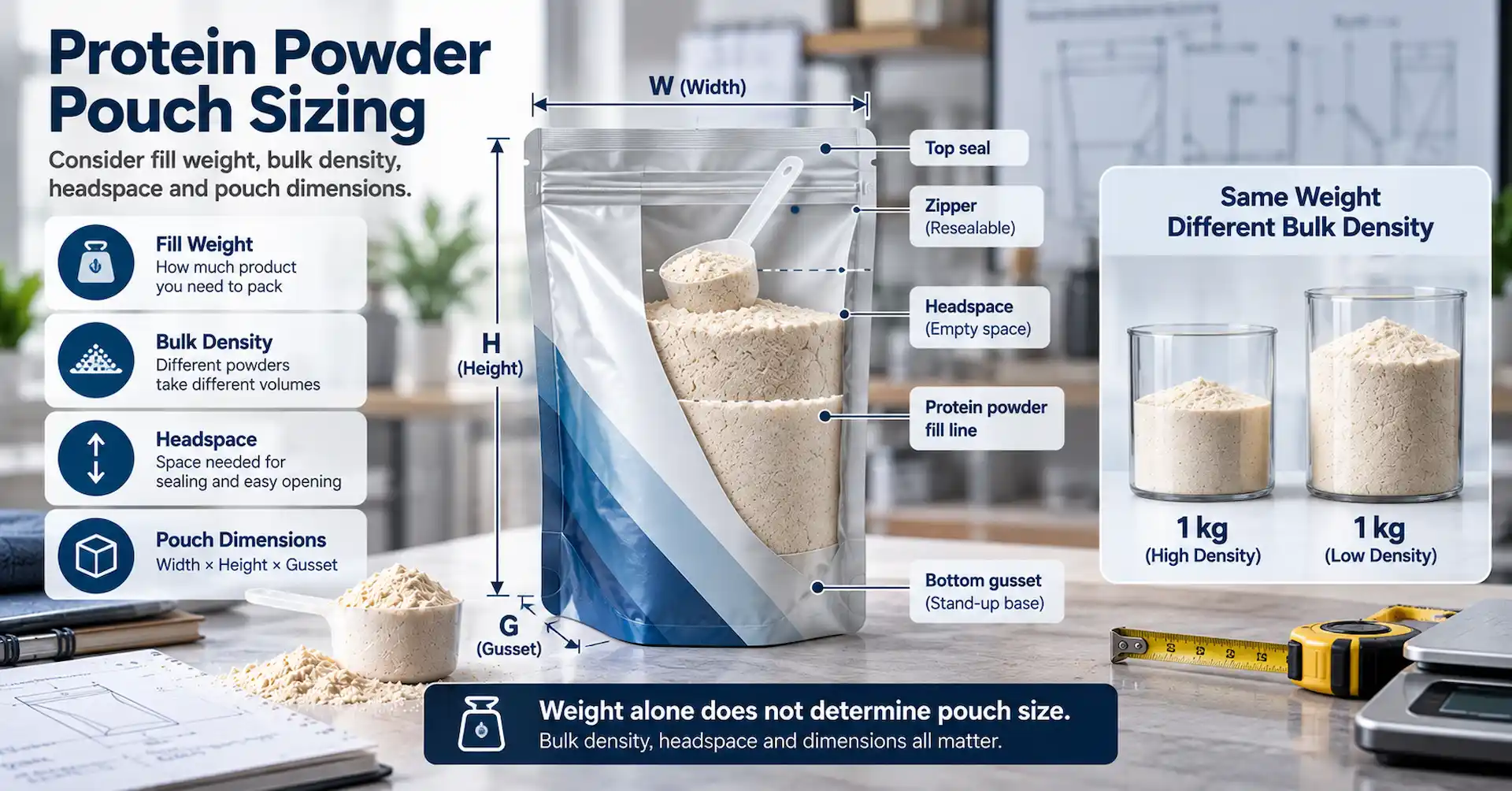
Never pick a protein powder pouch size by net weight alone. Pouches hold volume, but powder is sold by weight.
Start With Fill Weight and Bulk Density
Take your target net weight, then measure the powder’s bulk density: how much space each gram takes up.
Required product volume = Product weight ÷ Bulk density
For example, 907 g at 0.45 g/mL needs about 2,015 mL before headspace.
Density swings more than you’d think. In the same whey study, the 80% protein version needed about 60% more room than the 34% version at equal weight. Test whey, plant and blended formulas separately, then match them to real pouch capacity.
Allow for Headspace, Zipper and Scoop Access
Leave room for:
- Headspace, so the pouch closes and seals cleanly
- The top seal and zipper zone, which can’t be filled
- A gap that keeps powder out of the zipper track
- An opening wide enough for your scoop
Consider Width, Height and Gusset
Width controls the opening and how easily a scoop fits. Height sets the fill level. The gusset adds capacity and keeps the pouch standing. In practice, a wider, shorter bag is easier to scoop from than a tall, narrow one.
Protein Powder Pouch Size Guide
Use these ranges as a starting point, not a final spec:
| Fill Amount | Packaging Direction |
| 30–100 g | Sample/single-use pouch |
| 250 g | Small retail pouch |
| 454 g / 1 lb | Common retail size |
| 500 g | Medium retail pouch |
| 907 g / 2 lb | Larger retail pouch |
| 1 kg | Large stand-up or flat-bottom pouch |
| 2 kg+ | Larger/heavy-duty pouch format |
Important Note: These are starting categories, not fixed dimensions. Final size depends on bulk density, headspace, pouch construction, gusset, scoop size, zipper position and filling method.
Test Your Protein Powder Pouch Before a Full Production Run
Charts get you close, but only a fill test proves the pouch works. Order a printed prototype or blank samples, fill them with real powder and ask:
- Does the fill weight sit below the zipper, with enough headspace?
- Does the scoop go in and out cleanly?
- Does the zipper still close after powder contact?
- Do the seals and the filled pouch survive a shipping test?
A quick test costs far less than a reprint.
Common Protein Powder Packaging Mistakes to Avoid
Most packaging headaches trace back to these:
- Picking dimensions from weight alone
- Guessing bulk density instead of measuring it
- Going thin on barrier or film strength to save a few cents
- Making the opening too narrow for the scoop
- Leaving too little headspace, or filling up to the zipper
- Putting looks ahead of function
- Skipping the filled-pouch test
How to Choose the Right Protein Powder Packaging for Your Brand
Before approving the final packaging, check the product requirements from filling through everyday customer use.
Ask:
- What type of protein powder are you packing?
- What is the target fill weight?
- What is the powder’s bulk density?
- What shelf life is required?
- What moisture, oxygen, or light protection is needed?
- Would a pouch or tub work better?
- Which pouch format suits the quantity?
- Is the opening wide enough for the scoop?
- How will the package be filled and sealed?
- Has it been tested with the actual powder?
A good package should protect the product, work with the filling process, and remain convenient until the final scoop.
Conclusion
There is no single best protein powder packaging format for every brand. Tubs offer rigidity and easy scoop access, while protein pouches provide a lightweight, space-efficient option with greater flexibility in size and presentation.
If you choose a pouch, focus on barrier performance, bulk density, headspace, opening width, and closure design. Most importantly, test the actual powder before production so the final package protects the product and works well for the customer.
Build the Right Protein Powder Pouch for Your Product
Flexible Pouches makes custom protein pouch packaging in any size, with no upcharge for custom dimensions. Choose stand-up, flat-bottom or lay-flat styles, high-barrier or recyclable films and full-color printing, with free zippers and tear notches. Stand-up and lay-flat runs start at 1,000 units.
FAQs
1. Are pouches better than tubs for protein powder?
Not always. Pouches use less plastic and ship flat, so they suit online sales and refills. Tubs are easier to scoop from, which is why big sizes often stay in tubs.
2. What type of pouch is best for protein powder?
For most 1 lb and 2 lb products, a zippered stand-up pouch does the job. At 1 kg and up, a flat-bottom pouch stands firmer and opens wider. Stick packs suit single servings.
3. What barrier does protein powder packaging need?
Start with moisture protection, then oxygen. Metallized film suits most products, but a whey protein powder pouch facing hot warehouses or a long shelf life is safer in foil.
4.What size pouch do I need for 1 kg of protein powder?
It depends on bulk density. Many 1 kg whey pouches start around 7.5 x 11 inches with a 4-inch gusset, but lower-density powders need a bigger bag. Confirm with a fill test.
5. How do I calculate the right pouch size for protein powder?
Divide the fill weight by the bulk density. For example, 1,000 g at 0.5 g/mL needs 2,000 mL. Then add headspace and room for the zipper and seal, and test a sample pouch.
6. Can protein powder pouches be recycled?
Some can. Mono-material PE pouches can go through U.S. store drop-off programs if they carry a How2Recycle Store Drop-off label. Foil and mixed-material laminates usually can’t.