























Few packaging decisions cost you as much money as this one, and most brands make it early, with the least information they will ever have. Print quality sets how your product reads on a shelf. The print method sets what that quality costs you and how long you wait for it. So when brands start comparing digital printing vs conventional printing, the confusion is fair enough.
Both are in heavy use across the industry. Neither is the better method in the abstract, because they solve different problems. What follows is how each one works, what it genuinely costs, and which one fits digital printed pouches, digital pouch printing, and stand up pouch digital printing.
Understanding Digital Printing in Flexible Packaging
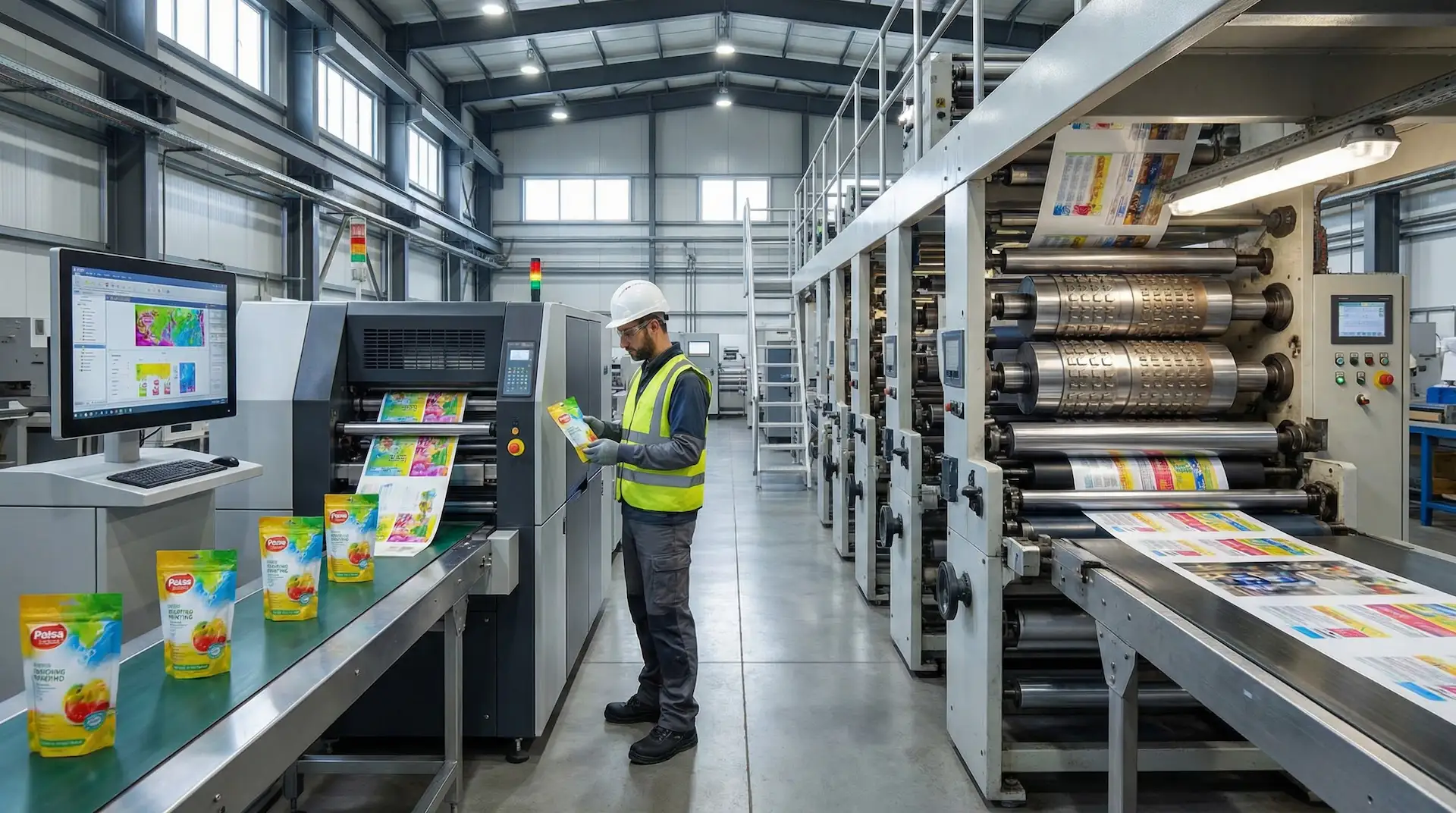
Digital printing sends your artwork from a file straight onto the packaging material. No plates. No engraved cylinders. Nothing physical has to be manufactured before the press can start, which is why setup collapses from weeks to hours.
For flexible packaging, ink is laid directly onto the film that becomes your pouch. Digital printing pouches produced this way hold sharp text, clean gradients, and photographic detail that used to be difficult on film at short volumes.
Digital printing is ideal for:
- Digital printed stand up pouches
- Custom food packaging
- Short production runs
- Several design variations at once
Have a look at what is possible with professional digital pouch printing solutions.
With no plate or cylinder bill sitting in front of the job, testing a product becomes affordable. So does seasonal packaging, and so does fixing a label detail you got wrong the first time.
Understanding Traditional (Conventional) Printing
Conventional printing covers flexographic, rotogravure, and offset. All three transfer ink using something physical: a plate or an engraved cylinder, made specifically for your artwork before anything gets printed.
That tooling is the whole story, cost-wise. It has to be produced, proofed, and mounted before the press runs, which pushes your first unit further out and puts real money on the table up front. Spread across a very large run, that same money almost disappears.
Decades of packaging have come off these presses, and they still handle the bulk of mass-market production. There is a reason for that, and it is not nostalgia.
Digital Printing vs Conventional Printing: Key Differences
Put the two side by side and the split is clearer than most suppliers make it sound. Every row below traces back to one thing: whether tooling has to exist before your job can run.
| Feature | Digital Printing | Conventional Printing |
| Setup Time | Very Fast | Longer |
| Plate Requirement | No | Yes |
| Minimum Order Quantity | Low | High |
| Cost for Small Runs | Lower | Higher |
| Cost for Large Runs | Higher | Lower |
| Design Changes | Easy | Expensive |
| Variable Data | Yes | Limited |
| Ideal For | Short & medium runs | Long runs |
Read that table against your own order size and the answer usually picks itself.
Cost Comparison: Which One Saves More Money?
Quantity decides this, and almost nothing else does. The mistake brands make is comparing the price per pouch without counting what has to be paid before the first pouch exists.
Digital printing has:
- No plate or cylinder fees
- A smaller cheque before production starts
- Less exposure if the product underperforms
That last point matters more than brands expect. Getting a launch wrong on a digital run costs you a run. Getting it wrong on a conventional run costs you a run plus the tooling.
Conventional printing has:
- Higher setup cost
- A lower price per pouch once the volume is there
Print a few hundred thousand pouches and conventional wins clearly on unit cost. Print two thousand and the tooling alone can outweigh everything you saved.
Work out where your real volume sits before anyone quotes you a per-unit price.
Advantages of Digital Printing
Digital earns its place on speed and flexibility rather than raw economics. For any brand whose artwork is still moving, whose volumes are uncertain, or whose launch date is fixed, these five advantages are usually decisive.
1. Fast Turnaround
No plates means no waiting for plates. Jobs start in days rather than weeks, which is the difference between hitting a retailer’s on-shelf date and missing it.
2. Low Minimum Orders
Digital pouch printing runs happily at quantities conventional presses will not entertain. That is what put custom packaging within reach of brands who could never justify it before.
3. High Print Quality
Current digital presses hold gradients, fine type, and photographic images cleanly. Put a digital pouch beside a gravure one on a shelf and most shoppers cannot tell you which is which.
4. Multiple SKU Printing
Six flavors can go through one run. Conventional printing would need six sets of tooling to do the same job, which is why multi-SKU brands lean digital.
5. Reduced Waste
Shorter setup means less film scrapped before the color settles. Less overproduction too, since you are not ordering 20,000 pouches just to justify a plate.
Advantages of Conventional Printing
Conventional printing is what the industry still runs on at scale, and the reasons are practical rather than traditional. Once your artwork stops changing and your volumes climb, these four advantages start compounding on every reorder.
1. Best for Large Volumes
At high enough quantities nothing beats it on cost per unit. The tooling gets divided across so many pouches that it stops registering on the invoice.
2. Strong Color Matching
Spot colors and tight brand matching are where conventional leads. If your identity lives or dies on one exact shade across millions of packs, this is your method.
3. Special Finishes
Metallic inks, heavy coatings, embossing. These are more straightforward on a conventional press, and a few of them are only practical there.
4. Production Stability
Once it is dialed in and running, it stays consistent for hours at a time. For long uninterrupted production, that stability is worth a great deal.
Use Cases: When to Choose Each Method
Your business plan answers this better than any spec sheet can. Match the method to where your volumes and artwork actually are today, not to where you hope they will be next year.
Choose Digital Printing If:
- You need short or medium runs
- You are launching something new
- Testing different designs is part of the plan
- Multiple SKUs share one dieline
- The deadline is tight
- You want personalized or regional packaging
Limited edition snacks and new coffee blends are the classic case, which is why digital printed stand up pouches turn up so often on launches like these.
Choose Conventional Printing If:
- The quantities are genuinely large
- Your artwork has settled and will not move for years
- Specialty finishes are part of the design
- Lowest possible cost per unit at scale is the priority
- You are supplying major retailers with steady, predictable demand
Size your production honestly and the method usually declares itself.
Common Mistakes Businesses Make
Most of the avoidable mistakes here come from comparing the wrong numbers, or from planning for the wrong year. Five come up again and again.
1. Looking Only at Unit Price
Per-pouch cost tells you nothing on its own. Add tooling and setup waste before you decide anything.
2. Ignoring Future Growth
A brand starts at 2,000 pouches and plans to reach 200,000. Pick a supplier who cannot follow you up that curve and you start again from scratch later.
3. Not Considering Lead Time
Tooling adds weeks. If a retailer has given you a date, that delay is not an inconvenience, it is a missed window.
4. Ordering Too Much Inventory
Large conventional runs look cheap per unit right up until the forecast proves optimistic and the spare stock never moves.
5. Overlooking Design Complexity
Detailed graphics and photographic artwork usually behave better digitally. Plan the method around the design rather than the other way round.
Future Trends in Packaging Printing
The industry is moving quicker than it has in decades, and most of the movement points the same way. Five shifts are worth watching if you are choosing a method you intend to stay with.
1. Growth of Digital Printing
Digital keeps taking share, driven by shorter runs and brands that want to change artwork without buying tooling.
2. Hybrid Printing Systems
Some printers now combine both methods on one line, using digital for variable elements and conventional for the rest.
3. Smart Packaging
QR codes, serialized packs, and per-unit variable data. All of this is native to digital and painful on conventional.
4. Sustainable Solutions
Recyclable film structures and low-migration inks are becoming the expectation rather than a premium extra.
5. Shorter Product Life Cycles
Products change faster now. Packaging that takes six weeks to retool cannot keep pace with a brand refreshing twice a year.
Digital printed pouches sit right in the middle of most of these shifts, which is a fair indication of where the market is heading.
Conclusion
Both methods earn their place. Digital suits short runs, multiple SKUs, and any deadline that will not move, while conventional comes into its own on large volumes and specialty finishes. Order size, timeline, and design complexity decide it between them.
Choosing correctly protects your quality, your schedule, and your margin at the same time. Choosing badly usually shows up as either a warehouse of packaging you cannot use or a launch date you cannot hit. Match the method to where your business actually is right now.
Get the Right Print Method for Your Next Run
Looking for high-quality digital printing pouches and custom packaging built around your product? Share your volume, SKU count, and artwork status, and we will price both methods so you can see the difference for yourself.
Get a free quote today and start with the numbers that apply to your run.
FAQs
Q1: Is digital printing better than conventional printing?
Neither is better outright. Digital wins on small to medium runs and quick turnaround. Conventional wins once the quantities get large and the artwork stops changing.
Q2: What is the minimum order for digital pouch printing?
Far lower than conventional, because there is no tooling to pay off. That is what makes it workable for startups, seasonal packs, and limited editions.
Q3: Can digital printing handle stand up pouch digital printing?
Yes. Sharp graphics, strong color, and several SKUs printed in the same batch, all without a cylinder in sight.
Q4: Which method is more eco-friendly?
Digital, for short and medium runs. Less setup waste, and far less overproduction, since you are not forced into a big order to justify the plates.
Q5: Which option is cheaper for large quantities?
Conventional, almost every time. Once tooling is spread across a high-volume run, the cost per pouch drops below what digital can reach.