
























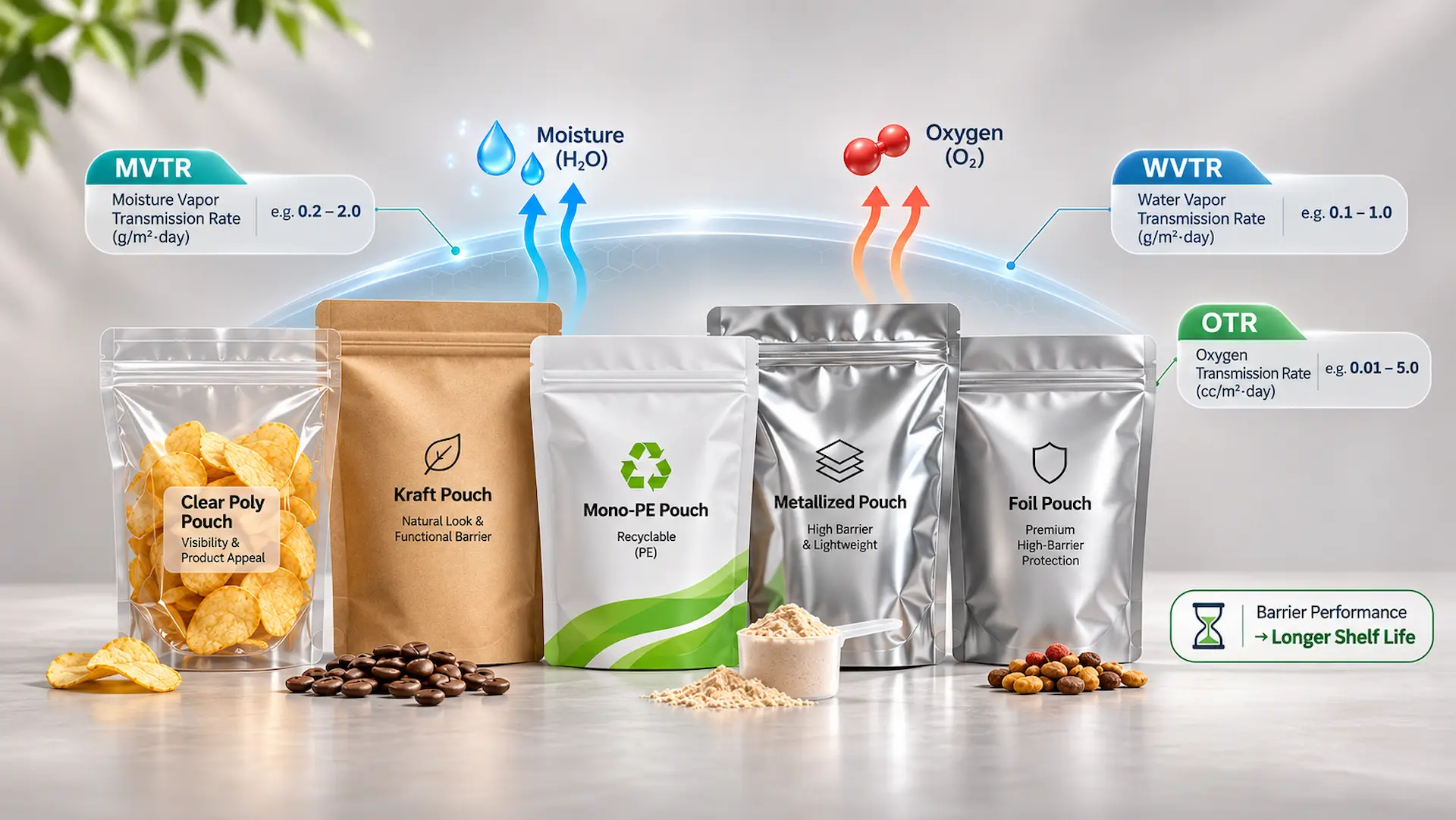
A product’s shelf life is not decided only by its ingredients or how it is stored. Packaging plays a big part, too. Before the first pouch is filled, manufacturers need to know how much oxygen and moisture their packaging material can keep out. That information often starts with three numbers: MVTR, WVTR, and OTR.
These terms may look complicated, but they tell a simple story about how well a packaging material protects what is inside. Two of them measure the same thing, while the third focuses on oxygen. Understanding the difference can help you compare materials, read supplier specifications, and choose the right barrier for your product. Our flexible packaging glossary also explains common terms used in the industry.
MVTR vs WVTR: Two Names, One Measurement
MVTR stands for Moisture Vapor Transmission Rate, while WVTR means Water Vapor Transmission Rate. Both describe how much water vapor passes through a packaging material over a certain period. In most flexible packaging discussions, the terms are used interchangeably.
You may see MVTR in pharmaceutical, medical, and general material discussions, while WVTR is common in packaging specifications and standards such as ASTM F1249. The important point is not which abbreviation a supplier uses. It is whether the test method, conditions, and reported units are clear.
| Term | Where you may see it | What it measures |
| MVTR | Medical, pharmaceutical and material specifications | Water vapor transmission |
| WVTR | Flexible packaging and film testing | Water vapor transmission |
| OTR | Food and flexible packaging specifications | Oxygen transmission |
Both MVTR and WVTR are commonly reported in g/m²/day. A lower value means less water vapor passes through the material under the stated test conditions, which generally indicates a stronger moisture barrier.
What OTR Measures and Why Oxygen Can Be a Major Threat to Product Quality
The third number is the one many food brands look at first.
OTR means oxygen transmission rate: how much oxygen gets through one square metre of film in one day, in cc/m²/day (US suppliers often use cc/100in²/day). Lower usually means stronger barrier protection, but the right value depends on the product.
Oxygen damage is slow and quiet, and you can’t undo it. It:
- Turns the oils in nuts, chips and pet food rancid
- Makes coffee taste flat
- Fades spices and dried fruit
- Breaks down vitamins in supplements
Not every product fears oxygen most, though. Crackers and powders worry more about moisture. Pet food and jerky need both barriers. The product decides which number matters.
How to Read Barrier Numbers on a Spec Sheet
A number on its own means nothing. Three things around it decide if you can trust it.
Units and the 15.5 Conversion
Some US suppliers report per 100 square inches. Most of the world reports per square metre. The link is a factor of 15.5.
| Metric unit | US unit | To convert |
| g/m²/day (WVTR) | g/100in²/day | Metric = US × 15.5 |
| cc/m²/day (OTR) | cc/100in²/day | Metric = US × 15.5 |
A film showing OTR of 0.5 cc/100in²/day is the same film as one showing 7.75 cc/m²/day.
Test Conditions Change Everything
Every data sheet should say what temperature and humidity the test used. The most common conditions are 23°C at 0% humidity for OTR, and 38°C at 90% humidity for WVTR. These are common, not compulsory, and labs can test at other settings.
Humidity matters for some films more than others. EVOH and nylon are strong oxygen barriers when dry, but moisture can reduce that barrier a great deal, depending on grade and conditions. If your product ships somewhere humid, ask for a humid-condition number.
What Counts as High Barrier
A rule of thumb many pouch makers use as a reference point, not a law:
- High oxygen barrier: OTR under about 15.5 cc/m²/day (1 cc/100in²/day in US units)
- Strong moisture barrier: WVTR around 1 g/m²/day or lower, for moisture-sensitive products
Lower usually means stronger barrier protection, but the right value depends on the product.
Important Note: Never compare two barrier numbers tested at different temperatures or humidity levels. A film tested dry will usually look better than the same film tested damp. Ask for the conditions before you ask for the number.
Barrier Properties of Packaging Materials: Real Numbers From Real Pouch Structures
Generic film charts are hard to trust, because thickness, grade and coating quality change the result. So here are the numbers from our own data sheets. Each one is a finished laminate, with the build and total thickness stated.
| Pouch structure | Build | Thickness | OTR (cc/m²/day) | WVTR (g/m²/day) |
| Clear Poly (gloss) | PET12 / LLDPE80 | 3.62 mil | 108.50 | 4.60 |
| Kraft Poly (gloss) | PET12 / Kraft / PET12 / LLDPE80 | 5.2 mil | 62.30 | 3.70 |
| #4 Recyclable mono-PE | PE (coex EVOH) / PE | 4.33 mil | 4.03 | 6.21 |
| Metalized Poly (gloss) | PET12 / VMPET12 / LLDPE80 | 4.09 mil | 1.55 | 0.94 |
| Kraft Metalized (gloss) | PET12 / Kraft / VMPET12 / LLDPE80 | 5.2 mil | 1.41 | 0.83 |
| Poly Aluminum Foil (gloss) | PET12 / AL7 / LLDPE80 | 3.90 mil | 0.02 | 0.31 |
Values are taken from Flexible Pouches material specification sheets. Those sheets do not list test temperature or humidity, so ask us for the conditions before comparing with another supplier. Compare results only when the test method, temperature, humidity and units are equivalent.
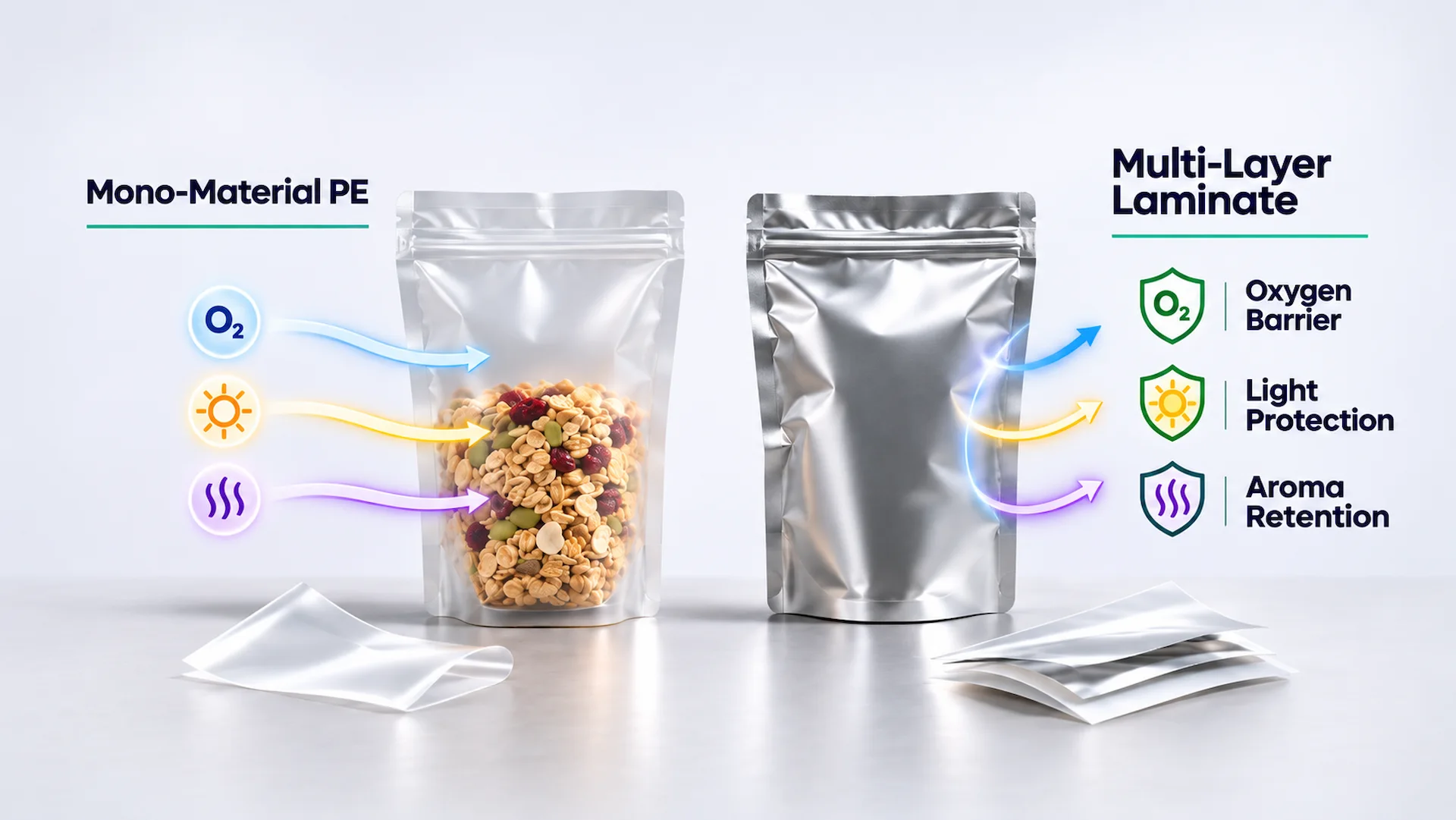
Two things stand out. A metallized layer cuts oxygen transmission by roughly 50 times compared with clear poly. Foil takes it close to zero.
What That Means for the Pouch You Order
- Clear Poly and Kraft Poly: medium barrier, fine for dry goods with shorter dates
- #4 Recyclable mono-PE: PE layers with under 5% EVOH. Much better than clear poly on oxygen, a little behind it on moisture. Check the recyclable mono-PE pouches sheet against your product
- Metalized Poly and Kraft Metalized: high barrier, opaque, the everyday choice for snacks, powders and pet food
- Poly Aluminum Foil: blocks almost everything, for long dates and strong aromas
- Compostable films: also available, with their own data sheet
Why Thickness Doesn’t Fix Barrier
A thicker bag feels safer. It isn’t. Look at the table: the 3.90 mil foil structure beats the 5.2 mil kraft poly on oxygen by thousands of times. Barrier comes from the barrier layer, not the gauge. Thickness buys puncture strength, not shelf life. Our guide to pouch thickness explains mil, micron and gauge.
Matching the Numbers to Your Product and Shelf Life
Which number should you watch? The table below gives rough starting points only. They are illustrations, not specifications. Your product, pack size, shelf life and storage conditions set the real target.
| Product | Main enemy | Watch this number | Illustrative starting point |
| Ground coffee | Oxygen | OTR | As low as possible; metallized or foil |
| Nuts, seeds, chips | Oxygen | OTR | High barrier, under ~15 cc/m²/day |
| Crackers, cereal, granola | Moisture | WVTR | Around 1–2 g/m²/day |
| Protein and supplement powders | Moisture | WVTR | Around 1 g/m²/day or lower |
| Dry pet food, jerky | Both | OTR + WVTR | High barrier on both |
| Flour, rice, grains | Moisture, insects | WVTR | Clear or kraft poly often enough |
Treat every row as a conversation starter and confirm with your own testing. Fresh-roasted coffee also needs a one-way valve, and protein powders often need tighter moisture control than you’d expect.
Pouch Size and Surface Area Change the Math
The numbers are per square metre, per day. A bigger pouch has more film. A longer shelf life has more days. Both raise the total.
A simplified example, just to show the logic:
- Assume a 100 g powder can take in 1 g of water before it clumps
- Assume 12 months and a 20 × 15 cm pouch, about 0.06 m² of film
- So: 1 g ÷ (0.06 m² × 365 days) ≈ 0.045 g/m²/day
That is foil territory. But this ignores seals, changing humidity and how much moisture your product can really take. Use it to understand the idea, not to set a spec.
Seals, Zippers and Valves Leak Too
The film number is the best case. Side seals, gussets, zippers and valves all let a little through, and the air already inside the pouch starts the clock before the film does. Testing the finished pouch can reveal extra transmission from seals, closures and small defects that a flat-film test never sees.
Understanding MVTR and OTR Testing: How the Tests Actually Work
Knowing where the numbers come from helps you trust them, and question them.
The WVTR Test
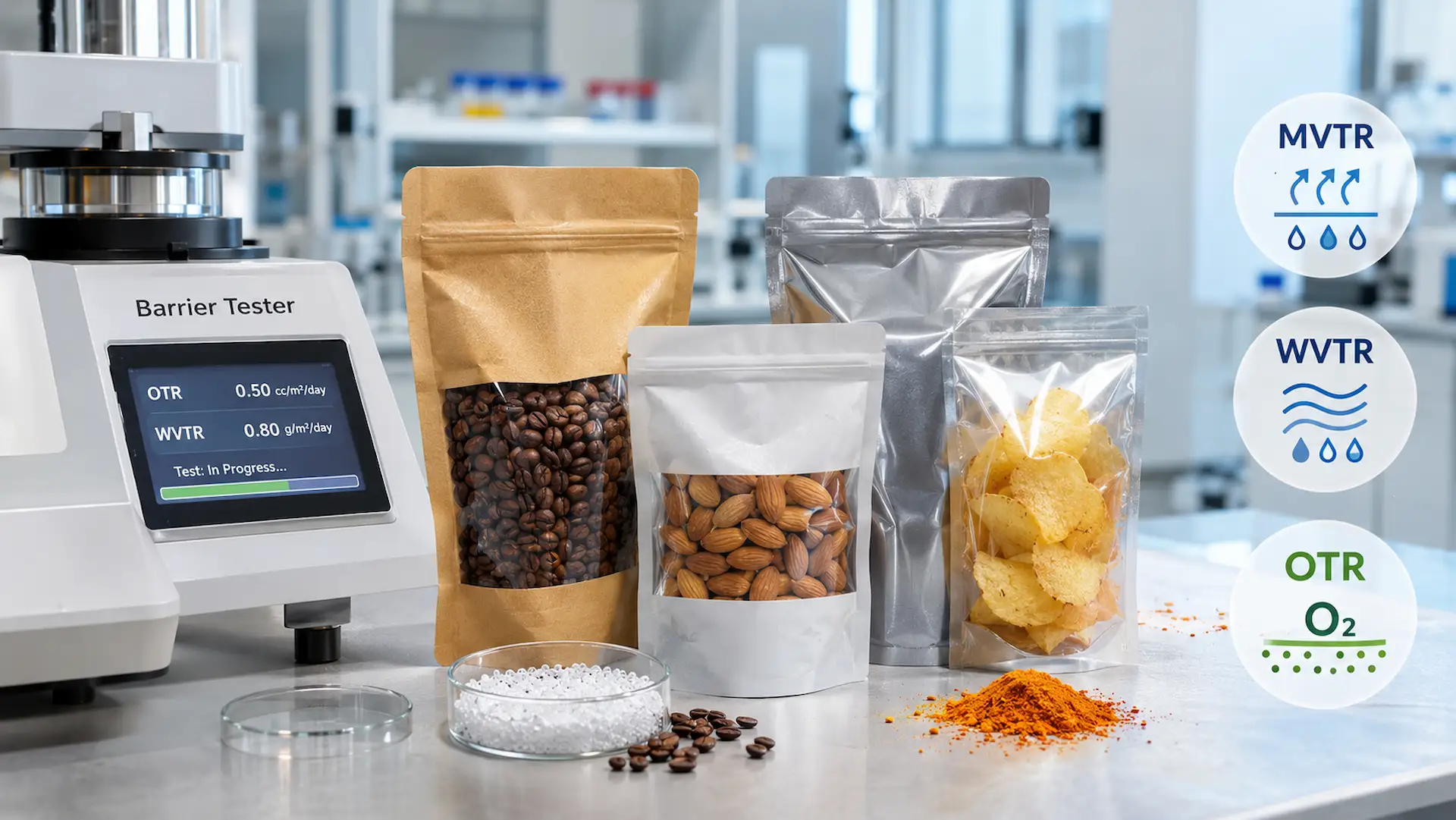
- ASTM F1249: film clamped between a damp side and a dry side; an infrared sensor counts the water getting through. Fast and sensitive, so it is the usual choice for high-barrier films.
- ASTM E96 (cup method): a sealed cup of drying agent is weighed over days. Simple and low-cost, fine for medium and low-barrier materials. For very high-barrier films it is slow and less sensitive, so F1249 is normally preferred.
The OTR Test
- ASTM D3985: dry oxygen on one side, a neutral gas on the other, a sensor measuring what gets through. The main method.
- ASTM F1927: the same test with humidity added. Important for EVOH and nylon.
- ASTM F1307: tests a whole sealed pouch instead of flat film.
Film Test vs Finished-Pouch Test
A film test shows what the material can do. A pouch test shows what your real package does, seals included. They measure different things, so don’t expect the numbers to match. How long a test takes depends on the material, the method, and how long the sample needs to settle to a steady reading.
Laboratories for WVTR and OTR Testing: Where to Send Your Samples
You have three ways to get a number:
- Your film supplier’s data sheet. Free, but tested on flat film in lab conditions.
- Your pouch maker’s own machine. Many larger converters run MOCON or Labthink testers and can test your structure before you order.
- An independent lab. AMETEK MOCON’s lab service, Smithers and Measurlabs all list OTR and WVTR testing to ASTM D3985 and F1249, and can test at conditions that match your product’s real storage, not just the standard ones.
Send flat film or sealed, empty pouches, and ask for a quote and turnaround up front.
Important Note: A test result that does not say the method, temperature, humidity and what was tested is not a usable number. Ask for all four before you accept it.
How Flexible Pouches Helps You Hit the Right Numbers
Each of the structures in the table above has a data sheet on our site with the build, thickness, OTR and WVTR. All films, inks and raw materials we use are FDA grade and safe for food contact.
- Clear, kraft, metallized and foil structures, plus #4 recyclable mono-PE and compostable options
- Any style, including custom printed stand up pouches
- Low minimums; most digitally printed packaging ships within 7–10 business days of art approval
Send us the product and your target shelf life, and we’ll match the numbers before you order.
Conclusion
MVTR, WVTR and OTR are not just jargon. They are the shelf-life forecast for your product, written down before you spend a cent on printing. Check the units, check the test conditions, match the number to what your product really fears, and test the finished pouch, not just the film. Do that, and the numbers stop being a mystery and start doing their job.
Not Sure What OTR or WVTR Your Product Needs? Ask Us Before You Order
Tell us your product, your target shelf life and where it ships. We’ll point you to the right film and send the data sheet.
Frequently Asked Questions
What is the difference between MVTR and WVTR?
None in practice. Both measure how much water vapor passes through a film per square metre per day. MVTR is more common in pharma and medical; WVTR is the term used in ASTM F1249 and on most film data sheets.
What is a good OTR rate for food packaging?
It depends on the product. Under 1 cc/100in²/day (about 15.5 cc/m²/day) is considered a high barrier. Coffee and nuts need to be near that level. Dry grains can tolerate far more.
What WVTR do I need for moisture barrier packaging?
Around 1 g/m²/day or lower for crackers, powders and anything that cakes or softens. Very moisture-sensitive products with long dates may need under 0.1, which means metallized or foil films.
How long does a WVTR test take?
Usually a few days for ordinary films and up to three weeks for high-barrier films, because the sample must reach steady state before the reading is valid.
Does a thicker pouch have a lower OTR?
Not meaningfully. Oxygen barrier comes from the barrier layer, not film thickness. A thin metallized film outperforms thick plain polyethylene by a wide margin.
Can I compare OTR values from two different suppliers?
Only if both were tested under the same temperature, humidity and method, in the same units. If any of those differ, the comparison is meaningless.