



















Packaging does more than hold a product. It keeps moisture out, slows oxidation, protects flavors, and helps products stay fresh until customers open them. For years, manufacturers have relied on multi-layer pouches because different materials work together to provide that protection.
Now, more brands are considering mono-material PE packaging to make their pouches easier to recycle. But changing the material structure raises an important question: will the product receive the same protection? Understanding the barrier differences matters before making the switch. Our guide to mono-material packaging explains the broader shift toward simpler packaging structures.
What Is Mono-Material PE Packaging and How Does It Work?
Before comparing anything, it helps to know what “mono-material” really means. It’s not what most people picture.
Understanding PE Films and Their Role in Mono-Material Pouches
Polyethylene comes in a few grades, and each one does a different job inside the pouch:
- LDPE – soft and flexible. The base of most mono material packaging.
- LLDPE – provides toughness, flexibility, and good heat-sealing properties. It is commonly used in inner sealing layers and other PE film structures.
- MDO-PE – polyethylene film stretched in the machine direction to improve stiffness, dimensional stability, and print performance.
A pouch built from these grades is still a laminate. It just stays inside one polymer family. PE-based structures are designed to be compatible with polyethylene recycling streams, although actual acceptance depends on the complete package and applicable recycling guidelines.
How Mono-Material PE Pouches Are Designed for Packaging Performance
A typical all-PE pouch uses two films. The outer one is oriented, so it holds the artwork and gives the bag some shape. The inner one seals. Add a PE zipper and a PE valve, and the whole thing stays recyclable. Getting the film thickness right matters more here than with PET, because PE is softer and needs a little extra body to stand up on a shelf.

What Are Multi-Layer Pouches and Why Are Different Materials Combined?
Now the other side. The conventional multi layer pouch structure exists for a simple reason: no single plastic does everything well.
Common Materials Used in Multi-Layer Pouch Construction
Common materials include:
- PET: Provides strength, stiffness, and a suitable printing surface.
- PE: Commonly serves as the inner heat-sealing layer.
- Metallized PET: Adds a thin metallic coating to improve barrier protection.
- Aluminum foil: Provides excellent protection against oxygen, moisture, and light when the foil remains intact.
You can see all of these on our flexible pouch material options page.
How Different Layers Work Together to Protect Products
Each layer covers a weakness in the others. PET gives stiffness and keeps oxygen out better than PE does. Metallized PET and foil block light and most gas. PE inside makes the heat seal. Bonded together, they protect better than any one of them could alone. The catch is that bond. Once PET, metal and PE are glued into one film, no recycling plant is going to pull them apart again.

Mono-Material PE vs Multi-Layer Pouches: How Do Their Performance and Structures Compare?
Here’s the whole mono material vs multi layer packaging argument in one table. The sections after this go deeper on the barrier rows.
| Comparison factor | Mono-material PE | Multi-layer laminate |
| Material composition | One polymer family (PE) | PET, metal or foil, PE |
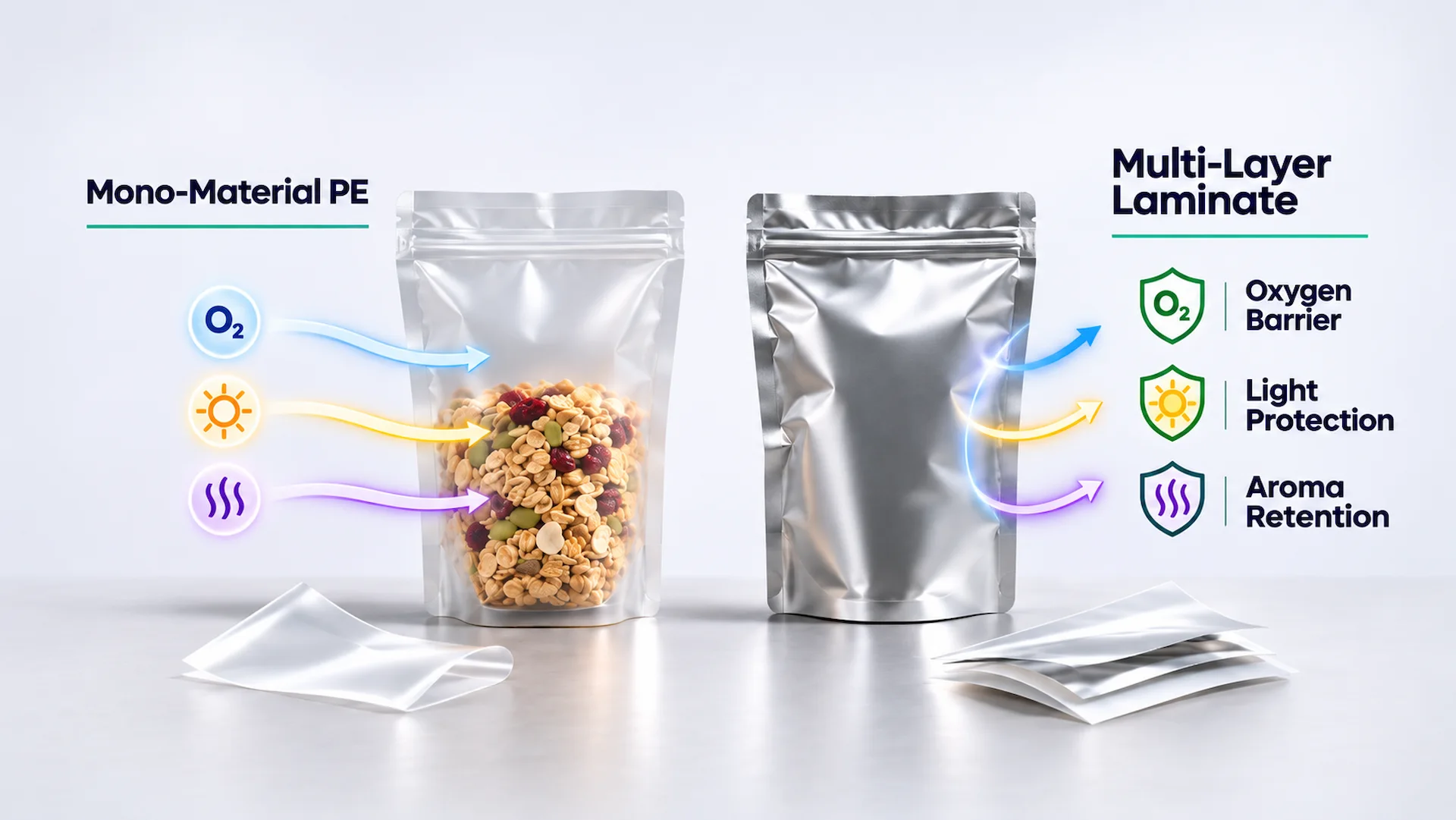
| Oxygen barrier | Low to medium (medium-high with EVOH) | Medium to very high |
| Moisture barrier | Good | Good to excellent |
| Light protection | Clear unless pigmented or metallized | Opaque options block nearly all light |
| Aroma retention | Fair | Good to excellent |
| Mechanical performance | Softer, less stiff | Stiffer, higher puncture resistance |
| Sealing performance | Wide seal window, easy to run | Depends on sealant layer |
| Recyclability | Designed for the PE stream, store drop-off | Recycling is more challenging and depends on local infrastructure |
| Shelf-life suitability | Short to medium shelf life | Suitable for demanding shelf-life requirements when the selected barrier structure is validated |
Not every laminate sits at the top of those ranges. A plain PET/PE pouch is closer to mono-PE in barrier than it is to foil. Keep that in mind when you compare.
What Barrier Performance Do You Give Up When Switching to Mono-Material PE?
This is the real question. Let’s go through the losses one at a time, starting with the biggest.
Oxygen and Aroma Protection: Where Ordinary PE Falls Short
PE film barrier properties are lopsided. PE is good at stopping water vapor. It is poor at stopping oxygen. The reason is in the material itself:
- PE is non-polar, so water molecules struggle to pass through it.
- Small gas molecules like oxygen slip through the looser regions of the film fairly easily.
- PET is denser and more ordered, so it slows oxygen down.
- Foil has no gaps at all, which is why it blocks almost everything.
Why does that matter? Oxygen is what turns nuts rancid, fades spices, and makes coffee go flat. It’s also the main reason flexible packaging shelf life drops when you switch.
Aroma works the same way, just in reverse:
- Flavour and fragrance molecules are small and oil-friendly.
- PE absorbs them and lets them escape.
- A PET or foil laminate holds them in far longer.
So for oxygen sensitive products, ordinary mono-PE on its own is usually not enough. You either add a barrier layer (more on that below) or you accept a shorter shelf life.
Light Protection and Its Impact on Product Shelf Life
Standard PE is clear. Foil and metallized PET are opaque. That’s a bigger deal than it sounds, because light, and UV light in particular, gives oxidation a push and bleaches natural colour. Think of green tea, dried herbs, or anything with natural fats.
You can print a solid white or colour layer onto PE, and that helps. Pigmented films help too. But neither matches the near-total light barrier packaging gets from foil or a metallized layer.
Important Note: Making the PE film thicker does not fix the oxygen or light gap. A thicker film mostly adds stiffness and moisture resistance. Oxygen still passes through at a similar rate per layer. You end up paying for more plastic without solving the actual problem.
How Engineered PE Structures Improve Barrier Performance
The good news: today’s mono-PE is a long way from a plain poly bag. A few technologies close most of the gap for most products.
MDO-PE, EVOH, and Advanced Barrier Coatings
- MDO-PE – the stretched outer film. It doesn’t add a barrier, but it gives the pouch the stiffness and print quality buyers expect from PET.
- EVOH – a thin oxygen-blocking layer sandwiched between PE layers. A small amount cuts oxygen transmission dramatically while keeping the pouch in the PE stream. The permitted EVOH content depends on the applicable PE-film recycling guidelines and the complete packaging structure. EVOH barrier film is the usual route for high barrier flexible packaging that still recycles.
- Barrier coatings – clear coatings, such as AlOx or SiOx, applied to the PE surface. They help with oxygen and aroma without adding a separate material.
One warning. These layers only work as part of a complete design. The amount of EVOH, the adhesive, the ink coverage and the zipper all affect both barrier and recyclability. “Contains EVOH” on a spec sheet tells you very little on its own.
Which Packaging Structure Is Best for Your Product’s Barrier Requirements?
Here’s the part that actually decides your order. The right answer depends on the product, not the trend.
Mono-material PE usually works well for:
- Dry snacks, chips, pretzels, crackers
- Granola, cereal, grains, rice, flour
- Pet treats and dry kibble in smaller sizes
- Candy and gummies
- Refill pouches for detergents and personal care
Mono-PE with EVOH or a coating is usually needed for:
- Nuts, seeds, and anything with natural oils
- Protein and supplement powders
- Coffee and tea (with a PE degassing valve for fresh-roasted coffee)
- Jerky and dried meat
Stick with a multi-layer laminate when:
- You need 12 to 24 months of shelf life
- The product is light-sensitive or strongly aromatic
- Packs are retorted or hot-filled — standard PE can’t handle retort pouch temperatures
Beyond the product itself, think about where it’s going. Hot, humid warehouses, long sea freight, and small pack sizes with lots of surface area per gram all push you toward more barriers. Mono material stand up pouches for a local snack brand with a four-month turnover? Easy switch. The same bag shipped to the Gulf with a one-year date? Test first.
Important Note: A recyclable film does not automatically make a recyclable pouch. The zipper, the valve, the label and even heavy ink coverage can push a pack out of the PE stream. Ask your supplier for the full structure before you print any recycling claim. Our guide on recyclable stand up pouches covers what else to check.
How to Test Barrier Performance Before Switching Pouch Materials
Never switch on a data sheet alone. Film numbers come from flat samples in a lab. Your product lives in a sealed, folded, shipped pouch.
Run these before you commit to a large order:
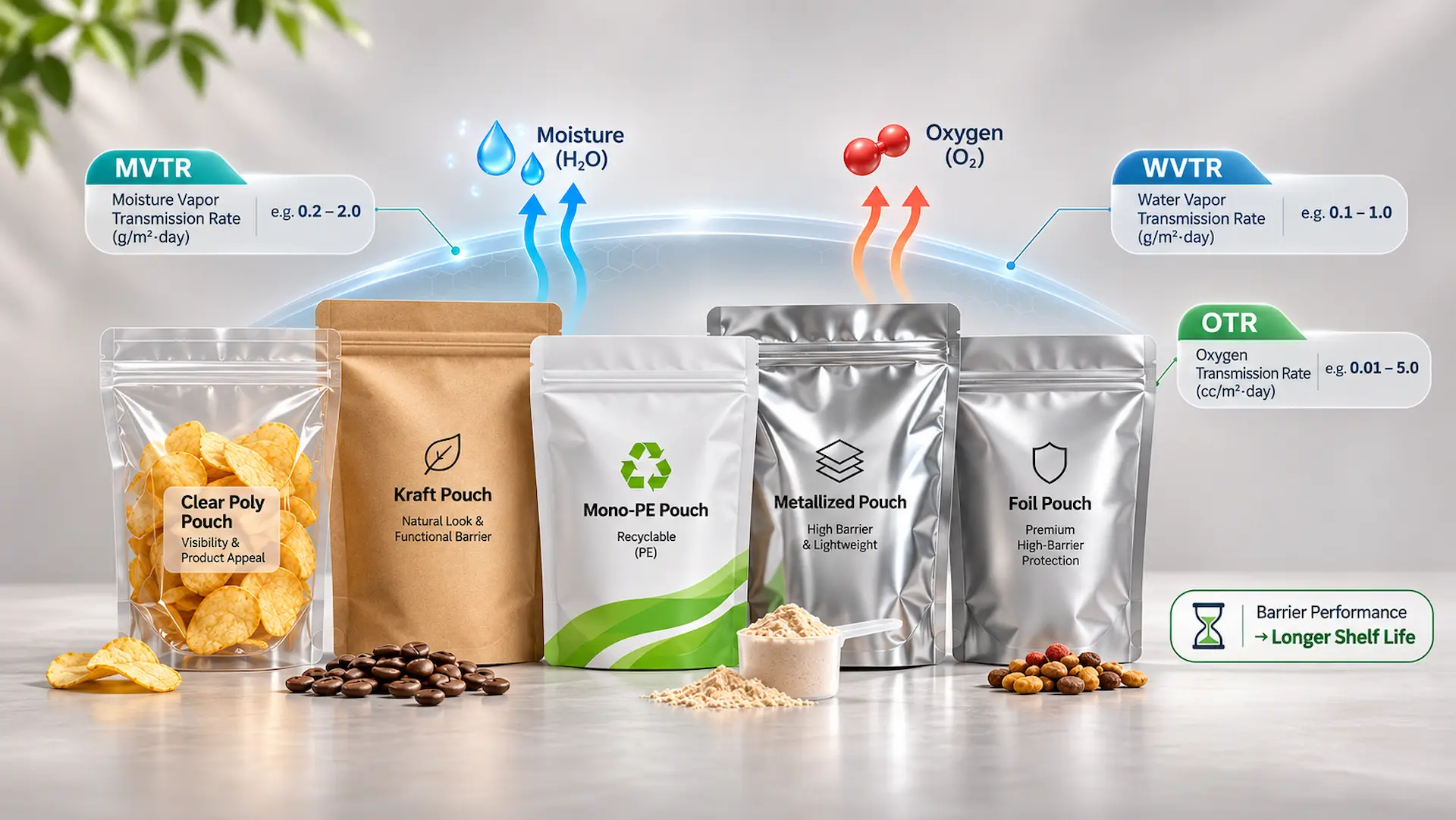
- Oxygen transmission rate (OTR) – measures how much oxygen passes through the film. Lower is better. Ask for the test temperature and humidity, because the number changes with both.
- Water vapor transmission rate (WVTR) – the same idea for moisture.
- Heat seal integrity – seal strength across the top, sides and bottom gusset. Pouches fail where layers overlap, not in the flat middle.
- Leak test – a simple pressure or dye test on finished pouches.
- Finished pouch testing – OTR measured on the whole sealed bag, not just the film.
- Shelf-life validation – fill real product, store it in real conditions, and open it at intervals. This is the only test that answers the question your customer will ask.
If you’re planning ahead for rules like the EU’s recyclable-by-2030 target, our PPWR breakdown explains what’s coming and when.
Conclusion
Mono-material PE gives up oxygen, light and aroma barrier compared with a foil or metallized laminate. That’s the honest trade. For dry, short-to-medium shelf life products, you’ll barely notice it. For oily, aromatic or long-dated products, EVOH and coatings can recover most of the gap, and for the rest, a multi-layer pouch is still the right call. Know your product, test the finished pouch, and the choice makes itself.
Not Sure Which Structure Your Product Needs? Let’s Find Out Together
Send us your product, your target shelf life and where it ships. We’ll recommend a structure, send samples, and help you run the tests before you commit. Our recyclable #4 mono-PE pouches start at 1,000 units and usually ship within 10 business days.
FAQs
1- What is mono-material PE packaging?
It’s a pouch made entirely from polyethylene grades, including the zipper and valve. Because it’s one polymer family, it’s designed for PE recycling streams such as store drop-off programs, where those programs accept it.
2- What are multi-layer pouches made of?
Usually three bonded films: a PET outer layer for print and stiffness, a middle barrier layer such as metallized PET or aluminum foil, and a PE inner layer for heat sealing.
3- Is mono-material PE as strong as multi-layer packaging?
Seal strength is similar. Stiffness and puncture resistance are lower unless MDO-PE is used. For most dry goods it’s more than strong enough.
4- Does mono-material PE provide the same oxygen barrier as aluminum foil?
No. Foil blocks almost all oxygen. Even EVOH-enhanced PE lets a little through. It’s close enough for many products, but not for everything.
5- Can EVOH improve the barrier performance of mono-PE?
Yes, and it’s the most common way to do it. A thin EVOH layer sharply reduces oxygen permeability while keeping the pouch recyclable, as long as the amount stays within the applicable recycling guidelines.
6- Can mono-material PE pouches protect products with long shelf-life requirements?
Sometimes. Dry products with low fat content can reach 12 months in a high-barrier mono-PE structure. Oily, aromatic or light-sensitive products with long dates still do better in a laminate. Always validate with real products.