



























Food brands have leaned on grease-resistant, moisture-proof packaging for decades now. It’s the reason a pizza box doesn’t turn to mush and a bag of chips stays crisp until you open it. And the chemistry doing most of that heavy lifting? PFAS. Which happens to be under more scrutiny today than at any point in its history.
So here’s what this guide walks through: what PFAS actually are, why brands are backing away, and where the regulations stand right now. Plus the alternatives that genuinely work, how to tell if a “PFAS-free” claim means anything, and how to switch without wrecking your production line along the way.
What Are PFAS and Why Were They Used in Food Packaging?
PFAS is short for per- and polyfluoroalkyl substances. They’re synthetic, engineered to shrug off oil, heat, and water, and so chemically stubborn that they hardly break down once they’re loose in the environment. That last part is where the “forever chemicals” nickname comes from. Nobody in marketing dreamed that up. It’s just what they do.
For years, PFAS treatments gave food packaging several useful properties:
- Oil and grease resistance
- Moisture resistance
- Stain prevention
- Heat and chemical resistance
- A clean, consistent appearance during food service
You’ll still find PFAS-treated materials all over the place: wrappers, paperboard containers, pizza boxes, microwave popcorn bags, molded-fiber containers, barrier-treated papers. For years this was simply how it was done. Cheap, reliable, got the job done without much fuss. Which is precisely why walking away from it now is such a shift for the whole industry.
Why Are Food Brands Moving Away from PFAS?
The move away from PFAS in food packaging isn’t about one single trigger. It’s several pressures landing at once.
Health and Environmental Concerns
The worry about forever chemicals in food packaging didn’t appear from thin air. PFAS lingers in soil and water for a very long time after the packaging is in a landfill, and in certain cases it migrates out of the packaging and into the food. For whoever ends up eating that food, and for the environment it all drains into, that’s a genuine concern rather than a theoretical one.
Changing Packaging Regulations
Rules are tightening in several regions at the same time, and that shifts the whole cost-benefit picture for PFAS-based packaging. Each new rule makes it a little harder to defend on commercial grounds. Drag your feet too long and you tend to end up paying for a scramble later, rather than a switch you planned on your own terms.
Retailer and Consumer Expectations
Retailers, restaurant chains, and procurement teams are asking harder questions before they sign off on packaging these days. So are shoppers, honestly.
A brand that can’t give a straight answer about what its packaging is made from risks losing both the shelf space and the trust that comes with it.
Brand Reputation and Supply-Chain Risk
A packaging recall is expensive. So is a last-minute reformulation.
Add inconsistent supplier information into the mix, and you’ve got significant risk on your hands, one that only gets worse the closer you get to a legal deadline with no room left to test or adjust.
What Do Current PFAS Packaging Regulations Mean for Brands?
Understanding the current rules doesn’t take a law degree, just a practical rundown of what matters right now.
PFAS Rules in the United States
In February 2024, the FDA confirmed that PFAS-based grease-proofing substances were no longer being sold for food contact use in the U.S. It’s worth flagging that this was a voluntary industry phase-out, not a formal ban on PFAS itself. Still, it mattered. It shut off a major source of dietary PFAS exposure from approved packaging uses. The FDA followed up in January 2025, declaring 35 related food contact notifications no longer effective once the substances behind them were out of production.
That’s not the whole story, though. A handful of U.S. states have their own PFAS restrictions on food packaging, so if you’re selling nationally, one federal announcement doesn’t mean you’re covered everywhere.
PFAS Limits under the European PPWR
The EU’s Packaging and Packaging Waste Regulation, the PPWR, sets hard numeric limits on PFAS in food-contact packaging: 25 ppb for any individual PFAS substance, 250 ppb combined for non-polymeric PFAS, and 50 ppm for total fluorine. These limits apply from August 12, 2026, which is weeks away, not some distant future date. There’s no grandfathering clause either. Packaging that misses the limits can’t be sold in the EU after that date, even if it was manufactured earlier.
Why Global Brands Need More Than One Compliance Checklist
Packaging almost never gets made, filled, and sold all in the same spot. It’s made in one country, filled in another, then sold across a few more on top of that. A supplier statement that satisfies one market won’t automatically hold up in the others, which means anyone selling across borders needs paperwork tailored to each region, not one blanket assurance stretched thin to cover everything.
How Are Brands Replacing PFAS Without Losing Packaging Performance?
This is the central question underneath everything else, and it’s where the actual alternatives to PFAS in food packaging start to matter. Here’s the encouraging part. Most brands that get this right aren’t hunting for a single chemical swap. They’re rethinking the material, the coating, sometimes the entire pouch structure, to get the same job done without PFAS.
Fluorine-Free Water-Based and Bio-Based Coatings
Starches, plant proteins, natural polymers, mineral barriers, clay, wax. Manufacturers are drawing on the whole lot of them to put together fluorine-free coatings that still stand up to grease and moisture.
The catch is that performance really does hinge on the product. A dry snack and a greasy takeaway meal ask completely different things of a coating, different seal, different heat tolerance, different moisture barrier, so a coating that’s brilliant for one can flop on the other.
Naturally Grease-Resistant Papers and Fiber Engineering
Not every solution needs a coating at all.
Some papers get their grease resistance from refining the fibers, packing the material more densely, or tweaking the manufacturing process itself, no added treatment required. It’s a simpler route, and it works especially well for bakery items and other drier products.
Molded Fiber and Plant-Based Packaging
Molded pulp, bagasse, and seaweed-based barriers are all gaining serious traction as renewable packaging options. It’s easy to see why. They look and feel natural, and that plays well with brands chasing a more sustainable shelf presence.
Important: A natural look doesn’t automatically mean a package is PFAS-free or safe. Plant-based packaging still needs proper testing before that claim goes anywhere near a label.
Recyclable Flexible Packaging
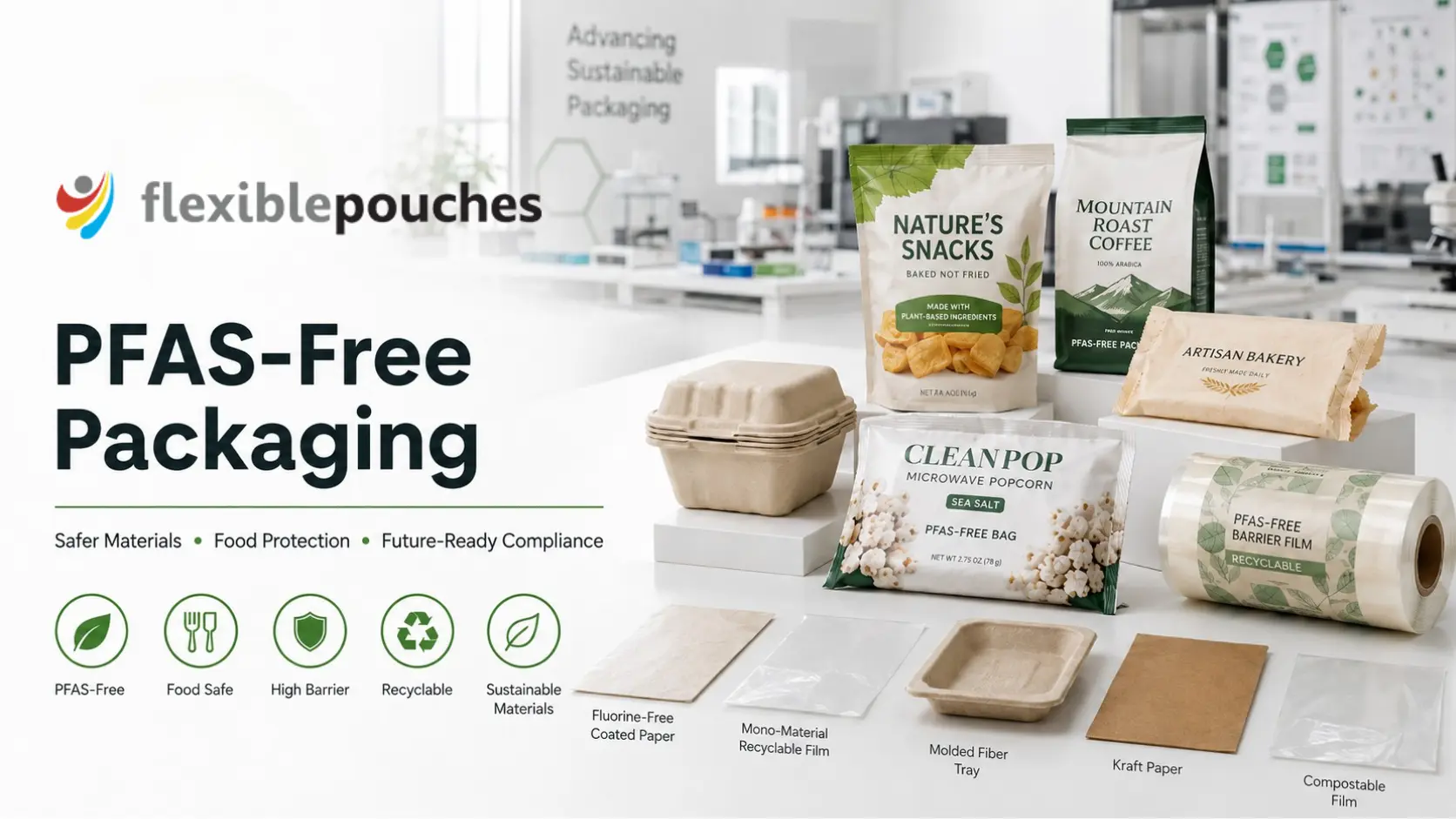
Mono-material flexible packaging deserves a look here too. Because it’s built from a single material type, it can still handle moisture protection, oxygen barriers, and dependable sealing, and it recycles far more cleanly than a mixed-material laminate ever will. Recyclable flexible packaging, sustainable flexible packaging, food-safe packaging materials. One format quietly ticks all three boxes, and that’s a big part of why it’s getting so much attention at the moment.
Biodegradable and Compostable Flexible Packaging
Kraft-PLA and certified compostable films are opening the door toward compostable flexible packaging for brands ready to make the jump.
Important: Biodegradable doesn’t automatically mean home compostable. Compostable doesn’t automatically mean PFAS-free. Disposal infrastructure and proper certification matter just as much as the base material.
Comparing the Main PFAS-Free Food Packaging Alternatives
Adjectives will only take you so far when you’re sizing up packaging options against each other. Hard numbers do the job better. So how do the leading alternatives actually compare, laid out side by side?
| Packaging Solution | Suitable Applications | Main Benefits | Points to Verify |
| Fluorine-free barrier coatings | Wrappers, trays, cartons | Grease and moisture resistance | Coating chemistry and recyclability |
| Uncoated grease-resistant paper | Bakery and selected dry or oily foods | Simple material structure | Moisture and shelf-life limits |
| Molded fiber packaging | Takeaway meals and foodservice | Renewable fiber content | Barrier treatment and compostability |
| Recyclable mono-material films | Snacks, powders, dry foods, and retail products | Strong sealing and barrier performance | Local collection availability |
| Biodegradable or compostable films | Selected dry foods and specialty products | Alternative end-of-life pathway | Certification and disposal conditions |
| Seaweed or plant-based barriers | Foodservice and emerging applications | Renewable-material potential | Scale, cost, and product suitability |
This table won’t replace lab testing. Nothing will. But it’s a solid jumping-off point before you go to suppliers with harder questions.
How Can a Brand Confirm That Packaging Is Truly PFAS-Free?
Not every PFAS-related claim carries the same weight, and that difference trips up more people than you’d think. These terms get thrown around as if they’re interchangeable. They aren’t:
- PFAS-free
- No intentionally added PFAS
- PFOA-free
- Fluorine-free
- Food-contact compliant
Mix them up on your own packaging, and you’re exposing yourself to legal risk you don’t need. Each term has its own scope. Treat them that way.
Request Complete Supplier Documentation
Ask your suppliers for declarations that cover every component, not just the headline film or paper. Coatings, inks, adhesives, seals, zippers, valves. Any one of them can sneak PFAS in even when the base material is spotless.
Use Appropriate Laboratory Testing
Assurances are fine as far as they go. Data goes further. Targeted PFAS analysis and total fluorine screening hand you something concrete to lean on, so keep an eye on detection limits and how samples get chosen, and push for third-party test reports rather than taking a supplier at their word.
Review Every Part of the Finished Package
A spotless base film counts for little if the coating, the adhesive, or some processing aid elsewhere in the package isn’t spotless too. Look at the finished product as a whole, not just its star component. That’s usually exactly where the trouble is sitting.
Avoid Unsupported Sustainability Claims
Don’t call something non-toxic food packaging, fully recyclable, compostable, or PFAS-free unless you can back that specific claim up with evidence. Vague claims are a liability. They damage trust just as fast as they build it, sometimes faster.
A Practical PFAS-Free Packaging Transition Plan for Food Brands
Moving away from PFAS works best as a structured project, not a rushed swap under deadline pressure. Six steps, in order, keep it manageable.
Step 1: Audit Existing Packaging
Map every food-contact material, coating, supplier, product category, and sales market you currently touch. You can’t fix what you haven’t fully mapped out first.
Step 2: Define the Required Barrier Performance
Document what each product actually needs: oil, moisture, oxygen, light, temperature, shelf-life. Not last year’s spec. This year’s reality.
Step 3: Ask Suppliers the Right Questions
Request chemical declarations, food-contact documentation, test reports, certifications, and market-specific compliance information upfront, before any material gets the green light.
Step 4: Compare Suitable Alternatives
Weigh recyclable, biodegradable, compostable, fiber-based, and coating-based options against what the product actually needs, not what looks impressive on a spec sheet.
Step 5: Create and Test Prototypes
Test sealing, leakage, shelf life, odor, migration, transport handling, printing, and everyday consumer use before locking in a final structure. Skip this step, and you’ll find out the hard way, after launch.
Step 6: Update Claims and Scale Carefully
Match the packaging artwork, sustainability statements, disposal instructions, and internal records to the final tested structure. Then, and only then, scale production.
What Should Brands Consider When Choosing Sustainable Flexible Packaging?
There’s no universal “best” option here. What’s right for you comes down to how your whole product-and-packaging system behaves together, never one factor considered on its own.
- Food type and fat content
- Moisture and oxygen sensitivity
- Required shelf life
- Heat-sealing conditions
- Filling equipment compatibility
- Storage and transportation needs
- Printing and branding requirements
- Recyclability or compostability infrastructure
- Regulatory markets you sell into
- Minimum order quantity and commercial scale
This is where an experienced packaging partner earns its keep. Flexible Pouches offers recyclable and biodegradable pouch materials, custom sizing, and prototype support, so you can test a genuine structure against your own product before committing to a full production run.
The Business Benefits of Moving to PFAS-Free Packaging Early
Switching to sustainable food packaging alternatives early pays off in ways that go well past simple compliance.
- Better preparation for changing regulations
- Lower reformulation and packaging-replacement risk
- Stronger conversations with retailers and procurement teams
- Greater customer confidence in your brand
- Clearer sustainability communication
- More time to test performance before deadlines arrive
- A chance to improve the whole packaging structure, instead of rushing a last-minute substitute
Conclusion: Replacing PFAS Requires Better Packaging Decisions
Swapping out PFAS was never just a case of crossing one chemical off a list. You’ve got to know what the packaging is actually doing, find a replacement that suits the product properly, and test the whole thing before it ever reaches a customer. Someone independent should be checking the supplier’s claims, too. And whatever material you land on has to fit a recycling or composting setup that genuinely exists, not one that only works on paper.
Handle it well, though, and eco-friendly food packaging can protect what’s inside, keep you on the right side of the rules, and give the brand a lift, all at the same time. You don’t need some dated chemical trick to get there. The brands pulling ahead tend to be the ones that treat this as a chance to build something better, rather than a mess they’re scrambling to clean up.
Build Safer, Future-Ready Food Packaging
Ready to build custom food packaging around your product’s actual barrier, shelf-life, sustainability, and branding needs? Work with Flexible Pouches to compare recyclable, biodegradable, and high-barrier options, and land on a structure that genuinely fits what you sell.
Get in touch for a free quote, and start testing a safer structure before your next production run.
FAQs
1. What is PFAS-free food packaging?
It’s packaging that hits a defined PFAS-free standard, and can prove it, through supplier paperwork or lab results. Not just a claim someone typed onto a marketing sheet.
2. Why were PFAS added to food packaging?
Mostly to fend off grease, oil, moisture, stains, and heat. That mix kept food fresher for longer and stopped the packaging from looking greasy or worn during handling and service.
3. Are PFAS banned in food packaging in the United States?
Not really. The FDA confirmed a voluntary market phase-out of PFAS grease-proofing substances on paper and paperboard packaging, and that’s a different thing from a formal nationwide ban. You still have to watch state-level rules and the other ways PFAS can turn up.
4. What is the difference between “PFAS-free” and “no intentionally added PFAS”?
“No intentionally added PFAS” simply means nobody added it on purpose. It says nothing about contamination, processing aids, or PFAS tucked away in some other part of the package. “PFAS-free” is the bigger claim, so it really ought to come with testing to back it up.
5. Are biodegradable and compostable packages automatically PFAS-free?
No. Where a material came from, or how it breaks down at the end, tells you nothing by itself about whether PFAS is in there. Only documentation and testing can settle that question.
6. How can food brands verify a PFAS-free packaging claim?
Begin with supplier declarations and a full breakdown of what’s in the material. Then back that up with third-party testing, targeted PFAS analysis, and total fluorine screening. Testing the finished package rather than a single component gives you one more layer of certainty.