
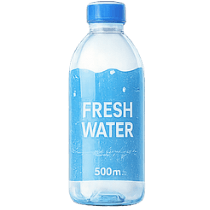













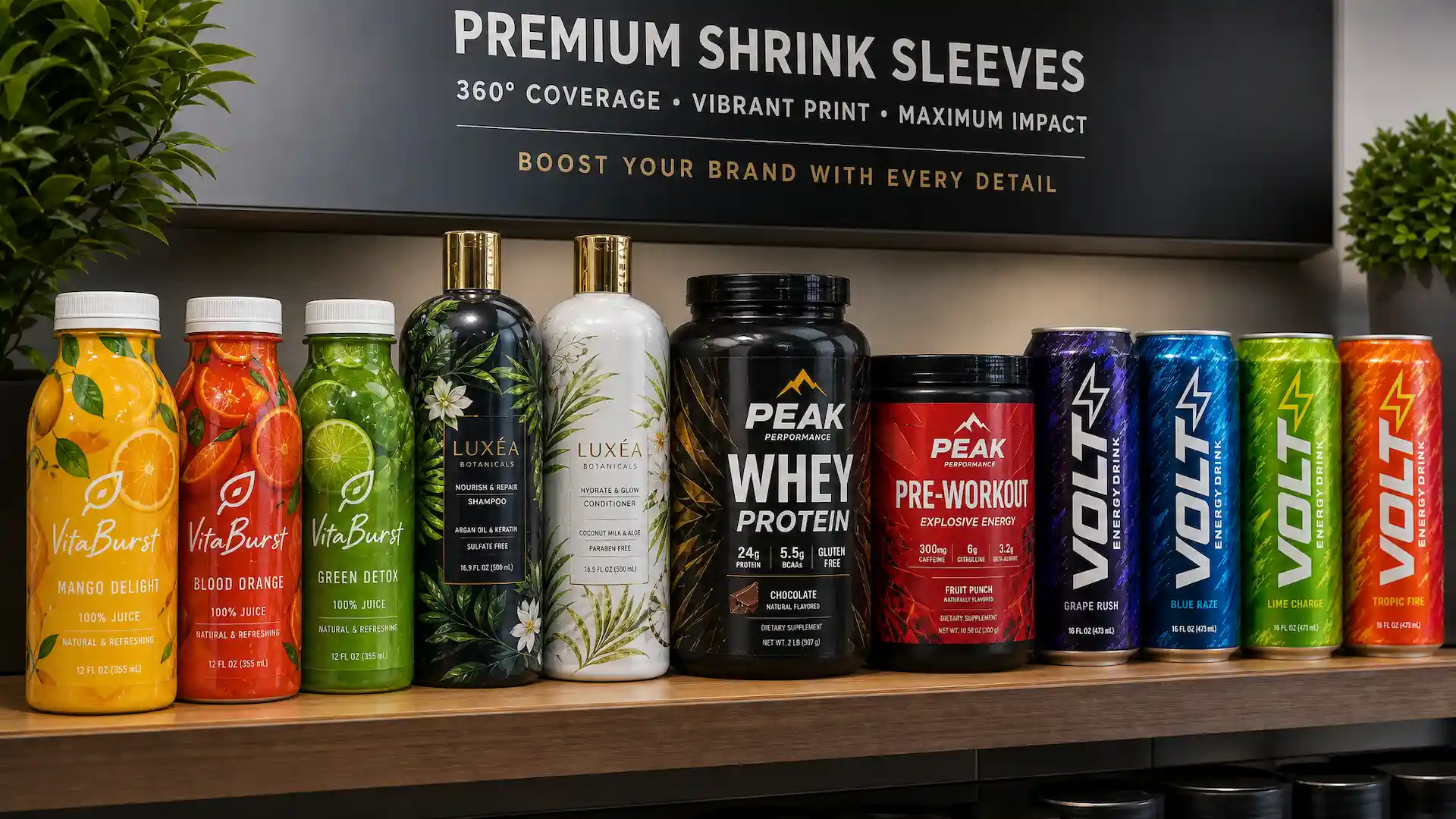
Grab any energy drink, shampoo, or juice bottle from a store shelf and flip it around. The label covers the whole thing back, sides, curves, all of it. No bare plastic anywhere. That is not a sticker. That is a shrink sleeve. A flat label gives you a panel. A shrink sleeve gives you the entire container as your canvas, from top to bottom, edge to edge.
Good brands know the packaging starts selling before a shopper picks anything up. A shrink sleeve makes the product look complete not labeled, but finished. It works on round bottles, tapered jars, wide-mouth tubs, weird shapes that nothing else would grip cleanly. Whatever the container, the sleeve wraps it and your brand shows up on every single side.
What Are Shrink Sleeves?
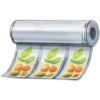
A shrink sleeve is a printed plastic film tube. It goes over the container, heat is applied, and the film shrinks tight to the shape of whatever is underneath no bubbles, no wrinkles, no edges lifting anywhere.
That is the whole game with shrink sleeve labels. A regular sticker covers a flat section and stops there. A shrink sleeve goes all the way around curves, tapers, narrow necks, odd shapes, whatever the container throws at it. The sleeve grips every surface and your design stays exactly where you put it.
How Shrink Sleeve Labeling Works
First question most people ask before ordering how does it actually work? Five steps:
- Film Printing — The sleeve artwork is printed on flat plastic film. The design is stretched during this step so it looks correct after the film shrinks.
- Tube Forming — The flat printed film gets folded and seamed into a tube sized to the container’s diameter.
- Sleeve Placement — The tube goes over the container. By hand for small batches, by automated applicator for bigger production runs.
- Heat Tunnel — The container moves through a heat tunnel. Hot air hits the film and it pulls tight — every curve, taper, and edge gripped cleanly.
- Done — No loose edges, no slack anywhere. Sits flush, looks clean, ships to retail.
📝 Important Note: Shrink sleeve artwork must be distortion-compensated before it goes to print. The film shrinks during application, so what looks stretched and odd in the flat file will look perfectly normal on the finished container. If you submit artwork without this correction, graphics will distort visibly on the final product. Always ask your supplier for a distortion template before building your design file.
Types of Shrink Sleeves — Which One Do You Need?
Not every product needs the whole container covered. Pick the format that fits what you actually need:
| Type | Coverage | Best Used For |
| Full-Body Sleeve | Entire container surface | Maximum branding, beverages, food, cosmetics |
| Neck Band / Tamper Evident | Cap and neck area only | Product security, tamper evidence, pharma |
| Partial Sleeve | One section of the container | Budget-conscious or promotional labeling |
| Multipack Sleeve | Groups multiple products together | Bundled retail products, promotional packs |
Full-body is the go-to when shelf impact is what you are after. Neck bands make sense in pharma and food where tamper evidence is not optional it is a legal box that has to be ticked. Partial sleeves come in handy when a product needs a packaging update but nobody has the time or budget for a full redesign right now.
Shrink Sleeve Materials: PVC, PETG, and OPS
Material selection changes everything the way the sleeve prints, how it handles on the container, and whether it fits your sustainability story. Three films cover most of the market:
| Material | Shrink Rate | Clarity | Eco-Friendly | Best For |
| PETG | High | Excellent | Recyclable | Complex shapes, premium look |
| PVC | Medium | Good | Less sustainable | Budget runs, simple shapes |
| OPS | Medium | Good | Moderate | Lightweight containers |
PETG is what most brands pick today. Prints sharp, shrinks well on complex shapes, and it is recyclable. Any brand with a sustainability checkbox to tick usually starts here.
PVC costs less. Runs easily on simple shapes. Still widely used, but brands watching their eco commitments are moving away from it because the recycling story is not great.
OPS is lighter, middle-ground on price, and fine for containers that do not need aggressive shrink. Works well, just not for high-shrink applications.
Still unsure which material fits your container? Flexible Pouches goes through the material options with you directly no guessing on your end.
Why Shrink Sleeve Packaging Works for Product Branding
Brands that make the switch from flat labels to shrink sleeves do not go back. Once you see what full-body coverage does to a product on shelf, it is hard to look at a front-panel sticker the same way again:
- 360-degree coverage — Front, back, sides all of it carries your brand. No bare spots, no wasted surface.
- Fits any container shape — Round, square, tapered, contoured heat shrink sleeve film grips shapes a flat label would peel off within days.
- Bold print output — Custom printed shrink sleeves handle full-color photography, metallic finishes, matte, gloss, holographic effects. No quality drop.
- Tamper evidence built in — Break the sleeve and it shows immediately. Pharma, food, and wellness buyers look for this — it builds trust before the product is opened.
- Handles rough conditions — Fridge, humidity, moisture, warehouse handling the film keeps graphics clean through all of it.
- Covers existing stock — Old inventory with outdated branding? Sleeve right over it. No scrapping, no waste.
Custom Shrink Sleeves: Design Tips That Work on Shelf
Shrink sleeve design trips people up more than anything else in this process. The mistakes are predictable — design flat, ignore distortion, skip the sample. First run comes back looking wrong. Here is how to avoid that:
- Design around the container, not just the front — The front panel is what faces the shopper, but sides and back still get seen. Plan all 360° on purpose, not as leftover space.
- Get the distortion template before touching your design file — Your supplier has one. The artwork gets stretched before printing so it looks right after shrinking. Skip this step and the graphics warp on the finished container.
- High contrast colors, always — Retail lighting on a curved, shrunk surface washes out low-contrast designs fast. Bold color differences hold up. Subtle ones disappear.
- Compliance content goes on the sides — Barcodes, recycling marks, legal text, and regulatory panels live on side panels. Keep the front clean so the brand gets the attention, not the fine print.
- Test it on the actual container — A screen proof shows you the flat file. A physical mockup or prototype shows you what lands on the shelf. Only one of those actually matters.
Shrink Sleeves vs. Pressure Sensitive Labels
Not one size fits all. Here is the honest comparison so you can decide what actually fits your product:
| Factor | Shrink Sleeves | Pressure Sensitive Labels |
| Coverage | Full 360° body | Front/back panels only |
| Container shapes | Complex and curved | Flat and simple surfaces |
| Application | Heat tunnel required | No equipment needed |
| Tamper evidence | Built in | Needs separate seal |
| Branding space | Maximum | Limited to label size |
| Entry cost | Slightly higher | Lower |
Bottles, cans, and unusual shapes shrink sleeves. Flexible pouches, flat surfaces, or anywhere equipment is a barrier pressure sensitive labels win on simplicity and cost every time.
📝 Important Note: No heat tunnel, no shrink sleeve application it is that simple. If your facility does not have one, the usual move is sending containers to a co-packer who does the sleeving and ships the finished product back to you. Work that step into your timeline and cost before you commit to this format.
Industries Using Custom Printed Shrink Sleeves
Walk any retail aisle slowly and shrink wrap sleeves show up on far more products than you noticed before.
Food & Beverage — Juice bottles, energy drinks, sauce jars, canned drinks, specialty foods. Shrink sleeves for bottles became the standard here because they survive moisture, refrigeration, and the kind of constant rough handling that grocery retail puts on packaging every single day without peeling or fading.
Cosmetics & Personal Care — Shampoos, conditioners, body washes, skincare. Full-body coverage on a curved personal care bottle gives cosmetics brands a premium look that a flat label on one side never quite achieves.
Health & Wellness — Supplement bottles, vitamin jars, functional drinks. People shopping in health and wellness packaging read every inch of the label — they want to see tamper evidence and they want branding that signals the company is serious about what is inside.
Pharmaceutical & Medical — Neck bands around caps are standard on OTC medicines. They show tampering immediately, and the surface area handles the dosage, warning, and compliance information that pharma products legally need to display.
Pet Food — Cans, jars, and bottles in pet food packaging use custom printed shrink sleeves to run full-color branding and ingredient information around the complete container surface, not just the front.
Sustainable Shrink Sleeves
Retailers are asking about it. Buyers are asking about it. In some categories, consumers check for it on the label before they decide. Shrink sleeve packaging has real eco options now — and they perform the same as conventional materials, not worse.
Flexible Pouches offers:
- Recyclable PETG film — the most recyclable shrink sleeve material available, right for brands making on-pack sustainability claims
- Water-based inks — FDA food-contact compliant, lower chemical output in production
- Thinner film gauges — less raw material used per sleeve without dropping print quality or shrink performance
- Compostable film options — for brands building packaging lines where everything breaks down together
Pair these with recyclable packaging and biodegradable packaging formats and the sleeve and container tell the same story nothing contradicting anything.
How to Order Custom Shrink Sleeves from Flexible Pouches
Four steps. That is it.
Step 1 — Share Your Product Details Container type, dimensions, shape, quantity, and anything you already have on the design side. More detail upfront, faster quote back.
Step 2 — Select Your Sleeve Style Full-body, neck band, or partial. Material PETG, PVC, or OPS. Finish — matte, gloss, or specialty. See what finishing effects are available at effects and custom options.
Step 3 — Artwork Submission and Proof Approval Send your files. The team checks distortion and sends a digital proof back within 24 hours. Nothing prints until you say so. Check the artwork setup guide first — it saves you a revision round.
Step 4 — Production and Delivery Ships within 10 business days from artwork approval. Free worldwide shipping to most destinations.
Conclusion
A shrink sleeve means no side of the container is ignored. When the design is strong and the material suits the container, the product grabs attention on its own shoppers pick it up, flip it over, and find good design all the way around the back. That just does not happen with a sticker on the front.
Go with custom printed shrink sleeves and you are deciding your product looks good from every angle, not just the side facing the shopper. That call pays off every time someone picks it up in a store, pulls it out of a delivery box, or photographs it for social media.
Ready to Wrap Your Product in Bold Branding?
Custom Shrink Sleeves With Full-Body Print, Precise Fit, and 10-Day Turnaround
Flexible Pouches makes custom shrink sleeves with sharp 360° printing, exact container fit, and eco-friendly material options. Free worldwide shipping on most orders.
FAQs
Q1. What are shrink sleeves?
Printed plastic film tubes that go over a container and shrink tight with heat. They cover the entire surface top to bottom, all the way around conforming to any container shape without gaps, lifting, or bare spots. Every side of the container becomes usable branding space.
Q2. What is shrink sleeve labeling?
You put a pre-printed plastic tube over the container and run it through a heat tunnel. The heat pulls the film snug against every curve and edge of the container. Simple enough to do by hand for small test batches, fast enough to run on automated lines doing thousands of containers an hour.
Q3. What are shrink sleeves for bottles used for?
Full-surface branding, product information, nutritional panels, ingredients, regulatory content, tamper evidence everything in one wrap. Beverage brands, cosmetics companies, supplement producers, and food manufacturers all use them because the sleeve holds up through refrigeration, moisture, and daily handling without lifting or fading.
Q4. How is a heat shrink sleeve different from a regular label?
A regular label sticks to one flat spot and covers that section only. A heat shrink sleeve goes around the whole container grips every curve, taper, and edge. You get 360° coverage, tamper evidence that comes built in, and it fits shapes a flat label would slide right off of.
Q5. Can I get custom printed shrink sleeves in any container size?
Yes. Each sleeve is produced to your container’s exact dimensions height, diameter, and shrink ratio. Whether it is a 50ml bottle or a 2-litre jar, the sleeve is built for that specific container. Nothing off-the-shelf, no generic sizing.
Q6. Are eco-friendly shrink wrap sleeves available?
Yes — recyclable PETG film, water-based inks, thinner film gauges, and compostable options. Use them alongside recyclable or biodegradable packaging and the sleeve does not undo the sustainable packaging story your brand is already building.