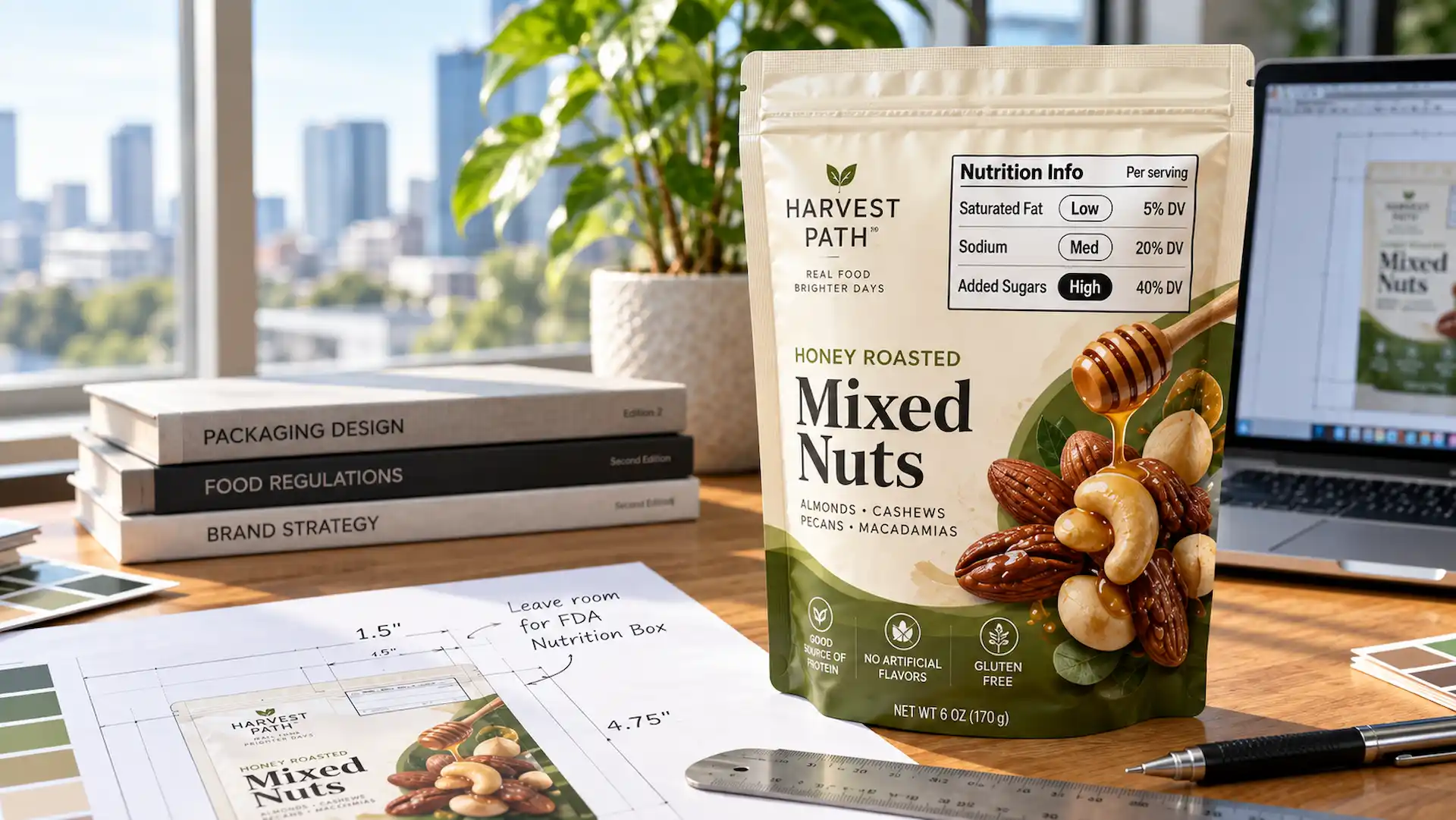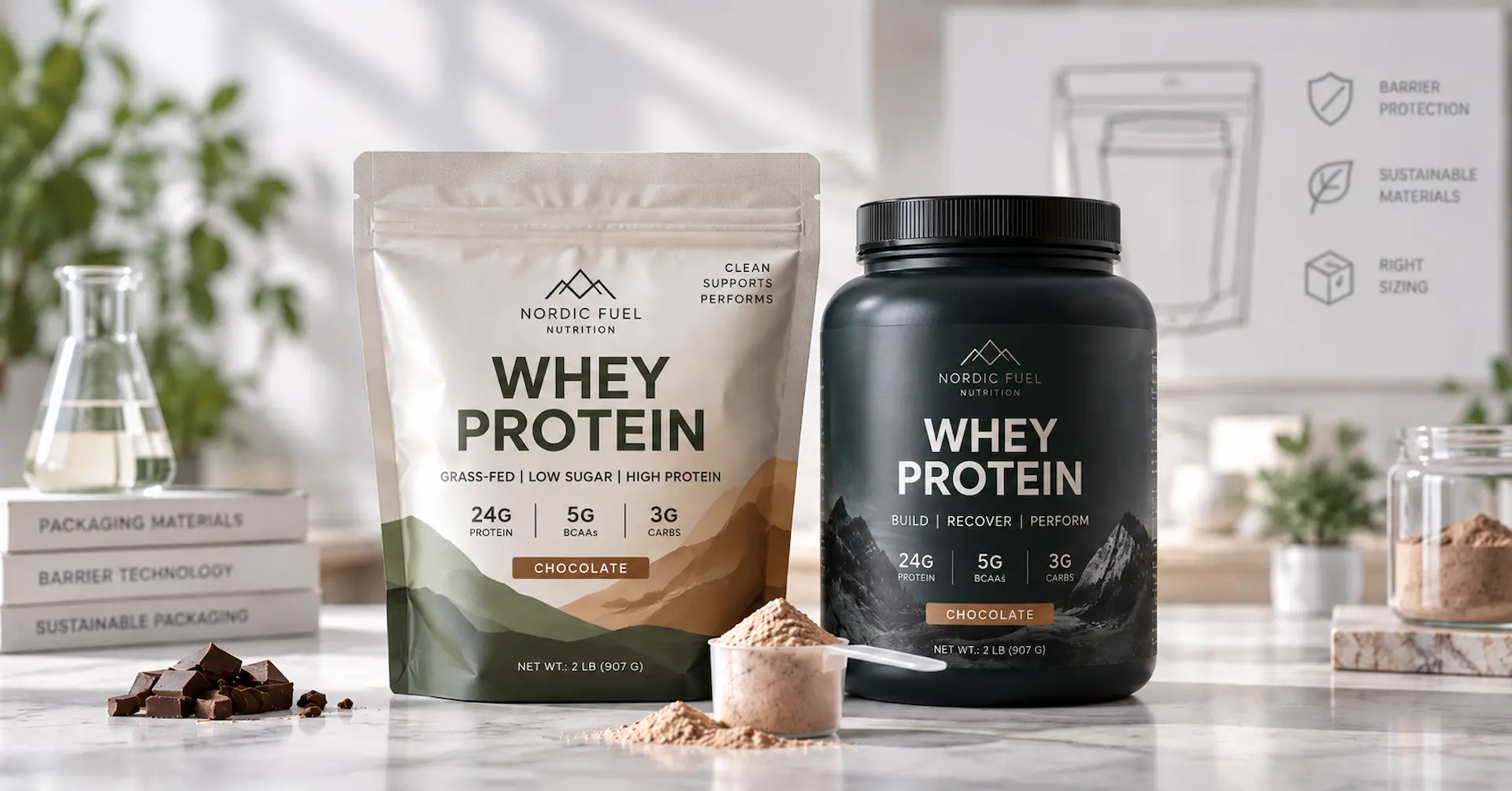

















Packaging is usually the first thing a customer touches. Before anyone tastes your coffee or scoops your protein powder, they pick up the bag and judge it in about three seconds. That is why choosing between a premade pouch and a custom pouch matters more than most business owners expect. It is not just a buying decision. It is a brand decision.
Both options work, and both are used by brands that sell well. The real question is which one fits your product, your budget, and the stage your business is in right now. This guide explains the difference in plain language, compares the true costs, and ends with a checklist you can use today. By the end, you will know which route to take and why.
Understanding the Difference Between Premade and Custom Pouches
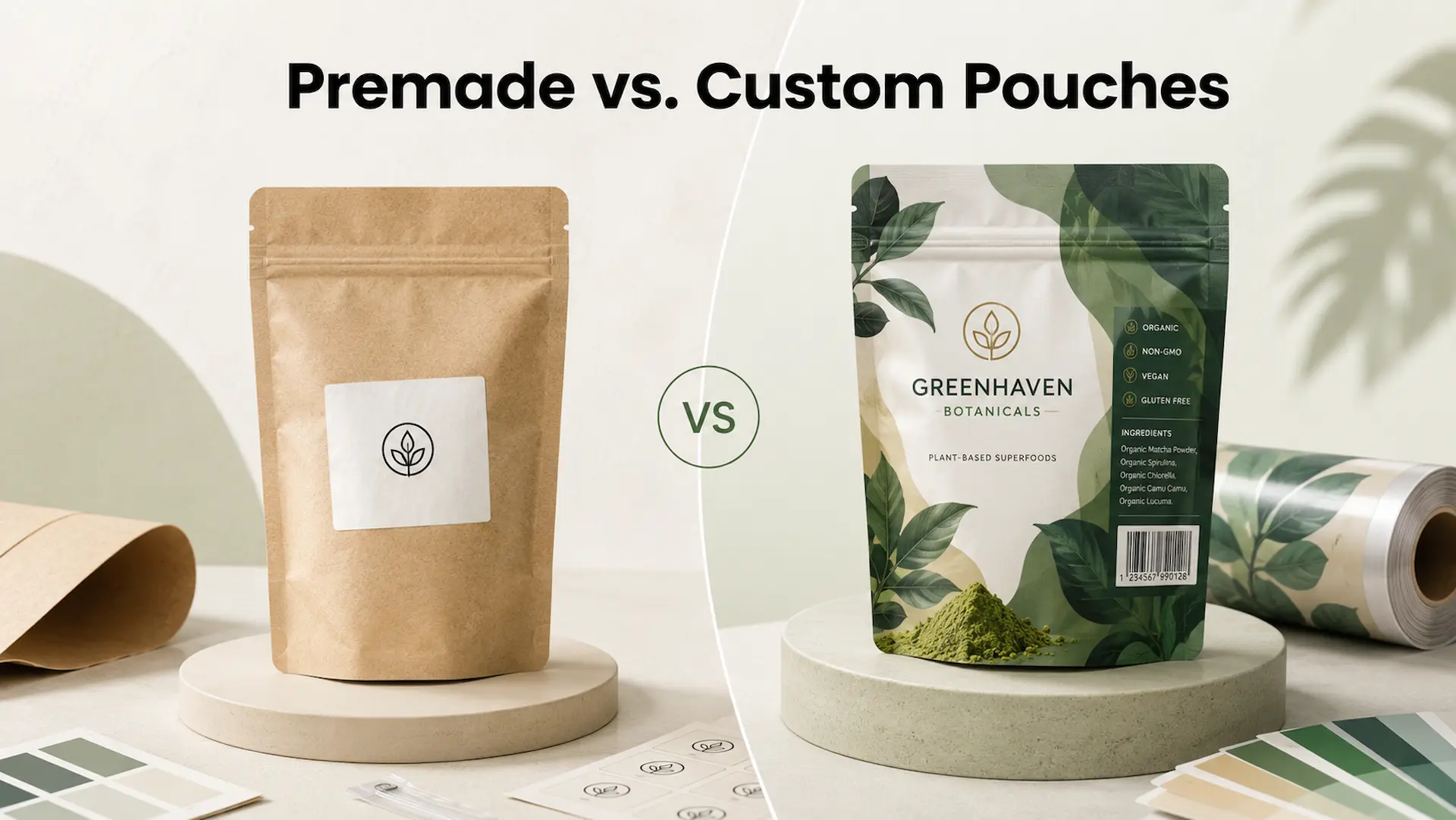
Most people treat premade and custom as opposites. They are not. They sit at two ends of the same road. One is ready now. The other is built around your product. Once you see that clearly, the rest of the decision gets much easier.
What is a Premade Pouch?
A premade pouch is a bag that arrives already formed. The film is cut, the sides are sealed, the gusset is shaped, and the zipper is attached. Your only job is to fill it and seal the top.
Most stock premade pouches come in ready colours and finishes. Kraft paper, matte black, clear front, plain white, or a mix. Brands then add their logo with a printed label or sticker.
One point confuses a lot of buyers. Inside the packaging industry, premade pouches also mean pre-formed bags as opposed to rollstock. Rollstock is a printed roll of film that your own machine turns into bags on the production line. So a premade pouch can be plain or fully printed. The word premade describes the format, not the artwork.
Common premade pouch styles include:
- Stand-up pouches with a bottom gusset
- Flat or lay-flat pouches
- Flat bottom pouches with a box shape
- Side gusset bags for coffee
- Spouted pouches for liquids and purees
What is a Custom Pouch?
A custom pouch is built to your spec from the first step. You pick the size, the film structure, the finish, the closure, and the artwork. Nothing is chosen off a shelf. The bag is made for one product, and that product is yours.
Custom pouch packaging is printed across the full surface. Your colours, your story, your ingredient panel, your barcode. No sticker covering half the bag and no white gaps at the edges.
You also control the technical side. Barrier level, film thickness, degassing valve for coffee, tear notch position, hang hole, window shape, and child resistant closures. These small details often decide whether a product stays fresh or fails on the shelf.
Quick Comparison at a Glance
| Point | Premade Pouch | Custom Pouch |
| Ready to use | Yes, ships quickly | Made to order |
| Branding | Labels or basic stock print | Full printing across the bag |
| Minimum order | Very low, sometimes 50 to 100 bags | Higher, often around 1,000 units with digital printing |
| Sizing | Fixed stock sizes only | Any size your product needs |
| Cost per bag | Stays flat, feels high at volume | Drops as your volume grows |
| Best stage | Testing and early sales | Growth, retail and scaling |
Premade Pouches: Pros, Limitations, and Best Use Cases
Premade pouches get a bad name from people who have already outgrown them. Used at the right stage, they are a low risk way to get a product into customers’ hands quickly.
Advantages of Premade Pouches
- Speed. Stock bags ship in days, so you can launch almost immediately.
- Low upfront spend. You are not paying for artwork setup or a full print run.
- Small quantities. Buy a hundred bags, sell them, then buy more.
- Easy testing. Try three flavours without committing to three print runs.
- Simple reordering. The same bag is always available in the same size.
- Low risk. If the product does not sell, you have not tied up cash in packaging.
Limitations of Premade Pouch Packaging
- Weak shelf presence. On a busy shelf, a kraft bag with a small label disappears.
- Hidden labour. Someone has to apply every label by hand, and crooked labels get binned.
- Wasted space. Stock sizes rarely match your fill weight, so bags look half empty.
- Limited barrier choice. You take the film structure that is available, not the one your product needs.
- Higher unit cost at volume. The price per bag does not really improve when you order more.
- Hard to look premium. Customers can tell the difference between a label and a printed pouch.
Best Products for Premade Pouches
Premade pouches suit products that are still finding their audience, or products sold in places where the packaging does not have to compete for attention.
- Small batch coffee sold at markets or through a local shop
- Tea and spice blends in short runs
- Supplement or protein samples
- Refill packs for subscription boxes
- Trade show giveaways and seasonal one-off items
- Products sold face to face, where you explain the brand yourself
When Premade Pouches Make the Most Sense
Choose premade when speed matters more than shelf appeal. If you are validating an idea, running a short campaign, or selling under a thousand units a year, a stock bag with a good label does the job. You keep cash free for product, ads, and inventory instead of locking it into packaging.
IMPORTANT NOTE: A premade pouch with a label is rarely as cheap as it looks on the invoice. Add the label cost, the labour hours, and the bags wasted on crooked applications. Most brands find the real cost lands close to a printed pouch once they pass a few thousand units a year.
Custom Pouches: Why Growing Brands Choose Them
Almost every brand that reaches steady sales ends up here. Below is what custom pouch packaging gives you, what it asks for in return, and who it really suits.
Benefits of Custom Printed Pouches
- Full brand control. Every inch of the bag says something about your product.
- Better shelf impact. Printed colour and finish pull the eye from a distance.
- Right size, right fill. The bag matches the product, so nothing looks empty.
- Correct barrier. You choose the film that protects your shelf life, not a close guess.
- Lower cost per unit at volume. Printing replaces labels and the labour that goes with them.
- Room for features. Valves, windows, tear notches, hang holes and resealable zippers are built in.
- Compliance made simple. Ingredient panels, warnings and barcodes are printed cleanly and consistently.
Limitations of Custom Pouch Packaging
- Higher minimum order. You commit to a run, usually starting around 1,000 units with digital printing.
- Longer lead time. Artwork, proofing and production take time, often around ten working days after approval.
- Artwork work required. You need print ready files and a designer who understands packaging.
- Less flexible after printing. A recipe change or a new claim means new artwork.
- Storage. A full run needs somewhere clean and dry to sit.
Who Should Invest in Custom Pouches?
Custom packaging pays off once your product has proven demand. If you are reordering the same item again and again, selling online at steady volume, or pitching a buyer at a retail chain, custom is no longer a luxury. It is the cheaper and stronger option.
- Brands moving more than a few thousand units a year
- Ecommerce sellers who want a strong unboxing moment
- Anyone preparing for retail shelves or a distributor meeting
- Products with strict shelf life or barrier needs, such as coffee, pet food and supplements
- Businesses running several flavours or SKUs under one brand look
How Custom Packaging Strengthens Brand Identity
Packaging is the only piece of marketing a customer holds in their hands. It travels home, sits on a counter, and gets seen every morning for weeks. A printed pouch keeps your name in front of that person the entire time the product lasts.
There is a trust effect too. Buyers read polished packaging as a sign that the business behind it is stable and careful. That perception affects what they are willing to pay and whether they buy again. Two products of equal quality rarely sell at the same rate when one looks handmade and the other looks finished.
Premade vs. Custom Pouches: Side-by-Side Comparison
This is the table to save. It covers the points buyers actually argue about internally before placing an order.
| Factor | Premade Pouch | Custom Pouch |
| Initial cost | Low, no setup spend | Higher, one print run at a time |
| Unit cost at volume | Stays high, labels add up | Falls steadily as quantity rises |
| Branding strength | Limited to labels and stickers | Complete, edge to edge |
| Printing | Stock designs or none | Digital or rotogravure, full colour |
| Lead time | Days | Around ten working days after art approval |
| Minimum order | Very low | Usually from 1,000 units |
| Shelf appeal | Basic | Strong, built for retail |
| Customisation | Almost none | Size, film, finish, features |
| Product protection | Standard stock barrier | Barrier matched to your shelf life |
| Scalability | Poor beyond a few thousand units | Built to scale |
| Sustainable options | Limited stock choices | Recyclable or compostable films available |
| Speed to market | Fastest | Fast, with a planned schedule |
| Best business stage | Launch and testing | Growth, retail and scaling |
Which Packaging Option Is Right for Your Business Stage?
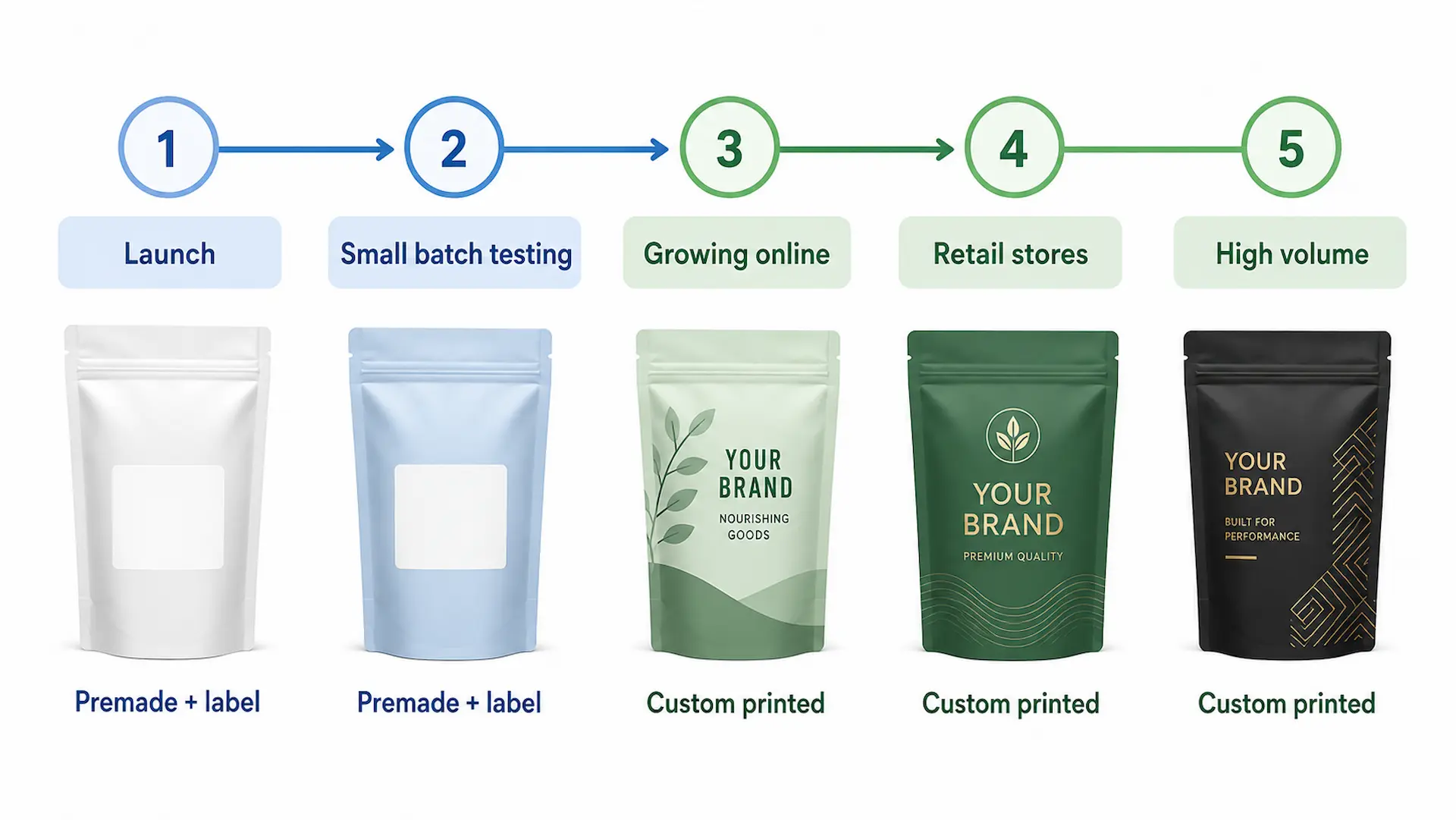
Packaging is not a one time decision. It changes as the business grows. Here is how the choice usually plays out at each stage.
1- Launching a New Product
You are still learning what customers want, and the recipe may change. Keep spending low and stay flexible. Best choice: premade pouches with a clean, well designed label.
2- Testing a Small Batch
Three flavours, fifty bags each, sold at a market to see which one moves. Custom printing at this point locks you into guesses. Best choice: premade pouches, with the same base bag across all flavours.
3- Growing an Online Brand
Orders are steady, reviews are coming in, and customers are posting photos of your product. This is where labels start holding you back. Best choice: custom printed pouches, starting with your bestseller only.
4- Selling Through Retail Stores
On a shelf, your bag has one second to catch an eye, and buyers check whether panels, barcodes and claims are printed properly. Best choice: custom pouches, no exceptions.
5- High-Volume Manufacturing
At this level, filling speed and cost per unit drive the decision. Many brands move to printed rollstock and form the bags on their own line. Best choice: custom printed rollstock or large custom pouch runs.
Key Factors to Consider Before Choosing a Packaging Solution
Before you compare prices, get clear on what your product actually needs. These seven points settle the decision far more often than the quote does.
1- Product Type
Powders, whole beans, liquids and pet food all behave differently inside a bag. Sharp products need thicker film. Oily products need a film that will not stain or absorb.
2- Shelf Life Requirements
A six month shelf life and a two year shelf life are two different packaging problems. Ask for the expected shelf life in writing before you order.
3- Barrier Protection
Oxygen, moisture and light are what spoil most products. High barrier film costs more, but a spoiled batch costs far more than the film ever did.
4- Budget
Look at the cash you have available now, not only the price per bag. A cheaper unit price is not helpful if it drains the money you need for stock.
5- Production Volume
Volume is the clearest signal in the whole decision. Under about a thousand units a year, premade usually wins. Above that, custom starts pulling ahead quickly.
6- Branding Goals
Ask an honest question. Are you selling a product, or building a brand people will look for by name? The answer points to the right pouch.
7- Customer Experience
Resealable zippers, easy tear notches and bags that stand on a counter get mentioned in reviews. Small conveniences turn first time buyers into repeat buyers.
Cost Comparison: Premade vs. Custom Pouch Packaging
Most cost comparisons stop at the price per bag, which is exactly where they go wrong. The full picture includes what you spend after the bags arrive.
| Cost item | Premade Pouch | Custom Pouch |
| Setup and artwork | None | One time cost, digital printing needs no plates |
| Price per bag | Higher and flat | Lower as quantity grows |
| Labels | Ongoing cost on every unit | Not needed |
| Labour | Manual labelling on each bag | Fill and seal only |
| Waste | Crooked labels and mismatched sizes | Minimal once the proof is approved |
| Storage | Small, buy as you go | Larger, a full run at once |
| Shipping | Frequent small orders | Fewer, larger deliveries |
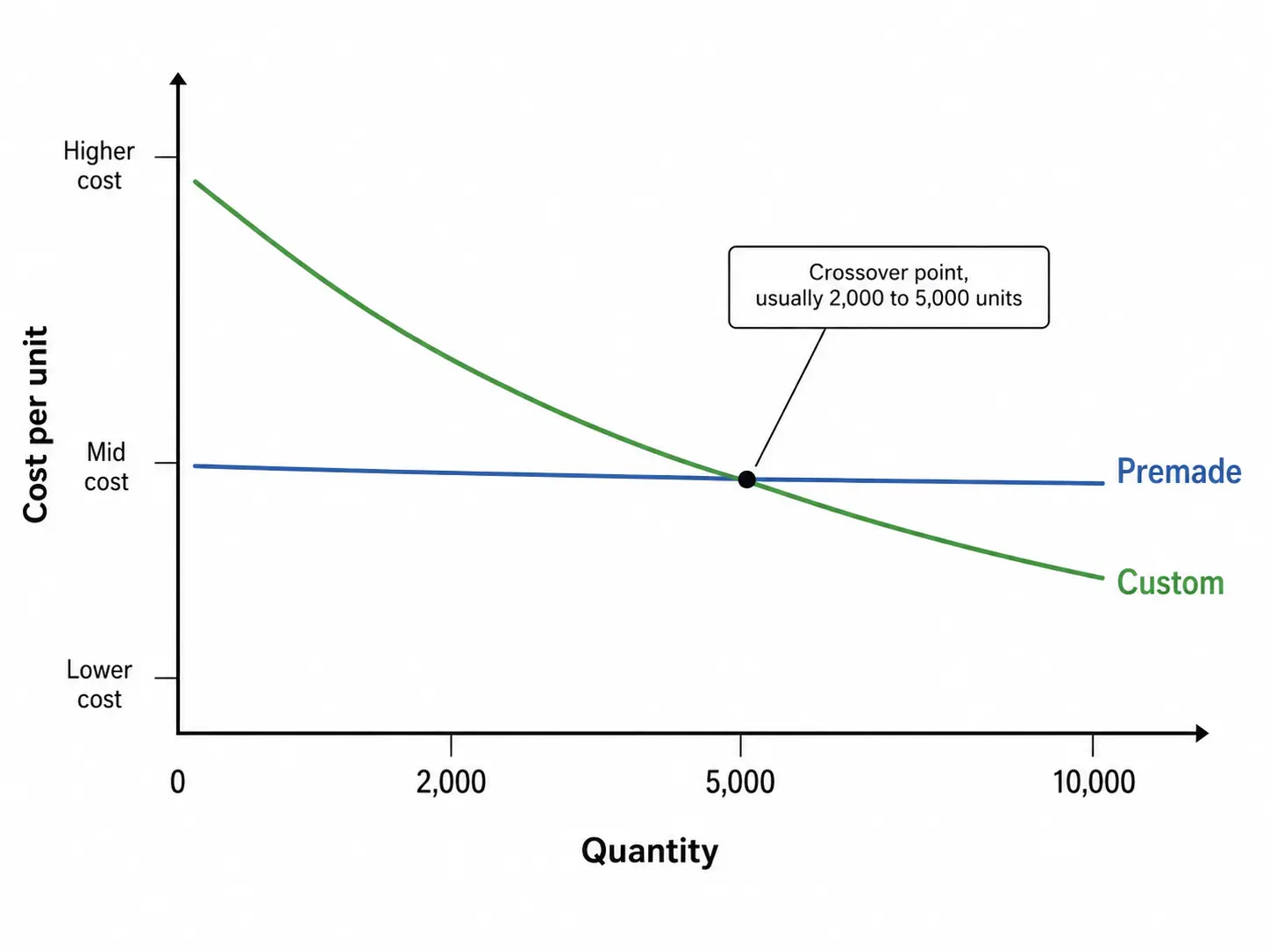
Here is the pattern most brands follow. Premade is cheaper to start and more expensive to keep. Custom costs more on day one and gets cheaper every year you stay with it. The crossover point is different for every business, but it usually arrives sooner than owners expect, often somewhere between two and five thousand units.
IMPORTANT NOTE: Judge packaging by cost per sale, not cost per bag. If a printed pouch adds a few cents to your unit cost but lifts your price or your repeat purchase rate, it has already paid for itself. Cheap packaging that slows sales is the most expensive option on the table.
Which Packaging Option Offers Better Branding and Shelf Impact?
Custom wins this one, and it is not close. A shopper scanning a shelf is not reading. They are reacting to colour, shape and finish. A printed pouch controls all three.
These are the finishes and features that do the heavy lifting:
- Matte finish for a soft, premium feel that resists fingerprints
- Gloss finish for bright colour and strong contrast
- Metallic or foil effects that catch overhead store lighting
- Spot gloss over a logo or one key element
- Clear windows so customers can see the product inside
- Flat bottom shapes that stand tall and use shelf space well
- Consistent colour across every flavour, so your range reads as one family
Premade pouches can still look good. A well designed label on a kraft bag has its own honest, handmade appeal, and some categories reward that. But it works best in markets and small shops, not on a shelf next to national brands.
Common Mistakes Businesses Make When Choosing Pouch Packaging
Most packaging problems are not bad luck. They come from the same handful of decisions, usually made in a rush. Check your plan against this list before you order.
- Buying on price alone and ignoring what labels and labour really cost.
- Skipping the barrier question, then dealing with stale product and refund requests.
- Ordering a huge run before the product has proven demand.
- Choosing a bag size that leaves the pouch looking half empty.
- Forgetting the next stage, so packaging has to be redone within months.
- Leaving out practical features like resealable zippers and tear notches.
- Approving artwork quickly without checking the proof, panels and barcode.
- Treating packaging as a cost line instead of part of the marketing budget.
Decision Checklist: Should You Choose Premade or Custom Pouches?
Answer these seven questions honestly. Keep count as you go.
- Am I still testing the product or recipe?
- Do I sell fewer than a thousand units a year?
- Do I need packaging in hand within two weeks?
- Is my cash tight right now?
- Do I sell mostly face to face or through a small local network?
- Am I likely to change the design in the next few months?
- Is packaging appearance a low priority for my category?
Mostly yes: stay with premade pouches for now. You are still in the testing phase, and flexibility is worth more than shelf appeal.
Mostly no: move to custom pouch packaging. Your volume, your sales channels and your brand have grown past what a stock bag can carry.
A close split is common, and there is a simple answer for it. Print your bestselling SKU as a custom pouch and keep the rest on premade bags until they prove themselves. Most brands make the switch one product at a time rather than all at once.
Conclusion
There is no single winner here, only a right answer for where you stand today. Premade pouches are the smart choice when you are testing, moving fast, or protecting cash flow in the early months. Custom pouches are the smart choice when your product has proven itself and the packaging needs to sell on its own. The trap is staying with premade long after the business has outgrown it, quietly paying for labels and labour that a printed pouch would have replaced.
Look at your volume, your sales channels and your next twelve months. If you are heading toward retail, growing online, or reordering the same product over and over, custom pouch packaging will cost less and do more. If you are still finding your footing, stay flexible and revisit the question in a few months.
Ready to Put Your Product in the Right Pouch?
You do not have to guess at film structures, barrier levels or minimum orders. Our team works with brands at every stage, from the first thousand units to full retail rollouts, and we will tell you honestly which route fits your product.
- Fully custom sizes, finishes and features with low minimums
- Digital and rotogravure printing, with no plates or tooling on digital runs
- Most digitally printed orders ship within ten business days of art approval
- Recyclable and compostable film options across every pouch style
- Free worldwide shipping to most destinations
Send us your product details and we will come back with a free quote, a recommended structure, and a proof you can review before anything is printed.
Request your free quote today and get packaging that works as hard as your product does.
FAQs:
1. What is a premade pouch?
A premade pouch is a bag that arrives already formed, sealed and fitted with any closure. You simply fill it and seal the top. It can be plain, stock printed, or fully custom printed, since premade refers to the format rather than the artwork.
2. What is the difference between premade and custom pouches?
Premade pouches are ready made in fixed sizes and finishes, and branding is usually added with labels. Custom pouches are produced to your exact size, film and artwork, with printing across the whole bag.
3. Are premade pouches cheaper than custom pouches?
They are cheaper to start with, because there is no artwork setup and you can order small quantities. Once you add labels, labour and repeat orders, custom pouches usually become cheaper per unit as volume grows.
4. Can premade pouches be customised?
Yes, within limits. You can add labels, sleeves or stamps to a stock bag. For custom sizes, printed panels, specific barrier films or features like valves and windows, you need a custom printed pouch.
5. When should a business switch from premade to custom pouch packaging?
The usual signals are steady reorders, sales above a few thousand units a year, a move into retail, or labelling that has become a daily chore. When any two of those are true, it is time to switch.
6. Which option gives better shelf life and protection?
Custom pouches, because the film is chosen for your product. Stock premade bags come with a general purpose barrier that may not suit coffee, oily snacks or moisture sensitive powders. If shelf life matters, specify the structure.