






















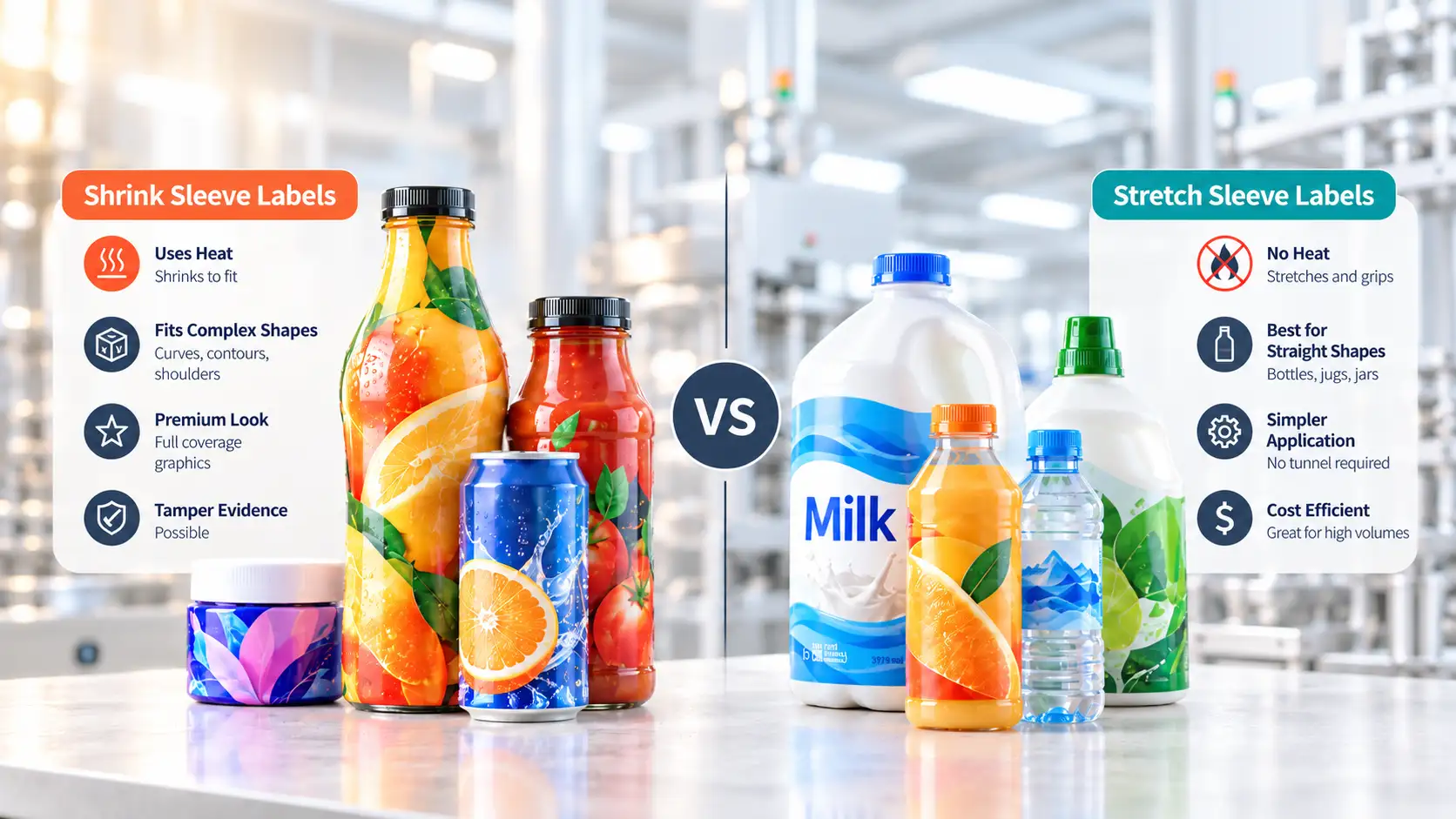
Pick up a can of energy drink and turn it in your hand. The design runs all the way around, with no paper edge and no glue line anywhere. Chances are, that label was shrunk on with heat. The juice bottle in your fridge may have a wraparound label too, but that one was probably stretched on like a rubber band and then simply let go.
On a store shelf, the two look a lot alike. On a production line, they’re nothing alike. Your choice affects your costs, your equipment and even which bottle shapes you can use. Below, we’ve put both options side by side in plain words, so you know exactly what to ask your packaging manufacturer before you place an order.
Shrink Sleeve vs Stretch Sleeve Labels: Quick Comparison
Need the short version first? Here it is. We’ll unpack every row in the sections that follow.
| Factor | Shrink Sleeve Labels | Stretch Sleeve Labels |
| Application | Heat shrinks the film around the container | Elastic film stretches and grips the container |
| Heat Required | Yes | No |
| Adhesive Required | No | No |
| Best Container Fit | Curved, tapered and contoured shapes | Straight or lightly shaped containers |
| Coverage | Full body, shoulders and some closures | Mainly the container body |
| Branding | Graphics that follow every contour | 360-degree graphics around the body |
| Equipment | Sleeve applicator plus shrink tunnel | Stretch sleeve applicator |
| Tamper Evidence | Possible | Usually limited |
| Main Strength | Complex shapes and premium look | Heat-free, simpler application |
Put simply, shrink sleeves are about shape and style. Stretch sleeves are about keeping things easy. Most brands end up choosing based on which of those they care about more.
How Shrink and Stretch Sleeve Labels Work
Both start life the same way, as a printed tube of plastic film that slides over a container. After that, they parted ways completely.
How Shrink Sleeve Labels Work
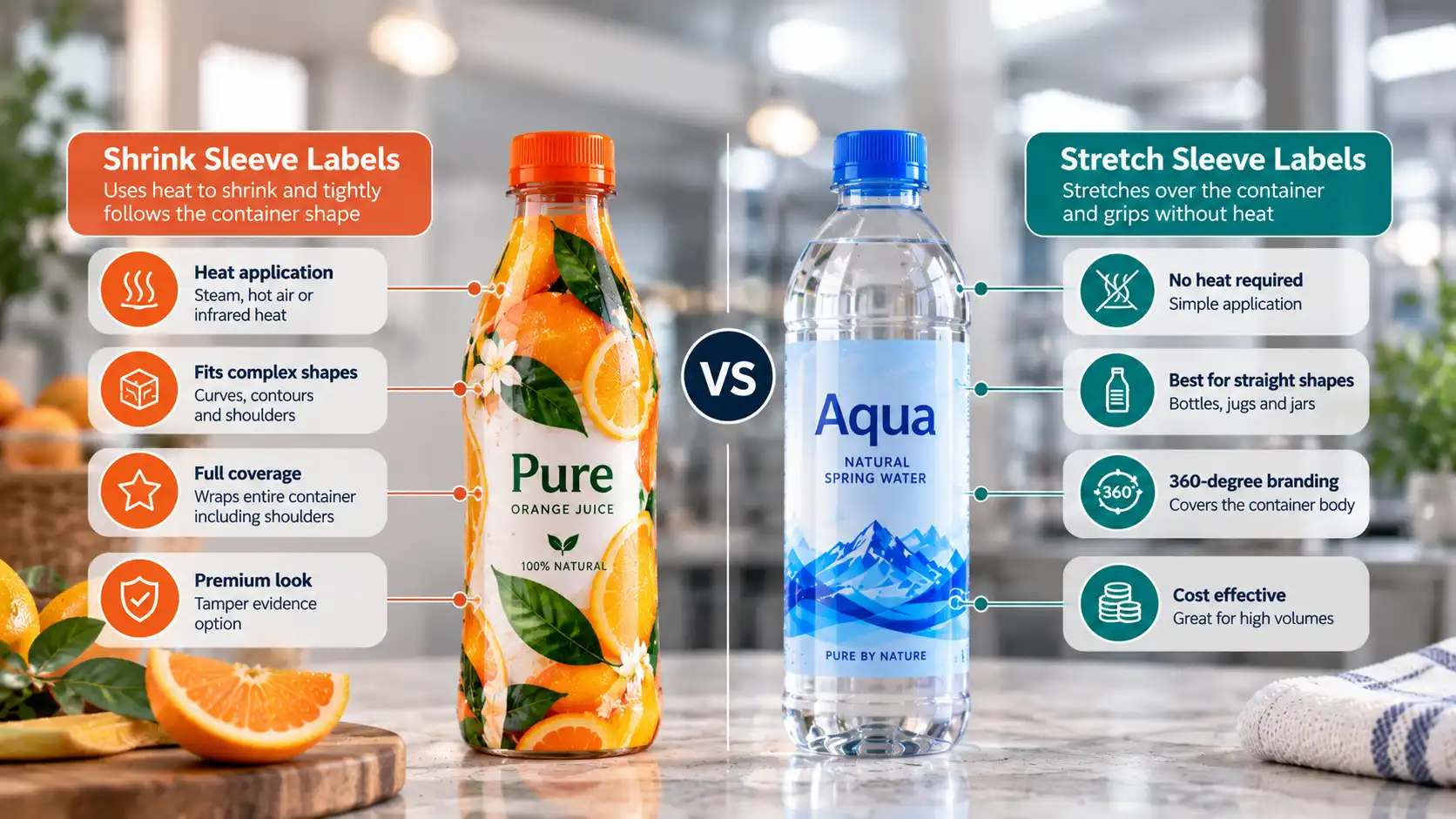
A shrink sleeve is printed on film that tightens when it gets hot. PETG is the most common choice these days. PVC and OPS are still around, and some brands use PLA when they want a plant-based option. The design is printed on the inside of the film, so the ink sits safely under a clear layer and won’t scuff off.
Getting it onto a bottle goes roughly like this:
- The sleeve is cut and dropped loosely over the container.
- The container rides through a shrink tunnel filled with steam, hot air or infrared heat.
- The film reacts to the heat and pulls inward.
- Within seconds, it’s hugging the container, curves and all.
The finished result looks almost painted on. That’s why heat shrink labels turn up on so many sauces, sodas, shampoos and craft beer cans. Once you notice shrink sleeve labels, you’ll start seeing them everywhere.
How Stretch Sleeve Labels Work
A stretch sleeve does the reverse. It’s usually made from LDPE (low-density polyethylene), a soft and bendy film, and it’s cut a little smaller than the container on purpose.
Stretch sleeving works like pulling a sock over your foot:
- The machine opens the tube and stretches it wider than the container.
- It slides the sleeve down over the body.
- It lets go.
- The film tries to shrink back to its original size, and that pull keeps the stretch sleeve label snug.
There’s no tunnel and no glue. Nothing gets heated. That’s why stretch sleeve labeling has been a favorite for milk jugs, bleach bottles and plain juice bottles for years.
Key Differences Between Shrink Sleeve and Stretch Sleeve Labels
This is the part that actually decides things. Here are six areas where the two sleeves behave differently, and each one can tip the balance for your product.
Container Shape and Sleeve Fit
Honestly, shape settles the question more often than anything else. A shrink sleeve goes on loose and gets pulled tight by heat, so it can follow almost any outline. A stretch sleeve only holds where the film has a surface to push back against.
Picture a bottle with a pinched waist. The stretch sleeve won’t dip into that curve. It stretches straight across the gap instead, like a bridge. You end up with a label that stands away from the bottle, and it may wrinkle or slide.
| Container Shape | Shrink Sleeve | Stretch Sleeve |
| Straight-sided bottles and jugs | Works well | Works very well |
| Lightly tapered containers | Works well | Usually works |
| Curved or waisted bottles | Excellent fit | Often bridges or slips |
| Bottles with shoulders | Can cover the shoulder | Stops below the shoulder |
| Irregular or sculpted shapes | Strong choice | Rarely suitable |
Here’s an easy way to think about it. If your container is basically a tube, you can go either way. The more it curves, the more you’ll lean toward shrink.
Heat, Equipment and Application Process
With shrink sleeves, you need a tunnel. Steam tunnels are popular because they tend to shrink film more evenly. Hot-air tunnels are common on smaller lines or in plants without a steam supply. Either way, a tunnel takes floor space, uses energy and needs someone who knows how to set it up.
Heat can also cause trouble for heat-sensitive products. Think chilled drinks, yogurts with live cultures or certain skincare formulas. Thin plastic bottles can soften in the tunnel too.
A stretch sleeve line keeps things lean:
- Just the applicator, no tunnel after it
- No steam or hot air to supply
- A shorter line, handy if your factory is tight on space
- Zero heat near the product
For a small plant, or a co-packer who doesn’t want another big machine, that’s a real draw.
Important Note: No tunnel doesn’t automatically mean a faster line. The Packaging Observer notes that stretch sleeving is usually slower than shrink sleeving, and even fast stretch lines tend to stay under 150 bottles per minute. If you’re running big volumes, ask your equipment supplier for real speed figures on your container before you commit.
Coverage, Printing and Shelf Appearance
Both sleeves give you 360-degree branding, but they don’t look the same once they’re on the shelf.
- Shrink sleeves: cover the whole pack, from base to cap, with glossy PETG film that makes colors look sharp and premium.
- Stretch sleeves: usually cover the body only, and the slightly cloudy film gives the print a flatter look.
- Distortion printing: shrink sleeve artwork is printed warped so it looks right after shrinking. Keep an eye on your brand colours, since they can shift slightly where the film shrinks most.
Tamper Evidence and Product Security
Here’s something shrink sleeves do that stretch sleeves usually can’t. A shrink sleeve can carry on up past the neck and tighten around the cap. Add a perforated tear strip, and a shopper can tell instantly if someone has opened the product.
You’ll see this a lot on:
- Vitamins and supplements
- Sauces, dressings and condiments
- Health and pharmacy products
- Drinks sold on open shelves
Stretch sleeves are really a body decoration. They hold by tension on a flat wall, so they can’t tuck in around a cap. If tamper evidence matters for your product, you’ll want a shrink sleeve or a separate neck band.
Production and Total Packaging Cost
It’s tempting to compare the price of one sleeve against another and call it done. Please don’t. What you actually want to know is what it costs to get a labeled container off the end of your line.
| Cost Factor | Shrink Sleeve | Stretch Sleeve |
| Film material | Usually higher | Usually lower |
| Printing and artwork | Extra work for distortion | Simpler artwork setup |
| Equipment | Applicator plus tunnel | Applicator only |
| Energy | Higher, due to heat | Lower |
| Labor and maintenance | Tunnel needs upkeep | Fewer moving parts |
| Waste and rejects | Depends on tunnel settings | Depends on fit and grip |
| Changeovers | Tunnel recipe per format | Sleeve size per format |
How much you produce matters as well. A brand running seasonal flavors or small test batches might care far more about flexible printing and smaller order quantities than about a few cents on film. And if you’re buying from an overseas supplier, don’t forget freight, duties and the extra weeks of lead time.
So look at the full packaging cost, not only the sleeve price.
Sustainability and Recycling
It would be nice if one of these sleeves were simply “the green one.” It isn’t that simple. Each has its strong points, and a lot depends on your bottle and where it ends up.
Stretch sleeves use no heat, so the line uses less energy. They also skip glue. When PET bottles get recycled, they’re chopped into flakes and dropped into water. PET sinks, and polyethylene floats. That means a stretch sleeve on a PET bottle splits off pretty cleanly.
Shrink sleeves take more planning. A sleeve that covers the whole bottle can confuse sorting machines, because they can’t tell what’s underneath. Some shrink films also sink with the PET and end up mixed into it. To get around this, many brands now:
- Add a perforated strip so people can peel the sleeve off before recycling
- Pick shrink films made to suit the bottle’s recycling stream
- Leave a bit of the bottle bare so sorting machines can recognize it
- Use thinner films to cut down on plastic
Important Note: Recycling rules change from country to country, and sometimes from city to city. Before you print “recyclable” on a sleeve, check your film and bottle against current design-for-recycling guidance for every market where you sell.
Benefits of Shrink Sleeve vs Stretch Sleeve Labels
Rather than two long lists, here’s one table. It’s easier to see where each sleeve comes out ahead.
| Benefit | Shrink Sleeve Labels | Stretch Sleeve Labels |
| 360-Degree Branding | Excellent | Excellent |
| Complex Container Shapes | Strong advantage | More limited |
| Full-Body Decoration | Excellent | Good on suitable shapes |
| Heat-Free Application | No | Yes |
| Adhesive-Free Application | Yes | Yes |
| Premium Shelf Appearance | Very strong | Strong |
| Tamper-Evident Options | Available | Limited |
| Energy Requirement | Higher, due to shrinking | Lower, with no tunnel |
| Equipment Simplicity | More equipment needed | Usually simpler |
| Reusable or Returnable Containers | Possible, depending on design | Useful on suitable containers |
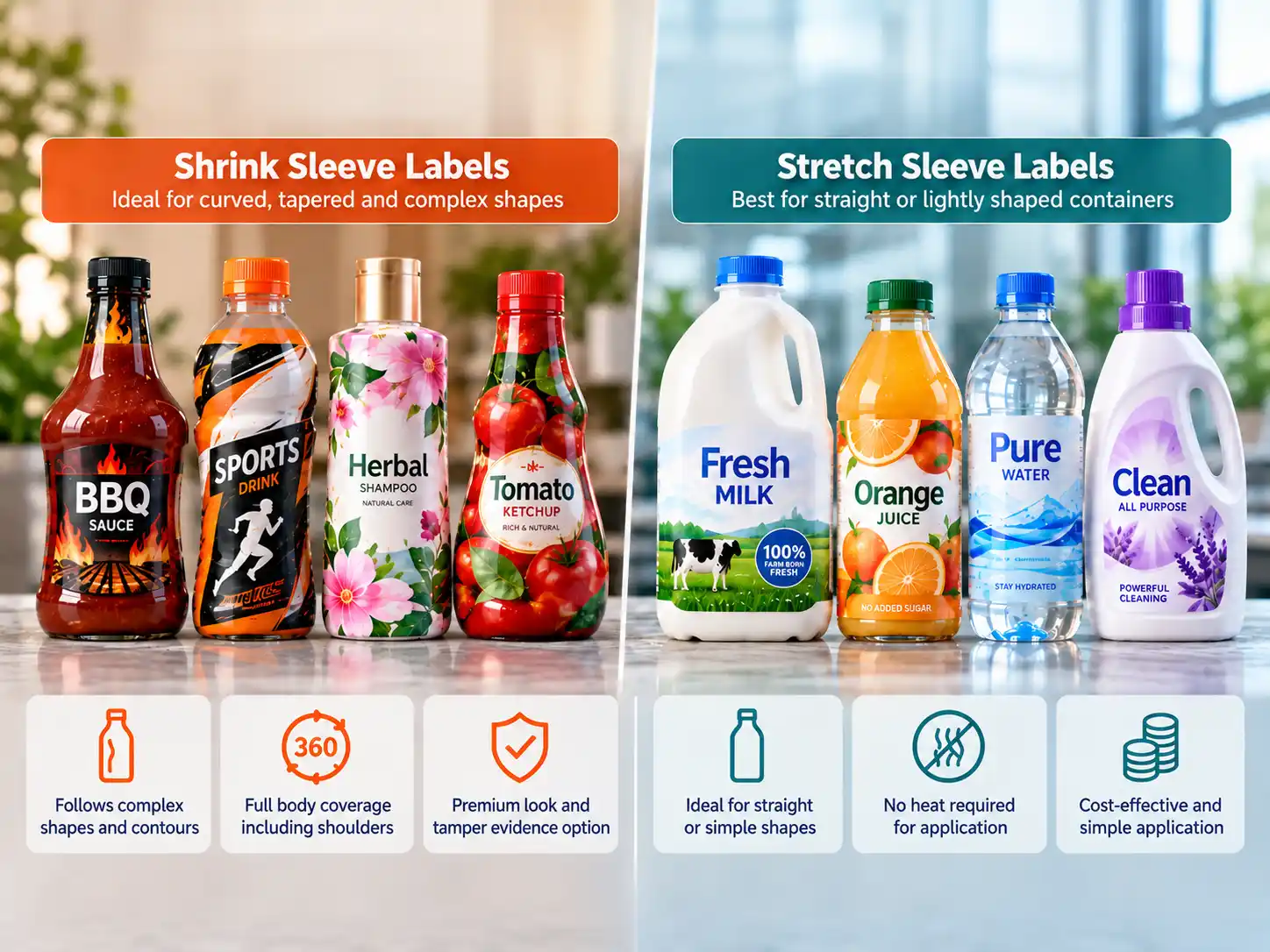
If your bottle has curves and your brand needs to look premium, shrink sleeves usually win. If you want no heat and a simple line, stretch sleeves are hard to beat.
Best Uses for Shrink and Stretch Sleeve Labels
Theory is useful, but it helps more to see where each sleeve actually shows up in real stores.
When Shrink Sleeve Labels Work Best
Reach for a shrink sleeve when your container has an interesting shape or your product needs to grab attention fast. Common examples:
- Contoured beverage bottles: sports drinks and flavored waters with shaped grips
- Premium drinks: spirits, wine and canned cocktails that need to look expensive
- Craft beer and seltzer cans: plain cans that become fully branded, even on short runs
- Cosmetics and personal care: shampoo, lotion and body wash in curvy bottles
- Food containers: sauces and jars where a tamper band adds trust
- Household products: cleaners and air fresheners in eye-catching shapes
- Shoulder or closure coverage: anything that needs the design to reach the neck or cap
Sound like your product? Custom shrink sleeves can be sized, shaped and printed around your exact container.
When Stretch Sleeve Labels Work Best
Stretch sleeves do their best work in everyday, practical packaging, where easy setup and low running costs matter more than a glossy finish. Stretch sleeve packaging suits:
- Straight-sided bottles: water, juice and milk in plain bottles
- Lightly tapered containers: tubs and jugs with a gentle slope
- Heat-sensitive products: fresh dairy, cold-pressed juice and similar items
- Dairy and beverage containers: gallon jugs and grab-and-go bottles
- Reusable or returnable packaging: sturdy bottles that get washed and refilled
- Industrial containers: jugs of chemicals and cleaners that get knocked around
- Lines without shrink tunnels: smaller plants that would rather not add heat equipment
Which Sleeve Label Should You Choose?
Still stuck between the two? Go through both lists below. Whichever one sounds more like your product is probably your answer.
Choose Shrink Sleeves If You Need:
- Coverage on curved or oddly shaped containers
- A tight fit with no loose spots
- Bold, full-body graphics that stand out on the shelf
- Branding that reaches over the shoulder or neck
- A tamper band built right into the label
Choose Stretch Sleeves If You Need:
- A label that goes on with no heat at all
- A simpler line with fewer machines
- A good fit on straight or gently shaped containers
- Branding around the body only
- To avoid buying or running a shrink tunnel
If both look like they’d work, don’t decide on paper. Try each sleeve on your real container, on your real line. Then compare the test results and the full applied cost before you commit.
What to Check Before Ordering Sleeve Labels
A bit of homework now can save you a costly reprint later. Go over these five points with your team and your label supplier.
Container Size, Shape and Material
It all starts with the container. Your supplier will ask for:
- Exact measurements, including height and width at a few points
- The general shape, from straight to heavily curved
- How much it tapers from top to bottom
- Shoulder and neck details
- What it’s made of: PET, HDPE, glass or aluminum
If you can, post a few real samples. Drawings are useful, but a physical bottle shows things a drawing can miss.
Sleeve Coverage and Position
Next, work out exactly where the sleeve will sit:
- Where it starts at the bottom
- Where it stops at the top
- How much room your logo, claims and legal text need
- Whether the shoulder, neck or cap should be covered
Your answers set the sleeve length. Sometimes they also decide which sleeve type is even possible.
Artwork and Print Requirements
Artwork is where many projects get held up. Sort these out early:
- How much the design has to be distorted to look right after shrinking
- Print alignment, especially where the seam falls
- A flat, low-shrink spot for the barcode so it still scans
- Whether small text and logos stay readable
- Which high-shrink areas to keep clear of fine detail
Application Equipment and Production Speed
Take an honest look at your line:
- Do you already own a sleeve applicator?
- Is there a shrink tunnel, or space to add one?
- How many containers per minute do you need?
- Do you have steam, power and compressed air on hand?
- How often will you switch sizes or designs?
Samples and Production Testing
Last of all, test before you order a full run. A good trial looks at:
- How well the sleeve fits the container
- Whether it slides up or down
- Whether it spins around the bottle
- Any warping in the printed design
- Where the print ends up after application
- Shrink quality, if you’ve gone with shrink sleeves
- How it holds up in boxes and shipping
- How it looks on a shelf next to competitors
Conclusion
If your bottle has curves, you want a premium look, or you need branding up to the cap, shrink sleeves are the stronger pick. Stretch sleeves make more sense for simple containers, where a heat-free, low-fuss line matters most. Neither one needs glue, and both can wrap your product in color all the way around.
In the end, let your container, branding goals, equipment, budget and recycling plans make the call. Test real samples, add up the full cost, and go with what the results tell you.
Need Custom Shrink Sleeves That Fit Your Product Perfectly?
Got a bottle with curves that a regular label just can’t handle? Flexible Pouches makes custom shrink sleeves around your container’s size, shape and artwork, and our team will help you pick the right fit, material and finish. Everything is made in BRCGS-certified facilities, with films the FDA recognizes as food-contact safe and water-based inks.
Request a Custom Shrink Sleeve Quote
FAQs
1- What is the main difference between shrink sleeve and stretch sleeve labels?
It comes down to how they stay on. A shrink sleeve goes over the container loosely, then heat tightens it. A stretch sleeve is pulled open, slid on and let go, and its own elastic grip holds it in place. No heat is involved.
2- Do stretch sleeve labels require heat or adhesive?
Neither. The film grips the container by itself. That’s a big reason brands with heat-sensitive products, or small packaging lines, like stretch sleeves.
3- Are heat shrink labels the same as shrink sleeve labels?
Mostly, yes. People say “heat shrink labels” because heat is what makes the film shrink onto the container. Some people also use the term for the narrow shrink bands that only go around caps.
4- Can stretch sleeve labels be used on curved or irregular bottles?
Not very well, in most cases. Stretch sleeves grip best on straight or gently sloped surfaces. On a deep curve or a sharp shoulder, the film tends to stretch across the gap and can slip or wrinkle. Shrink sleeves handle those shapes much better.
5- Which costs less, shrink sleeve or stretch sleeve packaging?
Stretch sleeve packaging is often cheaper to run, since there’s no tunnel and less energy use. Shrink sleeves can still be better value if you need premium graphics, a tamper band or a tricky bottle shape. Compare the full applied cost, not just the price per sleeve.
6- Are shrink sleeve and stretch sleeve labels recyclable?
Both can be, if they’re designed with recycling in mind. Stretch sleeves come off PET bottles easily because polyethylene floats in water. Shrink sleeves do best with a tear strip for easy removal, or with a film matched to the bottle’s recycling stream. Check the local rules wherever your product is sold.