

















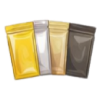







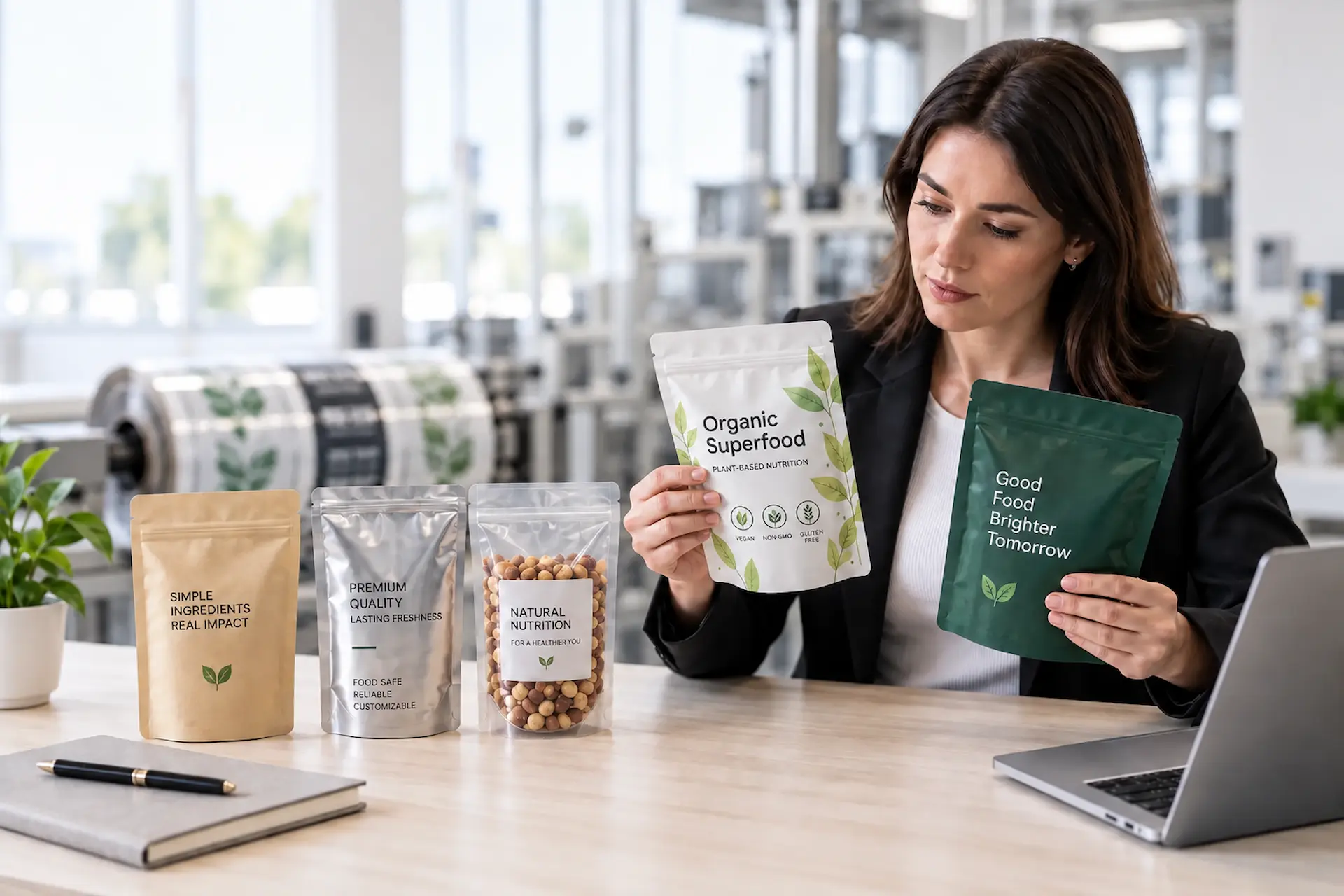
Two quotes for the same stand-up pouch can land in your inbox with almost the same price on them. One supplier sends a bag that keeps your product fresh for a full year. The other sends a bag that lets moisture in by month four. Nothing in the quote told you which one you were buying.
That gap is why the questions you ask before ordering matter more than the number at the bottom of the page. Most packaging problems start as a small detail that nobody talked about. The twelve questions below help you compare flexible packaging suppliers on the things that actually decide how your packaging performs, whether you are buying a stock bag or a fully custom flexible pouch.
Know Your Packaging Requirements Before You Contact Suppliers
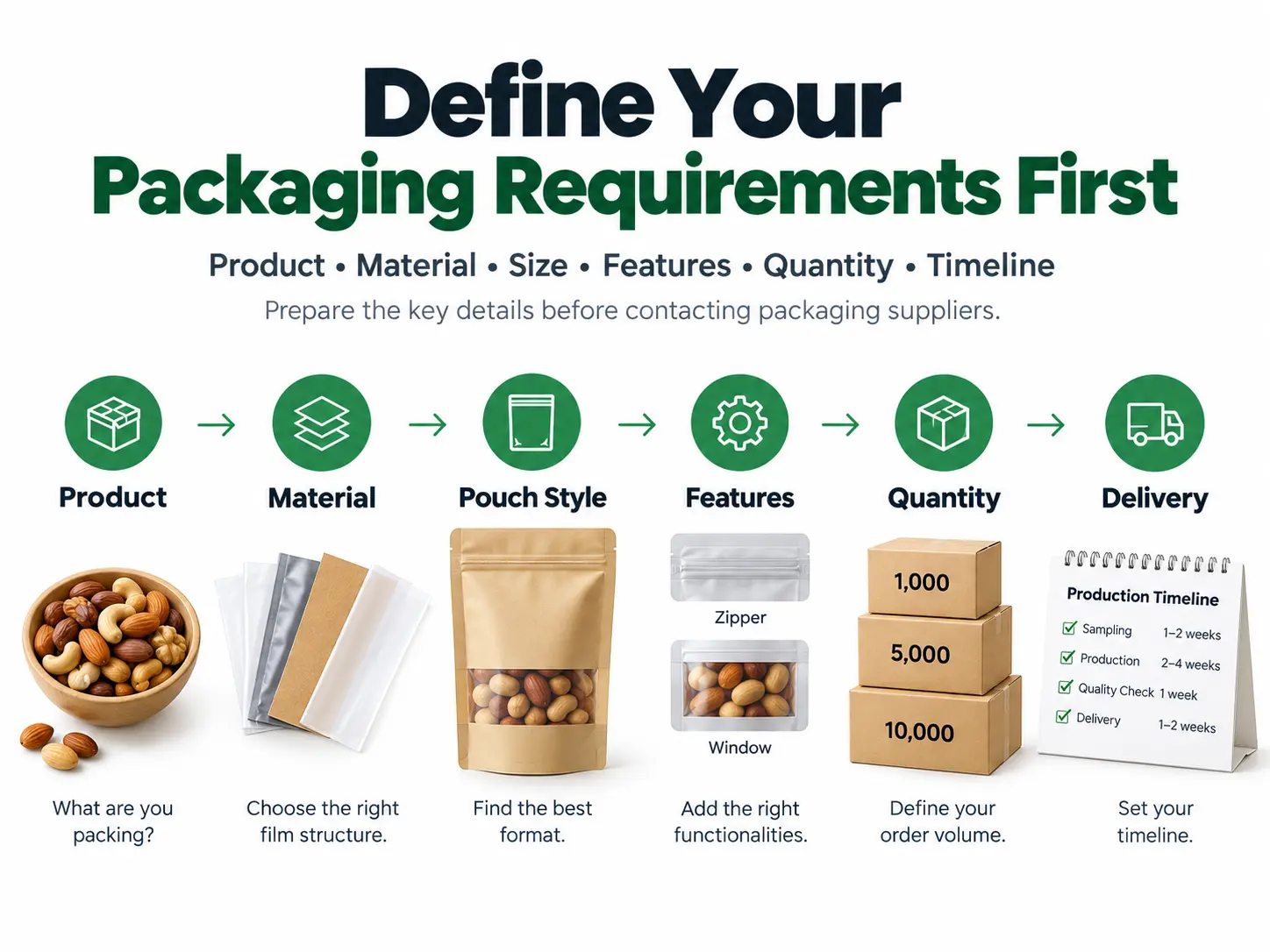
Before you email a single supplier, write down what your product needs. This sounds basic, but it changes everything. When every manufacturer gets the same information, their quotes become comparable. When they each get a different version of your brief, you end up comparing three answers to three different questions.
It also tells you something about the supplier. A good one will ask for these details before quoting. A weak one will send a price sheet within an hour and never ask what is going inside the bag.
Product and Shelf-Life Requirements
Your product decides your material. Nothing else does. Write down:
- What the product is, and whether it is dry, oily, sticky or liquid
- How sensitive it is to moisture
- How sensitive it is to oxygen
- Whether light affects colour, taste or potency
- Whether aroma needs to stay in, like coffee or spices
- Whether grease or oil will sit against the film
- The shelf life you are promising on the label
- Where it will be stored, including hot warehouses and cold chains
A protein powder and a bag of dog treats can use the same pouch shape and still need a completely different film.
Pouch Style, Size, and Features
Decide roughly what you want, but stay open to advice. Most suppliers can guide you here if you tell them how the product is filled and how it sits on the shelf.
| Decision | What to tell your supplier |
| Pouch style | Stand-up, flat, flat-bottom or rollstock |
| Size | Fill weight and product density, not just dimensions |
| Closure | Zipper, tear notch, or no reclosure |
| Extras | Valve, window, spout, hang hole |
| Finish | Matte, gloss, soft touch or metallic |
If you are filling by machine, say so early. A pouch that works for hand filling can jam a filling line.
Order Volume and Number of SKUs
Quantity affects almost every other answer you get. It sets your minimum order, your printing method, your price per unit and sometimes your material options.
Give suppliers two numbers instead of one. Tell them what you want for your first order, and what you expect to buy across a full year. Also tell them how many designs you have. Five SKUs at 2,000 pouches each is a very different job from one SKU at 10,000, even though the total is the same.
Artwork, Launch Date, and Delivery Requirements
Artwork delays hold up more orders than production does. Sort this out early:
- Is your artwork print ready, or still with a designer?
- Do you have a dieline from the supplier yet?
- When does the product need to be on shelf?
- Where is the delivery going, your warehouse or a co-packer?
- Do you need staggered deliveries or one full shipment?
12 Questions to Ask a Flexible Packaging Manufacturer
Ask these in order. Each one builds on the answer before it.
1. Have You Made Packaging for Products Like Mine?
General packaging experience is not the same as experience with your product. A supplier who runs snack pouches every day may never have handled a hygroscopic powder or a chemical that attacks adhesive.
Ask for specifics:
- Which product categories do they run most often?
- Have they packaged anything with the same fill behaviour as yours?
- What problems came up on those jobs, and how were they solved?
- Can they post you physical samples from similar work?
Do not settle for a gallery of logos on a website. Ask for pouches you can hold. The way a bag feels, seals and stands tells you more in thirty seconds than a case study will in ten minutes.
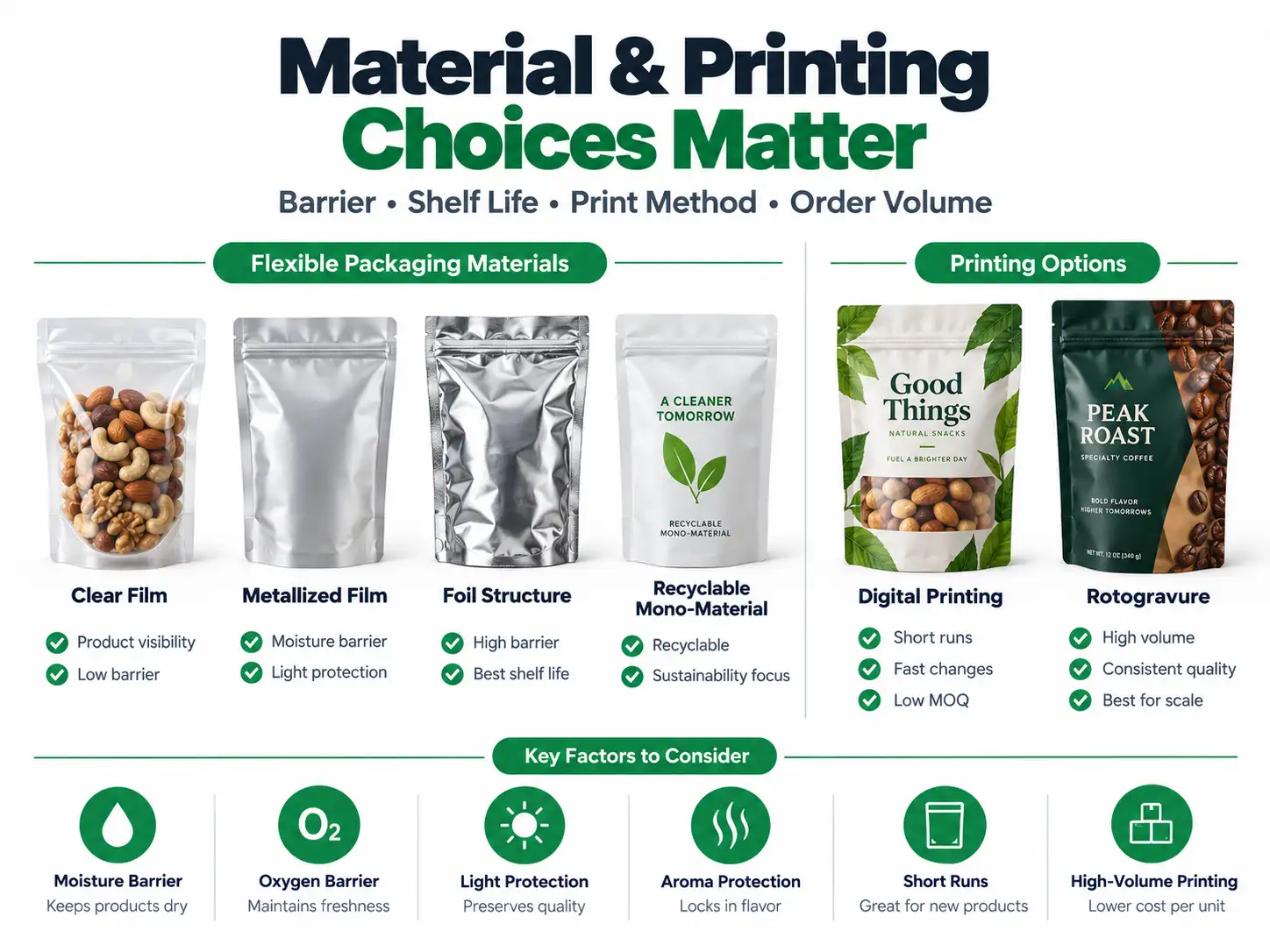
2. Which Packaging Materials and Barrier Structures Do You Recommend for My Product?
This is the most technical question on the list and the most useful. You are not asking for a list of what they stock. You are asking what they would choose for your product, and why.
A strong supplier will connect the recommendation to a real need. Something like: your product is oxygen sensitive with a twelve month shelf life, so a metallized structure makes more sense than a clear one, and here is the trade off in shelf appeal.
Ask them to cover:
- Oxygen and moisture protection levels
- Light barrier, if colour or oil can degrade
- Aroma retention
- Puncture and grease resistance
- Seal strength at your filling temperature
- Whether the structure is clear, metallized, foil based, paper based or recyclable
Ask to see the technical data sheet for the structure they suggest. Real barrier films come with numbers attached, not adjectives. A film described as a high barrier with no figure behind it is a sales phrase, not a specification.
Important Note: If a supplier recommends a material before asking what your product is, its shelf life and how it is stored, they are quoting what is easy for them to run, not what protects your product.
3. What Pouch Styles, Sizes, and Custom Features Can You Produce?
Some suppliers only offer stock sizes. Others can build any dimension you need. The difference matters because a stock size forces you to pay for space you do not use, or to under fill a bag that then looks cheap on the shelf.
Ask what they can produce:
- Stand-up, flat, flat-bottom, rollstock and stick packs
- Fully custom dimensions or set sizes only
- Zippers, tear notches, windows, valves, spouts and hang holes
- Matte, gloss and speciality finishes
Then ask the follow up that most buyers skip. Which of these are done in house, and which go to an outside partner? Outsourced steps are not automatically bad, but they add days to your lead time and a margin layer to your price. You deserve to know where each step happens.
4. Which Printing Method Is Best for My Order?
There is no single best printing method. There is only the right one for your volume and SKU count.
| Factor | Digital printing | Rotogravure printing |
| Setup | No plates or cylinders | Cylinders required per design |
| Best for | Short runs and multiple SKUs | High volume, fewer designs |
| Artwork changes | Easy and cheap | Costly once cylinders exist |
| Cost curve | Flatter across quantities | Drops sharply at high volume |
| Turnaround | Faster | Longer, cylinder making adds time |
Ask which method they would use for your order and why. Also ask what happens when you grow. Moving from digital to gravure at higher volumes is normal, but colour can shift during that switch if nobody plans for it. A supplier who has managed that transition before will tell you how they keep your brand colours consistent across both methods.
5. What Are Your Minimum Order Quantities, and Can You Scale With My Brand?
A single MOQ number tells you almost nothing. What you need is the full picture.
Ask about:
- MOQ per pouch style, since rollstock and pouches differ
- MOQ per SKU, not just per order
- Whether multiple designs can share one production run
- Pilot or test quantities before a full launch
- Reorder minimums, which are sometimes lower
- Where the price breaks sit as quantity rises
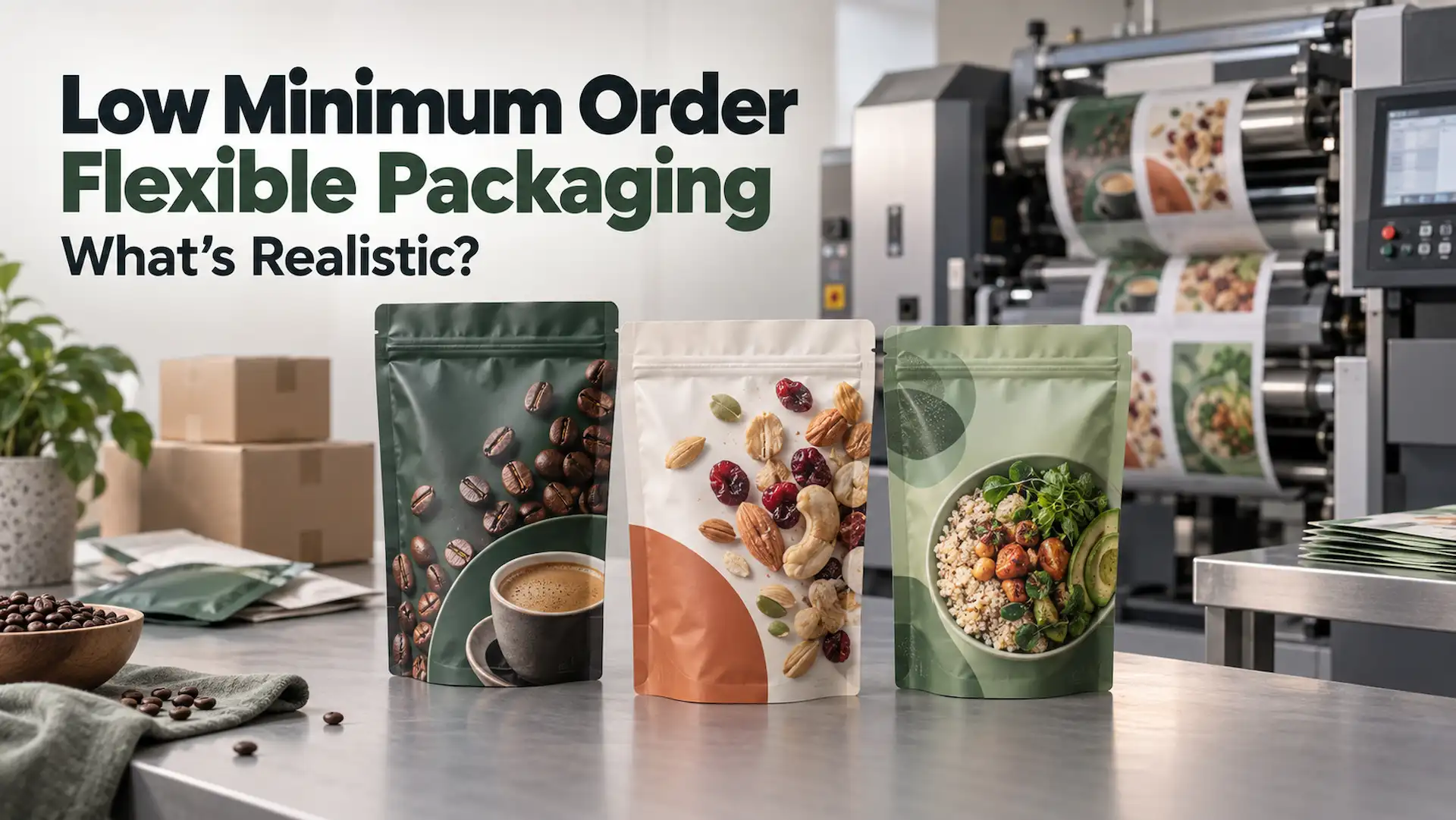
The useful answer is a price ladder. What does 1,000 cost, then 5,000, then 25,000? Once you see the ladder, you can judge whether stretching your first order actually saves money or just ties up cash. If you are launching small, our guide on minimum order quantity goes deeper into what is realistic at low volumes.
6. What Will My Packaging Really Cost Beyond the Price Per Pouch?
Unit price is the headline. It is rarely the full bill. Ask for every line item in writing:
- Unit price at your quantity
- Setup or start up fees
- Plate or cylinder charges, and who owns them afterwards
- Tooling for custom sizes
- Artwork, prepress and proofing fees
- Prototype or sample costs
- Charges for zippers, valves, windows and special finishes
- Freight, duties and customs handling
- Storage if they hold stock for you
- Rush fees if a deadline moves
A quote at four cents more per pouch with no setup charge often beats a cheaper quote carrying a large one time fee, especially on a first order. Do the maths across the whole run, not per bag.
Important Note: The cheapest unit price is not the cheapest order. Add setup, tooling and freight to every quote before you compare them, or you are comparing incomplete numbers.
7. What Is Your Real Production and Delivery Lead Time?
Lead time means different things to different suppliers. Some count from the day you order. Some count from artwork approval. Some include shipping and some stop at the factory door.
Ask them to walk you through the whole path:
Artwork approval, then proof, then production, then quality check, then shipping, then delivery.
Then ask for the number attached to each stage. Also cover:
- How long a proof takes to come back
- Whether the quoted time includes freight
- What happens in peak season
- Whether rush production exists and what it costs
- How reorders are timed, since they are usually faster
A supplier who publishes their production steps openly is easier to plan around than one who gives you a single vague number.
8. How Do You Control Packaging Quality From One Order to the Next?
One perfect sample proves very little. What matters is whether order number six matches order number one.
Ask what they check and how often:
- Incoming material inspection
- Print registration and colour against an approved standard
- Film thickness across the web
- Seal strength and seal integrity testing
- Finished pouch dimensions
- Zipper position and function
- Defect rate they work to, and what counts as a defect
- Batch codes and traceability back to a material lot
- What happens when a batch fails, and who pays
The answer you want describes a system with steps and records. The answer that should worry you is “we have never had a complaint.”
9. Which Certifications and Compliance Documents Can You Provide?
Not every product needs every certificate. A cosmetics brand and a baby food brand have very different paperwork needs. Ask for what applies to you, then ask them to send the actual documents rather than describing them.
| Document | What it covers | Who usually needs it |
| Food contact compliance | Materials safe for direct food contact | Food, beverage, supplements |
| BRCGS Packaging | Audited packaging safety and quality system | Retail food suppliers |
| ISO 9001 | Documented quality management system | Most regulated buyers |
| Technical data sheets | Film structure and performance figures | Any product with shelf life claims |
| Traceability records | Batch history back to raw material | Recall sensitive categories |
A footer logo is not proof. Ask for the certificate with its expiry date on it.
10. Can I Review Samples, Proofs, or a Prototype Before Full Production?
Never approve a large run from a screen. Colours shift between monitors and film, and a design that looks balanced on a flat PDF can sit awkwardly on a gusseted bag.
Your options usually include:
- Existing stock samples, to judge film feel and quality
- A PDF proof, to check layout and text
- A printed proof, to check colour on the real substrate
- A functional prototype, to test filling and sealing
- A digital mockup, for internal sign off
Ask which of these are free and which are charged. A supplier offering printed prototypes is inviting you to catch problems while they are still cheap to fix. Check dimensions, artwork position, colour, finish, how the pouch stands when filled and whether your product fits comfortably.
11. What Sustainable Packaging Options Can You Prove, Not Just Claim?
Sustainability claims are easy to make and harder to back up. Ask for evidence, not vocabulary.
Useful questions:
- Which structures are genuinely recyclable, and in which stream?
- Do you offer mono-material films?
- Are compostable options certified, and for home or industrial composting?
- Can recycled content be included, and at what percentage?
- What barrier performance do I lose by switching?
- What disposal wording should appear on the pack?
That last point about barrier loss is the one buyers forget. Some recyclable pouches give slightly less protection than a foil laminate. If your shelf life depends on that protection, you need the numbers before you switch, not after your first customer complaint.
12. What Happens If Something Goes Wrong, or My Business Grows Quickly?
This question tests whether you are buying from a supplier or building a partnership. Put a few honest scenarios to them:
- A raw material becomes unavailable mid run
- Production slips by a week
- A shipment arrives with bad seals
- You need an emergency reorder in ten days
- Your volume triples after a retail listing
- You add four new SKUs next quarter
Ask who you would call, whether you get a named contact, and what their capacity limit actually is. The way a supplier answers an uncomfortable question tells you a great deal about how they will behave when something genuinely goes wrong.
How to Compare Flexible Packaging Suppliers After You Get Their Answers
Collecting answers is only half the job. Now score them. Put your shortlisted flexible packaging companies side by side against the same criteria so you are comparing like with like.
| Evaluation Area | What to Compare |
| Product fit | Similar products and market experience |
| Material performance | Barrier and shelf-life suitability |
| Customization | Size, pouch style and features |
| Printing | Quality, technology and SKU flexibility |
| MOQ | Current and future order requirements |
| Total cost | Unit cost plus setup, tooling and shipping |
| Lead time | Production through final delivery |
| Quality | QC system and defect handling |
| Compliance | Required documents and certifications |
| Sustainability | Verified material claims and performance |
| Samples | Proofs, samples and prototypes |
| Support | Communication and problem resolution |
| Scalability | Ability to handle future growth |
Weight the rows that matter most to you. A brand with a two year shelf life should weigh material performance heavily. A brand launching six flavours at once should weight printing flexibility and MOQ per SKU.
One more signal worth watching. How quickly and clearly did each supplier reply during quoting? This is the stage where they are trying hardest to win you. If communication is slow now, it will not improve after the invoice.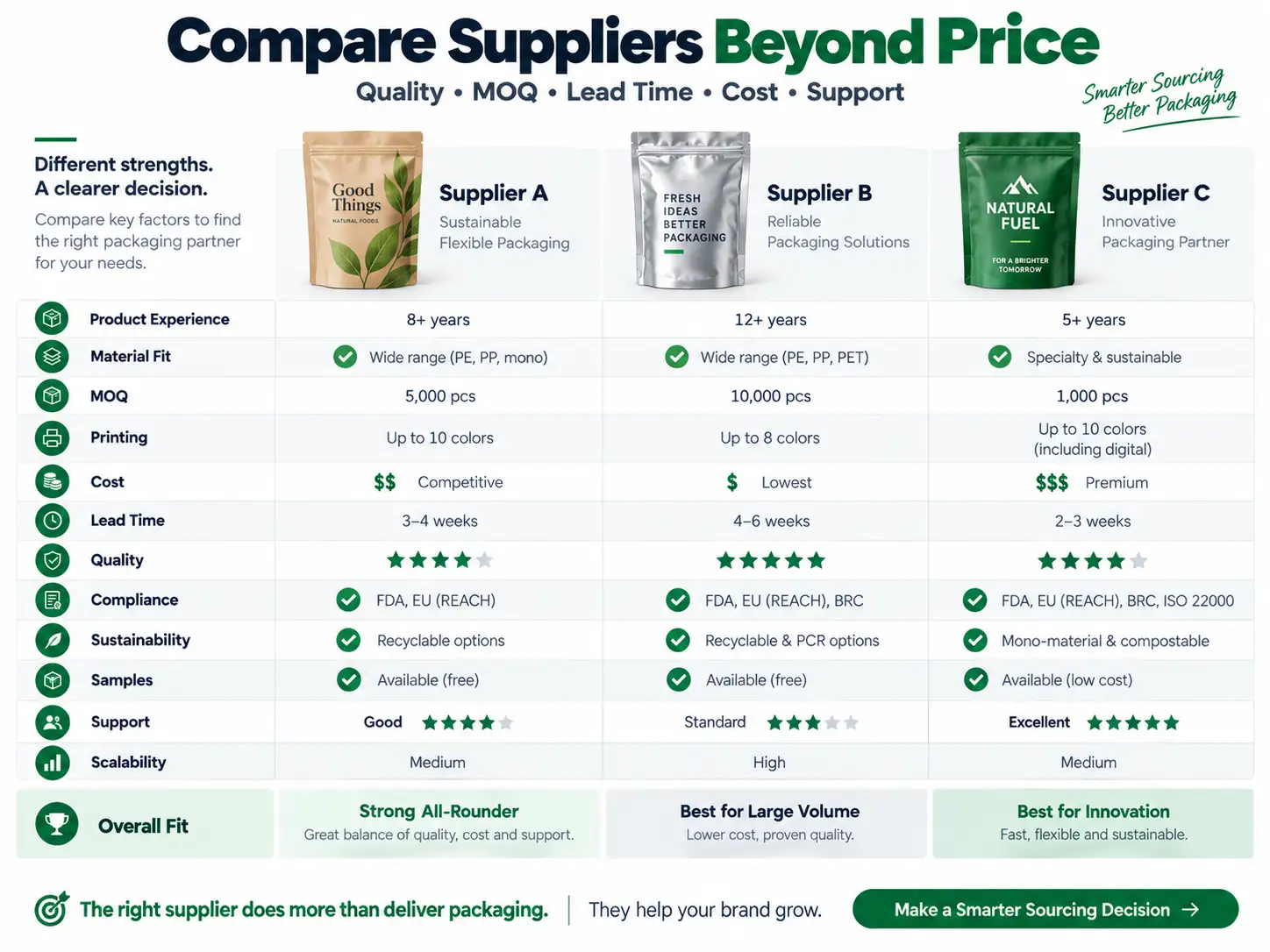
Red Flags to Watch for Before Choosing a Packaging Supplier
Some answers should make you pause:
- A material is recommended before anyone asks what your product is
- The quote has bundled costs with no breakdown
- Lead time is given as one number with no starting point
- The quality process is described in general words with no steps
- Certificates are mentioned but never sent
- Samples or prototypes are discouraged or delayed
- Sustainability claims come with no certification or test data
- Emails take days, and answers arrive incomplete
- Nobody will say what happens if a batch is defective
None of these alone proves a supplier is bad. Two or three together usually means you will be managing problems later that you could have avoided now.
Local Supplier or Global Manufacturer: Which Is Better?
The nearest factory is not automatically the best one. Distance is only one factor out of many, and it often matters less than buyers expect.
A closer supplier usually helps with:
- Shorter freight times and fewer customs surprises
- Easier press visits and faster physical sample rounds
- Simpler communication across the same time zone
- Quicker handling if a shipment has a problem
A larger or overseas manufacturer can offer:
- Lower unit pricing at high volume
- A wider range of film structures and finishes
- More equipment, so complex formats are possible
- Capacity that holds up when your orders scale
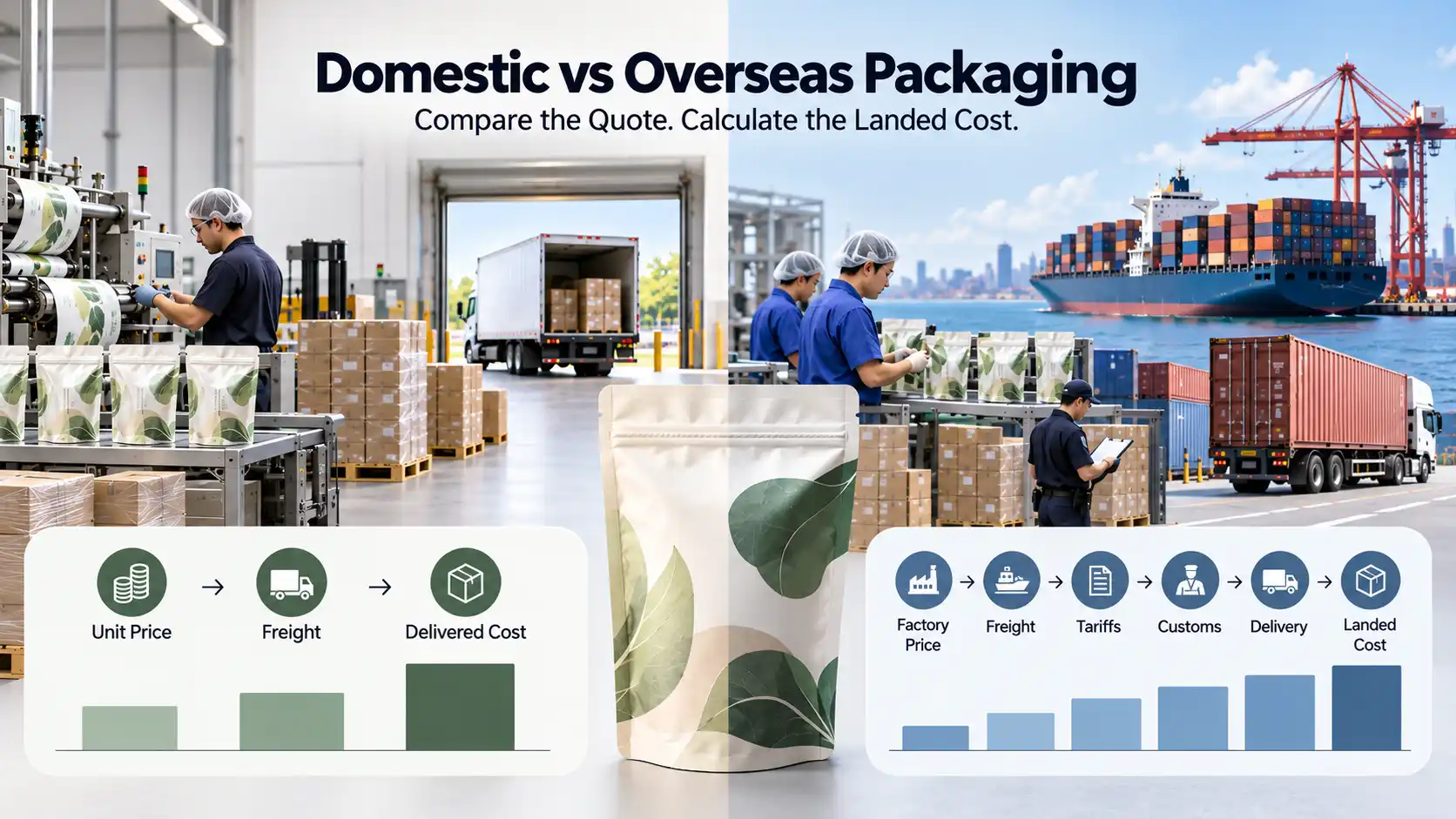
The smarter approach is to compare total landed cost and total lead time rather than location. Add freight, duties and storage to the unit price, then add transit time to production time. Sometimes a supplier three thousand miles away still delivers faster and cheaper than one nearby, because their process is tighter. Sometimes the opposite is true. The figures will tell you, and a manufacturer with worldwide shipping can remove much of the distance penalty anyway.
Choose the Manufacturer That Fits Your Product, Not Just Your Budget
The best flexible packaging suppliers are rarely the ones with the lowest quote. They are the ones who asked about your product before they gave you a price, explained why one material suits it better than another, and told you honestly what their limits are. That conversation is worth more than a few cents per pouch.
Work through the twelve questions with two or three manufacturers, write the answers down, and the right choice usually becomes obvious. You are looking for a supplier who understands the product, prices it clearly, keeps quality steady across repeat orders and has room to grow with you.
Ready to Find the Right Packaging for Your Product?
Your packaging has three jobs. It has to protect what is inside, work with the way you fill it, and sell the product on a crowded shelf. Getting all three right starts with a proper conversation about your product, not a generic price list.
Share your pouch size, order quantity, material needs and printing requirements with Flexible Pouches, and the team will walk you through the options that suit your product, your budget and your launch date.
FAQs
1. How do I choose a reliable flexible packaging manufacturer?
Start with your product, not with prices. Give every supplier the same details about your product, shelf life, volume and launch date, then compare how they respond. A reliable manufacturer asks questions before quoting, explains the material they recommend, gives a clear cost breakdown and provides samples or proofs before full production.
2. What should I compare between flexible packaging suppliers?
Compare thirteen things, not one. Look at product experience, material performance, customization options, printing method, MOQ, total cost including setup and freight, lead time, quality control, compliance documents, sustainability evidence, sample options, support and their ability to scale. Scoring flexible packaging companies on the same list stops price from dominating the decision.
3. What is a typical minimum order for custom pouches?
It depends on the printing method. Digitally printed pouches often start around 1,000 units per design, which suits new brands and multi SKU launches. Rotogravure printing usually needs much larger volumes because cylinders have to be made first. Always ask for MOQ per SKU, since that number matters more than the total order size.
4. How long does custom flexible packaging take to manufacture?
Most digitally printed orders take roughly 10 working days in production once artwork is approved, plus time for proofing and shipping. Rotogravure runs take longer because cylinders are produced first. Always ask whether the quoted lead time starts at order or at artwork approval, and whether freight is included.
5. Should I choose a flexible packaging company near me?
Not automatically. A nearby supplier makes samples and problem solving easier, but a larger manufacturer may offer better pricing, wider material choice and more capacity. Compare total landed cost and total delivery time instead of distance alone. Many suppliers ship worldwide, which reduces the advantage of being close by.
6. What information should I give a pouch manufacturer to get an accurate quote?
Send your product type, fill weight, required shelf life, pouch style, size, features like zippers or valves, number of SKUs, first order quantity, expected annual volume, artwork status and delivery date. The more complete your brief, the more accurate the quote, and the easier it becomes to compare suppliers fairly.