










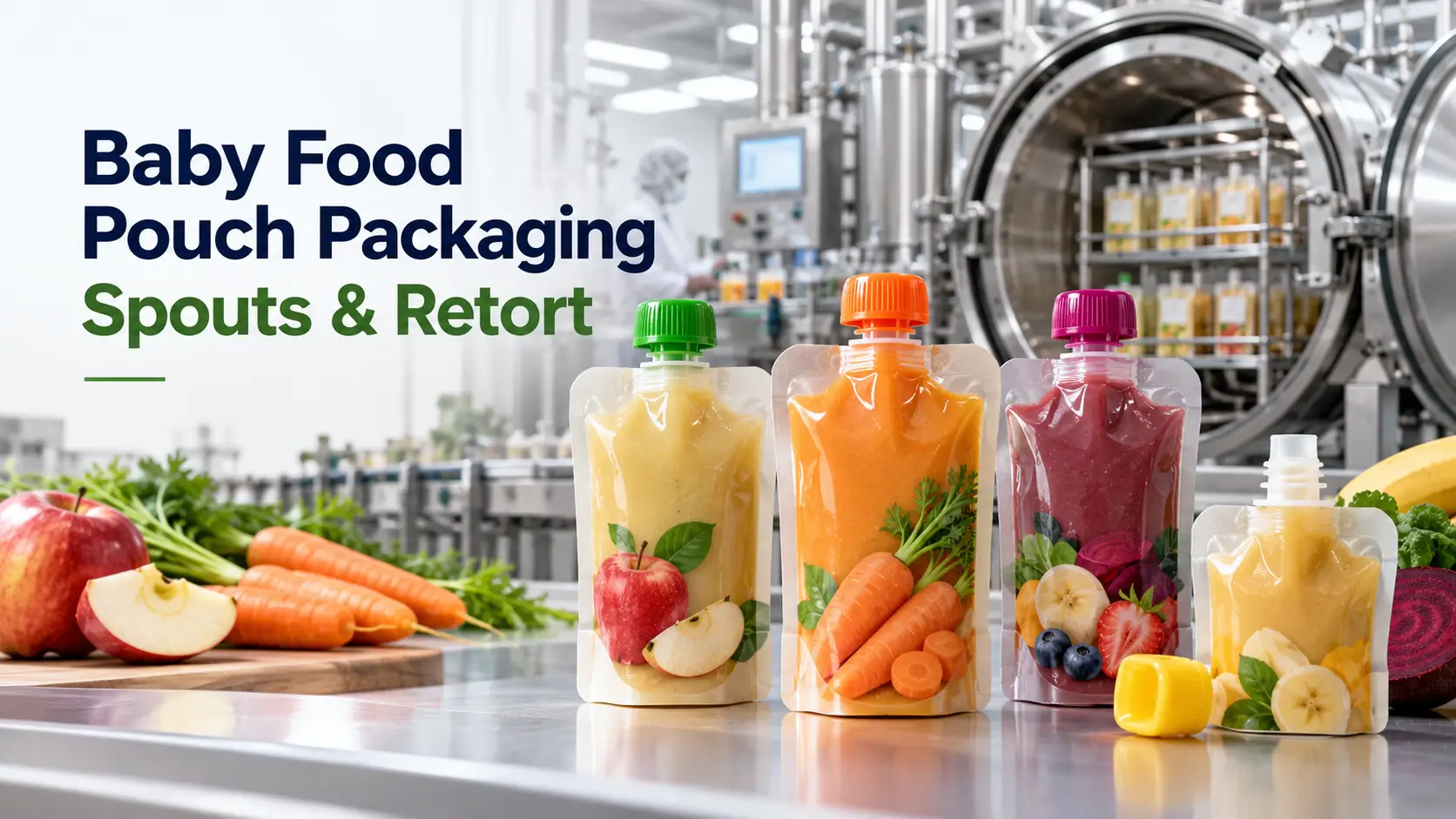
Baby food packaging has a bigger job than simply holding food. It needs to protect delicate ingredients, prevent leaks, and make feeding easier for parents. From fruit purées to smooth vegetable blends, the right pouch can make a difference in how a product is stored, carried, and used. This is why many brands are exploring baby food pouch packaging as an alternative to traditional containers.
However, not every pouch works the same way. Spout design, packaging materials, and heat processing all affect how well a pouch performs. For example, custom spouted pouches offer different openings, closures, and filling options. Understanding these features helps baby food brands choose packaging that protects their products while making everyday feeding more convenient.
What Is Baby Food Pouch Packaging?
Put simply, baby food pouch packaging is a soft bag made from thin film layers, with a spout and screw cap on top. It holds purées, yogurt, and other spoonable foods. Think of it as a cousin of regular stand-up food pouches, only with tighter rules, because the eater is a baby.
Why Are Baby Food Pouches Popular?
Ask parents why they buy baby pouches and you’ll hear things like:
- Portable: Fits in a pocket or bag, no bowl needed.
- Lightweight: A fraction of a glass jar’s weight, and cheaper to ship.
- Portioned: One pouch, one snack, no guessing.
- Easy to store: Stacks flat, and many skip the fridge until opened.
- Easy to dispense: A small squeeze puts food on the spoon.
None of that helps if the pouch is wrong for the food.
How Do Spout Pouches Work for Baby Food Packaging?
A spout pouch is a sealed bag with a stiff plastic fitting welded into the top. In spout pouch baby food packaging, that fitting decides how the food comes out.
How Spouts Make Baby Food Pouches Easy to Use
Since the opening is fixed, food goes where you aim it: on the spoon, not the high chair. Most brands center the spout at the top, which keeps the pouch steady in small hands.
Choosing the Right Spout Size for Baby Food Purées
A smooth apple purée flows fine through the usual 8 to 9 mm opening. Blends with oats or soft lumps need more room. Too narrow, and it clogs, the parent squeezes harder, and lunch ends up on someone’s shirt.
Leakproof Seals, Tamper-Evident Caps, and Child-Safe Closures
When a spout pouch leaks, it’s nearly always where the fitting meets the film. That joint has to survive heat, shipping, and a toddler’s grip. Caps do two separate jobs:
- Tamper-evident caps have a band that snaps on the first twist, so parents know it’s unopened.
- Anti-choke caps are oversized on purpose, and some are vented so air gets through if one is swallowed.
Plenty of brands want both on the same cap.
What Is Retort Pouch Packaging for Baby Food?
With retort, the food goes in, the pouch is sealed, and then it’s all cooked under pressure. That’s how retort pouch baby food lasts months on a shelf without a fridge.
How Retort Processing Works
Stripped down, it goes like this:
- Fill: The purée goes in with as little air on top as possible.
- Seal: The pouch is sealed shut and the cap goes on tight.
- Heat: Racks of pouches go into a pressure cooker called a retort, often at about 121°C (250°F).
- Cool: They cool under pressure, then get dried and checked for leaks.
Why Retort-Grade Materials and Spouts Matter
A retort cycle is rough on packaging. Ordinary films go soft or peel, and weak seals give up. Retort-grade pouches use heat-tough layers and a polypropylene (PP) sealant that holds up.
Important Note: A film that survives retort is only half the story. If the spout or cap is polyethylene, it can soften and warp in the heat while the bag around it looks perfect.
Retort vs. Hot-Fill vs. Aseptic Baby Food Packaging
These three get mixed up a lot, so here’s how they compare.
| Process | How it works | Pouch needs | Often suits |
| Retort | Food is sealed, then heated inside the pouch | High heat and pressure resistance | Low-acid purées, like vegetables or meat |
| Hot-fill | Hot food is filled, then sealed | Heat-resistant film and spout | Higher-acid fruit purées |
| Aseptic | Food and pouch are sterilized apart, then filled in a sterile zone | Sterile-ready film and fittings | Large runs of smooth purées |
One thing to watch: hot-fill won’t make every baby food shelf-stable. It’s fine for acidic fruit blends, but carrots, peas, or chicken usually need retort or aseptic.
Which Materials Are Used for Baby Food Pouch Packaging?
Almost every baby food pouch is a laminate, a fancy word for thin films glued into one sheet. Each film is there for a reason.
Common Materials Used in Baby Food Pouches
| Layer | Common material | What it does |
| Outer | PET (polyester) | Holds the print and resists scuffs |
| Strength | Nylon (PA) | Adds puncture and drop resistance |
| Barrier | Aluminum foil or a coated clear film | Blocks oxygen, moisture, and light |
| Inner sealant | PP or PE | Touches the food and forms the heat seal |
The inner layer is the one to watch, since it’s the only one touching the food. In retort pouches it’s usually cast polypropylene (CPP). And which material is most commonly used for packaging baby food? For decades it was glass, but in many markets plastic pouches now own the purée shelf.
Aluminum Foil vs. Clear Barrier Films
Foil blocks oxygen, moisture, and light better than anything. The catch? Nobody can see the food, and metal detectors can’t see through it. Clear films with an aluminum oxide coating show the purée and pass metal detection, with only slightly less barrier.
How Packaging Materials Help Protect Baby Food Quality
Given time, oxygen turns a bright carrot purée dull and flat and eats away at vitamins. A strong barrier and good seals hold that off through the tested shelf life.
How Safe Are Spout and Retort Baby Food Pouches?
A well-made pouch is safe for baby food. You just can’t prove that with one label.
Food-Grade Materials and BPA Requirements
In the US, any layer touching the food has to meet FDA rules for how it’ll really be used, heat included. Europe sets migration limits for plastics, and the EU ban on BPA hit its main deadline in July 2026.
“BPA-free” on a spec sheet is nice, but it doesn’t settle much, because other compounds can still creep into food through chemical migration. Ask for test results on the whole pouch at your real process conditions.
Cap Safety and Leak Testing
A decent supplier runs checks like these before you fill:
- Pull and twist tests on the spout, so caps don’t loosen or snap off
- Leak and burst tests, done after filling and heating
- Drop tests that mimic a careless delivery driver
- Size checks to confirm anti-choke caps really are oversized
It also helps to buy from a BRCGS-certified packaging maker, since that standard looks hard at hygiene and quality control.
Why Processing Validation Matters for Shelf-Stable Baby Food
A pouch rated for 121°C doesn’t make your product safe by itself. In the US, moist low-acid foods (pH above 4.6) sealed in a pouch fall under FDA’s low-acid canned food rules. You’ll need to register and file a heat process proven for your recipe and pack.
Important Note: Heat moves differently through a fatter pouch, a thinner one, or a new film. Switching pouches? Get your process checked again, even if the new one looks identical.
Choosing the Right Pouch for Different Baby Foods
No single pouch fits every recipe. The best infant food pouches are picked around what’s inside them.
Fruit and Vegetable Purée Pouches
Smooth baby purée pouches are the easy case, and a standard top spout works fine. Fruit blends are often acidic enough for hot-fill, while vegetable purées usually need retort.
Weaning Pouches and Thicker Food Blends
Weaning pouches for older babies are thicker, sometimes with soft lumps. They need a wider spout and solid seals.
Refrigerated Yogurt and Other Baby Food Products
Chilled yogurts and cold-pressed purées get gentler treatment, like pasteurization or high-pressure processing (HPP). They still need a good barrier, though. Cold doesn’t fix a leak.
| Product | Dispensing need | Storage | Possible process |
| Smooth fruit purée | Standard spout | Shelf-stable | Hot-fill or retort |
| Vegetable or meat purée | Standard spout | Shelf-stable | Retort or aseptic |
| Thick weaning blend | Wide spout | Shelf-stable | Retort |
| Yogurt or cold-pressed purée | Standard spout | Refrigerated | Pasteurization or HPP |
Use this table as a starting point; your process expert gets the final say.
Baby Food Pouches vs. Baby Food Jars: Which Is Better?
Honestly, it depends. Baby food jars and pouches are good at different things.
| Factor | Pouches | Glass jars |
| Convenience | Squeezable and easy to dispense | Needs a spoon |
| Portability | Light and hard to break | Heavier and can shatter |
| Product protection | Strong with the right barrier layers | Excellent, since glass blocks gases fully |
| Processing | Retort, hot-fill, or aseptic | Usually retort or hot-fill |
| Shelf presentation | Large print area and custom shapes | Classic look, food is visible |
| End of life | Hard to recycle unless mono-material | Widely recyclable |
Pouches win with families on the go. Jars still appeal to parents who like to see the food and recycle the empty.
Custom Baby Food Branding and Packaging Options
A tired parent sizes up your pouch in seconds. Good baby food branding and packaging catches the eye, then backs it up with honest facts.
Choosing the Right Pouch Size and Shape
Most single-serve baby pouches hold around 90 to 120 g (about 3 to 4 oz), smaller for first tastes and bigger for toddlers. A slim stand-up pouch with rounded corners is easy for small hands to hold.
Designing Attractive and Informative Baby Food Pouches
Bright colors get the pouch noticed. The back panel is what parents actually read, though, so save space for:
- Ingredients and allergens in readable type
- The age or stage it’s for
- What to do once it’s opened
- A feeding tip, like squeezing onto a spoon for younger babies
Keep artwork clear of the spout and seals, where print creases. Launching five flavors at once? Our guide to low minimum orders covers realistic run sizes.
Is Sustainable Baby Food Pouch Packaging Possible?
Yes, but safety comes first. Sustainable baby food packaging can only cut waste in ways that keep the food safe.
Recyclable and Reduced-Material Pouch Options
The classic retort pouch is PET, foil, and plastic stuck together, which most recyclers can’t separate. Mono-material pouches stick to one plastic family, often all-PP. Gerber did this in 2020 when it launched an all-PP baby food pouch with Gualapack. These films are newer, so test them closely.
Balancing Sustainability, Food Safety, and Shelf Life
A pouch uses much less material than a jar, but lighter isn’t the same as recyclable. Only print green claims you can back up. In Europe, the PPWR has applied since August 12, 2026, so recyclable design gets a closer look now.
How to Choose the Best Baby Food Pouch Packaging
Start with the food. The bag comes second.
Match the Pouch to Your Food and Filling Process
Get clear on your recipe first: acidity, thickness, and storage. Then choose a film and spout rated for your process, be it retort, hot-fill, or aseptic.
Check Materials, Spouts, Seals, and Safety Requirements
Ask for spec sheets, food-contact paperwork, and full-pouch test results. And check that the spout material matches the inner sealant; a mismatch often causes leaks.
Request Samples and Test Before Production
Run real samples on your own line, then hunt for leaks, weak seals, and fussy caps. A good packaging manufacturer will happily help with this.
A quick checklist before you order:
- Recipe, pH, and texture locked in
- Fill weight and pouch size picked
- Shelf-stable or chilled, decided
- Film, spout, and cap all rated for your process
- Samples run on your own line
- Artwork, finish, and label copy signed off
Conclusion:
Strip it back and good baby food pouch packaging is a few choices that lean on each other. The spout has to fit the food. The film has to live through the process. And every seal has to hold, even after a dozen hard squeezes.
So begin with your recipe and your process, then build the pouch around them. Test real samples before a full run. It’s a slower start, but much cheaper than reprinting thousands of pouches.
Get Custom Baby Food Pouch Packaging That Fits Your Product
Launching a new baby food line, or moving away from jars? Tell us what you’re making, your fill size, and your process. We’ll help with materials, specs, printing, and samples.
Request your free quote today.
FAQs
1. What is the difference between a spout pouch and a retort pouch?
A spout pouch has a spout and cap. A retort pouch can be heat-sterilized after sealing. Many baby food pouches are both.
2. Which material is most commonly used for packaging baby food?
For a long time it was glass jars. These days, multilayer plastic pouches are the most common pick for purées.
3. Are spouted baby food pouches safe for infants?
Yes, if the materials are food-grade, the seals are tested, and the cap is anti-choke. A grown-up should still watch at mealtime.
4. Can retort baby food pouches be stored without refrigeration?
Yes, while sealed. Once opened, it goes in the fridge, and the label says how long it keeps.
5. Can baby food pouches be recycled?
Most multilayer pouches can’t go in a curbside bin yet. Mono-material pouches have a better chance, if your local program takes them.
6. Can baby food pouches be customized with different spouts and designs?
Yes. Size, shape, spout position, cap, finish, and full-color print are all up to you.