






























Choosing a packaging supplier can look simple when two quotes are sitting side by side. One supplier may offer a much lower price per pouch, while another costs more but is closer to your market. The cheaper number gets attention first, but it rarely tells the full story. Freight, customs charges, order size, delays, inventory, and changing packaging tariffs can all change what you actually pay.
This matters even more when comparing domestic production with an overseas supplier. Recent changes in custom packaging costs have made brands more careful about where their packaging comes from and what is included in a supplier quote. Instead of asking only, “Who has the lowest price?”, it makes more sense to ask, “What will this packaging really cost by the time it reaches our warehouse and is ready to use?”
Domestic vs Overseas Packaging Suppliers: Quick Comparison
Domestic and overseas suppliers can both be the right choice. The better option depends on your order volume, timeline, cash flow, specifications, and how much supply-chain complexity you are comfortable managing.
Here is a simple comparison.
| Factor | Domestic Packaging Supplier | Overseas Packaging Supplier |
| Initial unit price | Often higher | Often lower |
| International freight | Usually not required | Required for imports |
| Import tariffs | Not applied to domestic goods | May apply |
| Customs clearance | No | Yes |
| Lead time | Usually shorter | Usually longer door to door |
| MOQ | Varies by supplier and process | Varies by factory and process |
| Inventory planning | Can allow smaller, more frequent orders | Often needs more forward planning |
| Artwork changes | Easier to react quickly | Changes can affect a longer production cycle |
| Communication | Easier working hours | Time-zone differences may apply |
| Supply-chain complexity | Lower | Higher |
| Best fit | Fast-changing or time-sensitive programs | Planned, stable, higher-volume programs |
There is no rule that says domestic production is always expensive or overseas production is always cheap. A domestic supplier may have an efficient digital setup that works well for smaller runs, while an overseas factory may provide excellent value at a larger volume.
The real comparison begins after both quotes are put on the same basis.
Which Option Is Usually Better?
Domestic sourcing wins on speed, flexibility and smaller runs. Overseas sourcing wins on scale, factory price and specialist capability. The right answer depends less on the country and more on how your business actually orders.
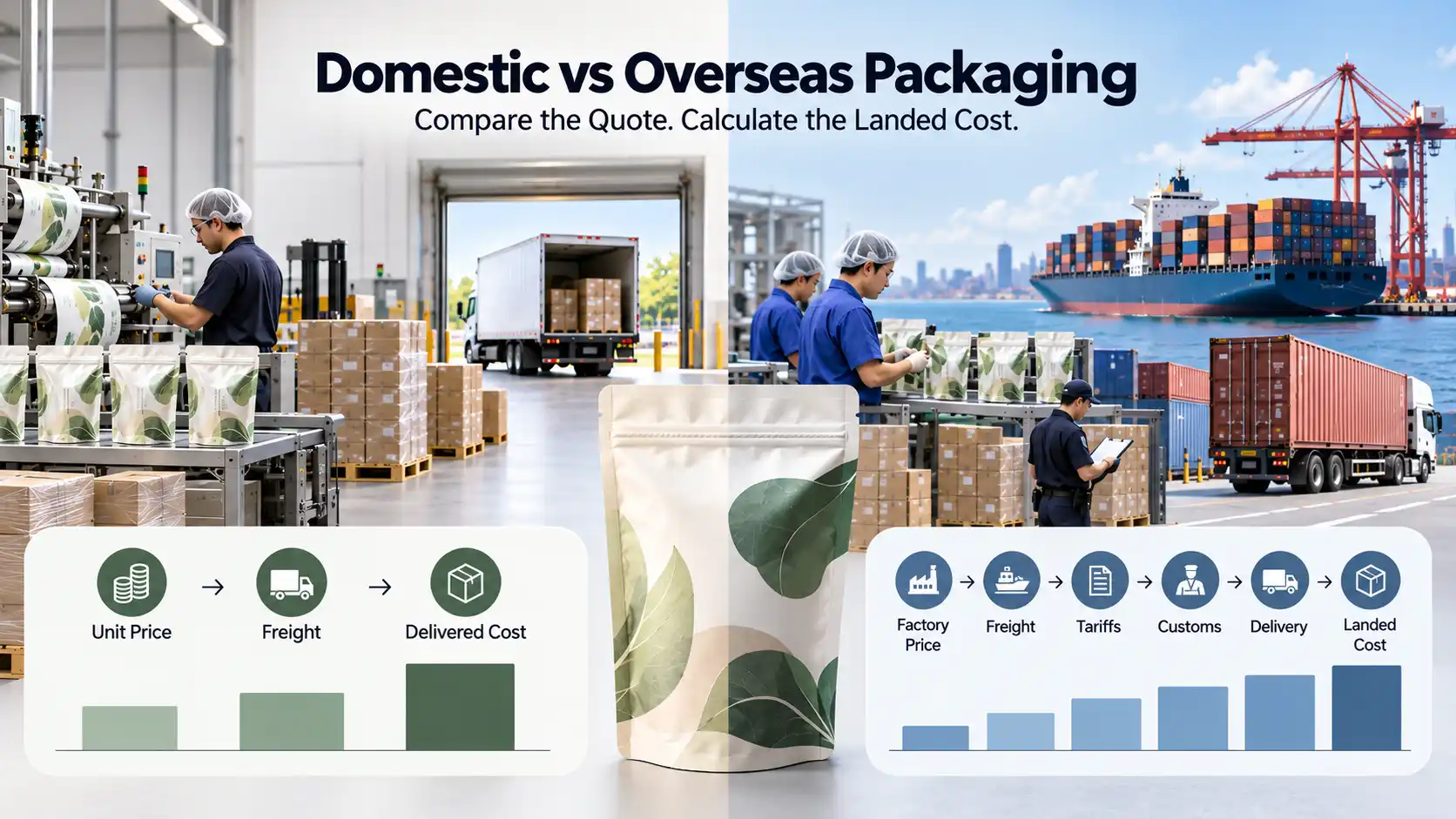
Why Packaging Unit Price Is Only Part of the Real Cost
Imagine receiving two quotes for the same pouch.
The domestic supplier quotes $0.42 per pouch.
The overseas supplier quotes $0.27 per pouch.
At first glance, the answer seems obvious. But what exactly does that $0.27 cover? It may be the factory price only. International freight, insurance, import duty, brokerage, port handling, and final delivery could still sit outside the quote.
That is why unit price and actual packaging cost are not the same thing.
Factory Price vs Total Landed Cost
Three terms get mixed up constantly, and mixing them up is how buyers overspend:
- Quoted unit price: what the factory charges per pouch
- Delivered cost: unit price plus getting the goods to your door
- Total landed cost: everything, including duties, customs fees, handling and the cost of holding stock
Two suppliers can quote the same unit price and still land 40% apart.
Calculate the True Cost Per Usable Pouch
The number that matters is simple:
Total landed cost ÷ usable pouches received = true cost per pouch
Note the word usable. If 200 pouches out of 10,000 arrive with weak seals, you paid for 10,000 and can sell 9,800. Domestically you reprint those in a week. On an import you either accept the loss or wait another two months.
What Is Included in the Total Landed Cost of Packaging?
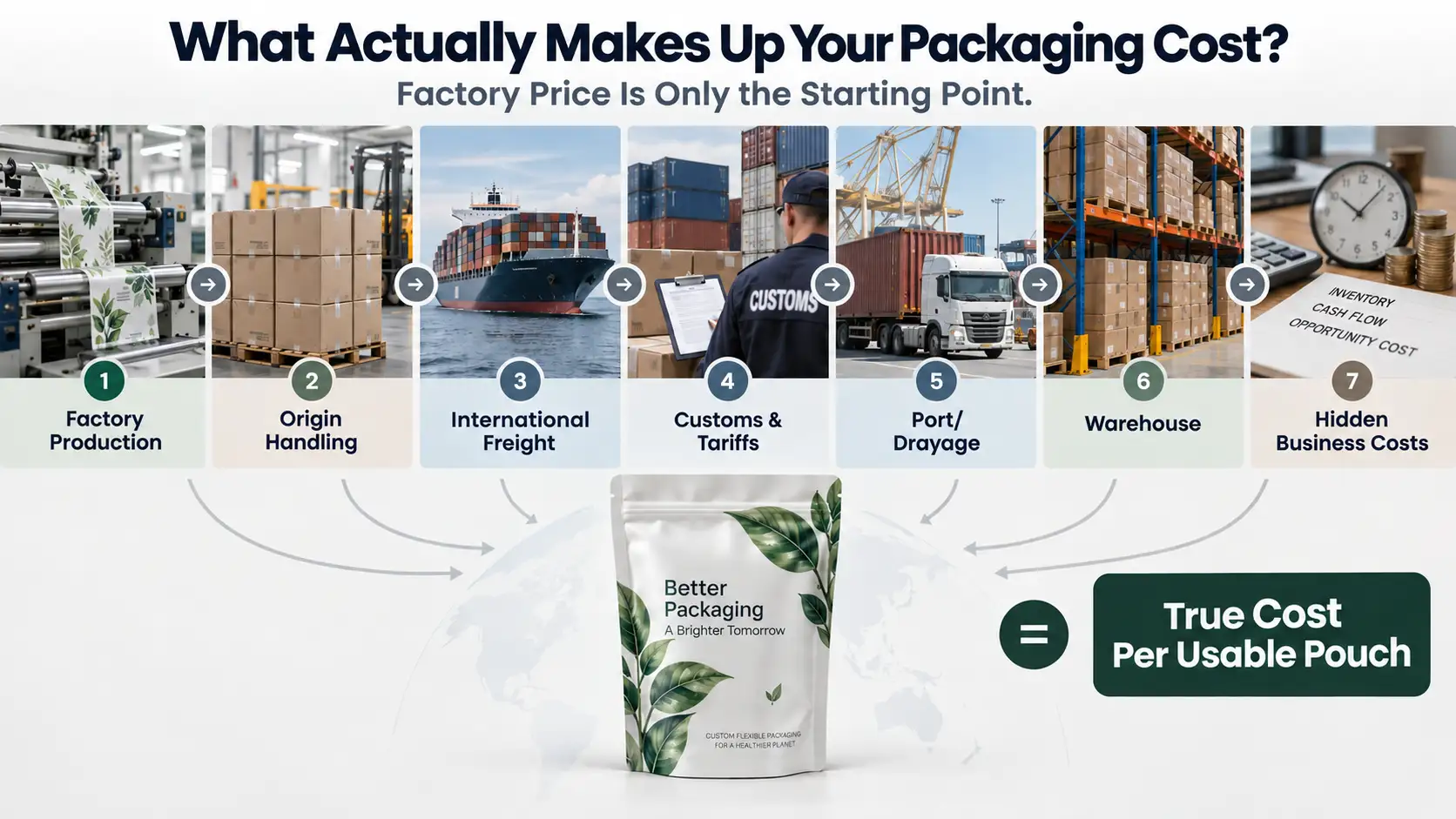
The landed cost is not one line item. It is six groups, and importing adds several that domestic buying never touches.
Packaging Production Costs
Raw materials and film, converting, printing, artwork and prepress, tooling such as plates or cylinders, zippers, spouts and valves, special finishes, plus sampling and proofing. These apply wherever you buy.
Origin and Export Costs
Inland transport from factory to port, export documentation, origin handling and loading, and pre-shipment inspection if you book it. Import only.
International Freight Costs
Ocean freight, air freight when a deadline slips, express shipping for samples, cargo insurance, and fuel or peak season surcharges.
Customs and Import Costs
Customs duties by classification, packaging tariffs and other trade measures, brokerage and entry filing, processing and port fees, and exam charges if your container gets pulled.
Destination and Delivery Costs
Port handling, drainage, storage and demurrage if anything is delayed, warehouse receiving, and domestic trucking to your facility or co-packer.
Hidden Business Costs
This group never appears on an invoice:
- Working capital locked up while stock sits on a shelf
- Quality failures and emergency reprints
- Obsolete packaging after a label change
- Rush freight and lost sales when an order runs late
How Packaging Tariffs Change the Cost of Overseas Sourcing
Tariffs are the part of the calculation that moves without warning. They are also the part most buyers guess at instead of checking.
Why There Is No Single Packaging Tariff Rate
Nobody can tell you “the tariff on pouches” because there is not one. Your rate depends on:
- The HTS code your product classifies under
- The material and construction of the pouch
- Whether it is plastic, paper based, foil lined or laminated
- The country of origin
- Any trade measures in force on that code and origin when the goods clear
One word in a product description can move a shipment onto a different code with a different rate.
Flexible Packaging Import Duty
Flexible packaging is not one category at customs. Printed plastic pouches, laminated film, rollstock, paper based structures and foil laminates classify differently and carry different base duties. Small changes in film structure can change the classification, which is why a broker needs the technical spec and not a photo of the bag.
Packaging Import Tariffs From China
Chinese origin packaging usually sits at the top of the range because several duty layers can apply at once. Before signing anything, confirm four things with your customs broker:
- The exact classification for your pouch construction
- The base duty rate on that code
- Any additional measures applying to that origin
- Whether exclusions currently apply, and when they expire
Important Note: Your broker prices duty at entry, not at order. The rate that applies is the one in force the day your container clears, not the one you modelled when you approved the quote. On a 12 week lead time, that is a real risk worth building into your numbers.
How Tariffs Affect More Than the Customs Bill
The duty payment is visible. The knock-on effects are bigger. A rate increase lands straight on your cost of goods. Buyers over-order to beat an expected change and then sit on stock. A higher landed cost means the same pallet count ties up more cash. And a supplier who cannot absorb duty changes will pass every one of them to you.
Packaging Freight Costs From China and Other Overseas Markets
Freight is where flexible packaging gets an honest advantage, and where quote comparisons quietly break down.
Ocean Freight vs Air Freight
Ocean freight costs less per unit and suits planned volume, but transit runs three to six weeks and needs real forecasting. Air freight cuts that to days and rescues a launch date, but it usually wipes out the savings that sent you overseas in the first place.
One genuine point in favour of pouches: flat, light packaging fills a container efficiently. Unlike corrugated boxes, you are not paying to ship air.
LCL vs Larger Shipments
Freight economics change sharply with volume. A part container load carries a high cost per unit because handling and documentation charges spread across a small quantity. The same fixed charges almost disappear across a full container. This is the main reason small import orders rarely beat domestic pricing.
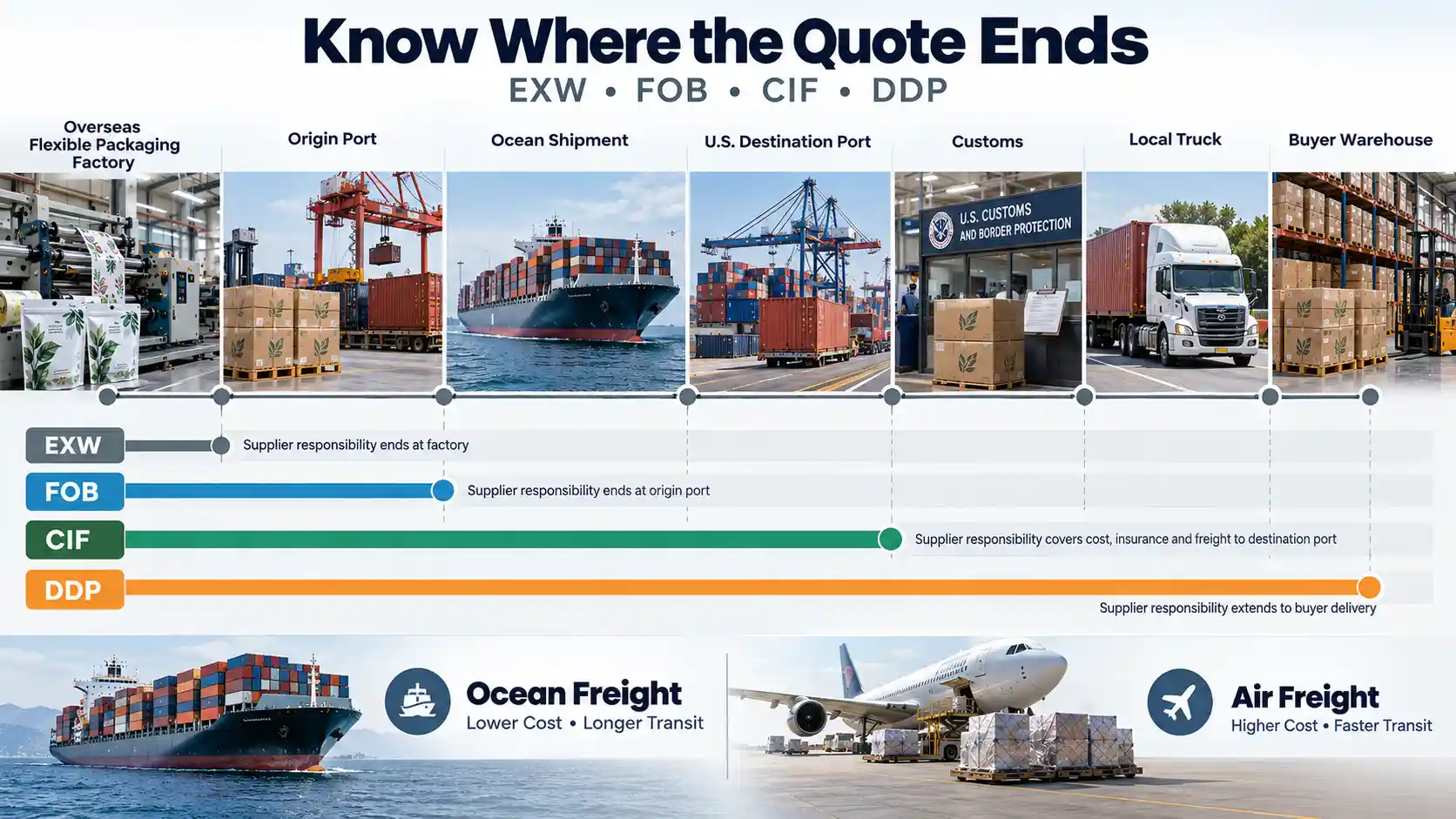
EXW, FOB, CIF and DDP
These terms decide where the supplier’s responsibility stops and yours begins:
| Term | Supplier covers | You cover |
| EXW | Goods at their door | Everything after that |
| FOB | Loading at origin port | Ocean freight, duty, delivery |
| CIF | Freight and insurance to destination port | Duty, clearance, inland delivery |
| DDP | Everything, duties included | Receiving the goods |
A $0.30 FOB quote and a $0.36 DDP quote are not what they look like. The FOB price is missing several thousand dollars that the DDP price already contains.
Ask Where the Supplier Quote Actually Ends
One question fixes most of this. Ask each supplier whether the price covers delivery to the factory gate, the origin port, the destination port or your warehouse. Until you know, you are not comparing quotes at all.
MOQ, Inventory and Cash Flow Can Change Which Supplier Is Cheaper
Price per pouch and cash required are different questions. Plenty of brands pick the cheaper unit price and then run short of working capital.
Why a Lower Unit Price Can Require More Cash Upfront
The commitment is the real figure:
MOQ × unit cost + tooling + freight + import costs = cash out the door
A supplier at $0.25 with a 50,000 minimum asks for far more money than one at $0.38 with a 5,000 minimum. If you are still testing demand, the cheaper option can be the one you cannot afford. Our guide on minimum order quantity covers what is realistic at low volumes.
The Hidden Cost of Holding Packaging Inventory
Stock is not free just because it is already paid for. Warehouse space, working capital, slow-moving pallets, overstock bought to hit a price break and safety stock you must carry because reorders take months all cost money every week they sit.
What Happens When Printed Packaging Becomes Obsolete?
Printed pouches have a shelf life that has nothing to do with the film. A pallet becomes scrap when you rebrand, change an ingredient, face a new labelling rule, discontinue a SKU or pass a seasonal window. The bigger the order, the bigger the write-off.
Domestic vs Overseas Packaging Supplier Lead Times
Lead time is not just production time, and the difference between the two is where launch dates get missed.
What Is Included in Packaging Lead Time?
The full path runs: quotation, artwork, proofing, material sourcing, printing, converting, quality check, shipping, customs, warehouse. Overseas orders add three stages. Domestic orders skip customs entirely. Knowing the production steps your supplier follows makes it far easier to plan backwards from a launch date.
Why Overseas Lead Times Can Become Longer
Worth knowing: overseas factories often produce faster than domestic plants because they run multiple shifts. The time is lost after production, not during it.
- Vessel schedules and sailing windows
- Port congestion at either end
- Customs clearance and random exams
- Raw material availability
- Final inland delivery
A clean nine week run becomes twelve when any two of these slip together.
The Cost of a Late Packaging Order
Late packaging is rarely just a packaging problem. It shows up as a missed retail slot, stockouts during peak demand, a co-packer sitting idle, expedited freight to recover the schedule, and emergency reprints at short-run pricing.
Quality, Compliance and Supplier Control Matter as Much as Geography
Overseas does not mean poor quality. Many international plants hold the same certifications as domestic ones. What changes is how easily you can verify quality on your order.
Flexible Packaging Specifications to Compare
Ask both suppliers for the same list in writing: film structure, barrier performance, film thickness, seal strength, zipper type, print registration, colour accuracy and finished dimensions. Colour is where remote approval hurts most, because screens and photographs lie. Our guide on Pantone and spot colours explains why a printed proof beats a PDF.
Certifications and Compliance Documents
Request actual certificates with expiry dates, not a logo on a website. Depending on your product that may cover food contact compliance, material specifications, testing reports, migration documentation and batch traceability.
What Happens If Packaging Arrives Out of Specification?
Agree this before the order, not after the pallet lands:
- Who pays for replacement stock?
- What defect percentage counts as normal?
- How quickly can the supplier reprint?
- Who covers expedited freight on a remake?
Domestic Packaging Supplier Advantages: When U.S. Sourcing Makes More Sense
Domestic production is not always cheaper per pouch, but it removes a long list of variables. For some brands that is worth more than the price gap.
Made in USA Pouches May Make More Sense When You Need
- Smaller order quantities
- Fast turnaround
- Frequent artwork changes
- Several SKUs running at once
- Quick reorders when something sells well
- Less inventory sitting in a warehouse
USA-Made Flexible Packaging for New and Growing Brands
Newer brands carry the most uncertainty, and uncertainty is expensive when packaging takes three months to arrive. Digital printing suits this stage because there are no cylinders to pay for, several SKUs can run together, and artwork can change between orders without a tooling bill. That matters for launches, test markets and seasonal lines.
Where Domestic Packaging Can Still Cost More
Manufacturing and labour costs are generally higher, some specialist finishes are cheaper overseas, and certain formats have deeper capacity abroad. If your volume is high and your design is settled, that gap is real money.
When Overseas Packaging Suppliers Can Be the Better Choice
Importing is not a mistake. It is a trade-off that works well under specific conditions.
It makes sense when volume is high, specifications are stable, artwork rarely changes, demand is predictable, the lead time is acceptable, quality control is organised, and the landed cost saving is still meaningful after everything is added.
The Question Is Not “Which Country Is Cheapest?”
The better question is narrower. Does the overseas cost advantage survive freight, tariffs, inventory and risk? If it wins by a wide margin, import. If it only just wins, the saving is not worth the exposure.
Is It Cheaper to Import Packaging? Use a Break-Even Comparison
Run both routes through the same model. A quote comparison tells you nothing until both sides are measured the same way.
Domestic model: manufacturing + setup + domestic freight + inventory cost + expected risk cost
Overseas model: factory price + tooling + origin costs + freight + insurance + tariffs + brokerage + destination costs + inland delivery + inventory cost + expected risk cost
Calculate Your Packaging Break-Even Point
There is no universal quantity where importing starts to win. Your break-even moves with pouch design, quantity, material, SKU count, printing method, shipping terms, tariff rate and both quotes in front of you.
The pattern holds, though. Brokerage, port handling and drayage barely change with order size, so they dominate small orders and fade on large ones. Below a certain annual volume, importing cannot win no matter how low the factory price goes.
Example: Domestic vs Overseas Cost for 10,000 Custom Pouches
Here is an illustrative comparison using the two quotes from the introduction. These figures show structure, not real pricing.
| Cost | Domestic | Overseas |
| Manufacturing | $3,800 | $2,500 |
| Printing and setup | $150 | $200 |
| Tooling and cylinders | $0 | $600 |
| Origin charges | $0 | $180 |
| Freight and insurance | $120 | $680 |
| Tariffs | $0 | $990 |
| Brokerage and customs fees | $0 | $260 |
| Port handling and drayage | $0 | $300 |
| Inland delivery | Included | $150 |
| Inventory carrying cost | $45 | $130 |
| Total landed cost | $4,115 | $5,990 |
| Usable pouches received | 9,950 | 9,800 |
| True cost per usable pouch | $0.41 | $0.61 |
The overseas quote opened 34% lower and finished 49% higher. That flip happens because roughly $1,700 of import costs stay almost the same whether you order 10,000 pouches or 100,000.
Important Note: This example is deliberately small. Run the same table at 250,000 pouches and the result often reverses, because those fixed import costs spread thin. Always model your annual volume, not your first order.
How to Compare Domestic and Overseas Packaging Quotes Fairly
Before comparing two suppliers, make sure they are pricing the same job.
Your quote checklist should cover:
- Pouch style
- Width, height, and gusset
- Material structure
- Barrier requirements
- Film thickness
- Printing method
- Artwork
- Number of SKUs
- Closure type
- Window, valve, or spout
- Finish
- MOQ
- Tooling
- Proofing
- Production lead time
- Shipping terms
- Delivery destination
- Freight
- Import duties or tariffs
- Required documentation
- Quality tolerances
- Reprint or defect policy
- Payment terms
- Reorder lead time
You should also confirm whether you are comparing the same packaging route. The cost and buying process can differ significantly between premade and custom pouches, particularly when artwork, materials, dimensions, and volume begin to change.
A supplier quote is only useful when the specification behind it is clear.
Domestic, Overseas or Hybrid: Which Packaging Strategy Fits Your Business?
Most brands treat this as a permanent choice. It works better as a decision you revisit as volume and SKU mix change.
Choose domestic when speed matters more than unit price, quantities are smaller, your SKU list keeps changing, demand is uncertain, or inventory risk is high.
Consider overseas when demand is stable, volumes are genuinely large, specifications rarely change, you have lead time to absorb delays, and the landed cost saving is clearly worth it.
Consider a hybrid if you are big enough to run both. Overseas handles stable, high-volume SKUs where the saving is real, while a domestic supplier covers launches, urgent restocks and anything with artwork that moves. It costs a little more overall and removes most of the risk of one supply lane failing at the wrong moment.
Conclusion
The cheapest quote and the cheapest packaging are rarely the same thing. Once freight, duties, customs charges, inventory and reprint risk are added, a $0.25 pouch and a $0.38 pouch can finish in the opposite order. Build the landed cost model once and every future quote takes ten minutes to check.
The right supplier is the one that fits how your business actually buys. Weigh cost against speed, quality, reliability and the freedom to change your mind when a product takes off.
Need Flexible Packaging That Fits Your Volume and Timeline?
Flexible Pouches produces fully custom flexible packaging with low minimums, digital and rotogravure printing, custom sizing, multi-SKU runs and sustainable material options, with fast turnaround and shipping included.
Send your pouch size, quantity, material requirements and printing details, and you will get a delivered price you can put straight against any import quote.
Request a Custom Packaging Quote
FAQs
1- What are packaging tariffs, and how do they affect imported pouches?
Packaging tariffs are import duties charged when packaging enters the country. The rate depends on your pouch’s HTS classification and country of origin, not the product inside it. Duties are charged on customs value, so they scale with order size.
2- Is it cheaper to import packaging from China or buy packaging in the USA?
It depends on volume. At small quantities, fixed costs like brokerage, port handling and drayage push landed costs above domestic pricing. At large, stable volumes those costs spread thin and importing can win. Run both through the same model using your annual quantity.
3- What costs should be included in packaging landed cost?
Factory price, tooling, artwork and setup, origin charges, freight, insurance, duties, brokerage, port handling, drayage, inland delivery, warehouse receiving and inventory carrying cost. Add an allowance for defects and reprints, since neither is ever exactly zero.
4- How much does freight add to packaging imported from China?
It varies with shipment size and market conditions. Pouches ship efficiently because they are flat and light, so per-unit freight is lower than for boxes. Part container loads cost far more per unit than full containers, and ocean rates swing widely by season.
5- How long do overseas packaging suppliers usually take?
Around 8 to 14 weeks door to door for a custom order. Production itself is often only two to four weeks. The rest goes to port handling, ocean transit of three to six weeks, customs clearance and inland delivery. Repeat orders are faster but still take months.
6- What are the main advantages of using a domestic packaging supplier?
Shorter lead times, faster reorders, lower minimums, no duty or customs exposure, in-person press approval and quick correction if a run goes wrong. It also frees working capital, because you buy closer to real demand instead of pre-paying for stock sitting at sea.