






















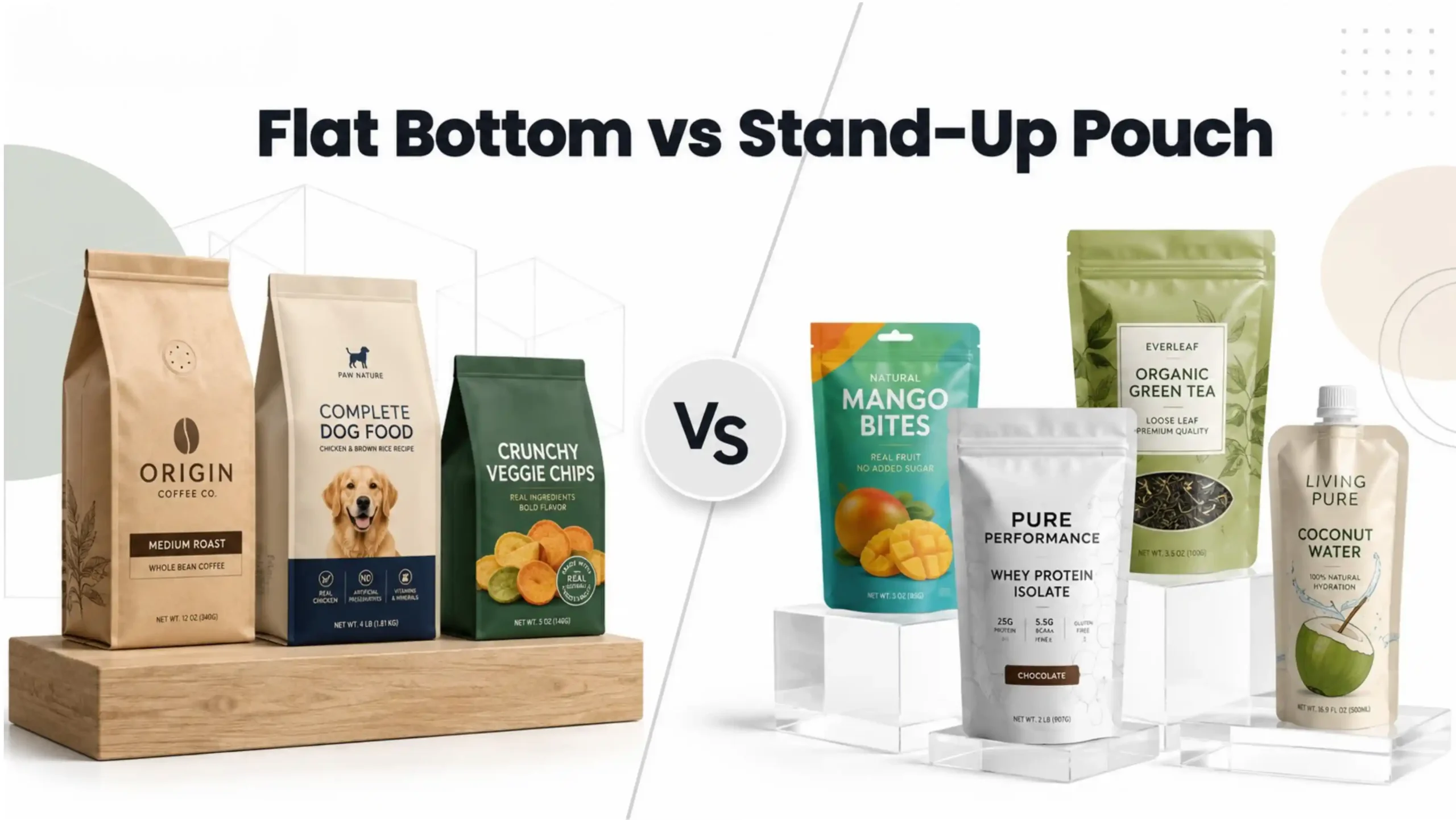
A flat bottom pouch and a stand-up pouch can look almost identical sitting side by side on a shelf. Fill them, though, and that similarity disappears fast. One holds its shape for months without much fuss. The other might lean, wobble, or eat up more carton space than you had budgeted for.
So what actually decides it? Weight, capacity, shelf space, how you fill it, what you can spend. This guide walks through flat bottom bags vs stand up pouches the way they perform once filled, not how they look in a catalog photo.
Flat Bottom Bags vs Stand Up Pouches: Quick Comparison
Here’s the short version before the long one: flat bottom pouches suit heavier, bulkier, or premium products that need real structure. Stand-up pouches suit lighter products, smaller runs, multiple flavors, spouted formats, and tighter budgets.
| Comparison Point | Flat Bottom Pouch | Stand-Up Pouch |
| Bottom design | Flat base with side gussets | Expandable bottom gusset |
| Filled shape | Structured, box-like | Flexible, rounded |
| Shelf stability | Stronger for heavy fills | Good for light to medium fills |
| Branding area | Front, back, sides, and bottom | Mostly front, back, and gusset |
| Product capacity | Better for bulky or dense goods | Efficient for smaller, lighter goods |
| Packaging cost | Usually higher | Usually more affordable |
| Typical positioning | Premium, specialty | Everyday, value, broad-market |
| Common uses | Coffee, granola, nuts, pet food | Snacks, tea, spices, supplements, refills |
| Common features | Zipper, valve, window, handle | Zipper, spout, window, hang hole, valve |
| Best starting choice | Stability and a premium shelf look | Versatility and cost efficiency |
That table won’t answer everything, but it’s a fair place to start. The reasoning behind each row comes next.
How the Bottom Design Changes Product Performance
Here’s the thing: these two pouches aren’t built the same way at all, and that one difference ripples through everything else.
How Flat Bottom Packaging Is Built
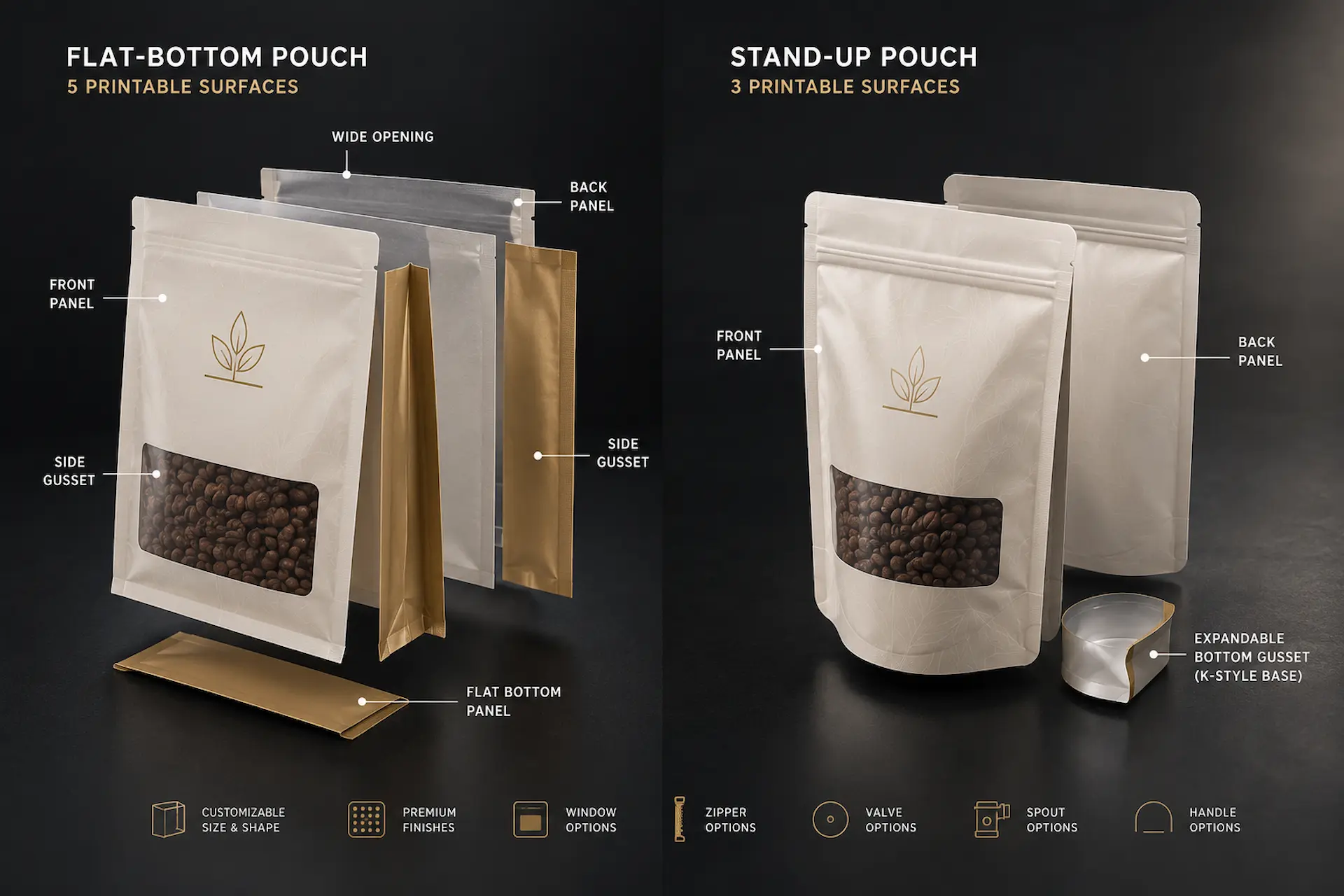
Strip a flat bottom pouch down to its parts and you’ll find:
- A defined bottom panel
- Front and back panels
- Two side gussets
- A wide pouch opening
- Several flat, printable surfaces
Fill it up, and it holds a firm, box-like shape. It just stands there, no leaning required.
Important Note: A flat bottom pouch and a lay-flat pouch are not the same thing. A lay-flat pouch skips the gusset entirely, so it can’t stand upright on its own.
How a Stand-Up Pouch Is Built
A stand-up pouch is the simpler build. Just:
- Front and back panels
- One expandable bottom gusset
- A large front panel made for branding
- A softer, more flexible shape once filled
The bottom style also shifts depending on weight, anything from round to K-style to plow bottom.
Why the Structural Difference Matters
One relies on a separate base panel plus side gussets. The other relies on a single gusset that expands as it fills. That’s the whole difference, but it changes standing stability, filled shape, printable space, and how easily the pouch fills and seals.
Which Pouch Handles Your Product Better?
This is the part that actually matters. Forget pouch style for a second and think about how your product itself behaves.
1- Product Weight and Density
Same net weight, completely different pouch needs, and that happens more often than you’d think. A dense powder packs down tight. Bulky granola or oddly shaped pet treats spread out and take up far more room for the same weight. Shape and density matter here, arguably more than the number on the scale.
2- Fill Volume and Required Headspace
Products settle. They shift. They expand a little once they’re sealed inside a pouch. Leave room above the zipper for a clean seal, and give coffee some extra breathing space for the gas it keeps releasing. Heavy goods spread out better in a flat bottom pouch. Lighter fills stay efficient in a stand-up pouch.
3- Shelf Stability and Shape Retention
A full pouch and a half-empty one don’t always look like siblings. Uneven or heavy contents can tip a stand-up pouch sideways over time. Flat bottom pouches, by comparison, tend to hold their shape whether they’re full, half-used, or opened for the hundredth time.
4- Product Protection and Shelf Life
Here’s something people get wrong a lot: pouch shape doesn’t decide shelf life on its own.
Important Note: Shelf life really comes down to the film, its oxygen barrier, moisture barrier, light protection, and seal quality, not whether the pouch stands tall or sits flat. Flexible Pouches offers high-barrier film options either way, so treat material choice as its own decision.
5- Filling and Sealing Requirements
Your production line has a say in this too. Manual filling, semi-automatic setups, full automation, they each treat zippers, valves, and spouts a bit differently. Pick a pouch that fits your equipment, not just your product.
Which Pouch Fits Different Product Types?
Enough theory. Here’s the quick-reference version by product type.
| Product Type | Recommended Starting Format | Main Reason |
| Whole coffee beans | Flat bottom pouch | Strong stability, premium look |
| Ground coffee | Flat bottom or stand-up | Depends on pack size |
| Coffee samples | Stand-up pouch | Better for small quantities |
| Granola | Flat bottom pouch | Bulky contents need a stable base |
| Nuts and dried fruit | Flat bottom or stand-up | Depends on volume and shape |
| Chips and light snacks | Stand-up pouch | Flexible for light fills |
| Protein powder | Depends on pack size | Density decides the choice |
| Small supplement packs | Stand-up pouch | Efficient for smaller amounts |
| Large powder packs | Flat bottom pouch | Better support for heavy fills |
| Pet treats | Stand-up pouch | Good for smaller, medium packs |
| Pet food | Flat bottom pouch | More stable for larger, heavier packs |
| Tea, herbs, and spices | Stand-up pouch | Works well for light retail sizes |
| Sauces and liquid refills | Spouted stand-up pouch | Easier pouring and control |
| Bath salts and detergents | Depends on density | Weight and closure matter |
| Cosmetics and personal care | Depends on product form | Powder, liquid, and refill needs differ |
1- Coffee and Tea
Whole bean coffee wants a flat bottom pouch with a degassing valve, full stop. Ground coffee is more flexible; it can go either way depending on your pack size. Tea and light dried herbs usually do just fine in something smaller, like a resealable stand-up pouch.
2- Snacks, Granola, Nuts, and Dried Fruit
Light, crunchy snacks are happy in a stand-up pouch with a big front panel to show off. Granola, nuts, and dried fruit, anything bulkier, tend to do better in a flat bottom pouch. That wider base means less breakage and a shape that survives being opened a dozen times.
3- Powders and Supplements
Protein powder, flour, drink mixes, it all comes down to density and pack weight in the end. Smaller, tub-style supplement packs are fine as stand-up pouches. Go bigger and heavier, and a flat bottom pouch with a wider scoop opening starts making a lot more sense.
4- Pet Food and Pet Treats
Small treat bags? Stand-up pouches, easy. Light, easy to carry, simple to reseal every day. Bigger bags of dry pet food need more standing power, and that’s exactly where flat bottom pouches earn their spot.
5- Sauces, Liquids, and Refill Products
Anything you pour rather than scoop usually wants a spouted stand-up pouch. Sauces, cooking oil, liquid soap, and detergent refills all benefit from a controlled pour over a wide-open top.
6- Non-Food and Personal-Care Products
Bath salts, cosmetics, cleaning products, these need pouches that won’t leak and actually suit what’s inside chemically. Material compatibility and a solid seal matter far more here than whether the bag stands up or lies flat.
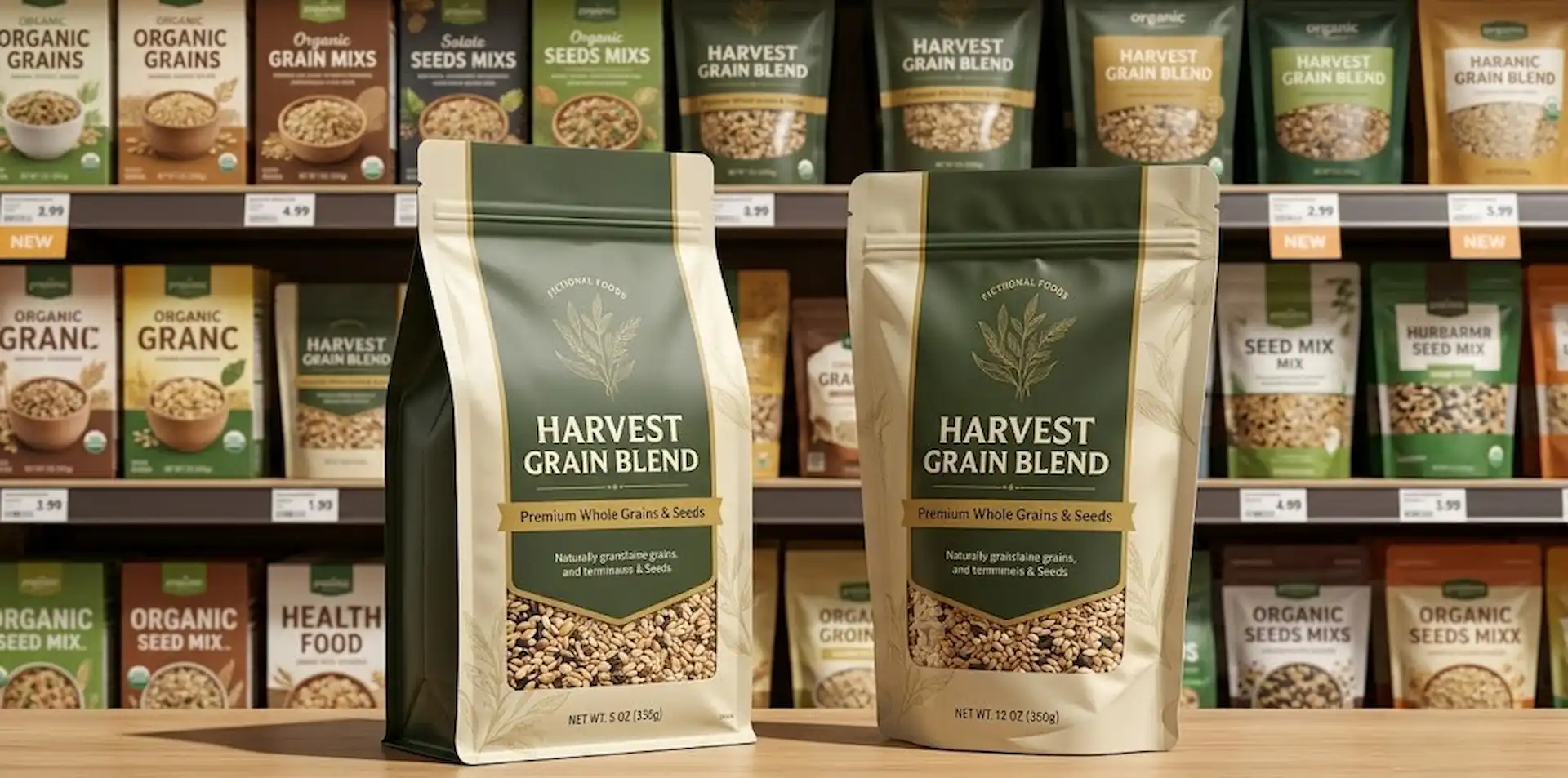
Which Pouch Gives Your Product Better Shelf Presence?
What your pouch looks like on a shelf says something about your brand before anyone reads a word of the label.
Flat Bottom Pouches for Structured, Premium Presentation
That box-like shape suits premium coffee, artisan goods, and anything positioned as higher-end. It lines up cleanly on a shelf and leaves room for more of your brand’s story than just a logo squeezed onto a front panel.
Stand-Up Pouches for Flexible, Front-Facing Branding
A big front panel is perfect for bold graphics, seasonal designs, and juggling multiple flavors at once. Everyday products, smaller sizes, fast shelf recognition: this is exactly where stand-up pouches shine.
Branding Space and Information Placement
Flat bottom pouches hand you extra side panels for ingredients, certifications, or a longer story than usual. Stand-up pouches keep it simpler with a strong front-and-back layout, which is often all a smaller package really needs.
Does the Sales Channel Change the Best Pouch Choice?
Where you actually sell the product can shift the right pouch just as much as the product itself does.
Pouches for Retail Shelves
Standing consistency matters. So does front-facing visibility and a shelf footprint that doesn’t hog space. A pouch that holds its shape hour after hour simply looks better, and it tends to sell better too.
Pouches for Ecommerce
Online, priorities flip. Carton space, shipping weight, and damage protection are what matter now. A pouch that packs flat, stacks neatly, and survives a bumpy delivery van beats one that only photographs well.
One Pouch for Both Retail and Ecommerce
Sometimes a single pouch style genuinely works across both channels. Other times, you’re better off running a different pack size for each, rather than forcing one format to juggle two very different jobs.
How Cost, MOQ, and SKU Count Affect the Decision
Budget and order size belong in this conversation too, not as an afterthought once the design is already locked in.
Why Flat Bottom Pouches Usually Cost More
More panels, more material, extra converting steps, it adds up fast. Printing setup, closures, valves, and your total order quantity all nudge the final price higher.
When a Stand-Up Pouch Offers Better Value
New launches, tighter budgets, multiple flavors, early market testing: stand-up pouches tend to win here. They also make sense for high-volume, everyday products where every cent per unit counts.
When Paying More for a Flat Bottom Pouch Makes Sense
Premium shelf positioning, heavier fills that need extra support, more room for branding: in those cases, the higher cost usually pays for itself pretty quickly.
Worth noting: Flexible Pouches currently sets a lower minimum order quantity for stand-up pouches than for flat bottom pouches. Factor that into your SKU and budget planning early, before you fall for a design you can’t yet afford to order.
Which Pouch Features Can Change Your Final Choice?
A handful of small features can end up changing your decision more than the base pouch style ever does.
1- Resealable Zippers
Anything used more than once needs a zipper, really. Coffee, snacks, pet treats, powders, supplements, all of it. A good zipper is what keeps the product fresh between uses.
2- Degassing Valves
Fresh-roasted coffee keeps releasing gas for days. A one-way valve lets that gas out without letting outside air sneak in, which is exactly how the coffee stays fresher for longer.
3- Spouts
Liquids, sauces, cooking oil, beverages, refill products: spouted stand-up pouches handle all of it, since pouring beats scooping here every time.
4- Clear Windows
A window shows the actual product, and that builds trust fast for snacks, grains, and anything colorful. One trade-off, though: more light gets in than with a solid printed panel.
5- Hang Holes and Handles
Need the pouch to hang on a retail hook? Get carried around easily? Hold a bigger fill size without fuss? That’s when they earn their place.
6- Stand Up Pouch Styles
Worth knowing the main types of stand-up pouch packaging: round-bottom, K-seal, plow-bottom, zipper, spouted, window, and shaped. Each one suits a slightly different weight, fill size, or shelf situation.
Where things are heading in 2026: better resealability, recyclable and mono-material films, custom shapes, and formats that work equally well in a store aisle and an ecommerce box. Flexible Pouches already offers zippers, valves, windows, spouts, handles, and several bottom gusset styles to build from.
What Should You Test Before Choosing a Pouch?
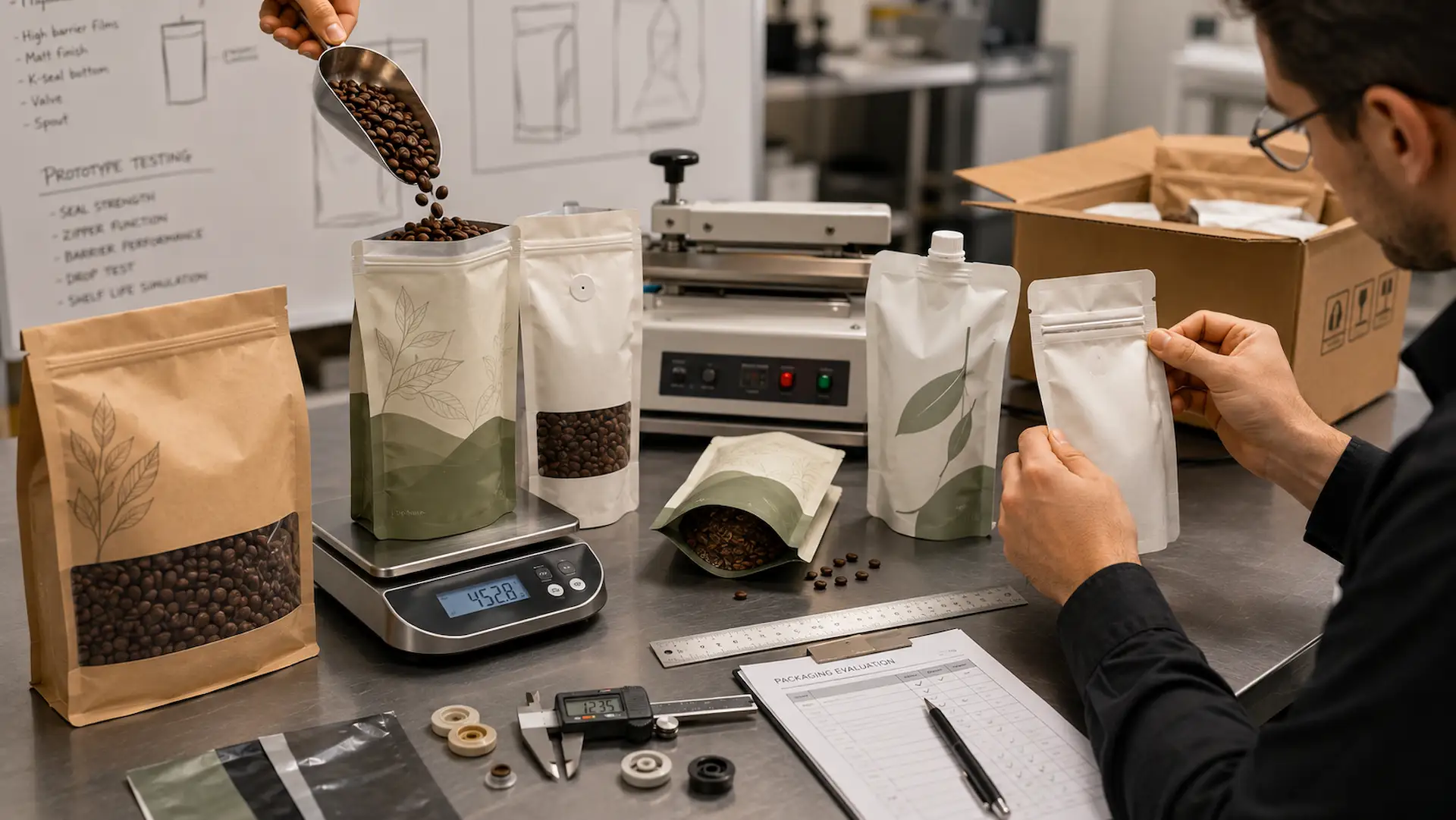
Dimensions on a spec sheet and an empty sample only tell half the story. Test with the real product before you commit.
Conduct a Real Product Fill Test
Check the actual capacity, filled dimensions, required headspace, and how the product settles once it’s actually sitting inside the pouch.
Test Opening, Resealing, and Pouring
Try the zipper. Try the spout or valve yourself, tear notch included. If something feels even slightly clumsy to you, your customer will notice it too.
Test Filling and Heat Sealing
Run an actual batch through your filling line. Watch the seals: are they clean and strong? Check the filling speed, and look for any stray product caught where the seal should be.
Test Storage and Transportation
Load a few finished pouches into your usual shipping carton and see what happens: compression, drops, a normal trip through the supply chain.
Flat Bottom or Stand-Up Pouch: Final Decision Checklist
Still torn? Run through this checklist before you place an order.
Choose a Flat Bottom Pouch When:
- Your product is heavy, dense, bulky, or irregular in shape
- Maximum standing stability genuinely matters to you
- The package needs a clean, structured, box-like shape
- Extra side-panel branding space would add real value
- Your product sells in medium to larger quantities
- The added cost clearly supports your brand’s positioning
Choose a Stand-Up Pouch When:
- Your product is lightweight or sold in smaller quantities
- Packaging cost is a major factor in your decision
- Your brand runs several flavors or SKUs at once
- You need a spout, hang hole, or hanging display
- Front-and-back branding space is genuinely enough
- You’re testing a new product or a fresh launch
Test Both Formats When:
- Your product has an unusual density or texture
- The contents settle a lot once they’re inside
- Your filling line has never run either format before
- Both pouches still look like a fair fit on paper
Conclusion:
Need heavier support, a premium look, more branding room, or serious shelf stability? Go flat bottom. Need flexibility, a lower price, smaller runs, or a spout? Stand-up wins. Neither pouch is universally better here, they’re simply built for different products and different jobs.
Base your final call on the real product, not the spec sheet or a sample photo. Run a fill test, check how it seals on your actual line, and hold a physical sample before you commit to a full production run. That one extra step tells you more than any comparison chart ever will.
Compare the Right Pouch Options for Your Product
Your pouch needs to handle more than just your product’s weight. It has to work with your filling process, your shelf life needs, your sales channel, and your budget too. Send Flexible Pouches your product details and compare custom flat bottom and stand-up pouch options before you commit to a full production run.
FAQs:
1- What is the main difference between a flat bottom pouch and a stand-up pouch?
One has a flat base with two side gussets, giving it a sturdy, box-like shape. The other relies on a single expandable gusset instead. Flat bottom wins on stability; stand-up wins on price.
2- Which pouch is more stable for heavy or bulky products?
Flat bottom, hands down. The wider base and extra side gussets spread weight evenly, so there’s much less risk of the pouch leaning or losing shape once it’s filled.
3- Which pouch is better for coffee packaging?
Whole beans do best in a flat bottom pouch with a degassing valve, since the gas needs somewhere to go without ruining the aroma. Ground coffee and small samples are more flexible; either style can work depending on budget.
4- Which pouch works better for snacks, nuts, and granola?
Light, crunchy snacks usually suit a stand-up pouch and its big front panel. Nuts and granola, being bulkier, tend to do better in a flat bottom pouch, since the sturdier base resists breakage.
5- Should protein powder go in a flat bottom or stand-up pouch?
Depends on size and density, honestly. Smaller supplement-style packs work fine as stand-up pouches. Bulk-size protein powder usually needs the extra stability a flat bottom pouch provides.
6- Which pouch is more suitable for pet food?
Small treat bags are perfectly happy as stand-up pouches, light and easy to carry. Bigger bags of dry food need the extra stability a flat bottom pouch offers, especially once you’re opening and resealing it daily.