

























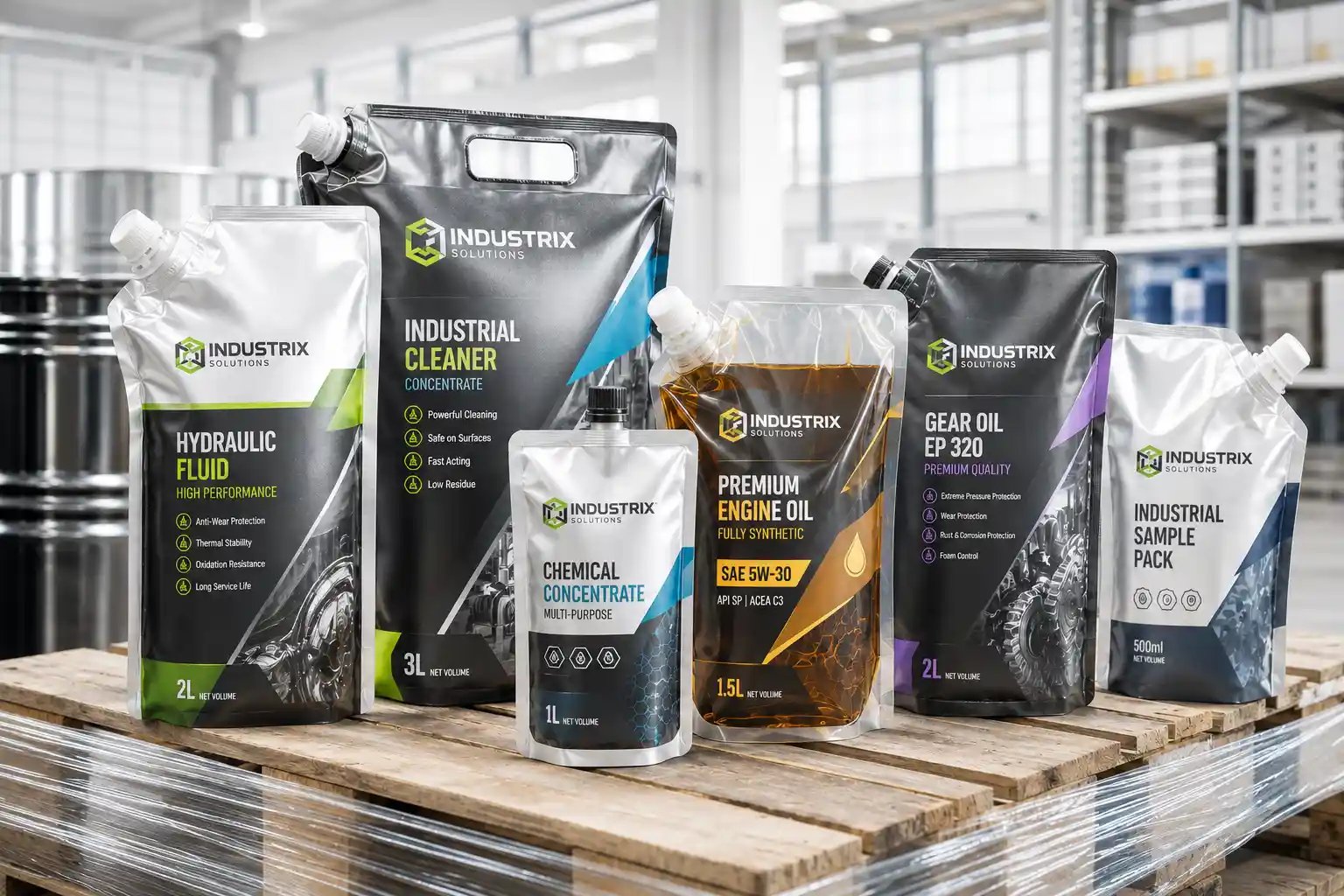
A bag of coffee forgives a lot. A litre of gear oil does not. Chemicals, lubricants, cleaners and industrial fluids push against their packaging every single day they sit in a warehouse, and a poor film choice shows itself fast. You notice it as a soft seal, a greasy outer surface, a label lifting at one corner, or a full pallet written off before it ever reaches a customer.
That is why chemical packaging works better as an engineering decision than a shopping decision. Bottles, jugs and cans have handled this job for decades and still suit plenty of products. But flexible pouches for oils, lubricants and chemicals now do much of the same work with less material, lower empty weight and far more room for branding. This guide walks through the choices that actually matter.
Why Chemicals and Lubricants Need Specialized Pouch Packaging
Most pouch construction was developed around food. Dry snacks, coffee, powders and sauces are predictable, and the films that hold them have been refined over many years. A solvent-based cleaner behaves nothing like a bag of granola, so the same laminate cannot simply be reused and hoped for.
Product and Packaging Compatibility
Every pouch is a stack of layers bonded together by adhesive. Your product touches only the inner sealant layer, but it does not always stop there. Solvents, surfactants and performance additives can soften that layer, work into the adhesive and weaken the bond holding the structure together.
Two cleaners with almost identical labels can behave very differently inside the same laminate. This is why material selection should begin with your formulation sheet, not with a catalogue of pouch sizes. Chemical resistance is specific to the product, not to the category.
Protection Against Leaks and Product Migration
Leaks rarely begin in the middle of a pouch. They start at a seal that picked up a trace of product during filling, or at a corner that took a knock on a forklift. Oils bring a second problem. The product slowly works its way into the laminate and lifts the layers apart, which is what packaging people call delamination.
The difficult part is timing. Oil migration and adhesive failure often appear weeks after production, long after the batch has shipped and passed its first inspection.
Barrier Protection Against Moisture, Oxygen and Light
Barrier requirements are not one size fits all. A hydraulic fluid may need strong moisture protection. A peroxide-based cleaner may need an oxygen barrier. A UV-sensitive additive may need a film that blocks light completely.
Some products need all three at once, and that is usually where foil or metallized structures earn their extra cost. Others sit happily in a clear film, and paying for high-barrier packaging would simply waste money.
Storage and Transportation Conditions
Ask a simple question early: where will this pouch actually live? A pallet in an unheated warehouse goes through more temperature swings in a year than most people expect.
| Real-world condition | What it puts at risk |
| Stacking pressure on a pallet | Seal strength and pouch shape |
| Heat in summer storage | Adhesive bond and viscosity |
| Cold in winter transport | Film flexibility and impact strength |
| Rough manual handling | Corners, spouts and puncture points |
| Long storage before sale | Barrier performance and delamination |
Important Note: A film that performs perfectly with one product in a range will not automatically perform with the next. Fragrance, dye, solvent level and pH can all change the result. Test each formulation separately before you approve a structure for a full SKU family.
What Chemicals and Industrial Products Can Be Packaged in Flexible Pouches?
Buyers usually want a straight answer here, so here is one. A wide range of industrial products run well in pouches, provided compatibility is confirmed first.
Motor Oils and Lubricants
Automotive and industrial fluids are one of the fastest growing uses for spouted packaging. Typical applications include:
- Engine oil and motor oil in retail sizes
- Gear oil and transmission fluid
- Hydraulic fluid for equipment servicing
- Automotive lubricants sold as top-up packs
- Fuel additives and treatment products
Cleaning Chemicals and Detergents
Refill formats have changed this category completely. Common examples include industrial cleaners, liquid detergents, cleaning concentrates, floor care products and specialty cleaning solutions sold as refills for rigid bottles.
Concentrates work especially well. A small pouch replaces a large jug, and the customer adds the water at home or on site.
Powders and Dry Industrial Products
Dry chemicals, technical powders and granulated products usually need a moisture barrier more than a chemical-resistant sealant. Clumping, caking and hardening are the failures to design against here, not leakage.
Adhesives, Gels and Specialty Industrial Products
Thicker, slower-moving products bring their own challenge. Viscous liquids need a wider spout, a controlled fill and enough headspace to allow proper evacuation. Adhesives and gels also tend to be aggressive towards standard sealant films.
Industrial Cleaning Wipes
Wipes need the opposite of most chemical packaging. Instead of keeping moisture out, the pouch has to keep solvent in. That means a strong barrier film plus a resealable closure that still works after hundreds of openings on a workshop bench.
Whatever the product, compatibility testing comes before the pouch structure is locked in. That order never changes.
Choosing the Right Pouch Style for Chemicals and Lubricants
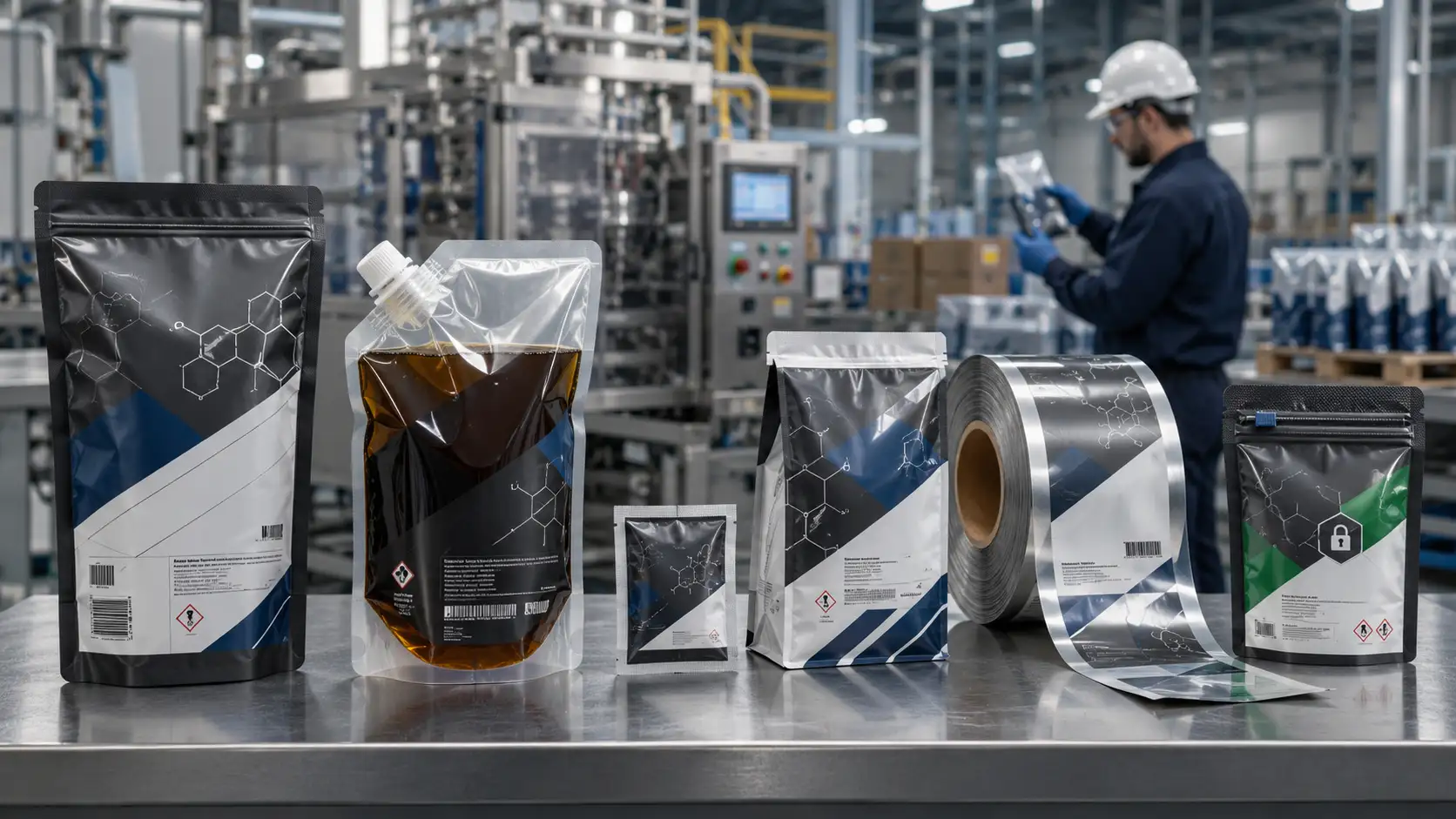
Style affects filling speed, shelf presence, dispensing and shipping cost. Here is how the main formats compare for industrial products.
Stand-Up Pouches
The stand-up pouch is the most recognisable flexible format and works well for retail-facing chemical packages. A bottom gusset lets the pouch sit upright on a shelf, and the front panel gives you a large print area.
Spouted Pouches
For liquids, this is usually the format that decides the project. A fitment turns a flexible bag into something a technician can pour accurately into a small opening, then close again without spilling.
Spout choice matters as much as film choice. Diameter controls flow rate, thread type controls cap compatibility, and position controls how cleanly the last 10% pours out.
Flat and Lay-Flat Pouches
Three-side-seal pouches and sachets suit single-use portions, trade show samples and small chemical samples sent to prospective buyers. They are cheap, light and easy to post.
Flat-Bottom Pouches
Box-shaped pouches give better stacking stability and a wide front panel. They pack more efficiently on a pallet than most stand-up formats, which helps on high-volume industrial lines.
Rollstock for Automated Packaging
If you already run form-fill-seal equipment, custom printed rollstock feeds your line directly and lets you form pouches, sachets or stick packs in house. It is the usual choice once volumes climb.
Child-Resistant Pouches
Some regulated and hazardous products need a closure a child cannot open easily. Child-resistant zippers and fitments are available in most standard structures.
| Pouch style | Best suited to | Main strength |
| Stand-up pouch | Retail chemicals, refills | Shelf presence |
| Spouted pouch | Oils, lubricants, liquids | Controlled dispensing |
| Lay-flat pouch | Samples, single doses | Low cost per unit |
| Flat-bottom pouch | Powders, larger volumes | Pallet efficiency |
| Rollstock | Automated filling lines | Speed and scale |
| Child-resistant | Regulated products | Safety compliance |
How to Choose the Right Material for Chemical Packaging Pouches
Material is where most chemical packaging projects succeed or quietly fail.
Why Multilayer Structures Are Used
No single film does everything. One layer gives strength and print quality, another provides the barrier, and a third seals to itself under heat. Laminating them together produces a structure that outperforms any one film on its own.
Adhesive between those layers is the quiet weak point with oils and solvents. Reviewing the full range of film and laminate options with your supplier before sampling saves a lot of rework later.
Clear, Metallized and Foil Barrier Structures
| Structure | Barrier level | Product visible? | Typical use |
| Clear laminate | Low to moderate | Yes | Cleaners, detergents |
| Metallized film | High | No | Powders, sensitive fluids |
| Foil laminate | Highest | No | Aggressive or long-shelf products |
Clear films let customers see fill level and colour, which matters in retail. Foil gives the strongest protection but removes visibility completely.
Preventing Oil Migration and Delamination
Oil-resistant sealant layers and adhesive systems designed for lubricants exist for exactly this reason. If your product contains base oils, esters or strong solvents, say so at the first conversation. It changes the recommended structure immediately.
Recyclable Mono-Material Pouch Options
Mono-material PE structures have improved a lot and now suit many industrial products. They are not right for everything, though.
Performance comes first. A recyclable pouch that leaks in a warehouse creates far more waste and cost than a multilayer pouch that holds.
Common Chemical Packaging Sizes and How to Choose the Right Capacity
There is no universal standard, but real orders cluster into a few familiar bands.
1- Small Samples and Single-Use Pouches
Volumes around 30 ml, 50 ml and 100 ml cover trial packs, single-dose treatments and samples posted to buyers. These are also useful for testing a new formulation in the field before committing to a full run.
2- Retail and Workshop-Size Pouches
250 ml, 500 ml and 1 litre are the everyday sizes for retail chemicals and workshop consumables. They match how the product is used, which keeps waste down and repeat purchase up.
3- Larger Refill and Industrial Pouches
Above 1 litre you move into bulk chemical packaging territory. Larger spouted pouches with handles serve refill programmes, service vans and industrial customers who buy in volume rather than by the bottle.
4- What Determines the Right Pouch Size?
Fill volume alone will not tell you the finished dimensions. These factors all pull on the final number:
- Product density — one litre of oil is heavier than one litre of cleaner
- Viscosity — thick products need a wider spout and slower fill
- Headspace — required for evacuation and seal integrity
- Gusset size — controls how much the pouch expands when filled
- Spout diameter — affects pour rate and cap choice
- Filling equipment — nozzle clearance and clamp width
- Pallet configuration — how many units fit a case and a layer
Our pouch size chart is a useful starting reference, though final dimensions should always be confirmed against a filled sample.
Features That Make Chemical and Lubricant Pouches Easier to Use
Small features decide whether a technician reaches for your pouch again or goes back to the old jug.
1- Spouts and Pour Fitments
A well-placed spout is the difference between a clean pour into an engine and a mess on the floor. Corner-mounted spouts suit controlled pouring, while centre spouts suit larger openings.
2- Handles for Larger Pouches
Anything above roughly two litres becomes awkward to hold. A die-cut or welded handle restores one-handed control and reduces drops.
3- Resealable Closures
Zippers and screw caps let a partly used product be stored safely. For workshop products, this is often the single most requested feature.
4- Tamper-Evident Features
Induction seals, tamper rings and sealed spouts show clearly whether a package has been opened. For regulated chemical packages, this is frequently a requirement rather than an option.
5- Tear Notches, Rounded Corners and Display Features
Tear notches give a controlled opening point. Rounded corners reduce puncture risk in transit. Hang holes let retailers display pouches on pegs instead of shelves.
How Chemical Pouches Are Tested for Leaks, Strength and Compatibility
Testing is not paperwork. It is how you avoid discovering a problem in a customer’s warehouse.
| Test | What it answers |
| Compatibility testing | Will the product attack the film or adhesive? |
| Seal and leak testing | Are the seals continuous and sound? |
| Drop testing | Will a filled pouch survive a fall in transit? |
| Burst testing | How much internal pressure can the seals take? |
| Puncture resistance | Can the film handle sharp contact and rough handling? |
| Accelerated aging | What happens after months of storage? |
Compatibility testing deserves the most attention. Filled pouches are held at raised temperatures for a set period, then checked for seal strength loss, layer separation, weight change and any change in the product itself.
Accelerated aging matters just as much for oils. Many failures are slow, and a pouch that looks perfect on day three can start separating at week eight.
Important Note: Printed hazard information on a pouch does not replace your regulatory duties. Classification, safety data sheets, transport approvals and labelling rules remain the responsibility of the product owner. Confirm requirements for every market you ship to before artwork is approved.
Printing and Labeling Requirements for Chemical Packaging
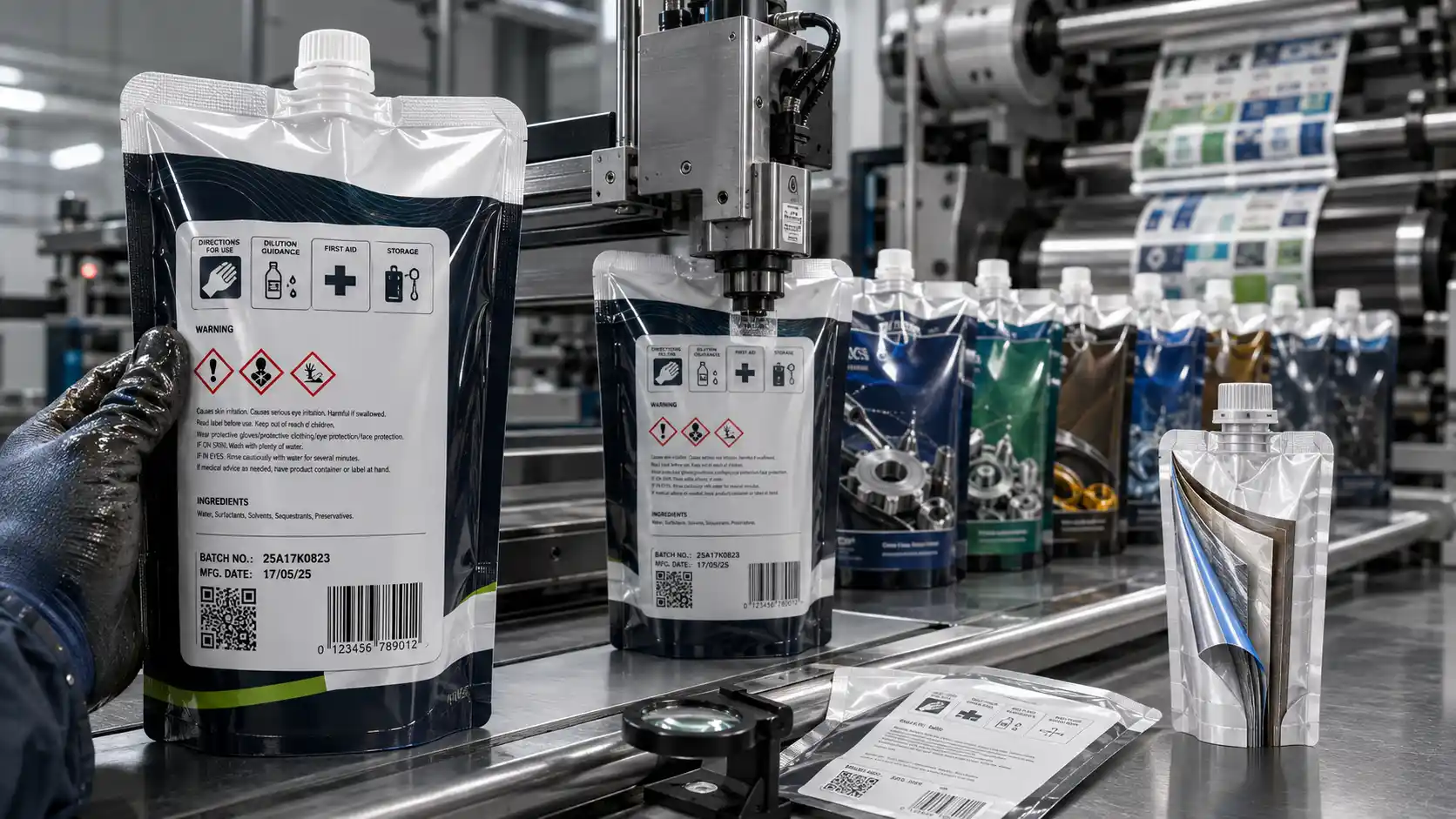
Chemical packages carry far more mandatory information than food packaging, and artwork has to be planned around that from the start.
Making Room for Important Product Information
Directions for use, dilution ratios, first aid guidance and storage advice all need space. Designers who treat the back panel as an afterthought usually end up redoing the layout.
Hazard Labels and Pictograms Where Required
GHS pictograms have defined shapes, colours and minimum sizes. They cannot be shrunk to fit a design. Build the artwork around them instead.
Batch Codes, Lot Numbers, Barcodes and QR Codes
Traceability is not optional in this sector. Leave a clear, uncoated area for batch coding, and confirm early whether codes will be printed inline or applied after filling.
Durable Custom Printing for Industrial Environments
Print on a chemical pouch has to survive oily hands, workshop dust and outdoor storage. Reverse printing places the ink between layers, protecting it from abrasion.
For long runs with consistent artwork, rotogravure printing delivers excellent colour depth. Digital printing suits shorter runs and multiple SKUs. Working with a label-ready chemical packaging company means artwork, coding areas and compliance panels are all handled together.
Flexible Pouches vs Bottles, Jugs and Cans for Chemicals and Lubricants
Neither format wins outright. It depends on the product and the customer.
| Factor | Flexible pouches | Bottles, jugs and cans |
| Empty weight | Very low | Considerably higher |
| Material used | Less per unit | More per unit |
| Storage space | Ships flat | Ships full of air |
| Branding area | Large, full panel | Limited by label |
| Dispensing | Good with fitment | Excellent |
| Reuse on site | Limited | Strong |
| Filling equipment | Often needs adaptation | Widely available |
When Flexible Pouches Make the Most Sense
Pouches perform best for retail sizes, refill programmes, samples, single-use packs and anywhere shipping weight is a real cost. If your product moves in high volume to end users, the savings add up quickly.
When Rigid Packaging May Be the Better Choice
Rigid containers remain the sensible answer for very aggressive chemicals, products needing repeated site decanting, high-pressure applications and situations where an existing filling line cannot be changed. An honest supplier will tell you when a jug is the better fit.
Sustainability in Chemical Packaging Without Compromising Performance
Buyers now ask about environmental impact almost as often as they ask about price. The good news is that flexible packaging delivers several of those gains automatically, before recycling even enters the conversation.
Reducing Packaging Material
A pouch uses noticeably less material than a rigid container of the same capacity. That reduction happens at production, before any recycling discussion begins.
Lower Empty-Package Weight and Transportation Impact
Empty pouches ship flat, so one pallet carries what several would carry in bottles. Lighter filled units also mean more product per lorry.
Refill Packaging Applications
Refill pouches paired with a durable rigid bottle give customers the best of both. The bottle stays, the pouch replaces the contents.
Recyclable Mono-Material Options
Recyclable PE structures are available for many industrial products. Confirm compatibility and barrier performance first, then move to the recyclable option once the structure is proven.
Custom Chemical Packaging for Different Products, Sizes and SKUs
Few industrial brands sell a single product in a single size. Custom chemical packaging exists so your pouch fits the product and the range, rather than forcing the range to fit a stock bag.
Custom Pouch Dimensions
Standard sizes rarely match a specific fill volume exactly. Custom dimensions remove wasted headspace and improve how cases stack.
Custom Printed Designs
Full-panel printing gives industrial brands the kind of shelf presence that labels on jugs struggle to match.
Multiple Products and SKUs
Digital printing makes short runs across many variants practical. Choosing custom pouches over premade stock bags becomes far easier to justify once you are managing several product lines.
Matte, Gloss and Specialty Finishes
Matte finishes hide fingerprints and handling marks well, which suits workshop products. Gloss lifts colour on retail shelves.
Samples and Prototypes
Ask for pre-production samples and fill them with your actual product. A mockup proves the look. A filled sample proves the packaging.
Small Runs and High-Volume Production
Low minimums let you test a new size without committing to a huge order. As demand grows, the same artwork scales into high-volume production and bulk chemical packaging formats without starting again.
How to Choose the Right Chemical Packaging Company
Not every pouch manufacturer works with industrial products. These questions separate the ones that do.
1- Do they understand product compatibility? A good supplier asks about your formulation before quoting. If the first question is about quantity, keep looking.
2- Do they offer the materials and pouch formats you need? Check they run the structures and spouts your product actually requires, not just their standard food range.
3- Can they produce custom sizes and samples? Custom dimensions and pre-production samples should be normal, not exceptional.
4- What testing support is available? Ask what compatibility and seal testing they can support, and what evidence they provide.
5- What are their MOQs and lead times? Confirm both before design work starts, so your launch schedule stays realistic.
6- Can they handle multiple SKUs, printing and labeling? Variable data, compliance panels and multi-SKU runs should be handled in one process.
One more point worth knowing. Pouch manufacturing and pouch filling are different services. If you need custom chemical repackaging, chemical liquid repackaging or emergency chemical repackaging when a batch has to move quickly, you will usually need a specialist filling partner alongside your pouch supplier. Ask both companies early how they work together.
Why Choose Flexible Pouches for Custom Chemical Packaging?
We produce custom chemical packaging for oils, lubricants, cleaners, powders and industrial fluids, in the formats and materials those products actually need.
- Stand-up, spouted, lay-flat, flat-bottom and rollstock formats
- Fully custom dimensions rather than fixed stock sizes
- Clear, metallized, foil and recyclable mono-material structures
- Spouts, handles, zippers and child-resistant closures
- Digital and rotogravure printing with multi-SKU support
- Low minimums, with room to scale into bulk production
Every project starts with your product, not our catalogue.
Choosing Better Pouch Packaging Starts With Your Product
The right pouch for a chemical product is never chosen from a picture. It comes from the formulation, the way the product will be stored, how it will be poured, and how long it must sit before someone opens it. Get those four things clear and the film structure, spout and size follow naturally. Skip them, and you are relying on luck.
Start with compatibility, confirm it with real testing, then think about appearance and price. Packaging that protects the product and pours cleanly does more for a brand than any finish. That is the order that keeps industrial customers coming back.
Ready to Package Your Product Properly?
Send us your product details and we will recommend a structure built around it. Tell us what you are filling, the volume you need and how it will be stored, and our team will come back with material options, spout recommendations and a clear quote.
Request your free quote today.
FAQs
1. What is the best packaging for chemicals?
There is no single best option. Chemical resistant packaging has to match the exact formulation, since a film that suits a detergent may fail with a solvent. Flexible chemical packaging suits retail sizes and refills, while rigid chemical containers still suit aggressive or high-pressure products.
2. Can chemicals and lubricants be packaged in flexible pouches?
Yes, and many already are. Chemical pouches hold engine oil, gear oil, hydraulic fluid, industrial cleaners and concentrates. Lubricant packaging needs an oil-resistant sealant layer and a spout for pouring. Always test compatibility first, because liquid chemical packaging tends to fail slowly.
3. What are the most common chemical packaging sizes?
Common chemical packaging sizes fall into three groups. Samples run 30 ml to 100 ml. Retail and workshop sizes cover 250 ml, 500 ml and 1 litre. Industrial pouch sizes go above 1 litre. Lubricant pouch sizes usually match existing bottle volumes.
4. What materials are used for chemical packaging pouches?
Most use multilayer films. A typical pouch laminate combines an outer print layer, a barrier layer and a chemical resistant film that seals. Barrier films may be clear, metallized or foil. Foil pouches give the strongest protection, while metallized film sits in the middle at lower cost.
5. How do you choose the right pouch for oils, lubricants and industrial chemicals?
Start with product compatibility, then set barrier requirements for moisture, oxygen and light. Pouch material selection and format come next, with spouted pouches preferred for liquids. Pouch sizing follows fill volume and viscosity. Confirm chemical resistance with filled samples before production.
6. How do I choose the right chemical packaging company?
Look for a chemical packaging supplier that asks about your formulation before quoting. A capable custom pouch manufacturer offers suitable materials, custom sizes, testing support and clear lead times. Check the flexible packaging company handles multiple SKUs and compliance printing. If you need filling too, ask who covers custom chemical packaging and repackaging.