

























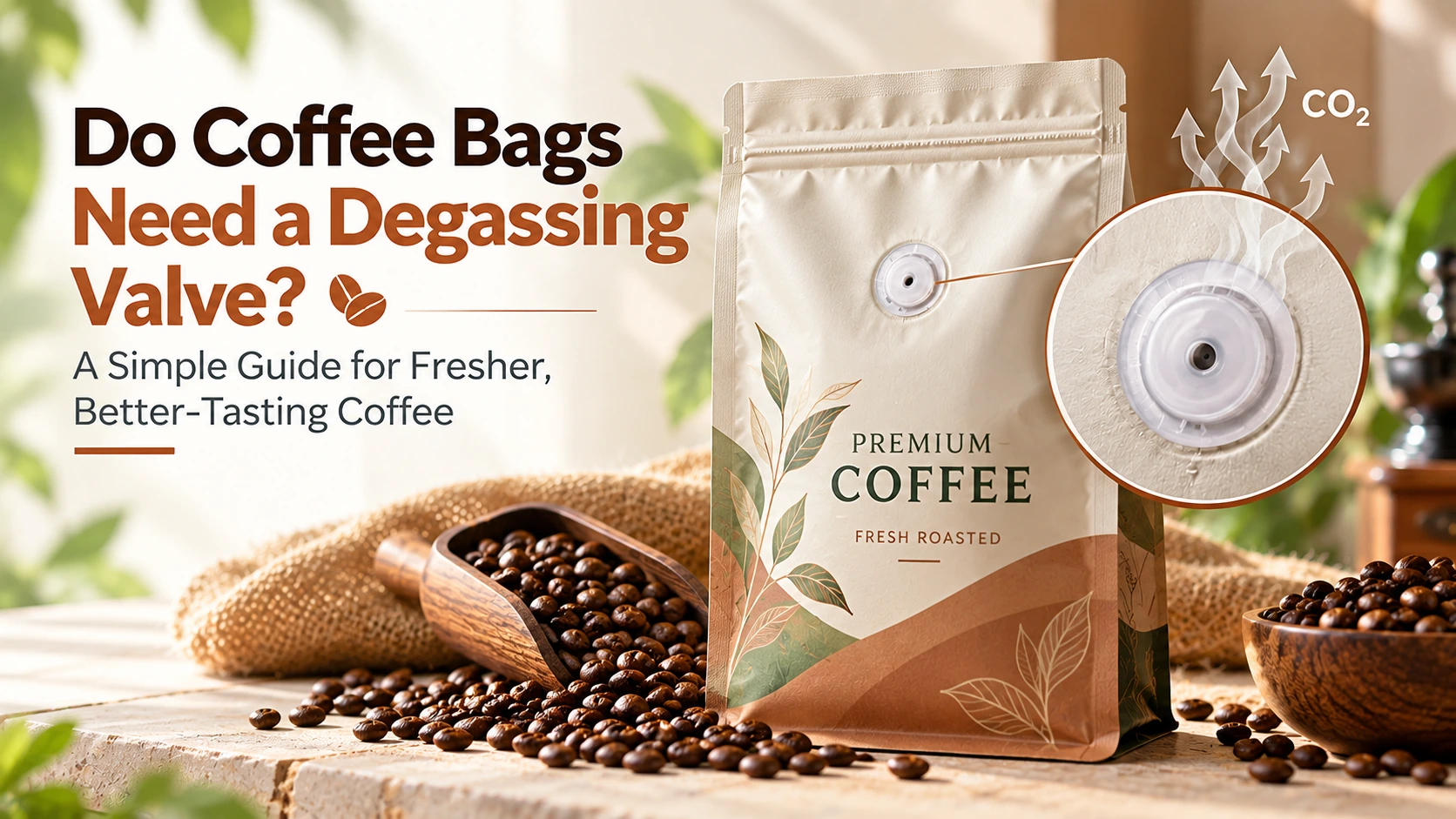
You have probably noticed the small round piece on the front of a coffee bag. It looks simple, but it has an important job. Freshly roasted beans release gas, even after they have been packed. Without a way for that gas to escape, a sealed bag can puff up. This is one reason coffee packaging deserves more attention than its appearance alone.
So, do coffee bags need a valve, or is it just an extra feature that adds to packaging costs? The answer depends on what is inside the bag and when it is packed. Fresh whole beans, ground coffee, and instant coffee do not all behave the same way. Here is how to decide what your coffee actually needs.
Do Coffee Bags Need a Valve? The Short Answer
Coffee doesn’t stop changing once it leaves the roaster. It keeps giving off carbon dioxide for days, sometimes weeks. Seal that coffee into an airtight bag and the gas is trapped with nowhere to go. Something has to give, and it’s usually the bag.
A valve fixes that. Gas gets out, air stays out, the bag stays flat. For most roasters it’s as normal as the zipper.
Still, “most” isn’t “all.” Here’s the rough split:
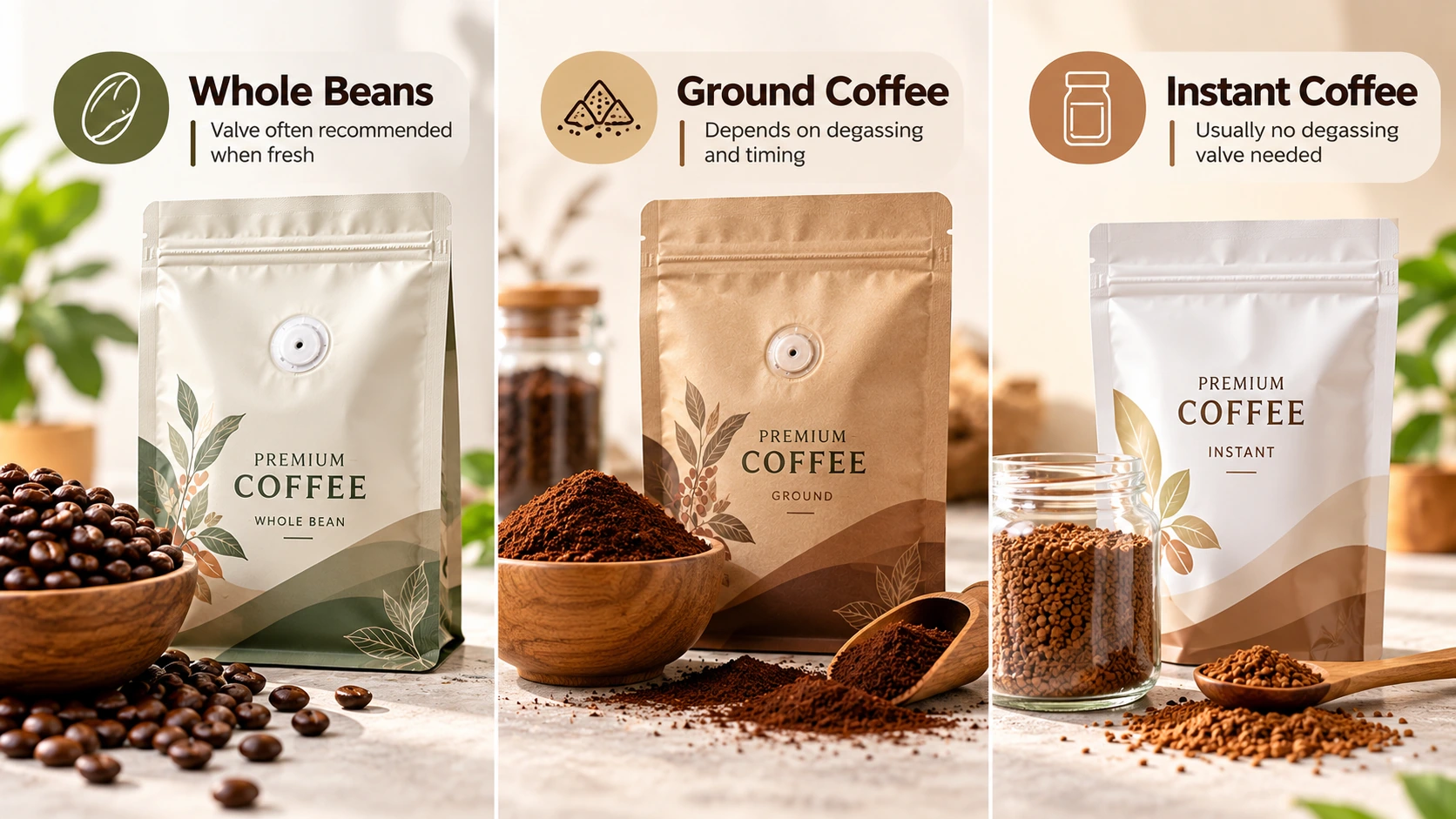
- Put a valve on it: fresh whole bean, fresh ground sealed right after grinding, 12 oz bags and bigger, and anything that ships or sits on a shelf for weeks.
- You can probably skip it: instant coffee, beans rested for a week or more, single-serve sachets, and coffee that’s nitrogen-flushed and sealed on the spot.
Why Do Coffee Bags Have a Valve in the First Place?
The valve exists because of one simple fact about roasted coffee: it keeps producing gas long after it looks finished. Everything else in this section follows from that.
Freshly Roasted Coffee Keeps Releasing Carbon Dioxide
Roasting cooks the bean from the inside out. Along with all the flavour changes, the heat creates gas, and most of it is CO₂. The bean’s structure traps that gas the way a sponge holds water. When roasting stops, the sponge starts to squeeze.
Roasters call this degassing. The first 48 to 72 hours are the busiest. After that it tapers off, but a medium roast can still be vented two weeks later. A kilo of fresh beans can give off several litres of gas in total. Several litres, inside a bag with maybe half a litre of empty space.
What Happens If You Seal Fresh Coffee Without a Valve?
First the bag gets fat. Then it gets tight. A 250 g bag usually just looks puffy and sits at a funny angle on the shelf. A 1 kg bag is a different story, because there’s four times the coffee and four times the gas pushing on seals that aren’t much stronger.
Things I’ve seen go wrong with valve-free bags:
- Pouches so bloated they won’t stand up or fit in the shipping carton
- Side seals that split somewhere between the roastery and the customer’s front door
- Emails from customers asking if the coffee is “off” because the bag looks inflated
- Tiny seal leaks nobody notices, which let oxygen in and stale the coffee anyway
Roasters who experiment with valveless bags tend to report the same thing. The small bags survive. The big ones don’t.
Important Note: A swollen coffee bag is not a sign of bad coffee. Nine times out of ten, it’s a sign of very fresh coffee sitting in a bag that can’t breathe.
How Does a One-Way Degassing Valve Work on Coffee Bags?
For something so small, the valve gets asked about a lot. The mechanism is easier to picture than most people expect, and once you see it you’ll understand why it can’t be swapped for a hole.
How the Valve Lets CO₂ Escape While Limiting Outside Air
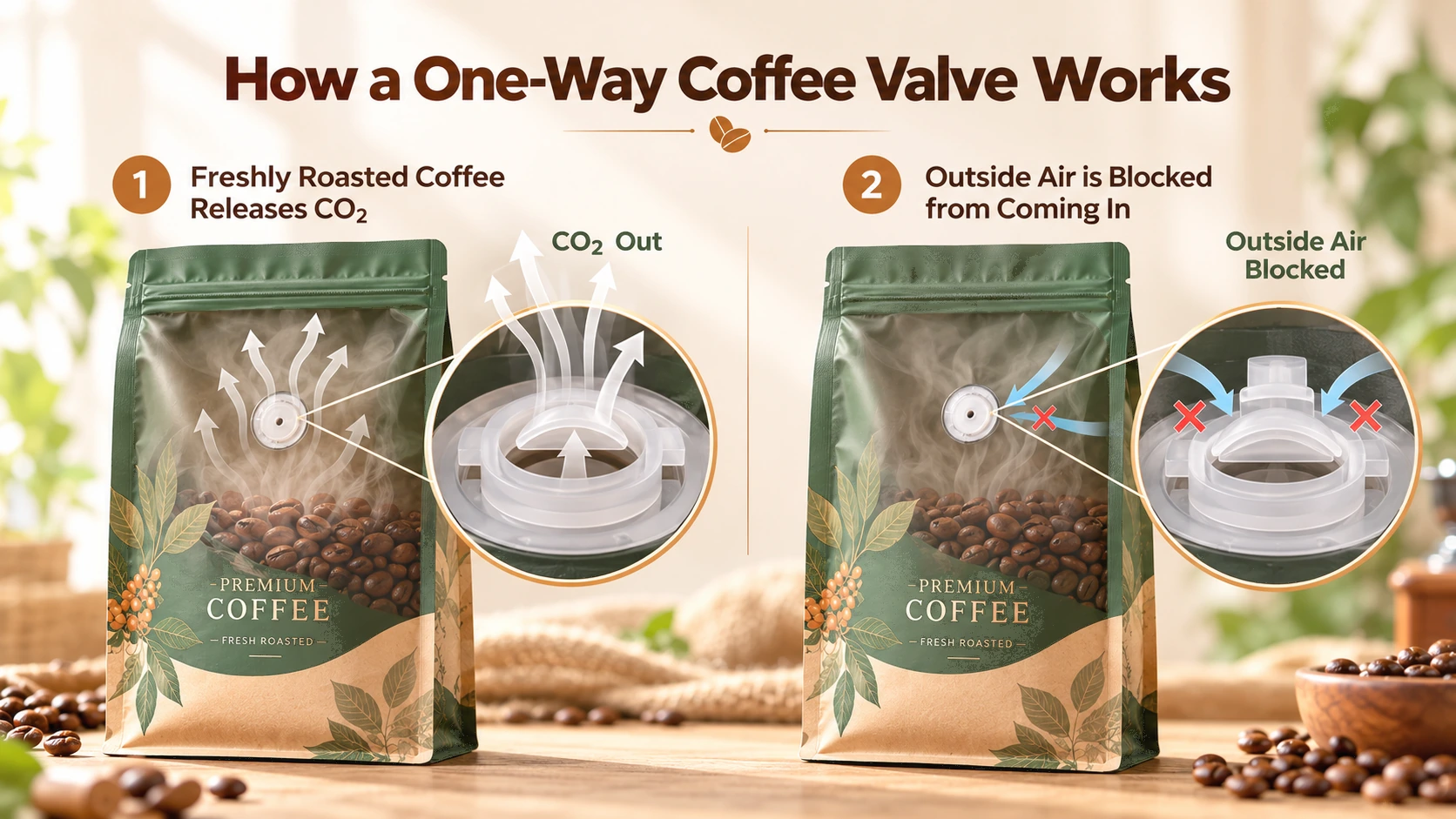
It’s a check valve, just a very small one. Inside the plastic housing there’s a thin, flexible disc resting over a hole. Nothing fancier than that. The whole thing runs on pressure.
- Gas builds up inside the sealed bag.
- When pressure hits a set point (low, well under one psi on most valves), the disc lifts a hair.
- CO₂ slides out past a little filter that keeps coffee oils from gumming things up.
- Pressure drops, the disc relaxes, and the hole is covered again.
Now flip it around. Air from the outside pushes the disc down, not up, so it stays shut. Most valves also carry a thin smear of food-grade oil on the disc to help it seal between releases. Pressure from inside opens it. Pressure from outside closes it. That’s the whole trick.
What Makes a One-Way Coffee Valve Different From an Ordinary Vent?
A pinhole works both ways. Gas out, oxygen in, no questions asked. Give it a few days and oxidation is well underway, and the coffee starts tasting flat.
A one-way coffee valve only opens under pressure from inside, and it closes on its own the moment that pressure drops. Small difference on paper. In practice, it’s the difference between a bag that protects the coffee and a bag that just stops it from bursting.
Which Coffee Bags Need a Degassing Valve—and Which Don’t?
This is the part most roasters actually want. Not every coffee behaves the same way after roasting, so the valve decision shifts with the product, the grind, and how quickly you pack.
Freshly Roasted Whole Bean Coffee: Why a Valve Is Usually Recommended
Whole beans hold gas the longest. They let it go slowly, a little every day, for weeks. Seal a bag on roast day and it will still be venting while it sits on a shop shelf or rides in a courier van. For whole bean coffee sold in stores or online, the valve isn’t really up for debate. It’s the default, and for good reason.
Ground Coffee: Does It Still Need a Degassing Valve?
Grinding breaks the bean wide open, so gas leaves far faster. A big chunk goes in the first hour after grinding. That leads some people to a tidy but wrong conclusion: ground coffee doesn’t need a valve.
Think about how roasters actually work. Grind, fill, seal, next bag. The whole thing takes minutes. The grounds haven’t finished venting, not even close, and now they’re sealed in. So yes, ground coffee usually needs the valve too. The exception is ground coffee that was rested on purpose first, or flushed with nitrogen and sealed straight away.
Instant Coffee and Fully Degassed Coffee: When a Valve May Be Unnecessary
Instant coffee is dried extract. There’s no gas left to release. Beans that spent a week or more in open bins before bagging have done most of their venting in the bin, not the bag. A few more that belong on this list:
- Sample packs and tasting kits
- Single-serve sachets and drip bags
- Café bags that sell out within a day or two
For all of these, a valve is a few cents you don’t need to spend.
Does Roast Level or Packaging Time Change the Decision?
Both do, and timing matters more than most people expect.
Dark roasts are more porous. They vent hard and fast in the first days. Light roasts are denser, so they let go slowly over a longer stretch. Either way, if it’s packed fresh it needs to breathe.
Time is the bigger lever. Coffee bagged within 48 hours of roasting is at peak pressure. The same coffee bagged after a seven-day rest is far calmer, and the valve turns into a safety net rather than a must-have.
| Coffee type | Valve? | Why |
| Fresh whole bean, packed within a week | Yes | Vents slowly for weeks inside the sealed bag |
| Fresh ground, sealed right after grinding | Yes | Still full of gas when the seal closes |
| Nitrogen-flushed ground, sealed immediately | Often optional | Oxygen already low; gas handled at fill |
| Beans rested 7+ days in open bins | Optional | Most of the gas is already gone |
| Instant coffee | No | Nothing left to vent |
| Sachets / sample bags | Usually no | Opened within days |
| Dark roast, any format | Yes | Heavy, fast CO₂ release |
| 1 kg / 2 lb bags and larger | Yes | More coffee, more gas, more strain on seals |
Does a Degassing Valve Keep Coffee Fresh or Just Prevent Swelling?
People ask this one in two different ways. Coffee drinkers want to know if the valve keeps their beans tasting good. Roasters want to know if it’s doing more than stopping bloated bags. The answer to both is yes, with limits.
How a Coffee Valve Helps Protect Flavor and Aroma
Both, honestly. It stops the swelling, and because it keeps oxygen out while doing that, it slows oxidation too. Less oxygen in the bag means the aroma hangs around longer.
There’s a catch worth knowing. Every time the valve opens, a little aroma rides out with the CO₂. It’s a small loss, but it’s real, and it’s why a lot of specialty roasters rest their beans a day or two before bagging. Less gas at packing time means the valve opens fewer times once the coffee is sealed.
Why High-Barrier Packaging and Proper Sealing Still Matter
A great valve on a weak bag is a waste of a great valve. If the film lets oxygen or moisture creep through, the coffee goes stale regardless. The valve handles pressure. The film handles everything else. What has to be right alongside it:
- A proper high-barrier structure, usually with a foil or metallised layer
- The right film thickness for the bag size and the trip it’ll take
- Clean heat seals with no wrinkles, channels, or coffee dust in the seal
- Storage somewhere cool, dry, and out of direct light
One myth to clear up while we’re here. A valve does not prove the coffee is fresh. Old coffee sits in valved bags all the time. The roast date tells you something. The valve tells you nothing.
Important Note: Squeezing a valved bag to get a sniff forces gas, and aroma, out through the valve. Once in the shop is fine. Every morning at home, and you’re slowly sniffing your own coffee away.
How to Choose the Right Coffee Bags With One-Way Valves
Once you’ve decided you need a valve, the next question is what to wrap around it. Bag style, film, valve position, and reclosure all pull in the same direction when they’re chosen together, and against each other when they’re not.
Choose the Right Bag Style and Barrier Material
The bag style affects where the valve goes, how the bag sits on a shelf, and how much print space you get.
- Stand-up pouches: the easy pick for 8 oz to 12 oz. Good shelf presence, simple to fill.
- Flat-bottom pouches: boxier, more premium-looking, and comfortable from 12 oz up to 1 kg.
- Side-gusset bags: the old-school coffee look, often finished with a tin tie.
On materials, most coffee bags are a PET / foil / PE laminate or a metallised film. Kraft paper with a barrier liner is popular with specialty brands that want the natural look. Pick the size to match how fast you sell through, and keep in mind that very large bags call for a higher-flow valve.
Consider Valve Placement, Resealable Zippers, and Custom Printing
The valve normally goes on the front or back panel, above the fill line. Too low and the beans can block it. Too high and the seal bar crushes it. Keep it well clear of your logo, your roast-date box, and any legal text.
A zipper or tin tie matters more than people think. Once the bag is open, the valve’s job is basically done, and the reclosure is what protects the coffee from then on. Digital printing lets you run short batches, swap artwork between SKUs, and keep the valve in exactly the same spot on every bag. It also means a new seasonal blend doesn’t need a whole new set of printing plates.
Test Your Coffee Bags Before Placing a Bulk Order
Don’t order 5,000 bags on the strength of a PDF proof. Get mockups and prototypes in hand first, then run these checks:
- Squeeze test: press a sealed bag. The hiss should come from the valve, not a seam.
- Fill test: pack coffee roasted a day or two earlier, leave the bag three days, and see if it’s still flat.
- Seal check: look closely at the seal area for wrinkles, gaps, or coffee dust.
- Headspace check: leave a bit of room at the top so the valve has space to work.
- Drop test: drop a filled bag from waist height a few times and look at the seals again.
Can Compostable Coffee Bags Have Degassing Valves?
Short answer: yes, and this is a newer development than many roasters realise. A few years ago the valve was the one piece that broke an otherwise compostable bag. That’s changed.
Compostable vs Recyclable Coffee Bags With Valve
A normal plastic valve undoes half the good work of an eco-friendly bag, because the customer has to cut it off first. That’s changing. Compostable coffee bags with valve options now use plant-based valves, and recyclable bags can use mono-material valves that match the film.
We offer both. Our compostable film is plastic-free kraft paper with a PLA lining. Our recyclable film is a #4 mono-material that follows How2Recycle guidelines. Either can take zippers and degas valves.
| Bag type | Film | Valve | After use |
| Standard | Mixed layers, like foil and PE | Regular plastic | Usually landfill |
| Recyclable | Mono-material #4 PE | Matching mono-material valve | Recycled where #4 film is accepted |
| Compostable | Kraft paper with PLA lining | Plant-based valve | Composted where facilities take it |
What to Check Before Choosing Sustainable Coffee Valve Bags
- Ask whether the complete bag is compostable, or only the film
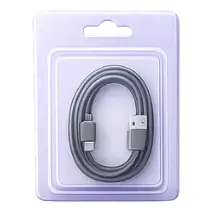
- Look for a recognised mark such as BPI or TÜV OK Compost
- Confirm the barrier is still strong enough for roasted coffee, because some eco films aren’t
- Find out if it needs an industrial composter or breaks down in a home bin
- Get the supplier to show you that the eco valve vents the same way a standard one does
The Final Verdict: Is a Degassing Valve Worth It for Your Coffee?
If you bag coffee while it’s still giving off gas, the valve earns its keep many times over. It saves the seal, keeps the bag looking right on the shelf, and slows the oxygen that flattens flavour. If your coffee has finished venting, or gets used within days, skip it and pocket the savings. Just don’t treat it as a magic freshness switch. It’s one part of a system, and the film, the seals, and your packing timing have to pull their weight too.
Ready to Build Coffee Bags That Keep Every Roast Fresh?
Flexible Pouches makes fully custom coffee bags with one-way degassing valves, resealable zippers, and high-barrier films, in recyclable and plastic-free compostable builds. Digital printing means a low minimum of 1,000 bags, production in around 10 business days, and free shipping to most destinations. Tell us what you roast and how you sell it, and we’ll build the bag around that. Get a free quote today.
FAQs
How Long Does Coffee Release CO₂ After Roasting?
Most of it goes in the first two to three days. After that the release slows right down, but it can keep going for two weeks or more. Dark roasts vent faster, and ground coffee vents fastest of all.
Can You Pack Coffee Immediately After Roasting?
Yes, if the bag has a working one-way valve. That’s the main reason valves were invented. Without one, you’d have to rest beans in open bins for days before sealing, which eats up space and time.
Can Nitrogen Flushing Replace a Coffee Bag Degassing Valve?
Not on its own. Flushing clears oxygen out at the moment of sealing, but the coffee keeps making CO₂ afterwards. Many roasters use both. Flushing protects the coffee at fill, and the valve deals with the gas that builds up later.
Does a Coffee Bag Valve Mean the Coffee Is Fresh?
No. It only means the bag was built to cope with degassing. The coffee inside could be a week old or a year old. The printed roast date is the thing to trust.
Are Compostable Coffee Bags With Valves Fully Compostable?
They can be, as long as the film, zipper, and valve are all compostable and the finished bag carries a proper certification. Ask the supplier directly whether the whole bag is certified or just the film.
Can You Get Custom-Printed Coffee Bags With a One-Way Valve?
Yes. Custom-printed coffee bags with a one-way valve are standard across the industry. Flexible Pouches offers them in stand-up, flat-bottom, and lay-flat styles with digital printing from 1,000 units.