




















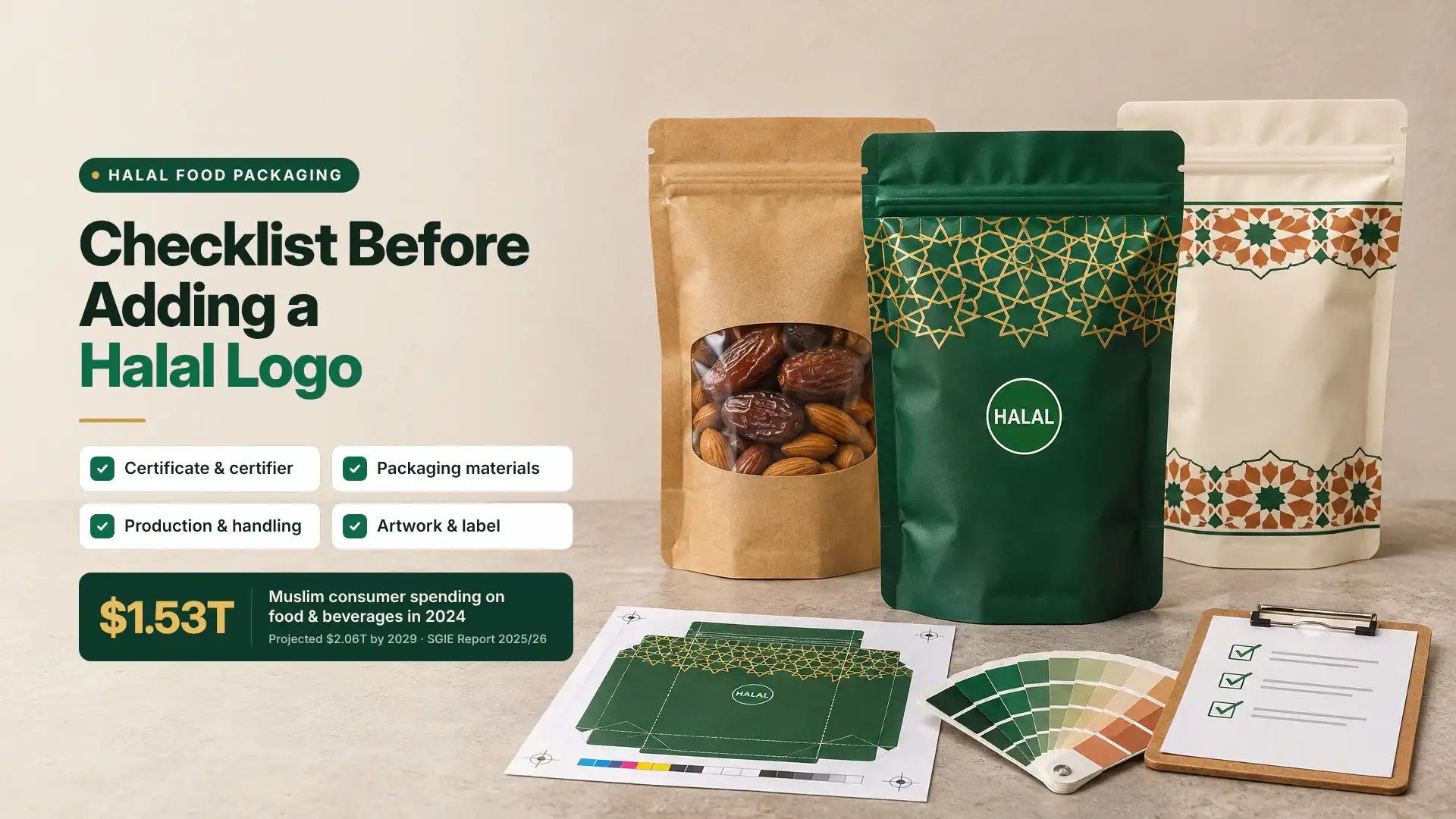
A halal logo takes up maybe one square inch of your pouch. But it makes a big promise: that everything inside, and everything touching it, meets Islamic dietary law. That promise reaches a huge market. Muslim consumers spent about $1.53 trillion on food in 2024, and spending is expected to pass $2 trillion by 2029, according to the State of the Global Islamic Economy Report.
Most brands focus on ingredients and forget the package. Yet film additives, printing inks, laminating adhesives, and even a cleaning brush on the filling line can cost you your certificate. This guide walks you through halal food packaging from the inside out, so your custom printed food pouches pass the audit, clear customs, and earn shopper trust before the logo ever goes to print.
What Is Halal Food Packaging?
Halal food packaging keeps a halal product halal from the filling line to the shopper’s kitchen. It covers both what the package is made of and what the label says.
In practice, Shariah compliance for packaging comes down to four things:
- Clean materials: No pork, non-halal animal derivatives, or other najs (ritually impure substances) in the film, inks, adhesives, or coatings.
- Clean handling: No contact with non-halal materials during manufacturing, storage, or transport.
- Safe for health: The material must be food-safe and non-toxic. In Islamic food law, halal (permissible) and toyyib (wholesome) go together.
- Honest labeling: Halal claims and logos appear only when a valid certificate backs them up.
Here is a point many brands miss. In most schemes, your pouch supplier does not need its own halal certificate. Your certifier reviews the packaging as part of your product audit, using supplier specs and declarations. Some retailers and importers still prefer certified packaging suppliers, so ask your buyers early.
Why Packaging Can Break Your Halal Status
Packaging rarely looks like a halal risk. The risk sits in small additives and shared equipment that never show up on your ingredient list.
Take polyethylene, the most common sealant layer in flexible packaging. PE films often contain stearates as slip or processing aids. These can be made from beef tallow, usually at around 100 to 200 ppm. That is a tiny amount, but halal rules care about the source, not just the dose.
This is not theory. A German testing lab found pork traces in halal food samples and traced the source back to stearates and lubricants used in paper packaging machinery.
Here is where the risks usually hide in a typical pouch:
| Packaging Component | Where the Halal Risk Hides | What to Ask Your Supplier |
| PE or PP sealant film | Slip agents and stearates from animal fat | Declaration that additives are plant-based, synthetic, or from halal sources |
| Laminating and cold seal adhesives | Animal-based glues such as gelatin or collagen | Adhesive spec sheet plus a “no animal origin” or halal statement |
| Printing inks and varnishes | Shellac, animal-based glycerin, leftover alcohol solvents | Ink system declaration and residual solvent results |
| Coatings and release agents | Animal-derived waxes or fats | Coating spec and source declaration |
| Machine lubricants | Food-grade lubricants with animal fat | Halal-approved lubricant with source details |
| Recycled (PCR) content | Unknown prior use of the material | Written approval from your certifier |
| Paperboard and cartons | Animal-based lubricants used in paper processing | Mill declaration for food-contact grades |
Adhesives deserve extra attention because they sit between layers and are easy to forget. If your pouch reseals or closes by pressure, ask about the chemistry behind its cold seal adhesives and coatings. Standard natural latex and synthetic systems are usually fine, but you want that in writing.
The Standards Behind Halal Packaging Requirements
There is no single global rulebook for halal packaging. Each market follows its own standard, but they agree on the basics.
| Standard | Where It Applies | What It Says About Packaging |
| MS 1500:2019 | Malaysia | Has a dedicated packaging and labelling clause. Packaging must not contain haram or najs materials. |
| MS 2565:2014 (now covered by MS 2738:2023) | Malaysia | Malaysia’s halal packaging guideline. Direct food-contact halal packaging was not to be made from recycled material. |
| GSO 2055-1:2015 | Gulf countries (UAE, Saudi Arabia, Oman, and others) | Packaging must be free of non-halal material, not made on contaminated equipment, kept physically separate, and safe for health. |
| OIC/SMIIC 1 | OIC member countries | Food-contact packaging must not contain or be made from haram substances. |
| Law 33/2014 and its regulations | Indonesia | Packaging is one of the stages covered by halal product assurance. BPJPH sets the label rules. |
The United States works differently. No federal agency defines halal or issues a halal seal. Your claim is a marketing claim that must be truthful, which we cover in the labeling section below.
Important Note: If you plan to use post-consumer recycled (PCR) film in the food-contact layer, check with your certifier before you order. Malaysia’s halal packaging guideline excluded recycled material for direct food contact, and certifiers handle this differently. Get their position in writing so a sustainability upgrade does not put your certificate at risk.
How to Choose the Right Halal Certification Body
Your halal certification body decides where your logo will be accepted. Pick it based on where you sell, not on price alone.
There is no universal halal certificate. Each importing country keeps its own list of foreign certifiers it trusts, and your certificate only counts where your certifier is on that list. Start with your target markets and work backward.
| Selling Into | Who Decides Which Certifiers Count | What to Confirm |
| Malaysia | JAKIM, through a gazetted list of recognized foreign bodies | Your certifier is on the current recognized list |
| Indonesia | BPJPH | Your certifier is accredited by or has a mutual recognition agreement with BPJPH (foreign body list) |
| Gulf countries | GCC Accreditation Center and national authorities | Accreditation against GSO 2055-2 for certification bodies |
| Pakistan | Import Policy Order | Your certifier is accredited by a member of IHAF or SMIIC |
| United States | No government authority; retailers and shoppers decide | A reputable certifier with a published standard, plus any state registration rules |
For Malaysia, the amendment effective January 30, 2026 recognized 94 foreign bodies in about 48 countries. Only a few US certifiers are on it, IFANCA among them. Recognition lasts two years and can be withdrawn, so check the official JAKIM Halal Malaysia portal before every renewal.
For Indonesia, timing just changed. Government Regulation No. 40 of 2026 moved mandatory halal certification for imported food and beverages to October 18, 2028, tied to mutual recognition deals between certifiers. If you already make a halal claim in Indonesia, the label rules still apply today.
Questions to ask a certifier before you sign:
- Which countries recognize your certificate today? Then verify each one on the official lists.
- Are you accredited under GSO 2055-2 or ISO/IEC 17065?
- Will the certificate list my exact products, SKUs, and production sites?
- What are your logo rules for size, color, placement, and certificate number?
- How do you review packaging materials during the audit?
- What do renewals, surveillance audits, and new SKU additions cost?
The Halal Certification Process, Step by Step
The halal certification process looks a lot like a food safety audit, with a Shariah review on top. Here is how it usually runs.
- Run a gap analysis. List every ingredient, processing aid, and packaging component. Flag anything animal-derived, alcohol-based, or of unknown origin.
- Collect supplier documents. Get halal certificates or declarations for raw materials, plus specs for film, inks, adhesives, and lubricants.
- Set up your internal halal team. Most certifiers want a named person or committee that owns halal compliance. Malaysia formally requires an Internal Halal Committee.
- Apply and submit documents. Expect to share process flow charts, HACCP plans, cleaning procedures, and label artwork.
- Pass the on-site audit. Auditors visit your facility and trace how product moves through it.
- Close non-conformities. Fix each finding and send evidence back.
- Receive your certificate and logo license. Only now can artwork with the logo go to print.
- Maintain it. Surveillance audits, renewals, and change notices keep the certificate alive.
Timelines vary. The American Halal Foundation says certification typically takes four to eight weeks. JAKIM has cut processing for Malaysian applicants to about 23 days, and Malaysian food and beverage certificates are valid for two years.
What Happens During a Halal Audit
A halal audit checks that your system works in real life, not just on paper. Auditors usually follow the product from receiving and storage through processing, packaging, warehousing, and dispatch.
Have these ready on audit day:
- Halal certificates or declarations from every supplier
- Process flow charts for each product
- HACCP plans and food safety records
- Cleaning and sanitation procedures with logs
- Packaging material specs and supplier declarations
- Final label artwork for every certified SKU
Where GMP and HACCP Fit Into Halal Food Manufacturing
Halal certification sits on top of food safety, not in place of it. Certifiers expect GMP and HACCP to be working before they arrive.
Many certifiers ask for HACCP, ISO 22000, or at least an established food safety system as a condition of certification. The two systems support each other:
- GMP covers hygiene, pest control, maintenance, and staff habits. The same controls also stop halal cross-contamination.
- HACCP finds food safety hazards. A halal plan uses the same logic to find halal control points, such as a shared conveyor or an incoming lot of sealant film.
- Traceability links every pouch lot back to its film, ink, and adhesive batches. If a supplier swaps a resin, you know which products are affected.
If you sell in the US, your packaging supplier should also support your preventive controls under FSMA. A supplier that already documents materials for food safety will find halal documentation far easier.
How to Prevent Halal Cross-Contamination
Halal cross-contamination happens when a halal product touches something non-halal, directly or through shared equipment. It is one of the most common reasons good products fail an audit.
At the Packaging Supplier
- Dedicated lines, or validated cleaning between non-halal and halal jobs.
- Halal-approved lubricants on machines that touch food-contact packaging.
- Separate, labeled storage for film rolls, inks, and adhesives used on halal jobs.
On Your Filling or Co-Packing Line
Shared lines need documented cleaning between runs, and tools count too. In 2026, two Melaka food makers lost their halal certificates after inspectors found cleaning brushes believed to have pig-hair bristles. Both had to recall products they had already distributed.
When equipment touches najs mughallazah (pig or dog derivatives), halal standards call for sertu. This is a ritual cleansing with seven washes of clean water, one of them mixed with soil.
In Storage and Transport
- Keep halal goods in separate, clearly marked zones.
- Use clean, dedicated pallets or containers where possible.
- Make sure warehouses and carriers know your halal handling rules.
Important Note: Sertu is a Shariah requirement after contact with severe impurities. It does not replace normal sanitation, and normal sanitation does not replace sertu. Record every sertu event with the date, equipment, and supervisor, because auditors will ask to see it.
Halal Food Labeling Rules to Check Before Printing
Your label is where certification becomes visible to shoppers. Each market has its own rules on which logo you may use and how it must appear.
Malaysia and the JAKIM Halal Logo
- The Malaysian halal logo is only for products certified by JAKIM or a Malaysian state Islamic authority. It must appear with the Malaysian Standard number and reference number.
- Products made outside Malaysia generally cannot print the JAKIM halal logo. They carry the logo of a recognized foreign certifier instead, and the certifier’s name must appear on the product.
- Keep non-Islamic religious symbols away from the logo. JAKIM has ruled against this before.
- Enforcement is real. In one 2025 case, a halal logo on packaging came from a certificate issued to a different company that had since sold its business.
Indonesia’s National Halal Label
Indonesia has replaced the old MUI logo with a national halal label. For foreign certificates registered with BPJPH, you can show the Indonesian halal logo alone or together with your foreign certifier’s logo, with the registration number near the label. Labels must also be in Bahasa Indonesia.
Pakistan and Other Strict Import Markets
Pakistan’s import rules require the certifier’s logo to be printed on the consumer pack. Stickers, overprinting, and stamps are not allowed for the halal logo and product details, and these details must appear in Urdu and English. If you export to markets like this, print the halal mark into the film rather than planning to sticker it later.
Halal Claims on US Food Labels
The US has no federal halal definition or seal. The FDA treats false or misleading labeling as misbranding, so a halal claim needs proof behind it. For meat and poultry, products with a halal claim and USDA inspection marks are not religious-exempt, and labels with third-party certified claims generally need FSIS sketch approval under its label approval guideline. Some states add their own rules. New York, for example, requires businesses to register who certifies their halal food.
Your halal mark also has to sit alongside every other required element, so build it into your FDA-compliant artwork from the start instead of squeezing it in at the end.
Your Pre-Print Checklist Before Adding a Halal Logo
Run through this list before you approve artwork. If any box is unchecked, hold the print order.
Certificate and Certifier Checks
- Certificate is active, and the expiry date falls after your expected sell-through date.
- Certificate lists this exact product name, SKU, and production site.
- Certifier is recognized in every market printed on the pack.
- You have written permission (a logo license) to use the certifier’s mark.
Packaging Material Checks
- Film, inks, adhesives, coatings, and lubricants have halal or “no animal origin” declarations on file.
- Any recycled content in food-contact packaging has written approval from your certifier.
- Your certifier has your packaging specs, and any material change triggers a notice.
Production and Handling Checks
- Cleaning between runs on shared lines is validated and logged.
- Halal materials and finished goods are stored separately.
Artwork and Label Checks
- Logo is the certifier’s official file, not redrawn, stretched, or recolored.
- Size, color, and placement follow the certifier’s logo guidelines.
- Certificate number, standard reference, and certifier name appear where the market requires them.
- Logo is printed into the film for markets that ban stickers.
- Nothing near the logo conflicts with Islamic principles, and there are no “100% halal” claims beyond what the certificate covers.
- Language rules are met for each market, such as Arabic for Gulf countries and Bahasa Indonesia for Indonesia.
- Final compliance check is done before you approve your printing proof.
Ongoing Checks
- Certificate expiry dates are tracked against stock on hand.
- Market-specific versions run as short digital print runs, so packs with outdated logos do not sit in your warehouse.
Common Mistakes That Get Halal Packaging Rejected
Most halal labeling problems are not about bad intent. They come from small gaps between the certificate, the supplier, and the artwork file.
- Printing before the certificate arrives. “It is coming soon” does not make the logo legal.
- Switching film or ink suppliers without telling the certifier. The new material may never have been reviewed.
- Adding a new flavor under an old certificate. Each SKU usually needs to be listed.
- Renaming a product. The name on the pack must match the name on the certificate.
- Using the wrong logo for the market. A logo accepted in one country can be rejected in another.
- Ordering a year of stock. If the certificate lapses or logo rules change, the whole inventory becomes a problem.
Conclusion
Halal food packaging is more than a logo on the artwork. Your film, inks, adhesives, lines, and labels all have to tell the same story as your certificate. Choose your halal certification body by target market, document every packaging material, and keep halal cross-contamination controls tight.
Then use the checklist above before every print run. Ten minutes of checking can save you from a rejected shipment, a recall, or a lost certificate.
Get Halal-Ready Pouches Printed Right
Flexible Pouches prints custom stand-up pouches, flat bottom bags, lay-flat pouches, and rollstock for food brands of every size. Share your target markets and your certifier’s logo guidelines, and our team will work through films, inks, adhesives, and material specs with you before anything goes to press. Request a free quote to get started.
Frequently Asked Questions
Here are quick answers to the questions brands ask most about halal packaging.
Q1. Does my packaging need its own halal certificate?
Usually not. Most certifiers review your packaging as part of your product audit, using supplier specs and declarations. Some buyers and importers still prefer packaging from a halal-certified supplier, so check what your sales channels expect.
Q2.Can a US brand print the JAKIM halal logo on its packaging?
Generally no. Products made outside Malaysia use the logo of a JAKIM-recognized foreign certifier and show that certifier’s name. JAKIM still keeps the final say on auditing and recognition.
Q3.Are plastic pouches halal?
The base materials, such as PE, PP, PET, foil, and paper, are generally acceptable. The concern is additives, adhesives, inks, and processing aids that may come from animal sources. Ask for declarations covering every layer.
Q4.What is the difference between a certification body and an accreditation body?
A halal certification body audits your company and issues your certificate. An accreditation body checks that certifiers themselves meet standards like GSO 2055-2. Importing countries look at both.
Q5. How long does the halal certification process take?
Many certifiers finish in four to eight weeks if your documents are ready. Allow extra time for packaging declarations, artwork approval, and any corrective actions. Certificates usually last one to three years, depending on the certifier and product type.
Q6.Can I use recycled film in halal food packaging?
Possibly, but ask your certifier first. Malaysia’s halal packaging guideline excluded recycled material for direct food contact. Many brands keep recycled content out of the food-contact sealant layer to stay safe.