














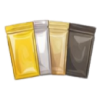









Flat pouches look simple. You fill them, seal them, and send them out the door. But the moment you place an order, one question shows up: do you want a 3 side seal pouch or a 4 side seal pouch? Both are flat, both are heat sealed, and from a few feet away they can look almost the same.
The real difference is in how each pouch is built, and it goes well beyond counting sealed edges. It can change how much product fits inside, how well the pouch protects it, what it costs to run, and how your brand looks in a customer’s hand. Below, we compare both styles side by side and help you pick one. If you want to see the 3-side style first, take a look at our lay-flat pouches.
What Is a 3-Side Seal Pouch?
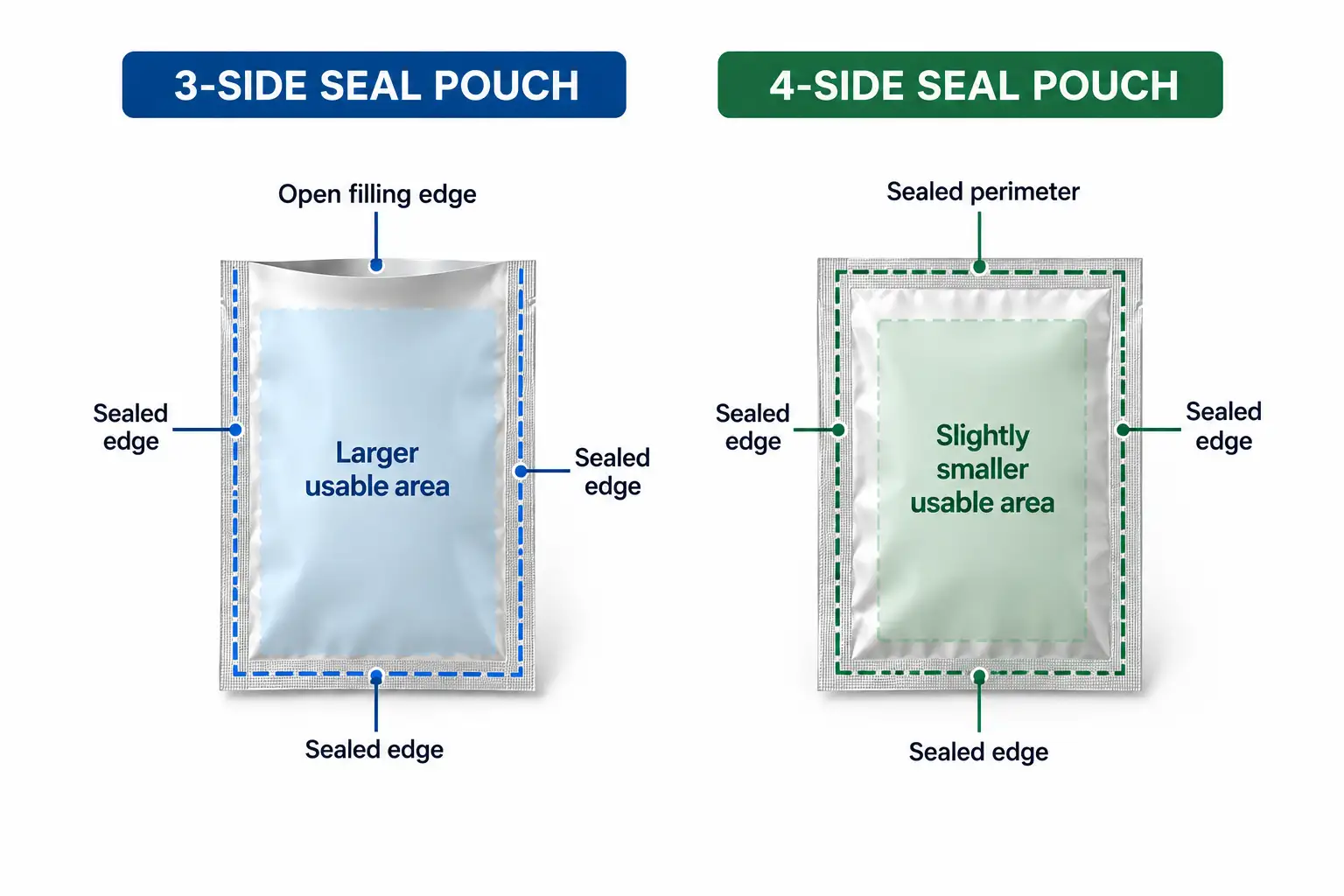
A 3 side seal pouch is a flat pouch with three sealed edges and one open edge. The open edge is where the product goes in. Makers build it in two ways. Some start with one sheet of film that is folded over, so one edge is a fold instead of a seam. Others use two separate panels sealed together on three sides. Both versions give you a flat pouch with no gusset. After filling, the open edge is heat sealed and the pouch is closed.
That simple structure is why a three side seal bag shows up in so many places. It’s easy to make, easy to fill, and easy to print on. It works for food and non-food products alike.
Here is what people like most about it:
- Good use of film. There are fewer seals to build, and folded versions need one less seam.
- Usable space. With no fourth seal eating into the width, the inside tends to be a little roomier.
- Flat storage. Empty pouches stack neatly and ship in a small footprint.
- Print area. The front and back are big, smooth surfaces for your artwork.
- Easy extras. A tear notch, zipper or hang hole is simple to add.
Common Uses of 3-Side Seal Pouches
You will see the three side seal pouch in a long list of products. The most common ones include:
- Snacks and dry foods, such as crackers, dried fruit and trail mix
- Coffee and tea, mostly single servings and sample packs
- Powders and spices, like seasoning blends and drink mixes
- Pet products, such as treats and supplements
- Pharmaceutical or healthcare items that need a clean, sealed pack
- Samples and single-use products, from skin cream to detergent
A 3 sided seal pouch is a flexible format, which is why many brands start here.
What Is a 4-Side Seal Pouch?
A 4 side seal pouch also has a front and a back, but here they’re two separate pieces of film. They’re joined on all four edges. The result is a flat pouch with an even border running all the way around.
Many 4 side seal pouches are formed and filled on the same machine. The product goes in, and the last seal closes it right away. That’s why you see this style so often in single-serve packs. When people talk about the four side flat pouch market, that’s mostly what they mean.
You may also hear it called a four side seal pouch or flat sachet packaging.
Common Uses of 4-Side Seal Pouches
You’ll find it in places like these:
- Sauces and condiments
- Liquid and semi-liquid products
- Cosmetic samples
- Medical and pharmaceutical products
- Powders
- Portion-controlled products
3-Side Seal vs 4-Side Seal Pouches: Key Differences
This is the heart of the question. Here is a quick table first, then we go through each difference in plain terms.
| Factor | 3-Side Seal Pouch | 4-Side Seal Pouch |
| Construction | Two panels, one edge left open | Two panels, all edges sealed |
| Sealed edges | Three, then a fourth after filling | Four |
| Usable capacity | Good space for its size | Border takes some room |
| Material usage | Often efficient | Can use a little more film |
| Seal setup | Final seal added after filling | Border sealed, often in-line |
| Filling process | Fill through the open edge | Often formed and filled in one pass |
| Packaging cost | Often a lower pouch cost | Varies with the filling setup |
| Shelf appearance | Clean and flat | Neat, even border |
| Printing and branding | Wide front and back area | Wide front and back area |
| Typical uses | Snacks, coffee, powders, samples | Sauces, creams, medical packs |
Construction, Capacity, and Material Use
The 3-side pouch saves film because one edge is just a fold or a single seal. A 4-side pouch needs two webs, so it uses more film and leaves more scrap.
Seals take up room, too. At the same outer size, the 3-side pouch usually holds a bit more. Don’t trust the spec sheet alone. Test the real pouch size and capacity with your own product first.
Seal Integrity and Product Protection
This is where many buyers get it wrong. Yes, a 4-side pouch is great at holding liquids. But more seals don’t automatically mean more protection. Leaks often start where two seals cross, and a fold has nothing to fail.
Important Note: Moisture and oxygen protection comes from the film, not from how many sides are sealed. Choose your barrier film first. Then pick the pouch style.
Cost, Filling, and Production Efficiency
For most products, the 3-side pouch is cheaper to run. Less film, fewer sealing steps. Small brands can even fill premade pouches by hand with a tabletop heat sealer.
Four-side sachets are a different story. They need dedicated equipment, so without your own line, you’ll need a co-packer who has one. Compare the total cost, not just the price per pouch.
Appearance, Printing, and Shelf Presentation
Both styles give you two flat panels with no seam down the back. The 4-side pouch wraps your design in a neat, even border. The 3-side pouch feels more relaxed and can puff out a little when full. Either way, keep your logo and barcode clear of the seals.
Which Products Are Best for 3-Side and 4-Side Seal Pouches?
Don’t start with your product category. Start with how your product behaves inside the pack.
Dry Products, Powders, and Granules
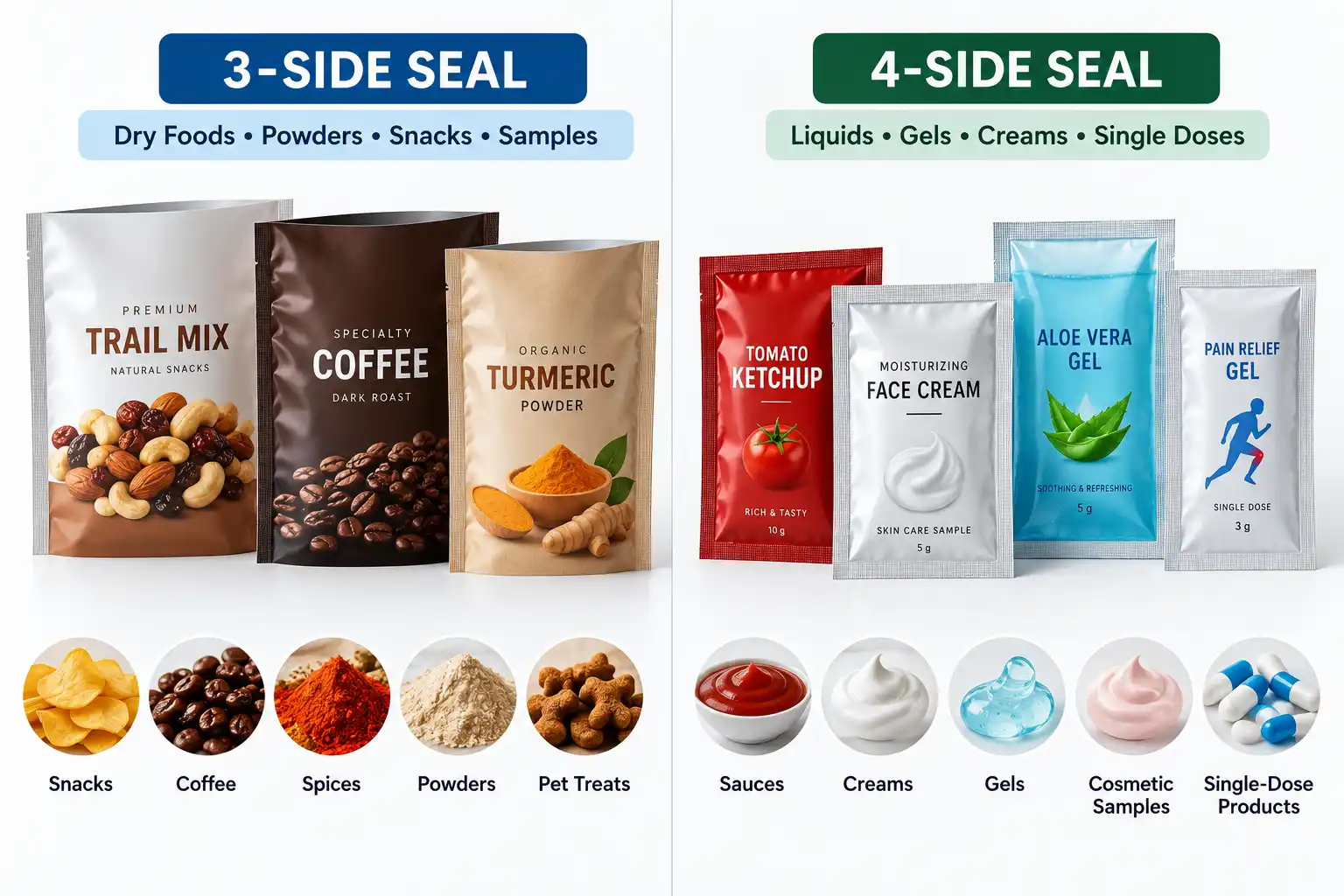
Dry goods are where the 3-side seal pouch really earns its keep. Coffee, tea, snacks, nuts, spices, supplements, and pet treats all fit nicely. The exception is very fine powder sold in exact single doses, which often goes into 4-side sachets.
Liquids, Semi-Liquids, and Portion Packs
Anything that pours or squeezes leans the other way. Sauces, condiments, gels, creams, personal care samples, and medicine doses usually go into 4-side seal pouches, since a full seal frame keeps liquid in. It’s also the go-to format for single-serve sachets made in big runs. Still, film and seal quality matter just as much.
How to Choose Between a 3-Side and 4-Side Seal Pouch
Time to turn all that into a decision.
Consider Your Product and Packaging Requirements
A few plain questions help. How much goes in each pouch? How long must it stay fresh? Does moisture, oxygen, light or smell spoil it? If you’re answering dry, bulky and watching costs, begin with a 3 side seal pouch. If it’s liquid, small dose and no leaks allowed, look hard at a 4 side seal pouch.
Consider Production, Cost, and Brand Requirements
Then the business side. How many do you need? What can your filling equipment or co-packer run? What’s the budget, and what look do you want? Small brand? Check minimums. A low minimum order lets you test a style before betting on a big run.
A 3-side seal pouch may be better when…
- You want lower film and pouch costs
- Your product is dry, like powder or snacks
- You want a little more room inside
A 4-side seal pouch may be better when…
- Your product is a liquid, cream or gel
- You want a framed, symmetrical look
- You make single-dose or sample packs
Important Note: Test with your real product. Fill a few samples, seal them, check for leaks and wrinkles, and see how they sit on a shelf. An hour of testing now beats a spoiled production run later.
Materials and Barrier Options for Flat Pouches
The seal style is only half the story. The film decides how well the pouch protects what’s inside.
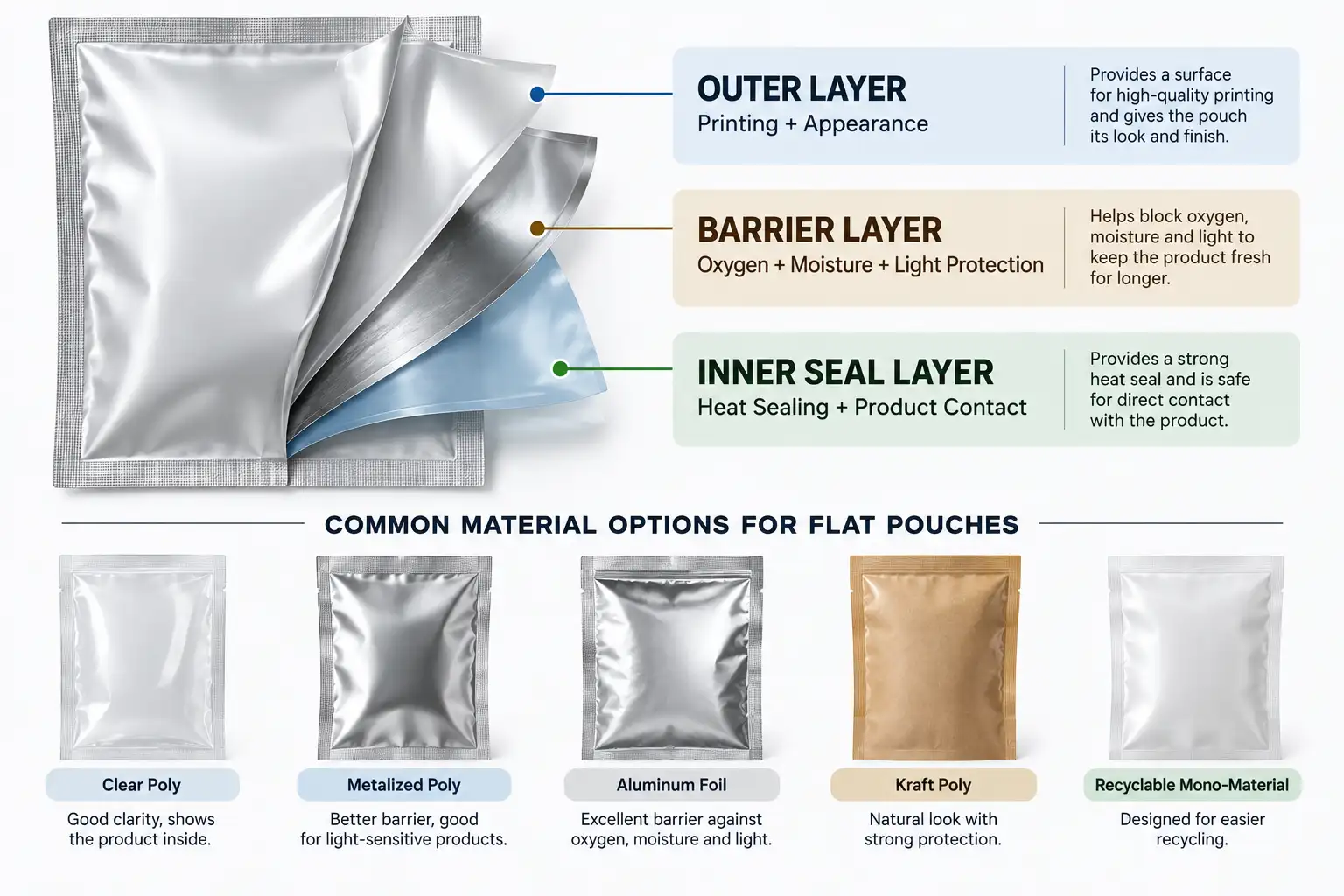
Our pouches are heat sealable, usually with an inner LLDPE layer, and every film and ink we use is FDA grade and food-contact safe. You’ll find each film on our material options page. Here’s a quick look.
| Film | Best known for |
| Clear Poly | See-through look with a high-barrier polyester layer |
| Metalized Poly | Opaque, better barrier, metallic shine |
| Poly Aluminum Foil | Strongest barrier against oxygen, moisture and light |
| Kraft Poly | Natural paper look with high-barrier layers |
| Recyclable mono-material | Fully recyclable LDPE structure |
| Compostable Kraft-PLA | Plant-based and biodegradable |
Match the Barrier Level to the Product
Work backwards from what can hurt your product. Powders and supplements hate moisture. Coffee and nuts go stale once oxygen gets in. Vitamins and oils break down in light. Coffee and spices also need their aroma kept in. A sturdy product with a short shelf life can get away with a lighter film. A delicate one that sits for months needs foil or a metalized layer.
Customization Options for 3-Side and 4-Side Seal Pouches
A flat pouch isn’t set in stone. You can change a lot:
- Custom sizes and shapes
- Printing on the front and back
- Matte, gloss or soft-touch finishes
- Tear notches, hang holes and rounded corners
- Resealable zippers and windows
- Spouts, where they suit the product
Our lay-flat 3-side seal pouches offer all of these. The minimum is 1,000 bags and most orders ship in 10 days or less.
Printing and Branding Options
A custom heat seal pouch can carry full-color art on both sides, plus metallic effects on the right films. Digital printing skips plates and cylinders, which makes short runs painless. If your brand depends on one exact shade, read our guide to Pantone colours before locking artwork. And ask for a mockup first.
3-Side Seal vs 4-Side Seal: Which Is Better for Your Product?
Neither one wins every time. It depends on your product and your process.
| Choose a 3-Side Seal Pouch If… | Choose a 4-Side Seal Pouch If… |
| Material efficiency is important | You prefer a four-edge, symmetrical format |
| You want good usable space inside | Your product benefits from a sealed perimeter |
| You need versatile flat packaging | You pack certain liquids or portion packs |
| Production efficiency is a priority | Presentation favors four-side sealing |
| Your filling setup supports the format | Your equipment runs four-side sachets |
Weigh product type, protection, fill volume, equipment, film, branding, order size and budget together. Most answers in one column? That’s your pouch. Split down the middle? A small test run will tell you more than any chart.
Conclusion
Neither pouch is better in every case. They just solve different problems. If saving material, getting more room inside, and keeping things flexible matter most, a 3 side seal pouch is hard to beat, while a 4 side seal pouch usually wins for liquids and exact doses. Either way, weigh your film, filling setup, and order size together before you decide.
Need Help Choosing the Right Flat Pouch?
Not sure which style fits your product? Tell us what you’re packing, and we’ll suggest the right pouch, film, and finish. Our minimums start at 1,000 pouches, and most digitally printed orders ship within about 10 business days.
FAQs
1- What is the difference between a 3-side seal and a 4-side seal pouch?
A 3-side seal pouch is sealed on three edges and filled through the open one. A 4-side seal pouch is sealed all the way around and has a framed look. That extra seal changes inner space, cost and how the pouch gets filled.
2- Which holds more product, a 3-side or 4-side seal pouch?
Usually the 3-side one, by a little. With no fourth seal border, there’s slightly more room at the same outer size. The gap is small, so fill a sample before you decide.
3- Are 4-side seal pouches suitable for liquids?
Yes. They’re a common choice for liquids, gels and creams in single-dose packs, since the seal runs around the whole pouch.
4- Which is more cost-effective, a 3-side or 4-side seal pouch?
A 3-side pouch is often cheaper because it can use less film and fewer seals. Look at the full cost though, including filling speed and waste.
5- Can 3-side and 4-side seal pouches be custom printed?
Yes, both. They have big flat panels that take full-color printing. Our lay-flat 3-side pouches are digitally printed with no plates or cylinders, starting at 1,000 bags.
6- What materials are used for flat heat-seal pouches?
Most use layered films with a heat-sealable inner layer, usually LLDPE. The outer and barrier layers can be clear polyester, metalized polyester, foil or kraft.