























A pouch can look simple from the outside, but its bottom has a lot of work to do. It helps carry the product, shapes the filled package, and affects how well the pouch sits on a shelf. This is why choosing a bottom style should be based on more than appearance. If you are still comparing formats, this guide to choosing the right custom flexible pouch explains the wider factors that go into the decision.
A skirt seal pouch is one option worth understanding when you are considering stand-up packaging. Its construction includes a sealed area at the base and a section of material, known as the skirt, below that seal. This guide explains what that means in practice, how the pouch works after filling, and when a skirt seal may be a suitable choice for your product.
What Is a Skirt Seal Pouch?
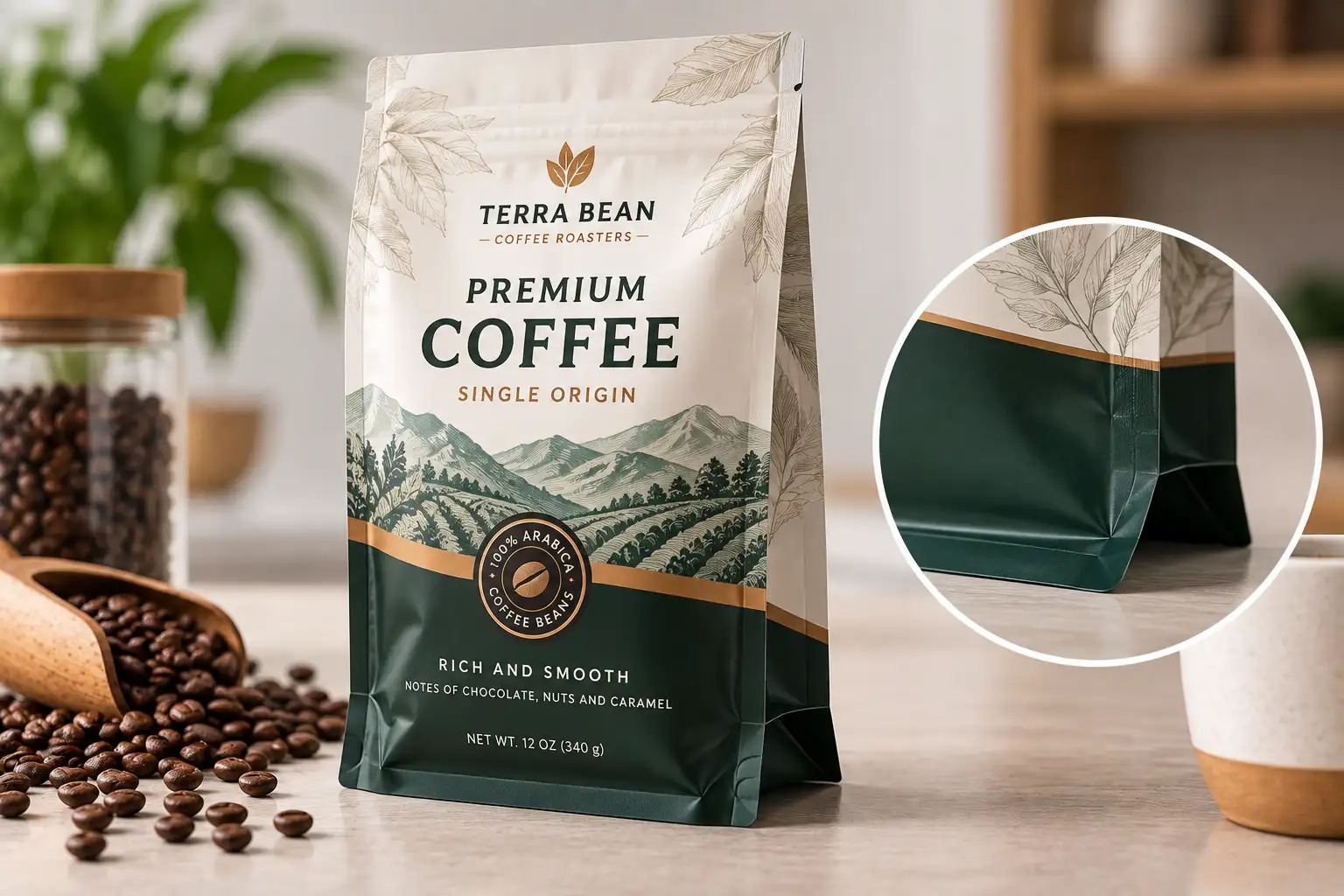
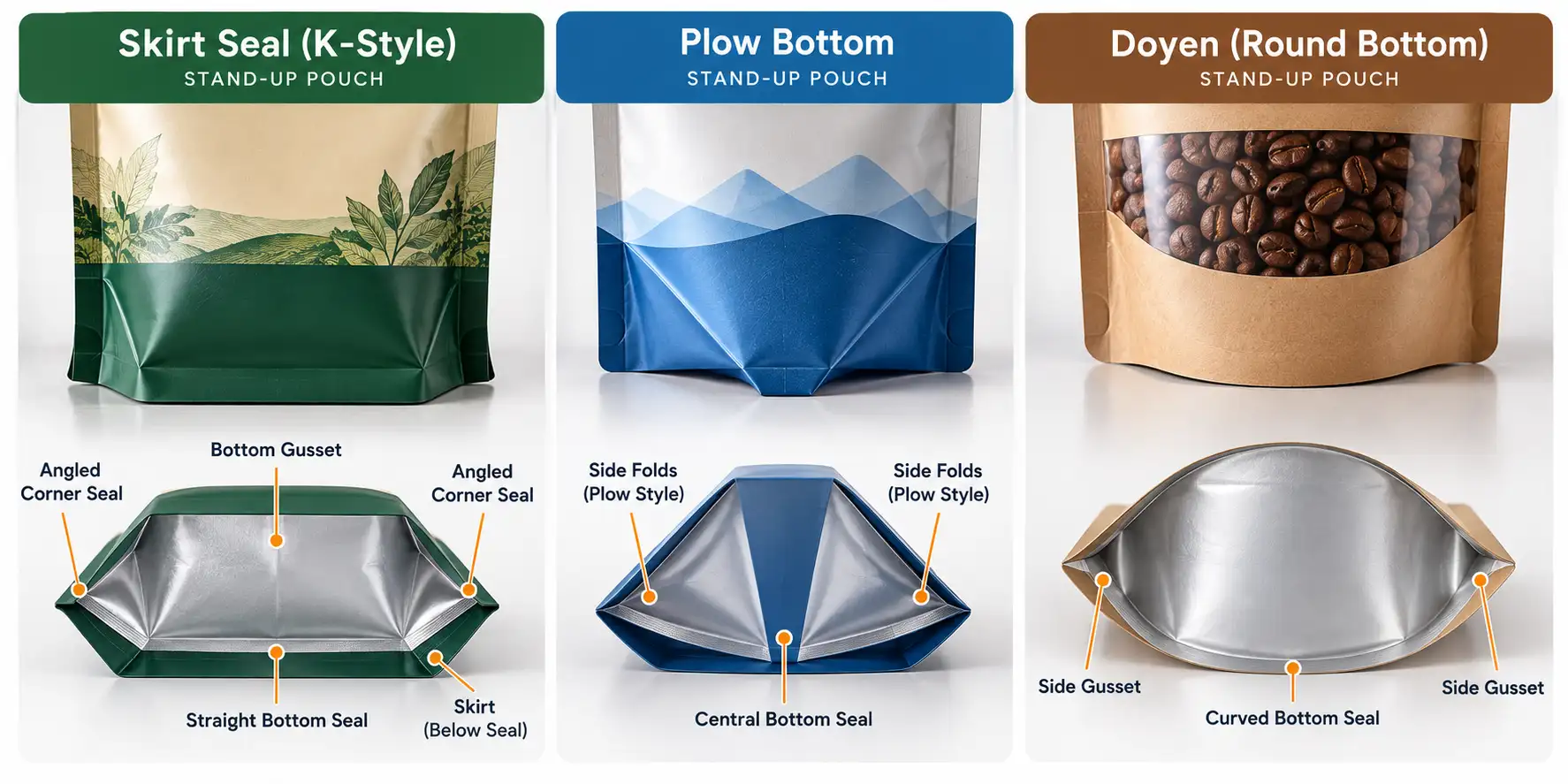
Picture a stand-up pouch lying face down on a table. Near the bottom, you’ll see two short seals angling in from the corners and one flat seal running straight across. That’s a skirt seal pouch.
The “skirt” is the narrow strip of film hanging below that flat seal. It sits at the very bottom edge, a bit like the hem on a skirt, and honestly, that’s all there is to the name.
Here’s what each piece does:
| Part | What It Does |
| Bottom gusset | A folded panel tucked inside the bag in a W shape. It opens up when the product goes in. |
| Corner seals | The two angled seals. Squint a little and they look like the arms of a K. |
| Bottom seal | The straight seal that ties the gusset to the front and back of the pouch. |
| Skirt | The thin bit of film left below that seal. |
Every one of these is made with heat and pressure. The film layers basically melt into each other, which is why a good pouch seal doesn’t pop open when a carton gets dropped or a shopper squeezes the bag.
How Does a Skirt Seal Pouch Work?
Out of the box, a skirt seal pouch is as flat as an envelope. The shape only shows up once you start filling it.
- It ships flat. The gusset stays folded inside, which is why a carton of 1,000 empty pouches barely takes up any room.
- You fill it from the top, by hand or on a machine.
- The product hits the bottom and pushes the gusset open. The base widens into a rough oval.
- The corner seals and the bottom seal split the load, so no one spot gets all the stress.
- You heat seal the top. Now it stands on its own.
Those corner seals don’t get much attention, but they matter. They stiffen the lower corners, and that’s mostly what stops a full bag from nose-diving off the shelf.
Quick heads-up if you’re moving over from a round-bottom (Doyen) pouch: a K-style base doesn’t puff out quite as much. You may need to make the bag a touch taller to fit the same amount.
When Should You Use a Skirt Seal Pouch?
More often than not, it comes down to weight. A skirt seal bottom is great for the in-between stuff. Too heavy for a soft round base, but not heavy enough to need a folded bottom with no seal at all. Most suppliers put that zone somewhere around 1 to 5 pounds (roughly 450 g to 2.3 kg).
Weight isn’t everything, though. It’s also a good pick when:
- the bag gets knocked around in shipping and needs to hold its shape
- you care about a crisp, upright look on the shelf
- you don’t want product sliding into one corner and making the bag lopsided
- jars and tubs feel like too much cost and bulk
- you want a zipper, tear notch, hang hole, or valve on it
Of all the pouch styles, this is the reliable middle one. Your product’s shape, the bag size, how you fill it, and where you sell it will still nudge the decision one way or the other.
A 2 lb bag of granola? Perfect fit. The same goes for dog treats. A 10 lb sack of rice is another matter, and you’ll see why once we line up the different types of pouch further down.
What Products Are Skirt Seal Pouches Best For?
Think dry or semi-dry, and think middle weight. These are the products we’d point toward a skirt seal bottom first, plus the one thing to watch with each.
| Product | Why It Works | Keep an Eye On |
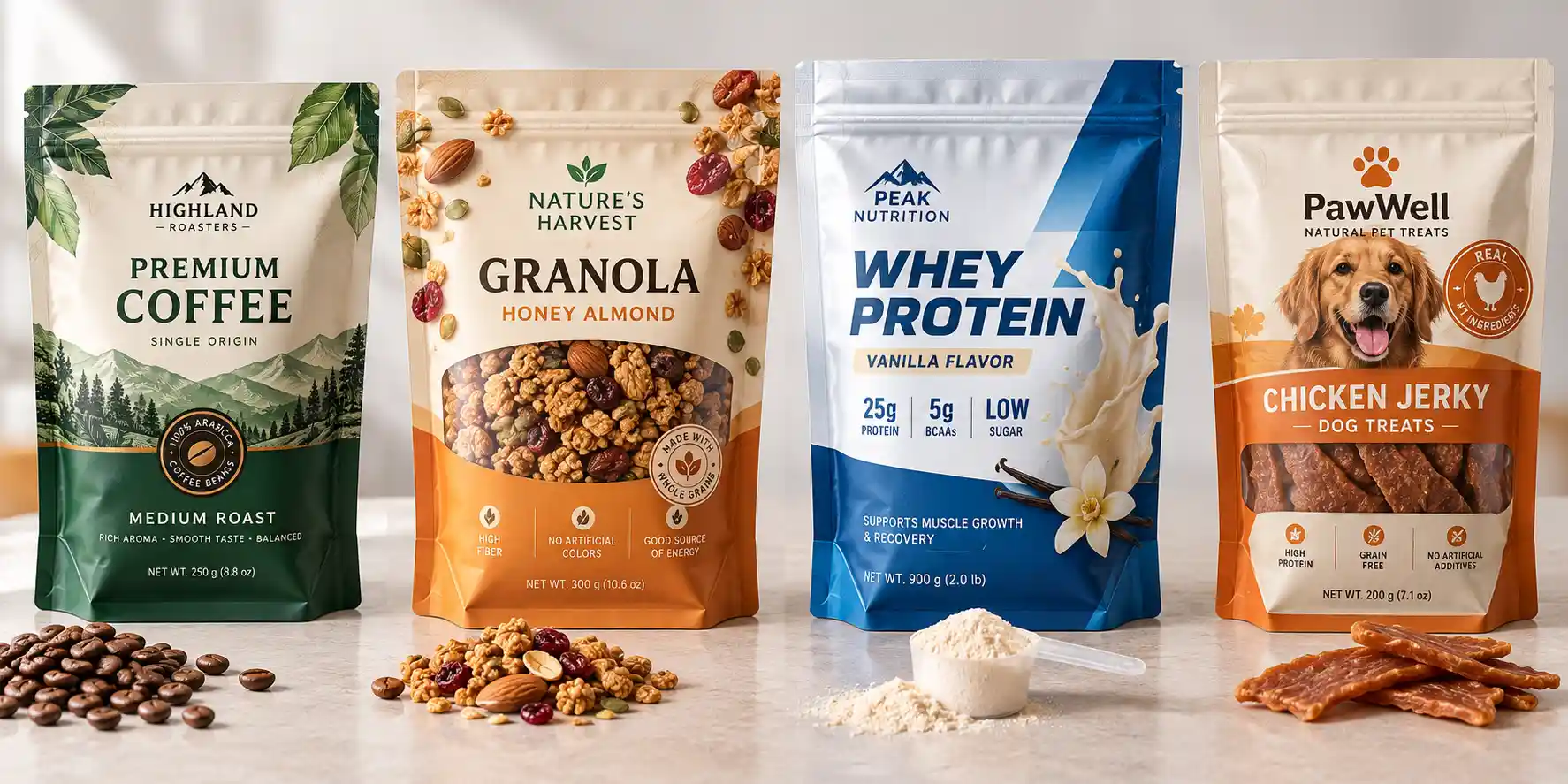
| Snacks and dry foods | Chips, granola, and jerky look fuller when the bag stands tall | Air and moisture making them go stale |
| Coffee and tea | A 12 oz or 1 lb coffee bag needs a firm base to stay upright | Fresh beans give off gas, so add a degas valve |
| Powders | Protein and baking mixes are heavy for their size | Powder getting stuck in the zipper |
| Pet treats | 1 to 5 lb treat bags stand nicely and leave lots of room for branding | Sharp, hard pieces poking holes in thin film |
| Rice, lentils, and seeds | Small bags stack well and pour without a mess | Bigger bags might be better off with a plow bottom |
One word of caution. The category alone won’t give you the answer. A café selling 12 oz bags of ground coffee and a roaster shipping 5 lb bags of whole beans are both “coffee,” but they’ll probably need different pouches.
Before you decide, take a hard look at the product’s form, how much goes in each bag, how sensitive it is to air and moisture, where it’ll be stored, and how you’ll fill it.
Skirt Seal vs. K-Seal vs. Plow Bottom Pouches
This is the part that confuses people most, and it’s not your fault. The industry doesn’t use these names consistently. Lots of suppliers say skirt seal pouch and K seal pouch and mean the exact same bag. Some don’t.
Here’s how we explain it. The K-style bottom is the one with the angled corner seals. The skirt seal is the flat seal running across its base. Take that flat seal away and just fold the bottom instead, and you’ve got a plow bottom pouch.
| Feature | Skirt Seal / K-Style | Plow Bottom | Doyen / Round Bottom |
| Bottom construction | Angled corner seals plus a straight base seal | Folded bottom with no seal across it | U-shaped seal around the gusset |
| General fill weight guide | About 1 to 5 lb | Often 5 lb and up | Usually under 1 lb |
| Look on the shelf | Crisp, angled base | Smooth base, no seal line | Soft, rounded base |
| Best reason to choose it | Mid-weight goods that need a neat upright look | Heavy or loose granular products | Light products that need help standing |
On a plow bottom pouch, nothing is sealed across the fold, so the product rests right on the film. That’s why people like it for heavy fillings and fine stuff like sugar. No bottom seal means no seam for tiny grains to sneak into.
The Doyen sits at the opposite end. Its rounded seal works almost like little feet, which is exactly what a light bag needs to stay up. The downside? It usually needs a custom die to cut that curve. K-style bottoms often don’t.
So the skirt seal lands right between these two pouch styles. If you want the longer version, our post on stand-up pouch gusset styles goes through all three.
Important Note: Since suppliers use these names a little differently, don’t approve an order based on the style name alone. Ask for a dieline that shows the bottom of the pouch, and you’ll know exactly what you’re getting before anything goes to print.
Benefits of Skirt Seal Pouches
If we had to pick one word, it’d be balance. You get a solid base that looks good, and you don’t have to pay for a fancier format to get it.
The corner seals and skirt seal hold the gusset in place from filling to shipping to the store shelf, so the base doesn’t sag. A pouch with a clean, straight bottom edge also looks more trustworthy next to one that’s slouching. Shoppers pick up on that, even if they couldn’t tell you why.
Then there’s the less exciting but still important stuff. Empty pouches ship flat and weigh next to nothing compared with jars, so you save on storage and freight. You also get plenty of space to play with:
- choose your own size, film, closure, and finish
- print the front, back, and bottom panel
- fit in your story, nutrition facts, or a quick how-to
When a Skirt Seal Pouch May Not Be the Best Choice
We’d rather you get the right pouch than the one this article happens to be about. So here’s when we’d steer you somewhere else.
| If Your Product… | Consider Instead | Why |
| Weighs well over 5 lb | Plow bottom pouch | No bottom seal to strain, and the product rests on the fold |
| Is very light, like loose-leaf tea | Doyen pouch | The rounded seal helps light items stand |
| Needs a box shape and lots of print space | Flat bottom pouch | A squared base and side panels look premium |
| Is a single serving made on a fast line | Back seal pouch | It’s formed from rollstock and filled at high speed |
| Is fragile and crushes easily | Folding carton or rigid pack | A firm structure protects it better |
A flat bottom pouch is worth the extra spend when shelf impact is the main goal. It stands like a box and shows off your artwork on every side.
Back seal pouches are a whole different animal. There’s one seal running down the middle of the back, plus seals at the top and bottom, and they’re usually made at high speed on form-fill-seal machines. We’ve written up their fin and lap seal styles if you want to dig in.
And don’t forget your co-packer. If their line is already set up for one pouch style, switching can eat up time and money, so bring them into the conversation early.
How to Choose the Right Pouch Bottom for Your Product
Picking a bottom gets a lot simpler when you break it into four questions. Take them one at a time.
Product Type and Weight
Start with what’s going in the bag. Popcorn takes up loads of space but weighs almost nothing. Protein powder packs down tight and finds its way into every fold, while rice and seeds pour fast and get heavy before you know it.
Heavier dry goods tug on the bottom seal every time someone lifts the bag. Liquids are a separate conversation. They push on every seal at once and usually need a spouted or specially built pouch.
Pouch Size and Fill Volume
A common mistake is sizing by weight alone. A pound of popcorn and a pound of rice need wildly different bags.
Width, height, and gusset depth all have to fit your fill, and you need a little headspace at the top for the zipper and final seal. Our guide on pouch size and capacity walks through how to measure it.
Barrier and Material Requirements
Think of the film as your product’s bodyguard against moisture, oxygen, light, and smells. Coffee, nuts, and supplements usually need a high-barrier film. Plenty of dry goods can get away with less.
The film structure also changes how the pouch feels in your hand and how well it seals. For the nuts and bolts, see our breakdown of the films used in printed pouches.
Filling, Storage, and Shelf Display
Think about the pouch’s whole life, not just the moment it hits the shelf:
- Hand filling or a machine?
- Cases to retailers, or straight to people’s doors?
- On a shelf, in a bin, or hanging from a peg?
Important Note: Weight ranges are a starting point, not a rule. Fill a sample pouch with your actual product before you order a full run, because two products can weigh exactly the same and still behave completely differently in the bag.
Customizing a Skirt Seal Pouch
Once you’ve settled the bottom, everything else can be shaped around your product. Most brands pick from a list like this:
- a custom size that fits your fill, not the other way around
- clear, metallized, kraft-look, or high-barrier film, with recyclable and compostable options too
- a press-to-close zipper if people will use it over a few days or weeks
- a tear notch so nobody’s digging around for scissors
- a hang hole for peg displays
- a degas valve, which is a must for fresh roasted coffee
- a clear window so shoppers can see what they’re buying
- a matte, gloss, or metallic finish on the print
Some brands also want shoppers to know nobody has opened the bag. That’s where a membrane seal pouch comes in. A thin inner seal sits under the zipper and gets torn off the first time the bag is opened. It’s simple, and it adds tamper evidence to any seal pouch.
Conclusion
A skirt seal pouch earns its place when your product sits in that middle range: dry or semi-dry, somewhere around 1 to 5 pounds, and in need of a bag that stands tall with a clean, steady base. It handles snacks, coffee, powders, and pet treats without the extra cost of a box-style pouch, and it still leaves plenty of room for zippers, valves, and eye-catching artwork.
That said, it isn’t the answer for everything. If your product is very heavy, very light, liquid, or packed on a fast single-serve line, a plow bottom, Doyen, or back seal pouch will probably treat you better. Whatever you choose, start with the product, check the dieline, and test a sample before you commit to a full run.
Find the Right Pouch Bottom With Flexible Pouches
Still not sure? Send us a quick note with what you’re packing, how much goes in each bag, the size you’re thinking of, and anything else it needs, and we’ll tell you which bottom makes sense. Orders start at 1,000 pouches, and most digitally printed jobs ship within 10 business days of art approval.
Request your free quote today, and let’s build a pouch that fits your product from the bottom up.
FAQs
1- What is a skirt seal pouch?
It’s a stand-up pouch with two angled seals at the bottom corners and one straight seal across the base. The skirt is the thin strip of film under that straight seal. Those seals keep the gusset in place, which is what lets the bag stand once it’s full.
2- What is the purpose of the skirt on a pouch?
On a stand-up pouch, it mostly gives the base a tidy, finished edge. Flat bags sometimes have a tiny skirt too, only a few millimeters wide, left there on purpose so the blade doesn’t cut into the seal. It’s harmless, and if you’d rather not have it, just ask.
3- Is a skirt seal the same as a K-seal?
Most of the time, yes. Plenty of suppliers use the two names for the same K-style bottom with a seal across the base. Not all of them do, though, so check the dieline before you sign off.
4- What is the difference between a skirt seal and a plow bottom pouch?
It’s all about that bottom seal. A skirt seal pouch has one across the base, and a plow bottom pouch doesn’t. Its bottom is simply folded, with the product resting on the fold, which is why plow bottoms usually handle heavier or grainier products.
5- What products can be packaged in skirt seal pouches?
Snacks, granola, nuts, coffee, tea, protein powder, supplements, and pet treats all work well. Most of them fall between 1 and 5 lb. If yours is very heavy, very light, or a liquid, you’ll likely be happier with another format.
6- How do I choose the right bottom gusset for my product?
Start with weight, form, and volume. After that, think about barrier needs, how you’ll fill the bag, and where it’ll be sold. Before placing a big order, test a sample with the real product. It’s the cheapest way to avoid surprises.