



















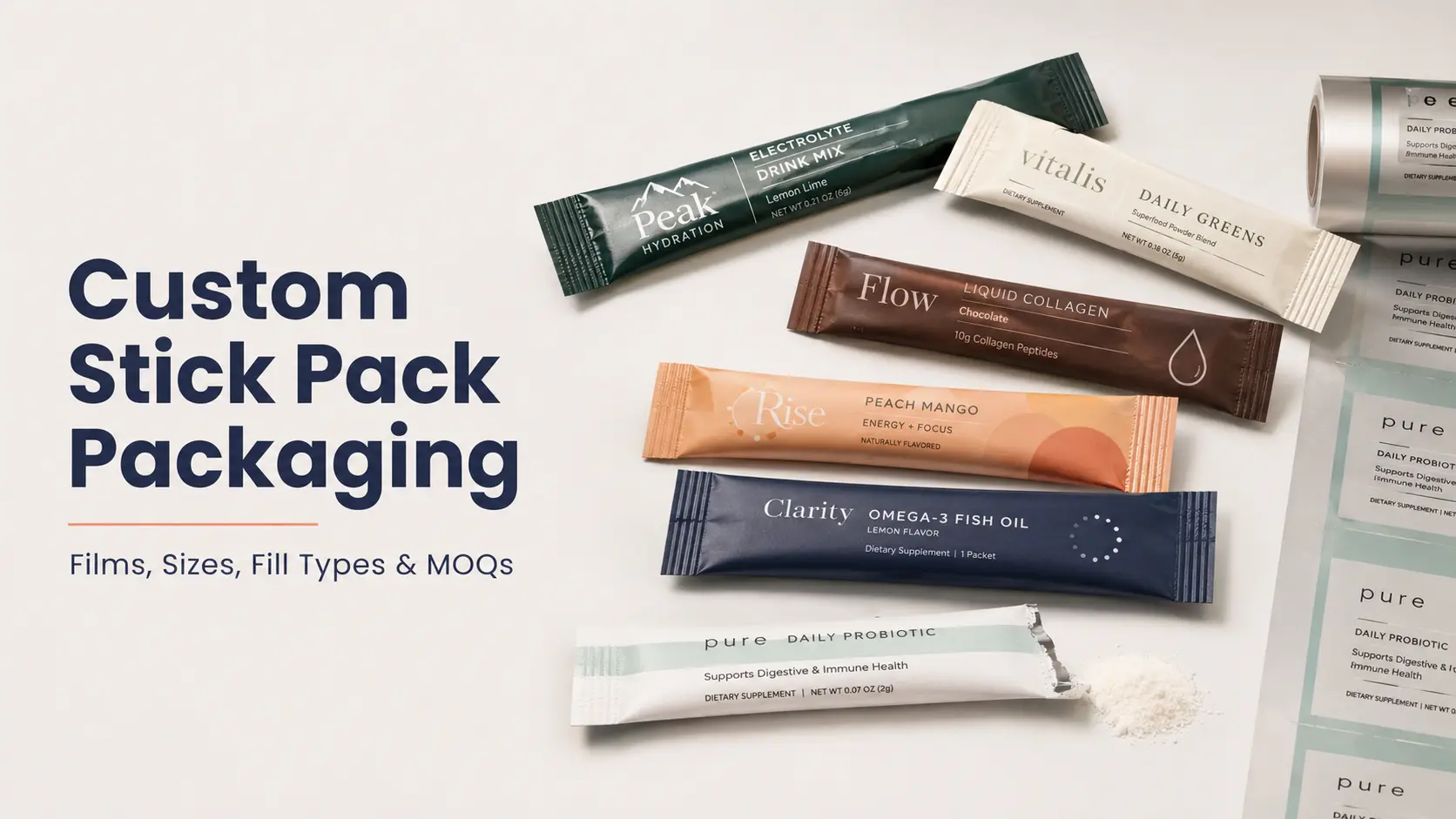
If you have ever torn open a slim packet of sugar at a coffee shop or squeezed out a single serving of honey on a flight, you already know what a stick pack is. These narrow, compact pouches have quietly become one of the most popular formats in flexible packaging, and there is a good reason for it. They are easy to carry, easy to open, and they deliver an exact measured portion every single time. For brands that sell powders, drink mixes, supplements, or liquid concentrates, stick packs offer a clean and convenient way to reach customers who want grab-and-go convenience without any guesswork.
But picking the right stick pack is not as simple as choosing a shape and adding a logo. Behind every good stick pack there are several decisions that need to work together: the film material, the pack size, the type of product going inside, and the minimum order you will need to commit to. Get one of these wrong and the rest fall apart. A film that cannot handle moisture will ruin a powder. A size that does not fit the filling machine will stall your entire production line. This guide walks through all four of those decisions: films, sizes, fill types and MOQs so you can get it right from the start.
What Is Custom Stick Pack Packaging?
Think of a stick pack as a tall, skinny pouch built to hold one serving of something. It gets sealed on three or four sides, and the shape is deliberately narrow so you can tear it open and pour straight into a glass or bottle. Most of them are made from printed rollstock film on form-fill-seal machines. The film comes off a roll, gets shaped into a tube, sealed along the length, filled with product, then cross-sealed and cut apart. That whole process happens fast and automatically.
Now, what makes a custom stick pack different from a generic one? Everything is tailored to the film layers, the barrier, the width, the length, the printing. It is all matched to your specific product, your filling equipment, and your shelf-life target. A lot of people confuse stick packs with sachets, but the difference is mostly shape. Sachets sit wider and flatter. Stick packs are narrow and tall, which makes pouring easier and actually uses less material per unit.
Stick Pack Films: Choosing the Right Material
Film choice can make or break your stick pack. Get it right and your product stays fresh, seals hold, and the pack looks professional. Get it wrong and you end up with clumped powder, leaking seals, or flavour that disappears two months before the expiry date.
Barrier Requirements
Every product has something trying to destroy it. Moisture wrecks powders by causing clumps. Oxygen and light kill flavour in coffee and spices. Greasy products can migrate through weak films. Liquids will find any pinhole in a bad seal. That is why barrier films exist; they block the specific threats your product faces. Some products only need a moisture barrier. Others need moisture, oxygen, and light protection all at once. What you are packing decides what you need.
Common Film Materials
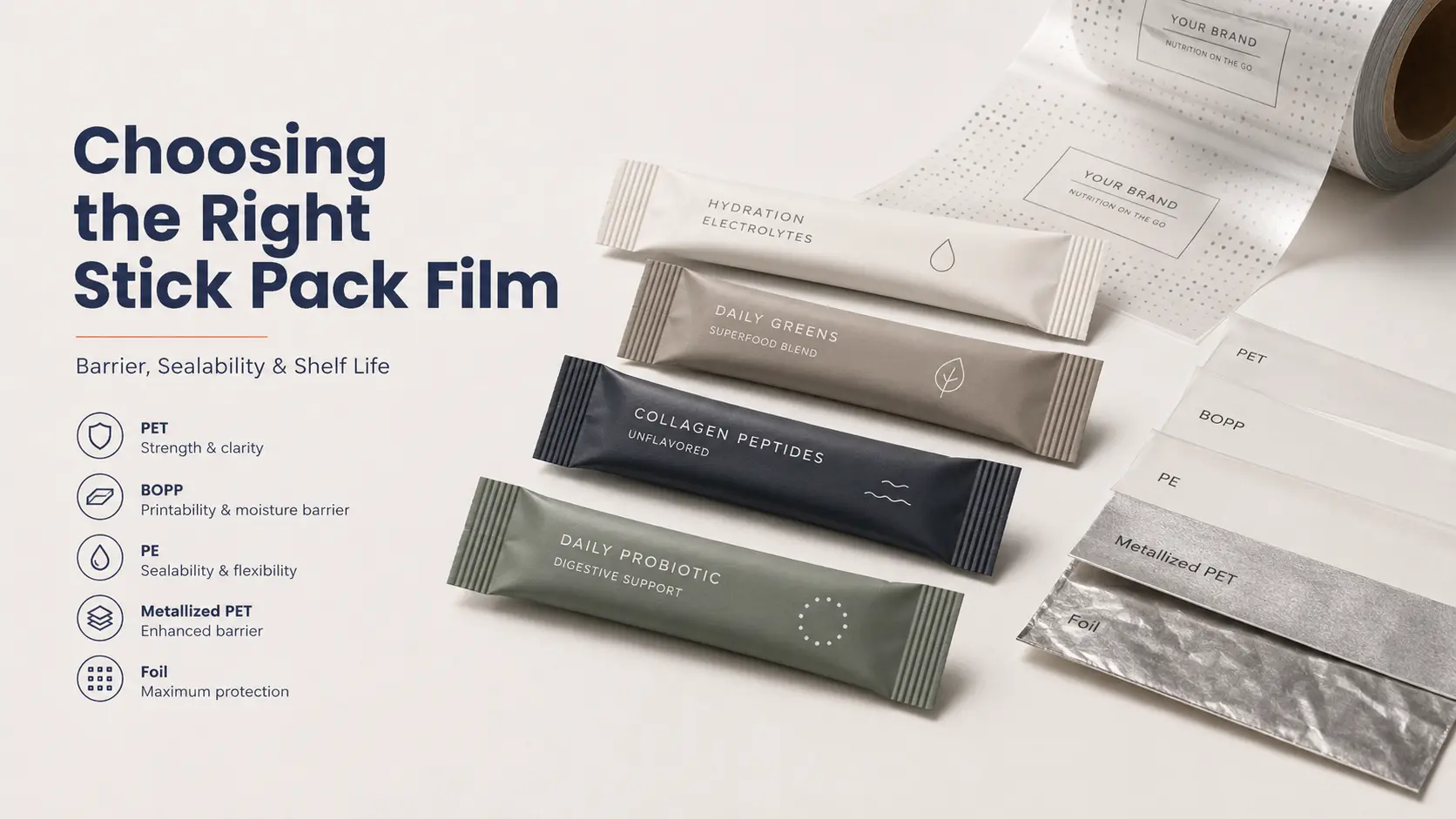
Most stick pack films are multilayer laminates two or three materials bonded together so each layer does its job:
- PET (Polyester) — Tough, prints sharp, great outer layer. Gives the pack its stiffness.
- BOPP — Lightweight with decent moisture protection. Works well for dry stuff like sugar and seasonings.
- PE (Polyethylene) — Usually the inner layer. This is what lets the film heat-seal on the machine.
- Metallised PET — PET with a thin aluminium coating. Good oxygen and moisture barrier without the cost of real foil.
- Aluminium Foil Laminates — Maximum protection. Blocks practically everything moisture, oxygen, light, aroma. Used when shelf life absolutely cannot be compromised.
- Clear Barrier Films — Transparent films with barrier coatings applied. Useful when the brand wants consumers to see the product inside.
A typical structure might be PET on the outside for printing and strength, with PE on the inside for sealing. Add a metallised layer in the middle if the product needs extra protection.
Mono-Material and Recyclable Films
Here is where things are shifting. Traditional multilayer films mix different plastics (sometimes with aluminium), and that makes recycling nearly impossible. Mono-material packaging uses a single polymer family, usually PE for every layer. Because it is all one material, the pack can go through standard recycling streams.
The catch? Mono-material films do not always hit the same barrier performance as traditional laminates. They are getting closer every year with better coatings and PE grades, but you need to test with your actual product. Sealing can be tricky too since the inner and outer layers are the same material. Temperatures and dwell times on your machine may need tweaking.
Important Note: If you are packing something highly sensitive pharmaceutical powders, premium coffee, anything with volatile flavours mono-material might not cut it yet. Always run shelf-life tests with your real product before switching. The sustainability story means nothing if the product goes bad on the shelf.
Stick Pack Sizes and Dimensions
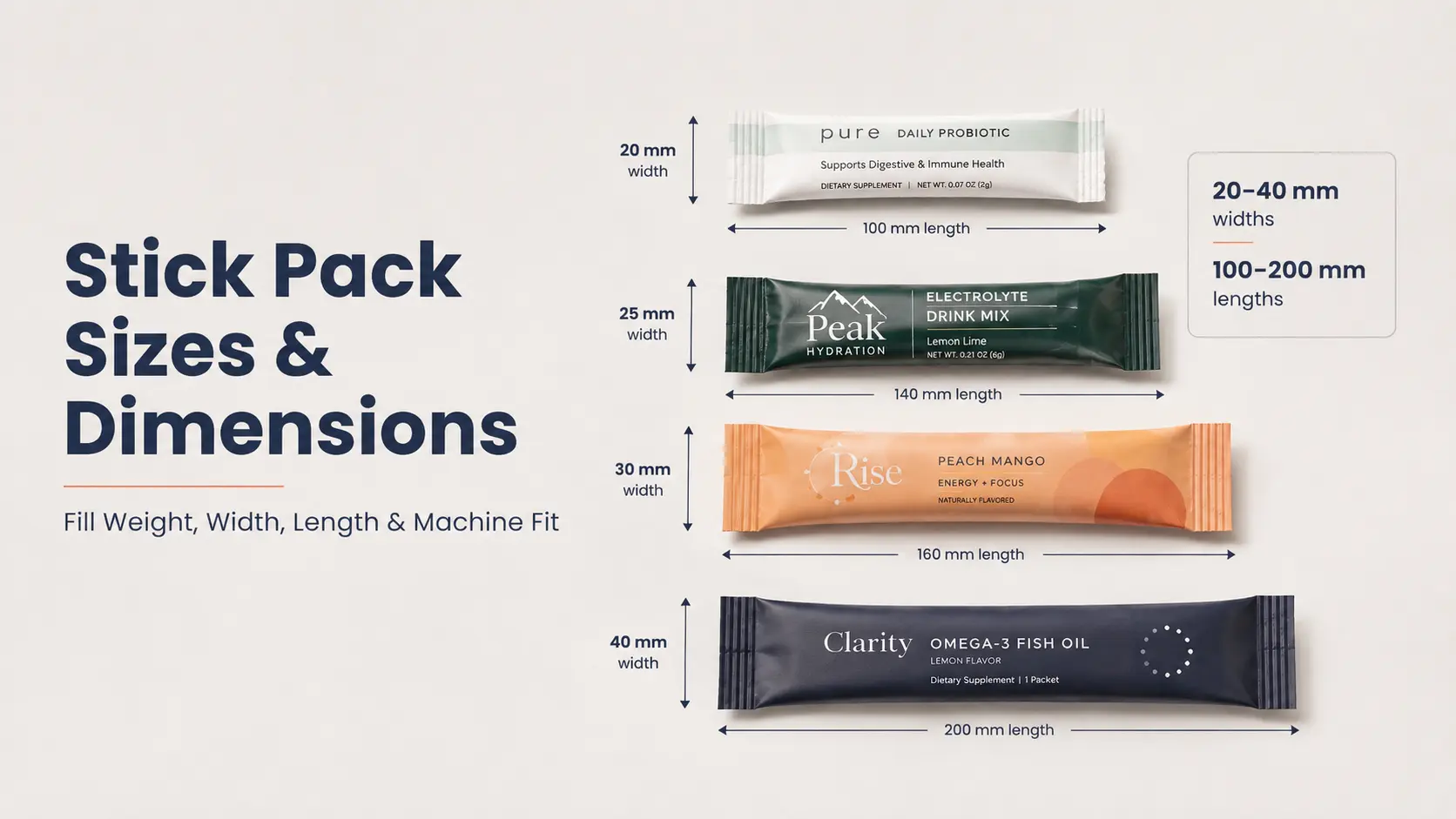
This is where buyers get tripped up the most. There is no magic universal size. Two products at the same fill weight can need totally different dimensions because density, flow, and machine specs all play a role.
What Decides Width and Length?
A bunch of things, and they all interact:
- Fill weight or volume — 5 grams of sweetener takes up way less room than 30 ml of liquid supplement.
- Product density — Dense granulated sugar packs tight. Fluffy protein powder takes up three times the space at the same weight.
- Flow behaviour — Free-flowing granules drop into narrow packs easily. Thick pastes need a wider opening.
- Headspace — You always need a gap between the product and the seal. Too little and you get contaminated seals. Too much and you waste material.
- Seal widths — Top, bottom, and side seals eat into your usable space. Wider seals are stronger but leave less room for product and artwork.
- Machine limits — Your filling equipment has a minimum and maximum width range. The pack has to fit within it. No negotiating on that one.
Standard Sizes vs Custom
Widths from 20 mm to 40 mm and lengths from 100 mm to 200 mm show up in most commercial projects. But do not treat any of those as a default. A 25 × 120 mm pack might be perfect for a 3-gram sweetener stick, but completely wrong for a 10-gram collagen serving the density difference alone throws the whole thing off.
If your product density and fill weight happen to match common formats, you might be able to use existing repeat lengths and tooling. Otherwise, custom dimensions are the way to go.
Rollstock Dimensions
The finished pack size is just half the equation. Your printed rollstock film has its own specs that need to match the machine: web width, repeat length, lane width, number of lanes, core size, roll diameter, and unwind direction. Get the unwind direction wrong and your print shows up backwards. Not a fun discovery on production day.
Stick Pack Fill Types: Powders, Granules, Liquids and More
What you are filling into the pack shapes almost every other decision. Here is how different product types affect things.
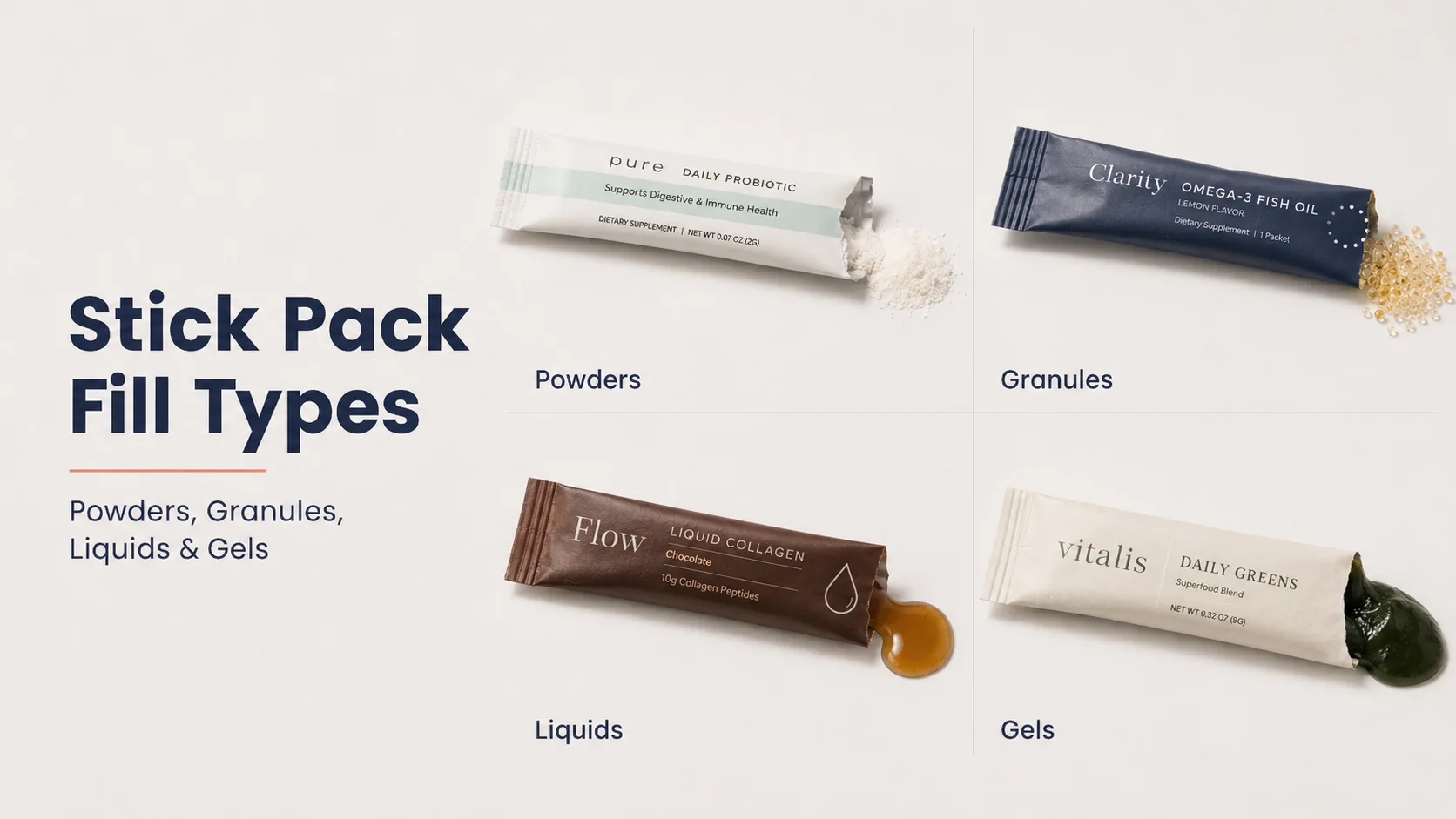
Powder Stick Packaging
Powders are the most common products packed in stick format. This includes protein powder, collagen peptides, electrolyte mixes, hydration powders, drink mixes, instant coffee, nutritional supplements, sweeteners, spices and seasoning blends.
The main packaging challenges with powders are moisture sensitivity (which causes clumping), dust during filling (which can contaminate seals), aroma retention (especially for coffee and spices), and accurate dosing. A moisture barrier film is essential for almost every powder product. Metallised PET or aluminium foil laminates are common choices for powders that need long shelf life.
Granule and Dry Product Stick Packs
Sugar, salt, crystals, instant drink granules flow more freely than fine powders and fill faster. Less dust too, which is nice for seal integrity. But particle size matters. Coarse granules can bridge in the filling auger if the opening is too narrow, and bulk density changes how much space they actually take up.
Liquid Stick Packs
Liquids add a completely different set of challenges. Products like syrups, honey, liquid supplements, beverage concentrates, sauces, condiments and flavour concentrates all need packaging that will not leak ever. That means strong, consistent seal integrity across every single pack. The sealant layer has to be compatible with the product, especially for oily or acidic liquids that can attack certain films over time.
Fill temperature is another consideration. Some liquids are filled hot, which puts stress on seals that a cold-fill product never would. And liquid stick packs have to survive shipping stacking pressure, drops and temperature swings can all test seal strength.
Gel and Paste Stick Packs
Gels and pastes are the most awkward fill type. They are hard to dose accurately, hard to push through a narrow fill tube, and they love smearing into the seal zone during filling. The pack often needs a wider format so the consumer can actually squeeze everything out. Stronger sealant layers help deal with the contamination risk.
Matching Film and Size to the Fill Type
These three things, film, size, and fill type are connected. You cannot pick them separately and expect it to work. Quick reference:
| Fill Type | Biggest Risk | Barrier Priority | Size Factor to Watch |
| Powder | Moisture, clumping | Moisture barrier | Product density |
| Granules | Flow, particle bridging | Depends on product | Particle dimensions |
| Liquid | Leaking | Strong seals + barrier | Fill volume, headspace |
| Gel / Paste | Seal contamination | Heavy-duty sealant | Opening width |
How VFFS Stick Pack Manufacturing Works
Most stick packs run on vertical form-fill-seal (VFFS) machines. The sequence: film unwinds from a roll → forms around a collar into a tube → longitudinal seal closes the tube → product gets dosed from above → cross seals close the top and bottom → a knife cuts packs apart. All automated, all fast.
Single-lane machines make one pack per cycle. Simpler, good for short runs. Multi-lane machines run eight, ten, or twelve lanes at once with faster output, but the printed film rolls need to be precisely slit and registered across every lane. Lane width, registration marks, and total web width all have to line up perfectly.
Before you order film, confirm compatibility with your machine. Check the make and model, number of lanes, web width, repeat length, core size, max roll diameter, unwind direction, registration mark specs, seal type, and sealing temperature range.
Important Note: Request test rolls before placing a full order. Running a small quantity through your actual machine catches compatibility problems that no spec sheet can predict. Skipping this step is how brands end up with thousands of metres of film they cannot use.
Stick Pack MOQ: What Determines the Minimum Order?
Minimum order quantity is one of the first questions every buyer asks, and the answer is almost never a simple number. MOQ for custom stick pack rollstock depends on several factors, and understanding these helps you plan your budget and timeline.
Factors That Affect Custom Stick Pack MOQ
The main factors that drive MOQ include film material and structure, pack dimensions, printing method (digital vs rotogravure), number of SKUs, artwork variations, special finishes like matte or gloss, roll configuration and overall production setup. More complex specifications generally mean higher minimums because setup costs are spread across fewer units.
How Stick Pack MOQ Is Calculated
Suppliers often express MOQ in different ways square metres of film, linear metres, number of rolls, or impressions. Some may quote a finished pack quantity, but that number can only be accurate once the final width, repeat length, film structure and lane configuration are locked in.
For example, 300 square metres of film produces a very different number of finished stick packs depending on whether each pack is 25 mm × 120 mm or 40 mm × 180 mm. The smaller pack yields far more units from the same amount of film.
Flexible Pouches Stick Pack MOQ
At Flexible Pouches, custom stick pack rollstock MOQ starts from 300 m², depending on final specifications. The number of finished stick packs this represents varies according to your pack dimensions and production layout. For brands that need a lower entry point, digital printing removes the need for plates and cylinders, which brings both the cost and the minimum quantity down compared to traditional rotogravure runs.
Custom Printing and Design
Stick packs can look just as premium as any other flexible packaging format you just have less real estate to work with. Here is what is available for customisation:
- Full-colour printing with custom graphics and branding
- Matte, gloss, or soft-touch finishes depending on the look and feel you are after
- Metallic effects for a premium shelf presence
- Transparent windows where the film structure allows it lets the customer see the product inside
- Tear notches for clean, easy opening
- Multiple SKUs on the same roll or separate rolls, depending on your setup and volume
If you sell several flavours or variants, digital printing is a big advantage here because it removes the cost of individual printing plates per SKU.
Designing Artwork for Narrow Stick Packs
This is where stick packs get tricky. The pack is narrower than a stand-up pouch or flat bag so every millimetre of printable area matters. When laying out your design, you need to plan around:
- Seal zones — these cannot be printed on, and they eat into your usable space on all sides
- Tear notch placement — has to sit where the consumer can open cleanly without tearing into the product area
- Barcode positioning — needs enough quiet zone around it to scan properly
- Date and lot coding areas — leave blank space for the filling line to stamp these during production
- Safe zones — keep critical text and logos well inside the trim boundaries so nothing gets cut off
Putting your brand name right on the edge of a seal line is a rookie mistake that shows up as a half-visible logo on the finished pack. The simplest way to avoid all of this is to start with a dieline template from your film supplier. That template shows exactly where the seals, folds, notches, and safe zones fall so your designer knows the actual printable area before they even open the art file.
How to Choose the Right Specification — Step by Step
If this is your first time ordering stick packs, follow this order and you will avoid most of the backtracking that slows projects down:
Step 1 — Start with your product. Is it a powder, granule, liquid, gel or paste? That answer narrows down film, size, and machine settings immediately.
Step 2 — Lock in the fill amount. Decide the exact weight or volume per pack before anything else.
Step 3 — Pick the film and barrier. Match the material to your product’s weaknesses: moisture, oxygen, light, aroma plus whatever your seal system needs.
Step 4 — Set the dimensions. Width and length come from the fill volume, product density, and artwork space, cross-checked against what your machine can handle.
Step 5 — Verify machine compatibility. Confirm every rollstock spec web width, repeat, core, unwind, lanes — against your actual equipment.
Step 6 — Finalise printing and MOQ. Lock in artwork, SKU count, film quantity, and roll configuration.
Follow that sequence — Fill Type → Film → Size → Machine → Print → MOQ — and the project stays on track.
What Information Do You Need to Order Custom Stick Packs?
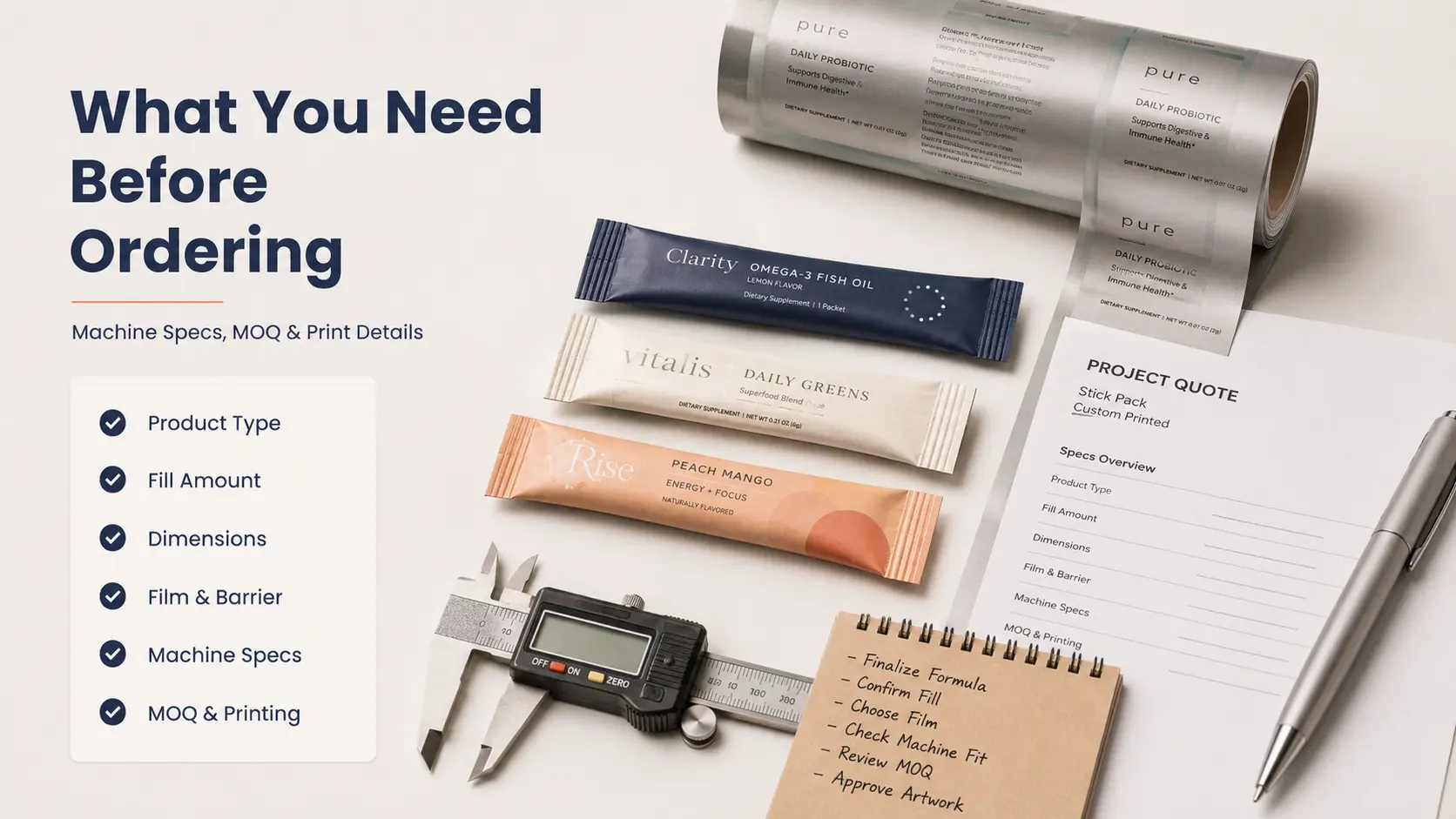
Have these details ready before you reach out for a quote:
- Product type and form (powder, granule, liquid, gel, paste)
- Fill weight or volume per pack
- Product density or viscosity
- Required width and length
- Film and barrier preferences
- Shelf-life target
- Filling machine make, model, number of lanes
- Web width, repeat length, core size, max roll diameter, unwind direction
- Artwork files and number of SKUs
- Required quantity and delivery location
- Whether you need test rolls first
More details upfront means a faster, more accurate quote.
Conclusion
Stick pack packaging boils down to four connected decisions: film, size, fill type, and MOQ. None of them work in isolation. A film that protects the product perfectly but jams your sealing bars is useless. A size that looks great on paper but cannot run on your machine is a waste of everyone’s time. And a minimum order that ignores your actual sales volume ties up cash you need elsewhere.
Add machine compatibility as the fifth piece, and you have got the full picture. Nail these five things and the rest printing, design, delivery falls into place without drama. Sort them out before you go into full production and you will save yourself a lot of expensive surprises.
Ready to Build Your Custom Stick Pack?
Tell us your product, fill amount, dimensions, machine specs and order quantity. We will recommend the right film, confirm your rollstock specifications and get you a custom quote so you can move from planning to production without second-guessing anything.
Get Your Custom Stick Pack Quote →
FAQs
1. What film is used for stick pack packaging?
It depends on the product. PET, BOPP and PE are the most common base materials. Metallised PET or aluminium foil laminates get used when stronger moisture and oxygen barriers are needed. Nearly all stick pack films are multilayer — two or three materials laminated together so each layer handles a different job.
2. What are standard stick pack sizes?
Widths between 20 mm and 40 mm are common. Lengths usually fall between 100 mm and 200 mm. But there is no one-size-fits-all. A pack that works for 3 grams of sweetener will not work for 10 grams of collagen powder. Size always depends on fill amount, density, and machine capability.
3. Can stick packs be made in custom sizes?
Absolutely. As long as the dimensions work within your filling machine’s range and the film supplier’s production capability, custom widths and lengths are fair game. Most real-world projects involve some degree of customisation.
4. What products can be filled into stick packs?
Powders (protein, electrolytes, coffee, sweeteners, spices), granules (sugar, salt, instant drinks), liquids (syrups, honey, supplements, sauces), and gels or pastes. If it can be dosed accurately through a form-fill-seal machine, it can probably go into a stick pack.
5. What is the MOQ for custom stick pack packaging?
At Flexible Pouches, custom rollstock starts from 300 m². The finished pack count varies depending on dimensions and layout. Digital printing lowers minimums further since there are no plate costs involved.
6. What information do I need to order custom stick packs?
Product type, fill amount, density, required dimensions, film and barrier preferences, machine specs (make, model, lanes, web width, repeat, core, unwind direction), artwork, number of SKUs, and your order quantity. Having these ready makes quoting much faster.