




























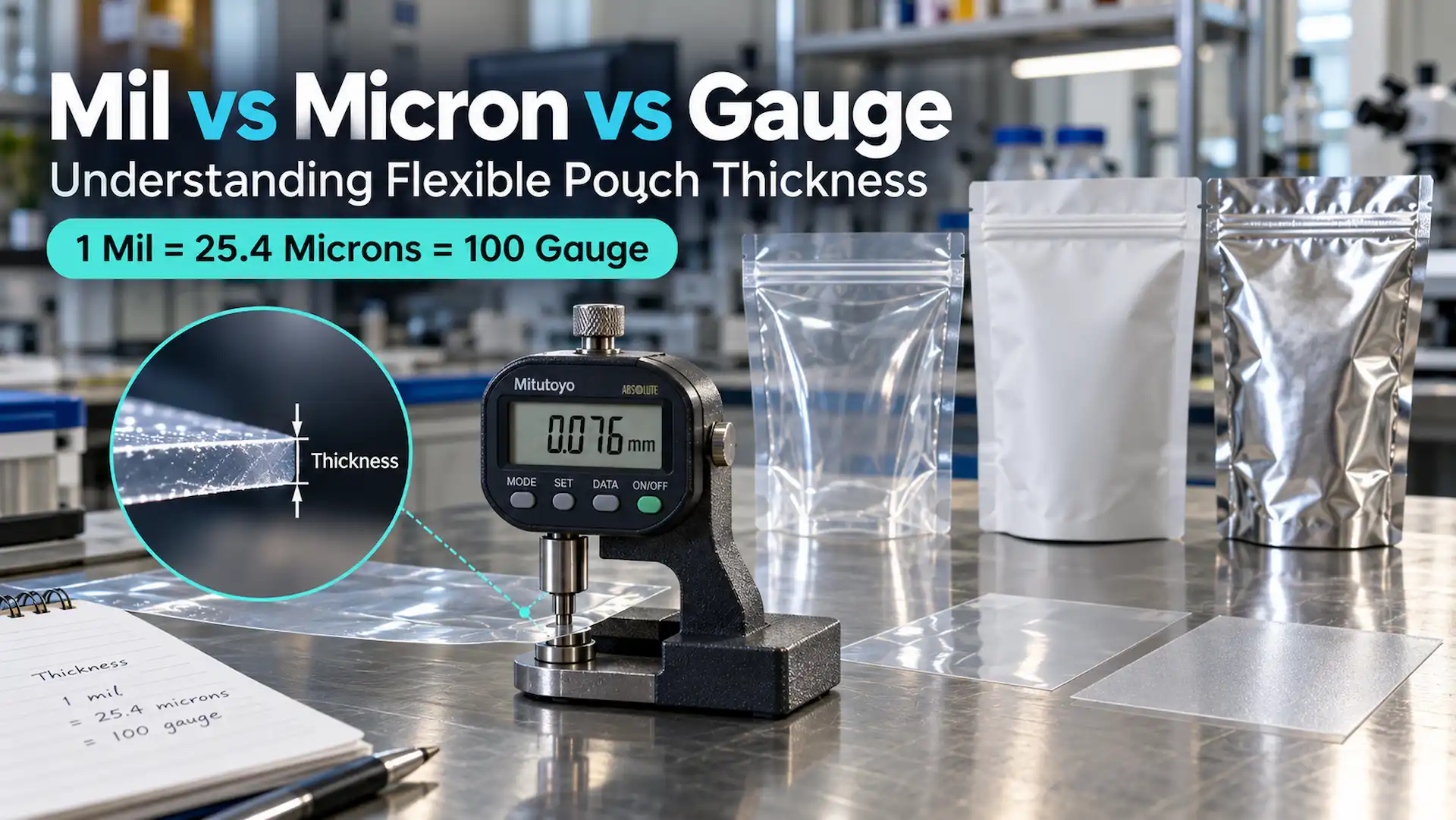
Choosing the right pouch thickness can feel confusing when packaging suppliers use different measurements. One supplier may describe a film in mils, another in microns, and another in gauge. Although the numbers look different, they can represent exactly the same thickness. Understanding these measurements makes comparing materials easier and helps you avoid costly mistakes when choosing the right pouch for your product.
Whether you’re packaging coffee, snacks, powders, or pet food, thickness plays an important role in how your pouch performs. It can affect durability, flexibility, and how well the material handles everyday use. However, thicker packaging isn’t always the better option. This guide explains mil vs micron vs gauge, provides an easy pouch thickness chart, and helps you choose a suitable film thickness based on your packaging needs.
What Are Mil, Micron, and Gauge in Pouch Packaging?
All three units measure the same thing: how thick the film is. They just use different rulers. This guide covers packaging pouches, not the laminating pouches used for paper.
What Is Mil Thickness?
A mil is a small imperial unit used to describe film thickness. Here’s what to know:
- One mil equals one thousandth of an inch (0.001 in).
- It’s the main thickness unit in the US.
- 1 mil = 25.4 microns.
- A mil is not a millimeter, and mixing them up is a costly mistake (more on that later).
What Is a Micron?
A micron is the metric way to measure thin film. Here’s what to know:
- It’s written as µm and equals one thousandth of a millimeter.
- It’s common in Europe and Asia, and on most material data sheets.
- 1 micron = 0.039 mil.
- Pouch films usually read in tens or hundreds of microns, because one micron is tiny.
What Does Gauge Mean in Plastic Film?
Gauge is a shorthand scale used for plastic film. Here’s what to know:
- 100 gauge equals 1 mil, so 200 gauge is 2 mil.
- A higher number means thicker film, the opposite of wire gauge.
- It isn’t always used the same way, so mil or microns are safer for specs.
- You’ll often see it in single layers. Our Clear Poly structure uses a 48-gauge polyester layer.
Mil vs Micron vs Gauge: Key Differences Explained
Here’s how the three units line up.
| Unit | What It Is | Where It’s Common | How It Converts |
| Mil | 1/1000 of an inch | United States | 1 mil = 25.4 microns |
| Micron (µm) | 1/1000 of a millimeter | Europe, Asia, data sheets | 1 micron = 0.039 mil |
| Gauge | A film industry scale | Plastic film specs | 100 gauge = 1 mil |
The easy way to remember it: 1 mil = 25.4 microns = 100 gauge. Mil and micron are exact units. Gauge is shorthand, and it isn’t always used the same way. So lean on mil or microns when you write a spec.
Pouch Thickness Chart: Mil, Micron, and Gauge Conversions
Use the chart and formulas below to switch between units without guessing.
Mil Thickness Chart: 0.5 Mil to 10 Mil
Use this chart to compare plastic film thickness at a glance.
| Mil | Microns (µm) | Gauge | Millimeters |
| 0.5 | 12.7 | 50 | 0.0127 |
| 1 | 25.4 | 100 | 0.0254 |
| 1.5 | 38.1 | 150 | 0.0381 |
| 2 | 50.8 | 200 | 0.0508 |
| 3 | 76.2 | 300 | 0.0762 |
| 4 | 101.6 | 400 | 0.1016 |
| 5 | 127.0 | 500 | 0.1270 |
| 6 | 152.4 | 600 | 0.1524 |
| 8 | 203.2 | 800 | 0.2032 |
| 10 | 254.0 | 1,000 | 0.2540 |
How to Convert Mil, Micron, and Gauge
These formulas cover most jobs:
- Mil to microns: mil × 25.4
- Microns to mil: microns ÷ 25.4
- Mil to gauge: mil × 100
- Gauge to microns: gauge × 0.254
- Microns to gauge: microns ÷ 0.254
Here are a few quick examples. A 3 mil film is 3 × 25.4 = 76.2 microns. A 50-micron film is about 2 mil. Our 48-gauge polyester layer is 0.48 mil, or about 12 microns. And the 7-micron foil layer in our foil structure is roughly 0.28 mil.
Important Note: Always write the unit next to the number. Put “mil” or “µm” on every spec and quote, and treat gauge as a backup. Gauge can mean different things in different industries, so it’s the easiest unit to misread.
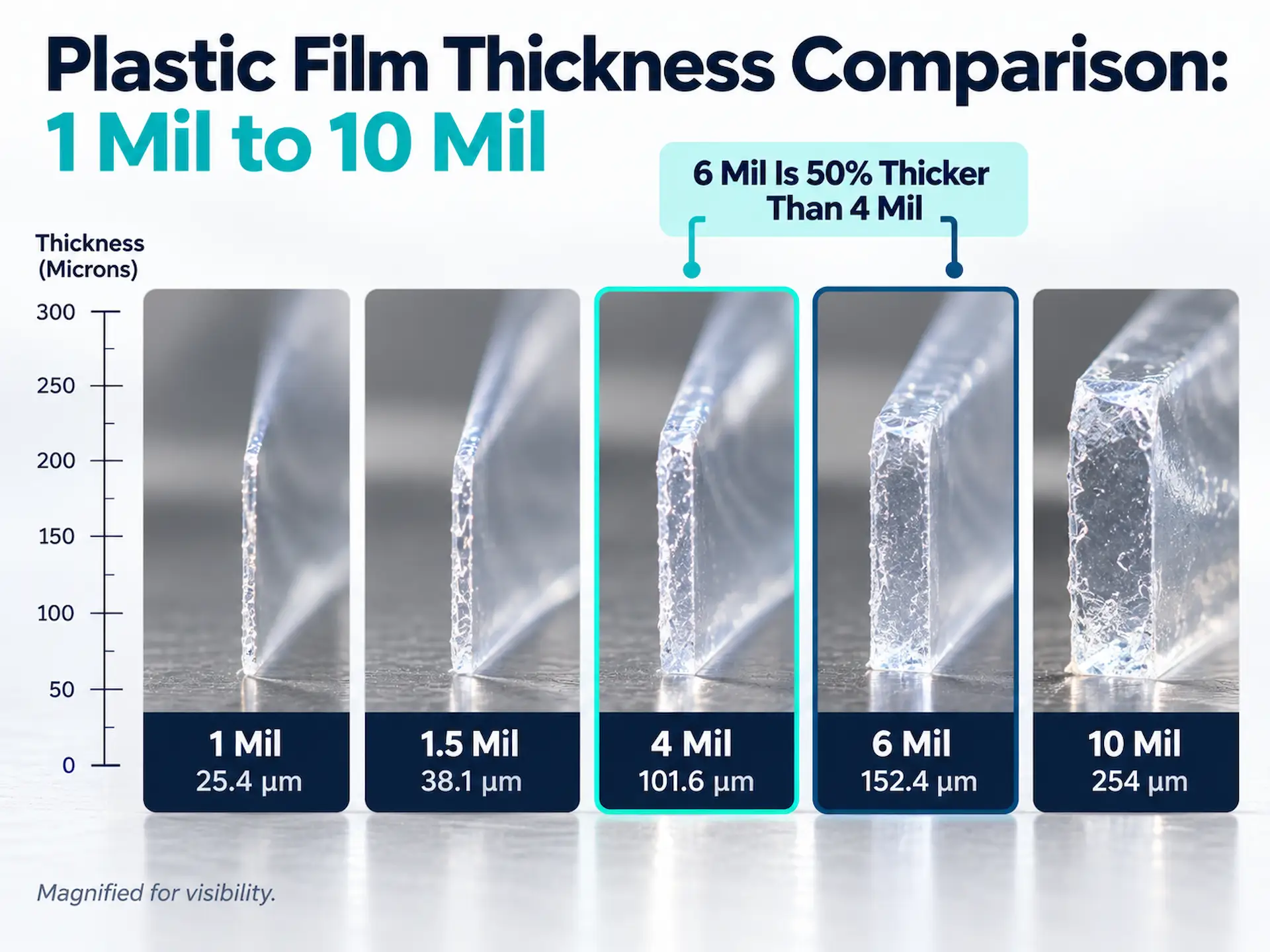
How Thick Is 1 Mil, 1.5 Mil, 4 Mil, 6 Mil, and 10 Mil?
Numbers on a chart are hard to picture, so here’s how each common thickness looks in real life.
Understanding Common Mil Thicknesses
- 1 mil: 25.4 µm (0.0254 mm). Thinner than a human hair. Very light film.
- 1.5 mil: 38.1 µm (0.0381 mm). Thin and flexible, like a lightweight zipper bag.
- 4 mil: 101.6 µm (0.1016 mm). Roughly one sheet of office paper.
- 6 mil: 152.4 µm (0.1524 mm). About one and a half sheets, with a sturdier feel.
- 10 mil: 254 µm (0.254 mm). Around two and a half sheets. Very stiff, and rare in everyday pouches.
Paper varies a bit, so treat these comparisons as a rough guide.
4 Mil vs 6 Mil: What’s the Difference?
A 6 mil film is 50% thicker than a 4 mil one. That’s a gap of about 51 microns. Here’s how that plays out:
| Feature | 4 Mil | 6 Mil |
| Thickness | 101.6 µm | 152.4 µm |
| Feel | Flexible | Stiffer, sturdier |
| Puncture resistance | Good for light and medium fills | Better for heavy or sharp items |
| Weight and cost | Lighter, usually costs less | More material, usually costs more |
Thickness isn’t the full story, though. A 4 mil pouch with the right layers can beat a 6 mil pouch with the wrong ones.
Pouch Thickness vs Plastic Bag Thickness: What’s Different?
A plastic bag and a pouch can both say 3 mil, yet they behave very differently.
Single-Layer Plastic Bags vs Multilayer Pouches
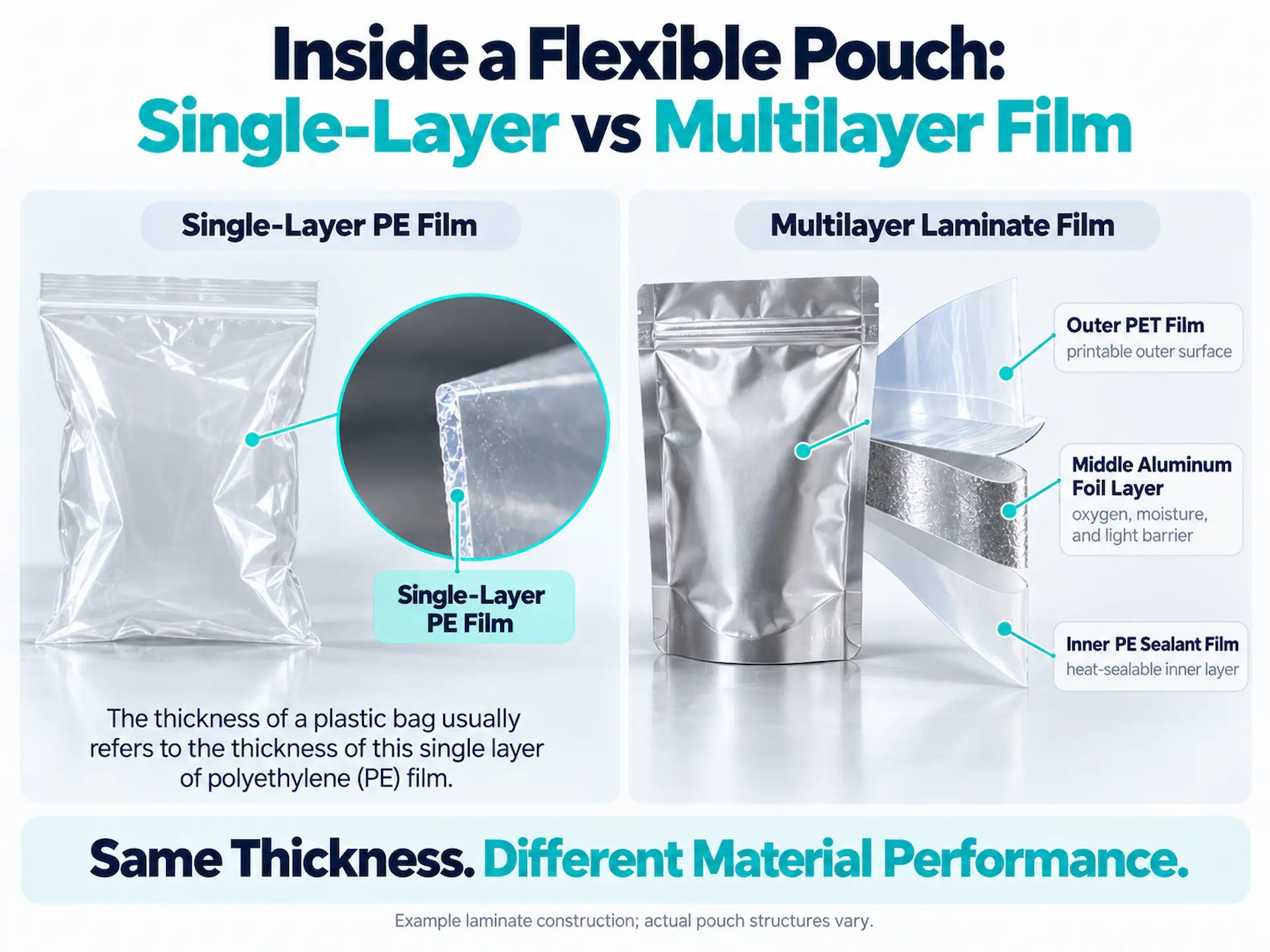
Plastic bag thickness usually describes one layer of polyethylene, like a basic poly bag. A pouch is a laminate. Several films are bonded together, and each layer has its own job.
Total Pouch Thickness vs Individual Film Layers
When a pouch is listed at 5 mil, that’s the total laminate thickness. The layers inside are much thinner. Here’s how some of our structures are built:
- Clear Poly: a clear laminate with a 48-gauge polyester layer.
- Metalized Poly: three layers, with metalized polyester in the middle.
- Poly Aluminum Foil: a 7-micron foil layer in the middle.
- Kraft Poly: kraft paper laminated to high-barrier poly layers.
These structures also have an inner heat-seal layer, usually LLDPE.
Does Thicker Pouch Material Mean Better Protection?
More thickness can help, but it’s only part of the story.
How Thickness Affects Durability and Flexibility
Thicker film generally resists punctures and tears better. The trade-off is stiffness. A thick pouch can feel rigid, be harder to squeeze, and run less smoothly on a filling line. For light products, extra thickness often adds cost without adding value.
How Film Layers Affect Barrier Protection and Sealing
Barrier comes mostly from the material, not the thickness. Here’s what that means in practice:
- Foil is a strong example. The 7-micron foil layer in our Poly Aluminum Foil structure blocks nearly 100% of oxygen, water vapor, and light.
- Barrier is measured, not guessed. Packaging teams use oxygen transmission rate (OTR) and water vapor transmission rate (WVTR). Lower numbers mean better protection.
- Powders need it most. Protein powder packaging has to keep moisture out, and that depends on barrier layers more than raw thickness.
- Seals matter too. The inner layer melts and fuses during heat sealing, so every edge needs a clean, strong seal. That’s true whether a flat pouch is sealed on three sides or four.
How to Choose the Right Mil Thickness for Your Pouches
The right thickness depends on what you’re packing, how heavy it is, and how long it needs to last.
Choose Thickness Based on Product Weight and Packaging Needs
Start with the product, not the number. Ask yourself:
- How heavy is it? Bigger fills need a stronger structure. The bottom of a pouch helps carry the product too, so look at styles like skirt seal pouches.
- Is it sharp or hard? Think nuts, pet treats, or lumpy powders. These need better puncture resistance.
- How long must it last? A longer shelf life calls for stronger barrier layers.
- Is it a liquid? Sauces and drinks often go into spouted pouches, which have their own build and filling method.
Many stand-up pouches fall somewhere between 3 and 7 mil. The right spot in that range depends on size, structure, and fill weight. Always ask for the exact figure on the data sheet.
Balance Material Strength, Barrier Protection, and Cost
More thickness means more material, more weight, and more cost. So look for the thinnest film that does the job well. Shortlist two close options, like 4 and 5 mil, and test them with your real product. Mockups and prototypes make that easier. Digital printing also lets you start with as few as 1,000 units. If volume is on your mind, see our take on low minimum order flexible packaging.

Common Mistakes to Avoid When Choosing Pouch Thickness
These slip-ups cost buyers time and money.
Important Note: A mil is not a millimeter. One millimeter is about 39.4 mil, so reading “mil” as “mm” makes a film look roughly 40 times thicker than it is. Always write the unit out.
- Thinking thicker always means stronger. Layers and materials matter just as much.
- Comparing films with different structures. A 5 mil clear pouch and a 5 mil foil pouch are not equal.
- Ignoring film thickness tolerance. Thickness varies slightly across a film, so ask your supplier for the allowed range.
- Relying on gauge alone. Put mil or microns on every spec.
- Skipping unit checks on imports. Microns are common abroad, so confirm the unit before you approve anything. Our guide to overseas packaging suppliers covers more.
Conclusion
Mil, micron, and gauge are three ways of saying the same thing: 1 mil = 25.4 microns = 100 gauge. Once you know that, spec sheets get a lot less confusing. But the thickness is only one piece. The layers inside the pouch decide how well it protects your product. Flexible Pouches can help you match the right structure and thickness to what you’re packing.
Not Sure Which Pouch Thickness Fits Your Product?
Tell us what you’re packing, and our team will point you to the right material and thickness. Custom sizes, low minimums, and fast turnaround are all on the table.
FAQs
1- How Many Microns Are in 1 Mil?
25.4, and that never changes. That makes 3 mil 76.2 microns and 4 mil 101.6, with every other size following the same rule.
2- How Many Gauges Is 1 Mil?
It’s 100 gauge. In film, gauge is just mil with the decimal moved two places, which is why 2.5 mil turns into 250 gauge.
3- How thick is 4 Mil in Microns?
It’s 101.6 microns. Call it 0.1 mm, or roughly one sheet of printer paper. Plenty of laminated stand-up pouches sit right around there, ours included.
4- How Thick Is 10 Mil in Millimeters?
0.254 mm, which edges just past a quarter millimeter. That’s stiff stuff for a pouch. It turns up mostly in heavy-duty liners and laminating sheets.
5- What Is the Best Mil Thickness for Plastic Bags and Pouches?
Whatever’s going inside decides it, mostly. Everyday poly bags tend to run 1.5 to 3 mil per wall. Laminated food pouches usually sit between 3 and 5 mil total. Heavy, sharp, or fast-spoiling products push you toward the upper end.
6- Is a Higher Gauge Always Thicker?
With plastic film, yes, so 200 gauge is double 100 gauge. Wire and sheet metal flip it around, and there a higher gauge number means thinner metal. Anyone buying both wire and film gets caught by this eventually.